Apple Opens the Gates: visionOS 27 and the New Era of Third-Party Spatial Accessories
The trajectory of Apple’s spatial computing journey has been defined by a steadfast, almost stubborn, commitment to a "controller-less" future. When the Apple Vision Pro first arrived in 2024, it was marketed as a device where the user was the interface—eyes for navigation, hands for interaction. However, with the release of visionOS 27, Apple has signaled a significant pivot. By opening its proprietary tracking stack to third-party manufacturers, Apple is transforming the Vision Pro from a closed ecosystem into a platform that can support a diverse array of specialized hardware.
This update, which reached users on September 14, 2026, introduces a sophisticated framework for "spatial accessories," enabling 90Hz six-degrees-of-freedom (6DOF) tracking for devices ranging from precision styluses to high-fidelity gaming controllers.
Main Facts: A Standardized Framework for Precision
The core of the visionOS 27 update is the introduction of a standardized API for spatial accessories. For the first time, Apple is providing third-party developers with the same high-level tracking capabilities previously reserved for the system’s internal hand-tracking algorithms.
High-Frequency Tracking
The most technically impressive aspect of the new framework is the support for 90Hz tracking. By combining Infrared (IR) LEDs with an Inertial Measurement Unit (IMU), these accessories can deliver precise, low-latency positioning data. The 90Hz refresh rate is critical for "high-motion" use cases—such as fast-paced gaming or industrial simulations—where the standard 30Hz or 60Hz tracking of human hands often falls short due to motion blur or occlusion.
The Hardware Partners
Apple has confirmed that it is not building its own controller. Instead, it is delegating hardware innovation to the ecosystem. Manufacturers like DFRobot and MikroE have been tapped to produce the first wave of reference hardware and development kits. These kits, expected to ship before the end of 2026, will serve as the blueprint for future consumer and enterprise products.
Engine Integration: Unity and Godot
The update isn’t just about hardware; it’s about the software pipeline. Apple has extended spatial accessory support to the Unity engine, allowing developers to integrate third-party controllers (specifically citing Sony’s PS VR2 Sense controllers) directly into their games. Support for the open-source Godot engine is also slated for the near future, lowering the barrier for indie developers to enter the visionOS space.
Chronology: The Evolution of Vision Pro Input
To understand the weight of visionOS 27, one must look at the timeline of Apple’s input philosophy.
- February 2024: The Launch Paradigm. The Vision Pro launches with a focus on "intentionality." Apple executives emphasize that controllers are a barrier to entry for general computing. The device relies entirely on external cameras for hand and eye tracking.
- Late 2024: The Third-Party Workarounds. Startups like Surreal Touch launch Kickstarter campaigns for independent controllers. These devices had to "trick" the system or run through complex workarounds because Apple provided no official API for external spatial tracking.
- June 2025: The First Cracks in the Wall. At WWDC25, Apple announces visionOS 26, which introduces experimental support for Sony’s PS VR2 Sense controllers. However, this support is limited and lacks deep integration into major game engines like Unity.
- September 14, 2026: The Open Platform. visionOS 27 is released. Apple formalizes the "Spatial Accessory" category, providing a robust SDK that allows any manufacturer to build tracked hardware that the Vision Pro recognizes as a native input device.
Supporting Data: The Mechanics of 90Hz Spatial Tracking
The technical requirements for a visionOS 27 spatial accessory are stringent, mirroring the technology found in industry leaders like the Meta Quest 3 or the Valve Index.

IR and IMU Fusion
The "Spatial Accessory" framework relies on a "sensor fusion" approach. The accessory must be equipped with an array of IR LEDs. The Vision Pro’s external cameras track these light points to establish a global position in 3D space. Simultaneously, an internal IMU (comprising an accelerometer and a gyroscope) tracks the device’s rotation and micro-movements at a much higher frequency than the cameras can capture. By fusing these two data streams, the system achieves "low-latency 6DOF," meaning it knows exactly where the device is and how it is oriented with millimetric precision.
Improved Object Tracking via Create ML
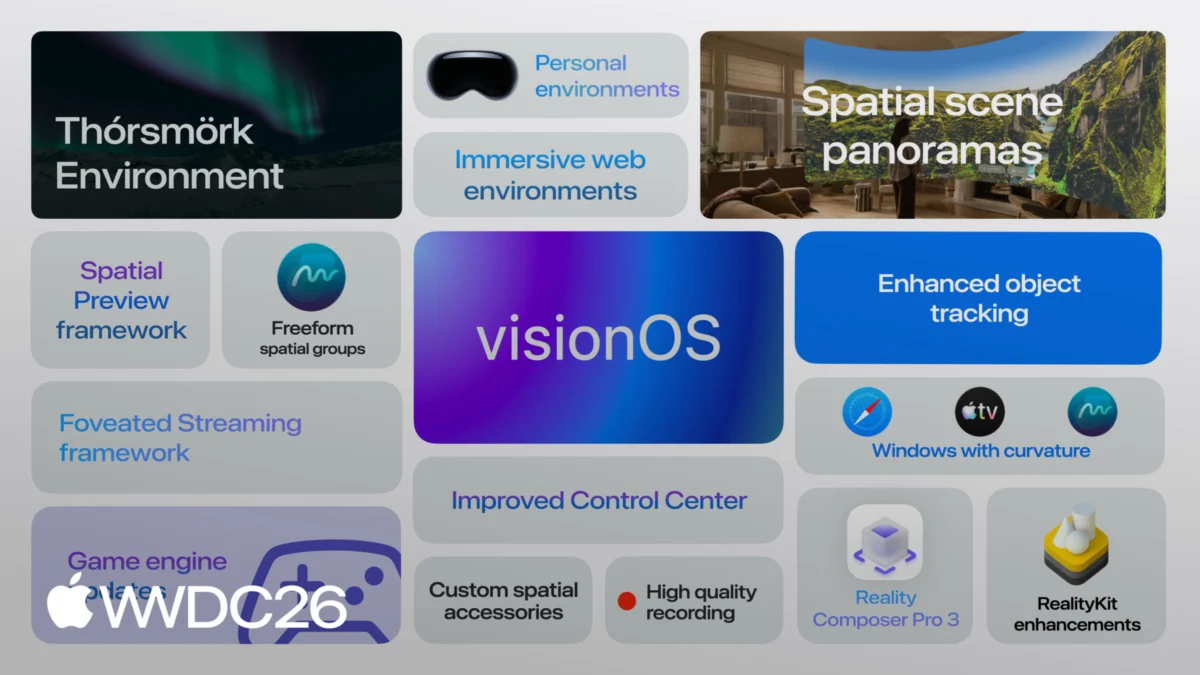
Beyond active accessories, Apple has improved "Object Tracking." Using the Create ML framework, developers can now train the Vision Pro to recognize specific static objects with higher accuracy. This is particularly optimized for objects held in the hand, such as a physical wrench in a mechanical training app. The high-frame-rate tracking ensures that as the object moves, the virtual overlay (the "digital twin") stays pinned to the physical item without "jittering."
Gaussian Splatting in RealityKit
Another data-heavy addition is the native support for 3D Gaussian Splatting within RealityKit. Unlike traditional polygonal modeling, Gaussian Splatting uses point clouds and volumetric data to render photorealistic "scans" of real-world objects. This technique allows for the rendering of complex surfaces—like fur, glass, or foliage—that are traditionally difficult for mobile processors to handle. By integrating this into RealityKit, Apple is making it easier for developers to bring "true-to-life" assets into the Vision Pro environment.
Official Responses: Apple’s Vision for the Ecosystem
In documentation provided to developers, Apple describes the new framework as a way to "expand the capabilities of spatial computing beyond the reach of human hands."
The Apple Developer portal states:
"A spatial accessory combines IR LEDs and an IMU for precise, low-latency six-degrees-of-freedom tracking… This enables high-motion use cases and tracking under low-light conditions, providing developers with the tools to create professional-grade tools and immersive gaming experiences."
The inclusion of DFRobot and MikroE as launch partners suggests that Apple is initially targeting the "pro" and "maker" communities. By providing reference designs, Apple ensures that the hardware follows its strict standards for power efficiency and signal interference, preventing the "clunky" experience often associated with third-party peripherals on other platforms.
Furthermore, the naming of Sony’s PS VR2 Sense controllers as a primary example of supported hardware in Unity reveals a strategic olive branch. Apple is signaling to the gaming industry that the Vision Pro is a viable destination for high-end VR ports, acknowledging that "eyes and hands" are not a substitute for the haptic feedback and physical triggers required by modern gaming.

Implications: What This Means for the Future of XR
The release of visionOS 27 is more than just a software patch; it is an admission that the "pure" vision of spatial computing requires physical anchors for certain tasks. The implications are wide-reaching across three main sectors:
1. The Death of the "Gamer" Stigma
For years, Apple distanced the Vision Pro from "VR headsets," preferring the term "Spatial Computer." By supporting PS VR2 controllers and optimizing Unity/Godot, Apple is finally embracing the VR gaming community. This will likely lead to a surge of "AAA" VR titles being ported to visionOS, as developers no longer have to redesign their entire control scheme for hand-tracking.
2. Enterprise and Precision Tools
In medical, engineering, and design fields, hand tracking is often insufficient. A surgeon practicing a procedure needs the haptic resistance of a scalpel; an architect needs the precision of a stylus. The 90Hz tracking framework allows for "digital tools" that feel as responsive as their physical counterparts. We can expect to see specialized hardware—surgical handles, precision pens, and industrial controllers—entering the market by 2027.
3. The Competitive Landscape with Meta
Meta (formerly Facebook) has long held the lead in controller-based VR. With visionOS 27, Apple is essentially adopting Meta’s hardware philosophy (IR + IMU) but applying it to a much more powerful computing platform. This puts Meta in a defensive position; if third-party manufacturers can create "Apple-quality" controllers, the Quest’s primary advantage—its input reliability—may evaporate.
4. The Rise of Gaussian Splatting
The native support for Gaussian Splatting marks a shift in how we consume digital content. This technology allows for "volumetric video" and hyper-realistic captures of real-world spaces. As the Vision Pro becomes better at rendering these "splats," the line between a digital twin and a real object will continue to blur, impacting everything from e-commerce (viewing a photorealistic product) to digital tourism.
Conclusion
visionOS 27 represents the maturation of Apple’s spatial computing platform. By opening the tracking system to third-party accessories, Apple is acknowledging that while the human hand is a versatile tool, it is not the only tool. As DFRobot and MikroE prepare to ship the first development kits, the stage is set for a hardware explosion. The Vision Pro is no longer just a headset; it is becoming the hub of a new, high-precision peripheral ecosystem that could redefine how we interact with the digital world.