The Treasury of Folklore Unveiled: A Decade of Myth-Making Culminates in a Landmark Compendium
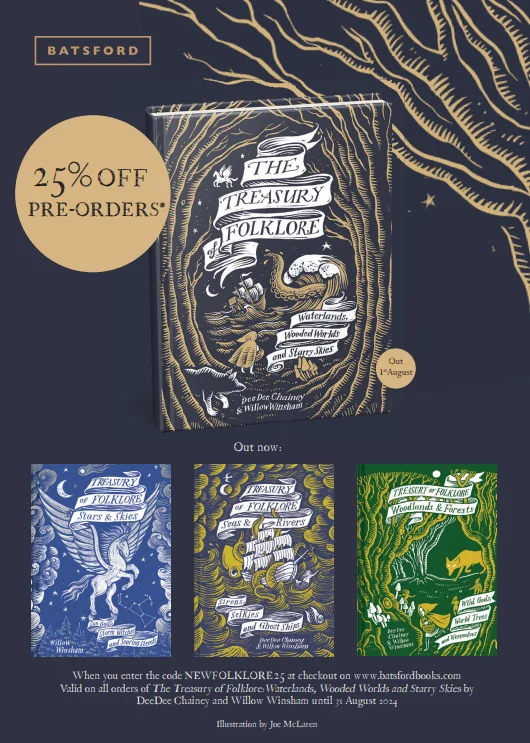
London, UK – Nearly a decade after its inception, the critically acclaimed Treasury of Folklore series is set to release its most ambitious volume yet: The Treasury of Folklore: Waterlands, Wooded Worlds and Starry Skies. This special compilation, due for release on August 1st, 2024, represents the fulfillment of an original vision by authors Dee Dee Chainey and Willow Winsham: to encapsulate the rich tapestry of global folklore within a single, comprehensive tome. Born from a profound desire to explore humanity’s universal connection to the landscapes it inhabits, this new compendium distills the essence of the beloved Seas and Rivers, Trees and Woodlands, and Stars and Skies into a beautifully bound edition, inviting readers on an unparalleled journey through the world’s most enduring myths and legends.
Main Facts: A Unified Vision Comes to Fruition
The forthcoming Treasury of Folklore: Waterlands, Wooded Worlds and Starry Skies is not merely a collection; it is a meticulously curated compendium designed to bring together the most cherished and illuminating tales from the original three volumes of the Treasury of Folklore series. This landmark publication by Dee Dee Chainey and Willow Winsham aims to offer readers a holistic perspective on how humans worldwide interact with, interpret, and mythologise their natural surroundings.
The authors’ initial aspiration was to create a single book that would traverse every physical landscape inhabited by humankind. However, the sheer volume and richness of the material they uncovered quickly surpassed the capacity of a solitary publication, leading to the development of three distinct and highly popular books: Seas and Rivers, exploring the folklore of watery realms; Trees and Woodlands, delving into the mysteries of forests and groves; and Stars and Skies, charting the myths inspired by celestial wonders.
Now, through this special compilation, that initial dream is realised. The new volume promises to be a "hefty tome," distinguished by its beautiful binding, striking cover art, and luxurious cream paper, designed to be both a valuable academic resource and an aesthetic addition to any bookshelf or coffee table. While it contains no new material, featuring text directly extracted from the existing three books, its unified presentation offers a fresh perspective on the interconnectedness of global folklore. The compendium is thoughtfully divided into three sections, each showcasing the wonderful original illustrations of Joe McLaren, whose distinctive artwork has become synonymous with the series.
The Treasury of Folklore: Waterlands, Wooded Worlds and Starry Skies is currently available for pre-order and is scheduled for its official release on August 1st, 2024. As an added incentive, readers can avail themselves of a 25% discount when ordering directly from Batsford Books using the code NEWFOLKLORE25.
Chronology: From Hashtag to Hefty Tome
The journey of the Treasury of Folklore series began nearly a decade ago, rooted in an unexpected wellspring of inspiration: the vibrant and burgeoning #FolkloreThursday hashtag. This online phenomenon, fostering a global community passionate about myths, legends, and traditional tales, profoundly inspired authors Dee Dee Chainey and Willow Winsham. They recognised the universal yearning for connection through story and were driven by a shared vision to create something meaningful and lasting that would reflect the unifying universality of folklore across the globe.
Their initial concept was ambitious: a single, expansive volume that would encapsulate the diverse folklore associated with every type of physical landscape on Earth. However, as Chainey and Winsham delved deeper into their research, the sheer breadth and depth of human storytelling proved far too immense for a single publication. Each landscape—the roaring oceans, the whispering forests, the silent, star-studded skies—unveiled a treasure trove of customs, beliefs, and narratives, demanding its own dedicated exploration.
This abundance led to the evolution of the project into a three-book series. The first, Seas and Rivers, charted the mystical depths and flowing currents that have shaped human imagination. This was followed by Trees and Woodlands, which explored the ancient spirits and hidden wisdom of the world’s arboreal domains. Completing the trilogy was Stars and Skies, a celestial journey through myths of constellations, moon deities, and cosmic phenomena. The popularity of these three books was, as the authors describe, "both surprising and heartwarming," a testament to the enduring appeal of folklore and the authors’ meticulous research and engaging storytelling. The widespread appreciation from readers validated their efforts and underscored the global resonance of these ancient tales.
The idea for a compendium, bringing the three volumes together, emerged as a natural progression, offering the perfect opportunity to finally realise the authors’ original dream. This decision was met with immediate enthusiasm, prompting extensive work behind the scenes. Chainey and Winsham embarked on the challenging task of revisiting their own words with fresh eyes, meticulously sifting through the wealth of material they had already created. The process involved careful selection and thoughtful arrangement, ensuring that the chosen extracts flowed seamlessly, weaving a cohesive narrative that transcended individual landscapes and highlighted the shared human experience across time and place. The meticulous attention to detail during this compilation process has resulted in a volume that the authors are "utterly thrilled" to share, expressing that they have been "blown away by the end result."

Supporting Data: The Enduring Power of Story – A Universal Tapestry
At its core, the Treasury of Folklore series, and now its definitive compendium, stands as a powerful testament to the unifying universality of human experience. Dee Dee Chainey and Willow Winsham embarked on their folkloric quest "in search of understanding," aiming to unravel how diverse cultures across the globe craft beliefs, customs, and narratives around their lived environments. What they unearthed was a profound truth: despite vast geographical and cultural differences, humanity is "inherently the same."
This revelation underscores that fundamental human emotions—primal fears, profound dreams, and an innate sense of wonder—transcend all boundaries. Whether one lives by the sea, deep within a forest, or under a vast desert sky, the anxieties of the unknown, the awe inspired by the natural world, and the longing for both tangible and intangible treasures are shared. The specific names given to "monsters of our myths and legends" or the particular rituals enacted may vary, but the underlying psychological and emotional drivers remain constant. From huddling around a campfire, dreading the unseen in the darkness, to gazing at ancient stars, contemplating the brevity of life against the backdrop of eternity, folklore provides a mirror to our collective soul. It is a universal language spoken through narrative, reflecting our deepest concerns and highest aspirations.
A Physical Manifestation of Folklore: The Compendium’s Craftsmanship
The physical manifestation of this grand vision, The Treasury of Folklore: Waterlands, Wooded Worlds and Starry Skies, has been crafted with an appreciation for the enduring nature of the stories it contains. The authors describe it as a "hefty tome," a substantial volume that feels significant in the hands, reflecting the weight and importance of the cultural heritage it preserves. The decision to use beautiful cream paper, combined with exquisite binding and a thoughtfully designed cover that unifies the themes of water, wood, and sky, speaks to a commitment to quality that matches the richness of its content.
Integral to the aesthetic and narrative appeal of the series are the "wonderful original illustrations of Joe McLaren." McLaren’s distinctive black-and-white engravings provide a visual vocabulary for the fantastical beings and mystical landscapes described within. His artwork not only enhances the reader’s immersion but also serves as a critical interpretive layer, bringing ancient legends to life with a contemporary yet timeless sensibility. Each illustration is a portal, inviting deeper engagement with the narratives and reinforcing the timeless quality of the folklore presented. This meticulous attention to design ensures the compendium is not merely a book, but an artifact—a conversation starter, a source of contemplation, and a tangible link to our shared human heritage.
Mythic Landscapes: Exploring the Extracts
The compendium masterfully weaves together tales from across the globe, demonstrating how disparate cultures have encountered similar mysteries and crafted parallel explanations. The extracts offered provide a tantalising glimpse into these interconnected worlds.
Beneath the Waves: The Perilous Allure of Water Horses
The section on "Water Horses" delves into the pervasive myth of malevolent steeds lurking beneath lakes and waterways, a common cautionary tale across various cultures. These entities, often appearing majestic and alluring, are masters of deception, luring unwary travellers to watery graves.
The Scottish kelpie, for instance, is a prominent figure, often confused with the each-uisge. While both are water horses, the kelpie is specifically associated with rivers, while the each-uisge haunts lochs and lakes. Kelpies are notorious for dragging their riders to a grim death beneath the surface. Yet, folklore also offers fleeting hope: some tales suggest a kelpie might be temporarily tamed by a bridle marked with a cross, forced to perform tasks, though its wild nature would inevitably reclaim it, often with fatal consequences for the rider. The most potent weapon against a kelpie, it is said, is red-hot iron, a common bane for many folkloric creatures. The enduring power of the kelpie in the Scottish imagination is strikingly evident in the monumental 30-meter-tall sculptures near Falkirk, a modern testament to an ancient legend, and its continued presence in contemporary literature by authors like Lari Don and J.K. Rowling. Intriguingly, such water horses are conspicuously absent from English folklore.
Across the border in Wales, the Ceffyl Dwr fills this folkloric void. These Welsh water horses varied in appearance and intent; in the north, they were shapeshifting spirits prone to violence, while in the south, they consistently appeared as enchanting small horses, luring people onto their backs. Known for their incredible speed, they could cover vast distances before vanishing, leaving their hapless riders to drown. A notable exception to their cruelty was towards clergymen of any creed, who were said to be able to ride them safely to their destination, while their less fortunate companions were abandoned or tossed into the water.
In Scandinavia, the bäckahäst, or "brook horse," is a luminous, majestic being often seen in the fog. Like its Celtic cousins, it entices riders, particularly children, before plunging into the water, trapping its victims. However, some tales suggest a means of escape: uttering the name of Christ, even through a child’s mispronunciation, could cause the bäckahäst to disappear, leaving riders sore but saved, owing to its aversion to the sacred name. Like the kelpie, it could also be tricked into labour. These tales collectively highlight humanity’s ancient fear of water’s unpredictable dangers, personified as beautiful yet treacherous entities.

Guardians of the Green: Lords of the Wild and Their Domains
Moving from watery depths to verdant canopies, the compendium explores the "Lords of the Wild"—powerful spirits and creatures that embody the forests and jungles across the globe. These entities range from malevolent forces of destruction to benevolent protectors of nature, mirroring humanity’s complex relationship with the wilderness.
The Finnish Tapio, also known as Metsähine or Hiisi, reigns as the king of the forest realm. He is depicted as a tall, slender figure, often with a coat of ermine or moss, a cap, and bushy eyebrows of moss and lichen, sometimes sporting a great black beard. Like Europe’s green man motifs, his front may appear human, but his back is that of a gnarled tree. As the personification and protector of the forest, hunters traditionally sought his blessing for a successful hunt, vowing to respect the land and its creatures. Tapio’s influence extends to all forest creatures, dictating a hunter’s fortune. His family includes his wife, Mielikki (benevolent) or Kuurikki (malevolent), and his children, Nyrikki, who guides hunters, and Tulikki, who directs prey. An Estonian counterpart, reminiscent of Odin, possesses only one eye.
From Slavic lands emerges the Leshy (leshhii or lyeshy), a tutelary spirit and protector of trees and animals, notably wolves and bears. The leshy, which hibernates like a bear, is a master shapeshifter, capable of altering its size from taller than a tree to as small as a blade of grass. It can mimic any forest inhabitant, human or animal, yet distinctive features betray its true nature: a lack of eyelashes or eyebrows, shoes worn on the wrong feet, clothing wrapped contrary to local custom, a single eye, wild hair, or cloven feet. Some accounts describe them with wings, tails, or swollen eyes. Leshies enforce their dominion with terrifying bellows that whip up winds and send creatures fleeing. They are tricksters, luring trespassers off paths with shrieking laughter or mimicked voices, often confusing them until they are lost forever, or even tickling them to death. They inflict illness, abduct women and children, and curse farms, prompting annual sacrifices of cows in some regions to appease them.
Protection against a leshy involves turning one’s shirt inside out and shoes on the wrong feet, an act believed to make them laugh, thus returning the lost to their path. Swearing at them or making the sign of the cross are other methods of banishment. For those daring enough to summon a leshy, a ritual involving cutting young birch trees, arranging them in a circle, and calling out to the "grandfather of the forest" while devoid of Christian symbols is said to work. These forest spirits underscore humanity’s ancient need to personify nature’s power, to understand its whims, and to devise means of coexistence or protection.
Celestial Chronicles: The Enduring Saga of the Moon Hare
Finally, gazing skyward, the compendium explores the widespread motif of "The Hare in the Moon," a global phenomenon where the dark markings on the moon are interpreted as the image of a rabbit or hare. This motif is found across numerous cultures, with the Sea of Tranquillity often seen as the hare’s head, and the Seas of Fertility and Nectar forming its ears.
One of the most profound iterations comes from the Buddhist Sasa-Jātaka story. It recounts a hare, alongside its friends (an otter, jackal, and monkey), advocating for the virtue of giving alms. On a fast day, the deity Sakka, disguised as an old man, tests their generosity. While the otter, jackal, and monkey offer readily available food, the hare, having only grass, offers itself as sustenance by leaping into a fire. Sakka, moved by such unwavering faithfulness, saves the hare and sets its image upon the moon for all eternity, or, in some versions, draws it using the essence of a mountain. Similar tales of a self-sacrificing hare exist in other cultures, with variations in the companion animals.
In a Sri Lankan tale, Buddha, lost and hungry in a wood, accepts the hare’s selfless offer to be eaten. Buddha saves the hare and sends it to the moon. A Japanese variation, known as Tsuki no Usagi, involves the Man in the Moon descending as a beggar to test animals. The rabbit, with only grass, sacrifices itself on a fire, leading the transformed beggar to take it to live on the moon. This poignant tale, celebrating selflessness, is particularly popular in Japan, often recounted to children during the Harvest Moon and Mid-Autumn Festival in September.
In stark contrast, a South African tale presents the hare as a trickster responsible for human mortality. The Moon instructs Hare to deliver a message to humanity: just as the Moon wanes and returns, so too will humans die and be reborn. However, the flighty Hare misdelivers the message, declaring only that humans will die permanently. Enraged, the Moon attacks Hare with a hatchet, only managing to split its lip. In retaliation, Hare lashes out, scarring the Moon’s face, marks still visible today. These narratives illustrate humanity’s ancient practice of projecting stories onto celestial bodies, exploring themes of sacrifice, compassion, divine judgment, and the consequences of deception.
Official Responses: A Shared Triumph and Deep Gratitude
The creation of The Treasury of Folklore: Waterlands, Wooded Worlds and Starry Skies is a culmination of a deeply personal and collaborative journey for authors Dee Dee Chainey and Willow Winsham. Their "utter thrill" at the end result and the palpable excitement to share this beautifully bound volume speaks volumes about their dedication. The success of the initial three books, described as "surprising and heartwarming," reflects the powerful connection they forged with readers, a sentiment for which they express profound gratitude to "each and every person who has bought and read these books."

The genesis of the series itself, "inspired so greatly by the overwhelming outpouring of folklore through the #FolkloreThursday hashtag," highlights a remarkable symbiosis between authors and community. This digital phenomenon not only provided a rich source of inspiration but also fostered a vibrant ecosystem where shared stories could thrive, directly influencing the authors’ drive to create something "meaningful, lasting, that reflected the unifying universality of folklore across the globe." The decision by the publisher to move forward with the compendium was, in essence, an official response to both the compelling vision of the authors and the demonstrated market demand for comprehensive, well-researched folklore collections. It underscores a shared belief in the enduring cultural value of these stories and the importance of making them accessible in a definitive format.
Implications: Bridging Worlds, Preserving Heritage
The release of The Treasury of Folklore: Waterlands, Wooded Worlds and Starry Skies carries significant implications for both the accessibility of folklore and its broader cultural impact.
Accessibility and Preservation
By compiling the essence of three extensive volumes into one, the compendium significantly enhances the accessibility of a vast array of global myths and legends. For readers new to the series, it offers a single, comprehensive entry point into the diverse world of folklore. For existing fans, it provides a unified, aesthetically pleasing edition that streamlines the exploration of interconnected themes. This act of compilation is crucial for cultural preservation, ensuring that these ancient stories—which embody the collective memory, wisdom, and anxieties of humanity—remain vibrant and available for future generations. In an increasingly homogenised world, such publications serve as vital archives of cultural distinctiveness.
Understanding Shared Humanity
The core revelation of the series—that humans, despite their differences, share "primal fears and dreams"—is profoundly relevant in contemporary society. The compendium functions as a powerful tool for fostering empathy and understanding across cultures. By illustrating how different societies have grappled with universal questions about nature, existence, and the unknown, it highlights our common humanity. This shared narrative tapestry can help bridge divides, demonstrating that beneath the surface of diverse customs lie fundamental experiences that unite us all.
Educational and Cultural Impact
The "hefty tome" is poised to become an invaluable resource for students, researchers, and general readers interested in mythology, anthropology, literature, and cultural studies. Its structured presentation, coupled with Joe McLaren’s evocative illustrations, makes complex folkloric concepts engaging and digestible. Beyond academic circles, the book serves as a "conversation starter," capable of igniting discussions about cultural heritage, the power of storytelling, and our own connections to the ancient world. It encourages a deeper appreciation for the imaginative traditions that have shaped human societies for millennia.
The Future of Folklore
The continued success and evolution of the Treasury of Folklore series underscore the enduring relevance of these ancient narratives in a modern context. In an age of rapid technological advancement, there is a renewed appreciation for stories that connect us to our roots, to nature, and to each other. Publications like this compendium contribute to the ongoing scholarly and popular engagement with folklore, ensuring that these tales continue to inspire, entertain, and educate, cementing their place not as relics of the past, but as living, breathing narratives that resonate with the human spirit.
The Treasury of Folklore: Waterlands, Wooded Worlds and Starry Skies is more than just a book; it is a journey into the heart of what it means to be human, as seen through the timeless lens of myth. Pre-order your copy now to embark on this extraordinary exploration, available from August 1st, 2024. For a 25% discount, order from Batsford Books using the code NEWFOLKLORE25.