Unveiling Humanity’s Shared Myths: "The Treasury of Folklore" Returns in a Definitive Compilation
FOR IMMEDIATE RELEASE
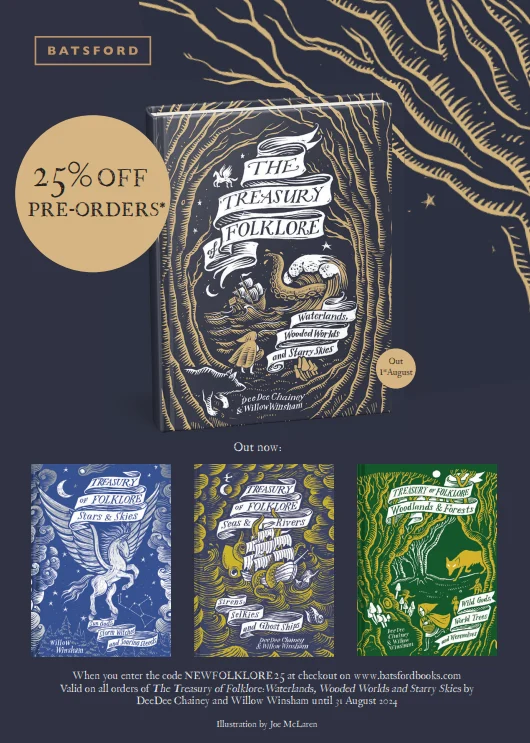
London, UK – [Date of Publication, e.g., July 24, 2024] – Nearly a decade after its genesis, a seminal work in the exploration of global myths and legends is set to culminate in a comprehensive new volume. Authors Dee Dee Chainey and Willow Winsham, acclaimed for their insightful "Treasury of Folklore" series, are poised to release The Treasury of Folklore: Waterlands, Wooded Worlds and Starry Skies. This special compilation, available for pre-order now and launching on August 1, 2024, brings together the most cherished narratives from their three original, best-selling books: Seas and Rivers, Trees and Woodlands, and Stars and Skies.
The forthcoming "hefty tome" not only serves as a beautifully bound collector’s item but also stands as a testament to the enduring power of folklore to illuminate the fundamental commonalities of human experience across diverse cultures and geographies. Featuring the beloved original illustrations by Joe McLaren, this volume reaffirms the series’ core mission: to explore how humans interpret and imbue meaning into the landscapes they inhabit, revealing universal fears, dreams, and awe that transcend time and place.
The Grand Vision Realized: A Decade of Discovery
The journey of "The Treasury of Folklore" began with an ambitious, singular vision. The authors initially conceived a comprehensive volume that would span the entirety of physical landscapes – from the deepest oceans to the highest skies – capturing the rich tapestry of human-made customs, beliefs, and tales associated with them. However, as their research deepened and the sheer volume of material they unearthed vastly surpassed initial expectations, it became clear that a single book could not do justice to the wealth of global folklore. This realization led to the creation of a distinct series, each book dedicated to a specific domain: the mysterious Seas and Rivers, the enigmatic Trees and Woodlands, and the celestial Stars and Skies.
This meticulous, years-long endeavor was profoundly inspired by the vibrant, global community fostered by the #FolkloreThursday hashtag, a digital movement that underscored the widespread and unifying appeal of traditional narratives. The overwhelming outpouring of interest and contributions through this platform solidified the authors’ conviction to create something both meaningful and lasting, reflecting the universal threads that connect humanity through its shared mythologies. The subsequent popularity of the three individual books, celebrated for their depth and accessibility, was met with both surprise and profound gratitude by Chainey and Winsham, who extend their thanks to every reader who embraced their work.
The concept of a compendium, a unified "Treasury of Folklore," emerged as a natural evolution, offering a unique opportunity to return to that initial grand vision. Behind the scenes, the arduous process of curating this special volume involved rereading and re-evaluating material already intimately known, approaching it with fresh eyes. The challenge lay in meticulously selecting what to include and what to judiciously omit, ensuring the final compilation flowed cohesively and majestically, truly spanning humanity’s shared landscapes across time and place. The authors express immense satisfaction with the outcome, describing themselves as "utterly thrilled" to share this exquisite volume. They particularly highlight its impressive physical attributes: its substantial size, the evocative cover art that harmoniously blends the series’ themes, and the tactile pleasure of its "beautiful cream paper," confirming its status as a truly "hefty tome."
It is important to note for existing fans that The Treasury of Folklore: Waterlands, Wooded Worlds and Starry Skies is a compilation. It intentionally contains text drawn directly from the existing three books, offering no new material. Its value lies in its comprehensive scope, its unified presentation, and its exceptional craftsmanship, making it an ideal addition to any bookshelf or coffee table – a true conversation starter and a conduit for connection through shared stories. The compilation is thoughtfully structured into three distinct sections, each dedicated to extracts from one of the original books, further enhanced by Joe McLaren’s captivating illustrations.

The Unifying Threads of Humanity: Exploring Folklore’s Depths
At its heart, "The Treasury of Folklore" series, and now its definitive compilation, seeks to explore the intrinsic human impulse to create meaning from the world around us. The authors eloquently articulate their discovery that beneath the surface variations of customs and beliefs, humanity shares a profound core of primal fears and dreams. Regardless of geographical location, cultural attire, or the names assigned to mythical creatures, humans universally gaze upon vast horizons with a longing for discovery, dread the unknown as they gather by campfires in the night, and stand in awe of the cosmos, contemplating their fleeting existence under ancient stars. This compilation offers a powerful lens through which to observe these shared psychological landscapes.
Water Horses: Majestic and Malevolent Guardians of the Deep
One of the most compelling examples of shared human apprehension about the unknown depths of nature comes alive in the widespread folklore of water horses. These creatures, often depicted as both beautiful and terrifying, embody the dangers and allure of lakes, rivers, and lochs. They serve as potent cautionary tales, warning against recklessness and the deceptive beauty of the wild.
In Scottish folklore, the Kelpie is perhaps the most renowned water horse, though distinct from the each-uisge, which prefers the deep lochs to the Kelpie’s rivers. Kelpies are infamous for luring unsuspecting travellers onto their backs, only to drag them to a watery demise. The tales often detail desperate attempts to "tame" these creatures, such as through a cross-marked bridle, though such control is invariably fleeting. The ultimate defeat of a Kelpie, as some stories suggest, requires the potent magic of red-hot iron, a recurring weakness for many folkloric entities. The enduring grip of the Kelpie on the Scottish imagination is dramatically visible in the towering 30-meter sculptures near Falkirk, a modern tribute to an ancient legend, and its continued presence in contemporary literature, from Lari Don to J.K. Rowling’s Fantastic Beasts and Where to Find Them. Intriguingly, despite its prominence in Scotland, similar water horse figures are notably absent from English folklore.
Across the border in Wales, the Ceffyl Dŵr fills this folkloric void. A staple belief well into the 19th century, the Ceffyl Dŵr presented varied forms. In northern Wales, it was a shapeshifting spirit, often violent, while in the south, it consistently appeared as an enchanting, small horse. Its defining characteristic was incredible speed, capable of traversing vast distances in impossibly short times before vanishing, leaving its hapless rider to drown. A curious exception to its malevolence was its treatment of clergymen of any creed, who were said to be able to ride it safely to their destination, a fascinating detail reflecting societal values and religious respect.
Scandinavian traditions offer the Bäckahäst, or "brook horse," often seen on foggy days. Described as majestic and luminous, it, too, beguiles riders, particularly children, before plunging into the water, trapping its victims. However, Bäckahäst tales often end with the riders surviving, frequently through quick thinking or accidental invocation of sacred names. One popular story recounts boys on a frozen river, saved when one mispronounces a rhyme, inadvertently uttering "Jesus Christ," a name the Bäckahäst detests. Like the Kelpie, the Bäckahäst could also be put to work, sometimes through trickery. These water horses, despite their regional variations, universally represent the treacherous beauty of aquatic environments and the inherent dangers of the unknown, embodying a deep-seated human respect for the power of nature.
Lords of the Wild: Shapeshifting Guardians of the Forest
Venturing from the watery depths into the verdant embrace of forests and jungles reveals another profound aspect of human engagement with nature: the belief in powerful, often shapeshifting, spirits and deities that govern these wild domains. These "Lords of the Wild" reflect humanity’s complex relationship with the wilderness – a source of both sustenance and peril, demanding respect and caution.
In Finnish mythology, Tapio, also known as Metsähine or Hiisi, reigns as the king of the forest realm. Depicted as tall and thin, with a coat of ermine or moss, and a head crowned with a hat, he mirrors the ancient European "green man" figures, peering out from mossy eyebrows and a great beard. He is said to be human-like from the front but with the gnarled back of a tree, embodying both personification and protector of the forest. Hunters traditionally sought his blessing for a successful chase, pledging reverence for the woods and its creatures, believing Tapio held sway over all forest life, capable of ensuring a plentiful haul or cursing a hunter with empty hands. He is part of a divine family, with his wife Mielikki (or Kuurikki when malevolent), and children Nyrikki (who guides hunters) and Tulikki (who directs prey). The Estonian equivalent shares similar traits, though, like the Norse god Odin, he possesses only one eye.

The Slavic Leshy (or leshii, lyeshy) presents a more ambivalent figure. A tutelary spirit of the woods, he is a protector of trees and animals, though some specify his guardianship over wolves or his subservience to bears. The Leshy hibernates in winter, akin to a bear, and is known by numerous names, all linking him to the forest and, often, to the Devil. He is frequently likened to Greek satyrs, sporting horns, claws, and a bushy, sometimes green, beard, and is entirely covered in wild hair, often with cloven feet. A master shapeshifter, the Leshy can alter his size and form at will, appearing taller than a tree or as small as a blade of grass, and can mimic any forest creature, plant, or even familiar human. Distinctive features in human form include a lack of eyelashes or brows, shoes worn on the wrong feet, or clothing wrapped in an unusual fashion. Some even possess a single eye, wings, or a tail.
The Leshy’s presence is often heralded by bellowing winds as he surveys his territory, terrifying all creatures. Those who trespass without permission are warned by his shrieking laughter, clapping, or howling. If these warnings are ignored, the Leshy will confuse and disorient them, luring them off paths until they are lost to the wilds forever. As a trickster, he can mimic voices to entice victims, even tickling them to death. He can also inflict illness, abduct women for marriage, and snatch children. Farmers once sacrificed cows to placate Leshies who cursed their herds. Protection from a Leshy’s wrath often involves simple acts of respect, such as prayer or offerings of bread and tobacco before entering the forest. Intriguingly, turning one’s shirt inside out and wearing shoes on the wrong feet is believed to provoke laughter from the Leshy, returning the lost traveller to the correct path, a common theme across global fae folklore. Swearing at them also works, or, more traditionally, making the sign of the cross. To summon a Leshy, one must enter the forest, cut young birch trees, arrange them in a circle with tops touching, stand in the centre devoid of Christian symbols, and call out to the "grandfather of the forest." These forest lords, whether benevolent or mischievous, underscore humanity’s enduring respect, fear, and desire to understand the wild heart of nature.
The Hare in the Moon: A Celestial Tapestry of Sacrifice and Fate
Finally, gazing skyward, the compilation explores the universal fascination with the moon and the myriad tales woven around the images perceived on its surface. Among the most prevalent motifs is that of a rabbit or hare residing on the moon, a concept found across vastly different cultures, with the Sea of Tranquility often identified as the hare’s head, and the Seas of Fertility and Nectar as its ears. These lunar hares embody themes of sacrifice, fate, and the very essence of human mortality.
In the Buddhist Sasa-jātaka, the hare, alongside its friends (an otter, jackal, and monkey), commits to giving alms on a fast day. When the deity Sakka (ruler of Trāyastriṃśa heaven and protector of Buddhism) descends disguised as an old man to test them, the other animals offer readily available food. The hare, having only grass, nobly offers itself as food, leaping into a fire. For this ultimate act of faithfulness, Sakka saves the hare, plucking it from the flames and placing it in the moon for all eternity, a symbol of selfless devotion. Some versions even suggest Sakka used the essence of a mountain to draw the hare’s image. Similar stories of self-sacrificing hares exist in various cultures, often with slight variations in the animal companions.
A tale from Sri Lanka features the Buddha, lost and hungry in a wood. The hare offers to guide him and, upon learning of Buddha’s poverty, offers itself as sustenance. As the hare throws itself into the fire, Buddha, using his divine powers, saves the creature and sends it to the moon. Similarly, in Japan, the Tsuki no Usagi (Moon Rabbit) is a beloved figure. In this narrative, the Man in the Moon descends as a beggar, and while other animals offer food, the rabbit, with only grass, sacrifices itself in a fire. The beggar then reveals his true form and takes the selfless rabbit to live with him on the moon. This poignant Japanese tale is frequently recounted to children during September, coinciding with the Harvest Moon and the Mid-Autumn Festival, reinforcing values of generosity and selflessness.
In stark contrast, a tale from South Africa attributes a darker role to the hare. According to this narrative, the moon sent the hare to deliver a message to humankind: just as the moon "dies" and is reborn each month, so too would humanity experience death and resurrection. However, the flighty hare garbled the message, telling people only that they would die. Enraged by this catastrophic miscommunication, the moon attacked the hare with a hatchet, intending to cleave it in two. She only succeeded in splitting its lip. The hare, retaliating in anger, lashed out with its claws, scarring the moon’s face – scars that, according to the legend, are still visible as the dark shapes on the moon today. These diverse narratives demonstrate how a single celestial observation can inspire vastly different, yet equally profound, interpretations of life, death, and human destiny.
Official Responses and Public Acclaim
The enduring popularity of "The Treasury of Folklore" series underscores a deep-seated human hunger for connection to the stories that shape our collective past and present. Dee Dee Chainey and Willow Winsham have consistently expressed their heartfelt gratitude for the public’s embrace of their work, recognizing the pivotal role of platforms like #FolkloreThursday in amplifying this interest.

"When the idea was first suggested to bring out a compendium, we immediately knew that we had to take this opportunity to bring the folklore together as originally envisaged: in one volume," the authors commented. They conveyed their profound satisfaction with the culmination of this ambitious project: "To say we have been blown away by the end result is an understatement, and we are utterly thrilled to be able to share this beautifully bound volume with you. We love the size and the cover combining everything and the beautiful cream paper: it is a ‘hefty tome’ indeed." This sentiment reflects not only their artistic integrity but also their dedication to producing a physically appealing and durable artifact that honors the rich content within.
Batsford Books, the publisher, has likely seen the series as a significant success, tapping into a growing interest in cultural heritage and mythological studies. The decision to produce a high-quality compilation speaks to the commercial and cultural confidence in the series’ lasting appeal.
Implications: Folklore as a Mirror to the Soul
The release of The Treasury of Folklore: Waterlands, Wooded Worlds and Starry Skies carries significant implications for both folklore enthusiasts and a broader audience. Firstly, it reinforces the enduring power of folklore as a vital mirror reflecting the human condition. By presenting narratives from across the globe, the compilation highlights that while the specifics of monsters and gods may differ, the underlying fears of the unknown, the dreams of prosperity, and the awe inspired by nature are universally shared. This universal resonance makes folklore not merely a collection of old stories, but a living testament to humanity’s shared psychological and emotional landscape.
Secondly, the book serves as an invaluable cultural artifact. Its comprehensive scope and exquisite presentation make it an ideal educational tool, capable of sparking curiosity in younger generations and offering deeper insights to seasoned scholars. It encourages dialogue, prompting readers to compare and contrast myths from their own cultures with those from distant lands, thereby fostering a greater understanding and appreciation of global diversity and interconnectedness.
Finally, the success of the "Treasury of Folklore" series, culminating in this magnificent compilation, underscores a robust and growing interest in folklore studies. In an increasingly globalized and often fragmented world, there is a renewed desire to understand our roots, our shared heritage, and the stories that bind us. This compilation, a "hefty tome" of shared human experience, is poised to become a cornerstone in many personal libraries, continuing its role as a conversation starter and a profound way to connect with the timeless truths embedded within humanity’s most ancient tales.
The Treasury of Folklore: Waterlands, Wooded Worlds and Starry Skies is now available for pre-order and will be released on August 1, 2024. Readers can secure a 25% discount when ordering directly from Batsford Books using the code NEWFOLKLORE25.
###