
A Seismic Shift in Southern Politics: Joseph Vijay Chandrasekhar Sworn In as Chief Minister of Tamil Nadu
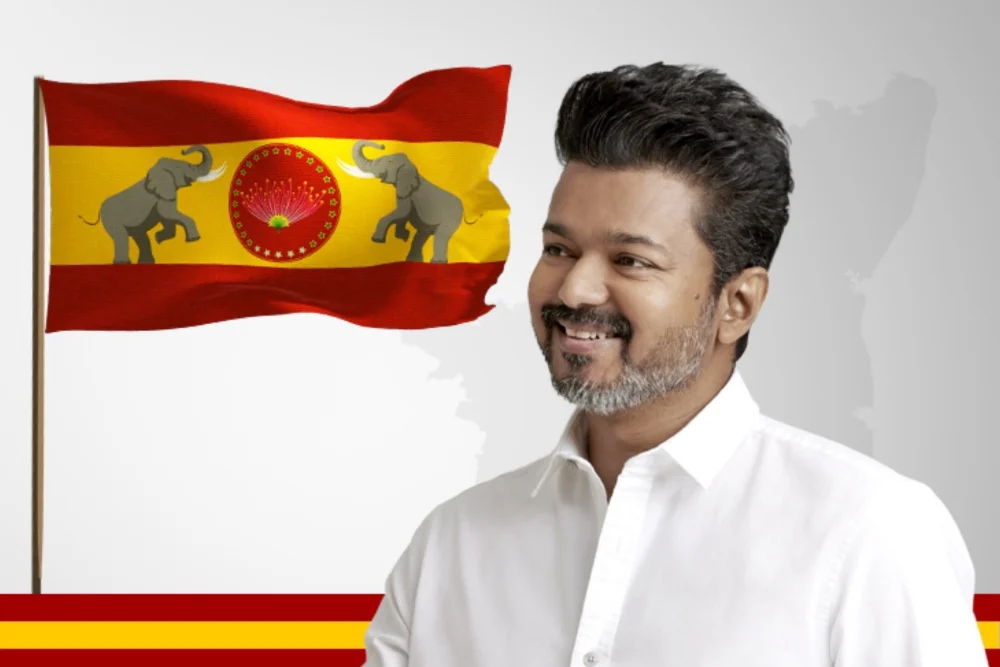
CHENNAI – In a ceremony that signaled the most significant transformation of the Tamil Nadu political landscape in over half a century, actor-turned-politician Joseph Vijay Chandrasekhar was sworn in as the Chief Minister of Tamil Nadu on Sunday morning. Held at the sprawling Jawaharlal Nehru Indoor Stadium in Chennai, the event marked the end of a nearly sixty-year duopoly held by the Dravidian parties—the DMK and the AIADMK—and ushered in a new era of governance under the banner of the Tamilaga Vettri Kazhagam (TVK).
Governor Rajendra Vishwanath Arlekar administered the oath of office and secrecy to Vijay at precisely 10:00 a.m. local time. The atmosphere inside the stadium was electric, a blend of political gravity and cinematic fervor, as thousands of supporters gathered to witness their "Thalapathy" (Commander) transition from the silver screen to the Secretariat.
The Inaugural Cabinet and Portfolios
The swearing-in ceremony was not merely a solo act. Nine ministers were inducted into the inaugural cabinet, representing a mix of loyalists and strategic appointments designed to stabilize a government that currently rests on a thin majority.
Among the key inductees were TVK General Secretary N. Anand, a long-time confidant of Vijay, and prominent leaders Aadhav Arjuna and K.A. Sengottaiyan. Highlighting the administration’s commitment to inclusivity, Selvi S. Keerthana was sworn in as the sole woman in the initial council of ministers.
In a move that mirrors the administrative style of several of his predecessors, Chief Minister Vijay has chosen to retain the most critical portfolios for himself. By reserving Public Administration, Police, and Home affairs, Vijay has signaled that he intends to keep a firm grip on the state’s security apparatus and the bureaucratic machinery as he navigates the challenges of a freshman administration.
Chronology of a High-Stakes Political Week
The path to the Nehru Stadium was anything but certain. The week leading up to the swearing-in was characterized by intense political maneuvering, rumors of "horse-trading," and the looming threat of a "hung" assembly that could have triggered a constitutional crisis.
The Election Verdict (April 23)
The April 23 assembly election results provided a stunning, yet incomplete, victory for the TVK. In its electoral debut, Vijay’s party secured 108 seats. While an extraordinary feat for a party less than two years old, it fell 10 seats short of the 118-seat majority mark in the 234-member house.
The Standoff (Wednesday – Thursday)
When Vijay first met Governor Arlekar on Wednesday to stake his claim, he could only demonstrate the support of 113 legislators. This included his own 108 MLAs and five from the Indian National Congress. The Congress party’s decision to break its long-standing alliance with the DMK to support the TVK sent shockwaves through the political establishment, drawing vitriolic criticism from DMK veterans who viewed the move as a betrayal.
Rumors of a Dravidian "Grand Alliance"
As Vijay struggled to find the remaining five seats, television news channels were flooded with speculation. Reports emerged that the DMK and AIADMK—bitter rivals for six decades—were holding clandestine meetings. The rumored goal was a "Dravidian Front" government designed specifically to keep the "outsider" Vijay out of power.
AIADMK General Secretary Edappadi K. Palaniswami (EPS) added fuel to the fire. After a meeting with his 47 newly elected MLAs, he officially ruled out supporting Vijay but ordered his legislators to remain in Chennai for several days, citing the possibility of "something new and unprecedented."
The Breakthrough (Friday – Saturday)
The political logjam finally shattered on Thursday evening. Thol. Thirumavalavan, president of the VCK, announced his party’s two MLAs would provide unconditional support to the TVK. This was quickly followed by the Indian Union Muslim League (IUML). Finally, the Left parties—CPI and CPI(M), with two seats each—joined the coalition.
By Saturday morning, the TVK-led coalition’s floor strength stood at 120, comfortably above the 118 threshold. This total accounts for TVK’s 107 effective seats (Vijay won two seats but must vacate one by law), five from Congress, and two each from the VCK, IUML, CPI, and CPI(M).
Supporting Data: The 35% Mandate
The TVK’s rise is being analyzed by political scientists as a "black swan" event in Indian state politics. The party’s ability to secure approximately 35% of the popular vote is a historic milestone.
To put this into perspective, the legendary M.G. Ramachandran (MGR), the first major actor to successfully transition to the Chief Minister’s office in Tamil Nadu, managed a lower vote share during his landmark 1977 debut. Vijay’s success is largely attributed to the mobilization of his 85,000-strong fan club network, which was transformed into a grassroots political apparatus in early 2024. This network proved more efficient than the traditional party machineries of the established Dravidian giants in many rural and semi-urban pockets.
| Party/Alliance | Seats Won | Vote Share (Approx.) |
|---|---|---|
| TVK | 108 | 35% |
| DMK & Allies | (Significant losses) | 28% |
| AIADMK | 47 | 22% |
| Others | 19 | 15% |
Official Responses and Key Attendees
The presence of Rahul Gandhi, the Leader of the Opposition in the Lok Sabha, was the most significant diplomatic signal at the ceremony. His attendance underscored the national importance of the Tamil Nadu results.
"This is a new dawn for Tamil Nadu," Gandhi told reporters on the sidelines of the event. "The people have spoken for change, and the Congress is proud to be a partner in this transformative journey. Our success here, alongside our victories in Kerala, Karnataka, and Telangana, shows that the South is leading the way in offering a progressive alternative for India."
In contrast, the DMK leadership remained largely silent, with several senior leaders skipping the event. A spokesperson for the DMK briefly stated that the party would "function as a responsible opposition" but warned that a "coalition built on film stardom rather than ideology" would face internal contradictions.
From the film fraternity, the presence of superstar Trisha Krishnan and several high-profile directors highlighted the industry’s pride in seeing one of its own reach the pinnacle of political power. "It’s a proud day for the industry," she noted briefly. "We have seen him as a leader on screen; now we see him lead the state."
Implications: A New Southern Bloc and the 2026 Horizon
The formation of the Vijay-led government has profound implications for both state and national politics.
1. The End of Dravidian Exceptionalism
Since 1967, Tamil Nadu has been the bastion of Dravidian ideology, centered on social justice, regional autonomy, and linguistic pride. While Vijay has not explicitly renounced these values, his "Tamilaga Vettri Kazhagam" (Tamil Nadu Victory Party) represents a shift toward a more personality-driven, populist governance model that bypasses the traditional DMK-AIADMK structures.
2. The Rise of the "Southern Quad"
With Vijay’s victory, the Indian National Congress now finds itself in power—either alone or as a coalition partner—in four major southern states: Karnataka, Telangana, Kerala, and now Tamil Nadu. In Kerala, the Congress-led UDF’s recent win (102 of 140 seats) ended years of Left dominance. This "Southern Bloc" creates a formidable geographical and political counterweight to the BJP-led Union Government in New Delhi.
3. National Counter-Narratives
While the BJP suffered a setback in the South, the same election cycle saw them consolidate power elsewhere. The BJP’s landslide in West Bengal (207 seats) and their retention of Assam (82 seats) suggest a deeply polarized national electorate. Vijay’s administration will have to navigate this complex federal relationship, particularly regarding GST shares and central schemes.
4. The Fate of "Jana Nayagan"
On a cultural level, the transition marks the end of Vijay’s 69-film career. His final project, Jana Nayagan, directed by H. Vinoth, remains stuck in a certification battle with the CBFC and was recently hampered by a piracy scandal. Political analysts suggest that as Chief Minister, Vijay may now have the leverage to resolve the film’s release, though he must tread carefully to avoid accusations of using his office for personal commercial gain.
Conclusion
Chief Minister Joseph Vijay Chandrasekhar has committed to facing a vote of confidence on the floor of the Assembly on or before May 13. While he has successfully navigated the first week of political turbulence, the real test begins now. Managing a multi-party coalition of Leftists, Ambedkarites, and the Congress—all while fulfilling the massive expectations of a 35% vote share—will require political acumen that exceeds even his most celebrated on-screen performances.
For now, Chennai celebrates. But as the lights dim on the Nehru Stadium, the spotlight shifts to Fort St. George, where the "People’s Actor" must now prove he is the "People’s Administrator."



Leave a Comment