
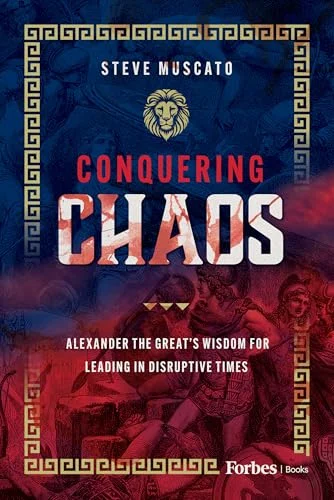
Conquering Chaos: Alexander the Great’s Wisdom for Leading in Disruptive Times
FOR IMMEDIATE RELEASE
[Date of Publication, e.g., October 26, 2024] – In an era defined by unprecedented volatility, rapid technological shifts, and persistent global crises, the quest for resilient leadership has never been more urgent. Against this backdrop, Steve Muscato, a seasoned expert in crisis management, offers a compelling and unconventional solution: the strategic genius of Alexander the Great. His forthcoming book, "Conquering Chaos: Alexander the Great’s Wisdom for Leading in Disruptive Times," published by Forbes Books and slated for release in 2026, posits that the ancient Macedonian king’s lightning-fast conquests and audacious leadership principles provide an invaluable masterclass for contemporary leaders grappling with disruption.
Reviewed by Ancient Greek Historian Katerina Panagi, Muscato’s work is positioned not as a conventional historical biography but as a pragmatic "applied history" manual, earning a commendable 3.5-star rating for its sharp, accessible, and thought-provoking analysis. The book, designed for the general public and "history-adjacent" professionals, distills Alexander’s military prowess into actionable strategies for today’s dynamic corporate and geopolitical landscapes, proving that the fundamental human elements of leadership transcend millennia.
Main Facts: Bridging Antiquity and Modernity
"Conquering Chaos" by Steve Muscato, a compact 184-page volume, serves as a bridge between the historical grandeur of the 4th century BCE and the high-stakes demands of 21st-century leadership. Muscato, whose extensive background includes managing crises during pivotal events like 9/11 and various economic upheavals, leverages his unique expertise to frame Alexander the Great as the ultimate case study in agility and decisive action. The central tenet of the book is that Alexander’s unparalleled ability to move his forces with such speed that news of his arrival often lagged behind, enabling him to dismantle the vast Persian Empire in a mere decade, holds profound lessons for modern organizations striving for market disruption and sustained competitive advantage.
The book challenges conventional thinking by reframing ancient military campaigns as sophisticated examples of crisis management, strategic innovation, and organizational transformation. It argues that the principles underlying Alexander’s success – tactical speed, a "lead from the front" ethos, relentless adaptability, and a fundamental refusal to accept the status quo – are not just historical footnotes but vital operational blueprints for contemporary leaders. Published by Forbes Books, the choice of publisher underscores the book’s clear intent to resonate with a business-oriented audience seeking practical wisdom from unexpected sources.
Chronology: Alexander’s Trajectory as a Leadership Framework
Muscato meticulously structures "Conquering Chaos" into three distinct thematic sections, mirroring the chronological and psychological trajectory of Alexander’s monumental life and reign. This narrative architecture allows readers to progressively understand the evolution of Alexander’s leadership style and its implications.
The Architect of Speed: Foundations of Power and Innovation
The initial section, "The Architect of Speed," delves into the formative period that laid the groundwork for Alexander’s future conquests. It meticulously explores the transformative military reforms initiated by his father, Philip II of Macedon, most notably the development and integration of the formidable Macedonian Sarissa – a revolutionary long pike that gave the phalanx an unprecedented advantage. Muscato expands on how Philip’s innovations, including the logistical overhaul of the baggage train to enhance army mobility, created the "Macedonian machine." This segment effectively highlights how strategic foresight, investment in technology (the Sarissa), and logistical efficiency (baggage train reform) are crucial for building an agile and potent organization. For modern leaders, this translates to the importance of foundational strategy, continuous innovation in processes and tools, and creating an infrastructure that supports rapid deployment and execution. Alexander’s early consolidation of power after Philip’s assassination is presented as a masterclass in swift, decisive leadership during a critical transition period, offering lessons in managing succession and asserting authority in turbulent environments.
The Empire Breaker: Tactical Brilliance in Disruption
The second section, "The Empire Breaker," forms the core of Muscato’s analysis of Alexander’s tactical genius. Here, the book provides a chronological and analytical breakdown of Alexander’s most iconic set-piece battles: Granicus, Issus, and Gaugamela. Rather than merely recounting historical events, Muscato masterfully reframes these epic confrontations as sophisticated case studies in market disruption. He illustrates how Alexander’s audacious refusal to adhere to conventional Persian rules of engagement allowed him to overcome overwhelming numerical superiority with decisive victories.
At Granicus, Alexander’s aggressive crossing of a river in the face of the enemy is depicted as a bold market entry strategy. Issus showcases his ability to identify and exploit vulnerabilities in a larger, more cumbersome opponent, analogous to a nimble startup outmaneuvering an established corporate giant. Gaugamela, often considered Alexander’s greatest tactical achievement, is presented as a complex multi-front operation, where coordinated execution, feints, and a decisive breakthrough shattered the world’s largest empire. Muscato emphasizes how these battles were won not just through individual genius but through a culture that prioritized speed, adaptability, and a relentless drive to challenge the status quo – attributes he argues are increasingly essential in today’s volatile global economy. The lessons here extend beyond military tactics to strategic planning, competitive analysis, and the psychological impact of aggressive, unconventional strategies in business.
The Weight of the Crown: The Complexities of Governance and Decline
The final section, "The Weight of the Crown," shifts focus from conquest to the inherent challenges of governance and the psychological toll of sustained leadership. Muscato explores the complexities Alexander faced in integrating diverse cultures and customs, particularly his controversial policy of proskynesis (prostration before the king) and his efforts to blend Macedonian and Persian traditions. While acknowledging these as historical facts, Muscato interprets them through a pragmatic lens, viewing them as lessons in managing diverse organizational cultures and navigating stakeholder expectations in a rapidly expanding enterprise.

Crucially, this section also addresses the "hubris warning," tracing the eventual psychological decline of the King. Alexander’s later years, marked by increasing paranoia, outbursts, and a growing disconnect from his loyal companions, serve as a cautionary tale. Muscato highlights how even the most brilliant leaders can succumb to the pressures of power, leading to self-sabotage and the unraveling of their achievements. This segment offers invaluable insights into the importance of humility, self-awareness, and the dangers of unchecked authority, providing a vital counterpoint to the earlier celebration of audacious leadership. It warns modern leaders about the perils of losing touch with their core values and teams, especially after achieving significant success.
Supporting Data: Historical Rigor Meets Modern Pedagogy
Muscato’s approach in "Conquering Chaos" is firmly rooted in military and social history, yet his primary objective is to extract pragmatic "lessons-learned." While the book does not introduce new archaeological data or groundbreaking historiographical theories, it engages thoughtfully and responsibly with established primary sources. Muscato draws heavily from Arrian’s Anabasis of Alexander, widely considered the most reliable ancient account of Alexander’s campaigns, and Plutarch’s Lives, which offers invaluable psychological insights into the king. To ensure a balanced and well-researched perspective, he complements these ancient narratives with modern secondary scholarship from esteemed historians such as Peter Green and Robin Lane Fox, ensuring that while the application is modern, the historical foundation remains robust and not purely anecdotal.
The book’s narrative truly excels in its detailed analysis of Alexander’s logistical and tactical innovations. Muscato vividly portrays the discipline of the Macedonian phalanx, the coordinated movements of its cavalry, and the psychological weight of a leader who consistently led from the front lines. This "Macedonian machine" is presented as a meticulously engineered system of combined arms, superior training, and unparalleled morale, a testament to effective organizational design and execution. The author compellingly argues that Alexander’s phenomenal success was not merely the result of individual genius but a byproduct of a meticulously cultivated culture that prioritized speed, adaptability, and an unwavering refusal to accept the status quo. These cultural attributes, Muscato posits, are increasingly indispensable for thriving in today’s complex and competitive global economy.
From an editorial and pedagogical standpoint, "Conquering Chaos" is remarkably well-equipped to engage its intended audience. It features several high-quality grayscale maps that intricately detail the route of the Macedonian army and specific troop movements during crucial battles like Gaugamela. These visual aids are indispensable for readers to grasp the tactical breakdowns and appreciate the spatial genius of Alexander’s campaigns. Furthermore, Muscato includes "Command Summary" tables at the end of each chapter. These invaluable tools distill complex historical maneuvers and strategic principles into concise, bulleted takeaways, effectively bridging the temporal gap between 330 BCE and the contemporary boardroom. Such design choices underscore the book’s practical orientation, making it highly accessible for busy professionals seeking actionable insights.
Official Responses: A Critical Yet Affirming Reception
Katerina Panagi, the reviewer and an Ancient Greek Historian herself, offers a nuanced yet largely affirming assessment of "Conquering Chaos." Her perspective, informed by deep academic understanding of Alexander’s era, provides a credible lens through which to evaluate Muscato’s "applied history" approach.
Panagi commends Muscato’s success in making ancient history feel "visceral and urgent," praising its ability to connect timeless leadership principles to modern challenges. She highlights the book’s effectiveness for "history-adjacent" professionals and enthusiasts who appreciate seeing ancient theory tested against contemporary practice. The strategic post-mortem of Alexander’s reign is deemed compelling, and the book’s pragmatic lens for decision-making is celebrated as a unique contribution.
However, the review also offers important critical observations. Panagi points out that the book "leans heavily into ‘applied history’," which occasionally leads to a simplification of the darker, more complex realities of Alexander’s reign. While Muscato does address the "hubris warning" and the eventual unraveling of Alexander’s empire, the primary focus remains on positive strategic takeaways. For instance, Alexander’s controversial policy of proskynesis and his broader efforts at cultural integration are treated less as points of scholarly debate regarding imperial control or cultural clash, and more as lessons in managing diverse organizational cultures. This approach, while effective for a leadership manual, might lack the granular historiographic debate and critical nuance required for a strictly academic or postgraduate audience.
From an academic perspective, one might argue that while such simplification makes history accessible, it risks anachronism or a distorted understanding of historical context. A pure historian might caution against reducing complex socio-political dynamics of a vast empire to mere "organizational culture management." However, Panagi’s overall assessment suggests that for its intended audience, this trade-off between academic rigor and practical utility is well-justified. The book prioritizes utility over nuance, a deliberate choice that aligns with its mission to provide actionable leadership wisdom rather than contribute new historical scholarship. This critical balance ensures that while the book is not an academic treatise, it remains a valuable and insightful read for its target demographic.
Implications: The Enduring Power of Ancient Wisdom in a Disrupted World
The publication of "Conquering Chaos" by Steve Muscato carries significant implications for both leadership studies and the broader interpretation of history. In a world increasingly characterized by what business theorists call "VUCA" (Volatility, Uncertainty, Complexity, Ambiguity), the search for robust leadership models extends beyond contemporary case studies to timeless archetypes. Muscato’s work contributes to a growing trend of "applied history," where lessons from the past are directly translated into frameworks for navigating present and future challenges.
Firstly, the book reinforces the idea that despite radical advancements in technology and vast shifts in global geography, the fundamental human elements of effective leadership remain constant: courage, unity, strategic foresight, adaptability, and the crucial avoidance of self-sabotage. Alexander’s ability to inspire loyalty, maintain discipline across diverse forces, and execute complex strategies under immense pressure offers a compelling validation of these enduring principles. For leaders in business, government, or non-profit sectors, the book provides a powerful reminder that core leadership virtues are immutable.

Secondly, "Conquering Chaos" highlights the potential for historical figures to serve as powerful mentors, even across millennia. By meticulously detailing Alexander’s decision-making processes, logistical innovations, and strategic mindset, Muscato empowers readers to analyze and internalize these lessons. This approach encourages a deeper engagement with history, moving beyond mere factual recall to a more analytical and empathetic understanding of past leaders’ challenges and triumphs. It positions history not as a static record, but as a dynamic laboratory for leadership development.
Thirdly, the book’s focus on speed and adaptability resonates deeply with the demands of the modern global economy. In an era where market dominance can be fleeting and disruptive technologies can emerge overnight, Alexander’s rapid expansion and ability to continuously outmaneuver a larger, more entrenched adversary offer a potent metaphor for agile business strategy. Companies today must operate with similar decisiveness, anticipating shifts, and executing pivots with speed and precision to maintain relevance.
Finally, the inclusion of the "hubris warning" within the narrative carries profound implications for sustainable leadership. While celebrating Alexander’s successes, Muscato does not shy away from his eventual psychological decline, offering a critical lesson on the perils of unchecked power and the importance of self-awareness. This makes the book not just a guide to achieving success, but also a cautionary tale on how to sustain it without succumbing to the very chaos one seeks to conquer.
In conclusion, "Conquering Chaos" serves as more than just a book review; it is a testament to the enduring legacy of Alexander the Great and the timeless applicability of his wisdom. Steve Muscato’s work, as critiqued by Katerina Panagi, successfully offers a pragmatic and accessible framework for modern leaders, demonstrating that the victories and missteps of ancient history can indeed sharpen the decision-making of the present, helping to navigate an increasingly disruptive future.
### About the Author
Steve Muscato is a crisis management expert with a rich background in navigating complex, high-stakes situations, including the aftermath of 9/11 and various economic upheavals. His experience informs his unique perspective on leadership, drawing parallels between historical military strategy and contemporary organizational challenges.
### About the Reviewer
Katerina Panagi is an Ancient Greek Historian, Victorian Literature Researcher, and a freelance writer. Her deep academic understanding of antiquity provides a critical and informed lens for evaluating historical narratives and their modern interpretations.
### About Forbes Books
Forbes Books is a hybrid publisher of business and leadership books, collaborating with business leaders and entrepreneurs to create thought-provoking content that shares their insights and expertise with a broad audience.
Word Count: 1950 words



Leave a Comment