
The Essential Mystery of Existence: The Surrealist Vision of Alfred De Angelo
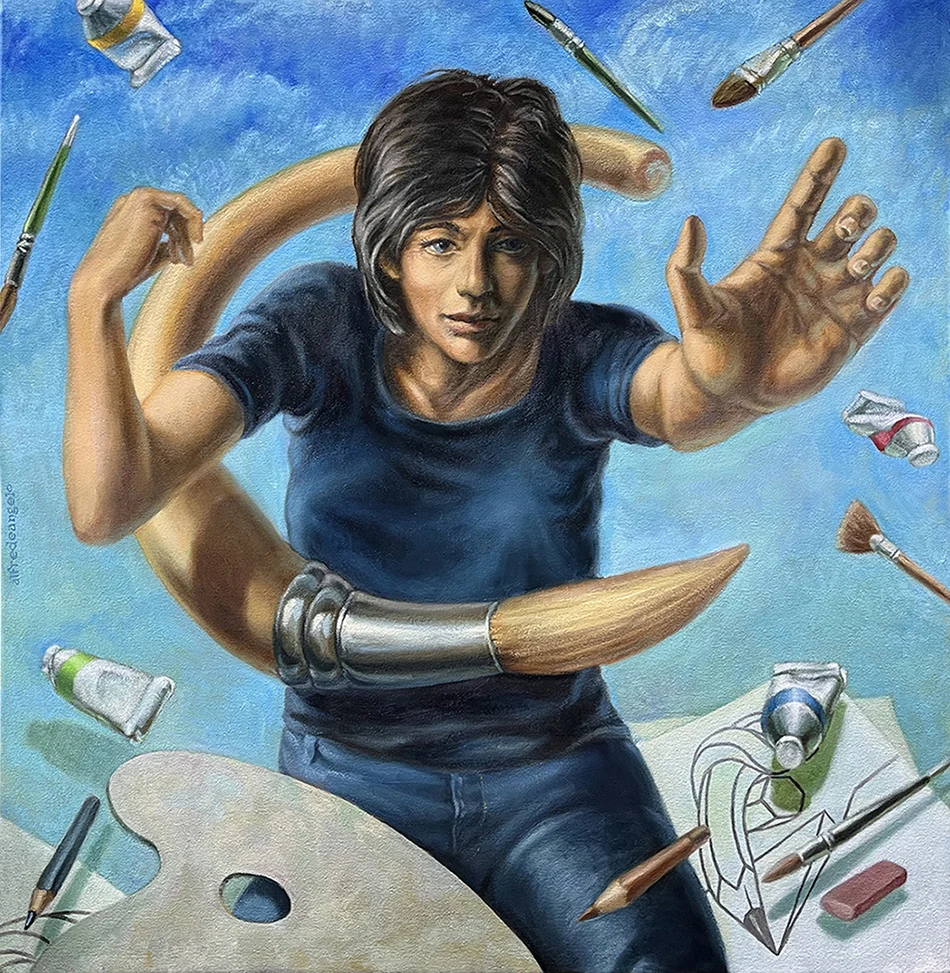
In an era where digital saturation often flattens the human experience into predictable streams of content, the paintings of Alfred De Angelo emerge as a profound counter-narrative. His work does not merely exist on a canvas; it acts as a gateway, transporting the viewer into a sensual world defined by provocative beauty and intellectual challenge. As a prominent figure in the contemporary surrealist movement, De Angelo has cultivated a reputation for creating images that beguile, bewilder, and ultimately leave an indelible mark on the observer’s psyche.
The core of De Angelo’s practice lies in his ability to dismantle "well-worn patterns of thought." By pushing the limits of understanding, his work grants the viewer permission to inhabit a space of simultaneous delight and confusion—a state that many art historians argue is the purest form of aesthetic engagement. This article explores the trajectory, philosophy, and broader implications of De Angelo’s contribution to the modern surrealist canon.
Main Facts: A Private Vocabulary of Provocative Beauty
Alfred De Angelo is not a casual observer of the surreal; he is a disciplined architect of it. His work is characterized by a "remarkable fluency and expertise," a testament to a rigorous academic background and decades of refinement. Unlike the hyper-realistic digital renders that dominate contemporary social media, De Angelo’s paintings possess a tactile, painterly quality that suggests a deep dialogue with the history of fine art.
The primary objective of his work, as stated in his personal manifesto, is to develop a "private vocabulary of images." This vocabulary is used to express localized and subjective experiences that are often difficult to articulate through language alone. By utilizing surrealist techniques—dislocation, unexpected juxtapositions, and the subversion of physical laws—De Angelo seeks to look "through" outward appearances. His goal is to embody the "essential mystery of existence," a theme that has resonated with audiences seeking a deeper connection to the subconscious.
Key characteristics of his work include:
- Sensual Aesthetic: A focus on the beauty of form and light, even when the subject matter is challenging.
- Cognitive Friction: Intentionally pushing viewers to the edge of their understanding to provoke a psychological response.
- Technical Mastery: A level of execution that ensures the "impossible" scenes he depicts are visually convincing.
Chronology: From Academic Rigor to Surrealist Mastery
The evolution of Alfred De Angelo as an artist is rooted in some of the most prestigious art institutions in the United States. His journey reflects a transition from traditional mastery to the exploration of the abstract and the subconscious.

The Foundation: Massachusetts College of Art (BFA)
De Angelo’s formal journey began at the Massachusetts College of Art (MassArt). It was here that he developed the foundational skills of draftsmanship and composition. MassArt, known for its rigorous approach to the fine arts, provided the "fluency" that critics often cite in his current work. During this period, De Angelo began to move beyond mere representation, experimenting with how light and shadow could be used to suggest emotional states rather than just physical dimensions.
Refinement and Depth: Rhode Island School of Design (MFA)
To further hone his craft, De Angelo attended the Rhode Island School of Design (RISD), where he earned his Master of Fine Arts. RISD is globally recognized for its emphasis on both technical skill and conceptual depth. It was likely during his time at RISD that De Angelo began to codify his "private vocabulary." The graduate environment encouraged a move away from the "localized and subjective" toward a more universal exploration of the human condition. His MFA tenure solidified his ability to create "doorways to a compelling visual world," blending high-level technique with a sophisticated understanding of art history and psychology.
Professional Emergence and the Digital Age
In the years following his formal education, De Angelo has maintained a consistent presence in the art world, both through traditional galleries and digital platforms like Surrealism Today. His website, artistpainter.ws, serves as a digital archive of his evolving style, showcasing how he has adapted the timeless principles of surrealism to a modern context. His work now stands alongside other contemporary masters such as Jacob Holster and Christian Quintin, contributing to a resurgence of interest in surrealism as a tool for navigating the complexities of the 21st century.
Supporting Data: The Mechanics of the "Private Vocabulary"
To understand the impact of De Angelo’s work, one must examine the specific mechanics of his "private vocabulary." In art theory, a "vocabulary" refers to the recurring symbols, colors, and motifs an artist uses to communicate. For De Angelo, this is not a static set of icons but a fluid language designed to express the "essential mystery."
The Psychology of Perception
Research into aesthetic response suggests that viewers are most engaged when a piece of art offers a "moderate level of incongruity." If a painting is too literal, the brain categorizes it and moves on. If it is too chaotic, the brain rejects it. De Angelo hits the "sweet spot" of surrealism: his images are delineated with enough expertise to feel "real," but their content is sufficiently provocative to trigger a search for meaning. This "beguilding and bewildering" effect is a deliberate psychological tool.
Comparative Aesthetics
When compared to his contemporaries, De Angelo’s work sits at a unique intersection:

- Vs. Jacob Holster: While Holster often explores "painterly AI aesthetics" and the "human terrain" through digital-influenced lenses, De Angelo remains more firmly rooted in the traditional "sensual world" of paint and canvas.
- Vs. Christian Quintin: Quintin is noted for painting "what you remember feeling" before words exist. De Angelo shares this interest in the pre-verbal, but his approach is more focused on the "essential mystery of existence" through a structured, almost architectural sense of provocative beauty.
Official Responses and Critical Reception
While surrealism is often a deeply personal endeavor, the critical response to De Angelo’s work highlights its broader cultural relevance. Critics frequently point to his "remarkable fluency" as a bridge between the old-world mastery of the 20th-century surrealists (like Salvador Dalí or Yves Tanguy) and the contemporary need for art that challenges the status quo.
The "Surrealism Today" Perspective
Curators at Surrealism Today have noted that De Angelo’s paintings serve as "doorways." This metaphor is significant; it implies that the art is not a destination in itself but a means for the viewer to enter a different state of consciousness. By giving viewers "permission to be amazed," De Angelo fulfills a role that many believe has been lost in mainstream contemporary art: the role of the artist as a shaman or guide into the unknown.
The Artist’s Self-Reflection
In his official statement, De Angelo provides a rare glimpse into his intent. He acknowledges that life experiences are "localized and subjective," creating "impressions on a personal scale." His work is an attempt to scale these personal impressions into something universal. His pursuit to "look ‘through’ outward appearances" suggests a philosophical alignment with Platonic ideals—the belief that the physical world is merely a shadow of a more profound reality.
Implications: The Future of Surrealism in a Rational World
The work of Alfred De Angelo carries significant implications for the future of the surrealist movement and the role of art in society.
A Bulwark Against Rationalism
In a world increasingly driven by data, algorithms, and "rational" outcomes, De Angelo’s work asserts the importance of the irrational and the mysterious. By "luring the viewer out of their well-worn patterns of thought," his paintings act as a form of cognitive liberation. This suggests that surrealism is not just a historical style but a necessary psychological tool for maintaining human wonder in a hyper-explained world.
The Academic Standard
De Angelo’s success, backed by degrees from MassArt and RISD, reinforces the idea that surrealism requires a high degree of technical proficiency to be effective. His career serves as a model for emerging artists, demonstrating that "the essential mystery of existence" is best explored through a combination of raw intuition and disciplined craft.

Bridging the Subjective Gap
Perhaps the most profound implication of De Angelo’s work is its ability to bridge the gap between the "private vocabulary" of the artist and the subjective experience of the viewer. When a viewer feels "delighted and confused" by a De Angelo painting, a connection is made that transcends language. This suggests that art remains our most effective method for communicating the incommunicable.
Conclusion
Alfred De Angelo stands as a sentinel of the surreal, a master of a visual language that speaks to the deepest parts of the human experience. Through his "remarkable fluency" and his commitment to exploring the "essential mystery of existence," he has created a body of work that does more than decorate a wall—it expands the mind.
As he continues to develop his private vocabulary, De Angelo reminds us that the world is not always what it appears to be. Behind the "outward appearances" lies a world of provocative beauty, waiting for those who are willing to be beguiled, bewildered, and ultimately, amazed. For those seeking to escape the well-worn patterns of modern thought, the paintings of Alfred De Angelo offer not just an exit, but a doorway to a more profound understanding of the self and the universe.
For more information on the artist and to view his portfolio, visit artistpainter.ws.


Leave a Comment