"The Dragon in Winter": A Penultimate Episode of Shifting Sands and Fiery Spectacle
King’s Landing, Westeros – The penultimate episode of House of the Dragon Season Three, titled "The Dragon in Winter," delivered a potent mix of quiet political maneuvering and breathtaking, brutal spectacle, defying the usual Game of Thrones tradition of saving its most explosive moments for the second-to-last installment. While offering significant table-setting for the impending finale, the episode also unleashed the series’ most visceral and prolonged sequence of dragon-on-dragon combat to date. Adding to the dramatic weight, it saw the unexpected return of a character many viewers had presumed long dead, injecting a fresh layer of tension and surprise into the escalating Dance of the Dragons. This episode plunged deep into the grim realities of war, showcasing its "finger-removing, neck-biting, chin-stabbing glory" with an unflinching gaze.
Thematic Depth: Unpacking "The Dragon in Winter"
The episode’s title, "The Dragon in Winter," immediately signals a rich tapestry of historical and literary allusions, drawing heavily from James Goldman’s acclaimed 1966 play, The Lion in Winter. The play, later an Oscar-winning film, chronicles the Yuletide machinations of King Henry II, his estranged wife Eleanor of Aquitaine, and their vying, often disappointing, children plotting for succession. While George R.R. Martin has never explicitly cited the play as a direct inspiration for A Song of Ice and Fire, his well-documented fascination with Medieval history and classic cinema, coupled with his acknowledgment of Eleanor of Aquitaine as a muse for Queen Alysanne Targaryen, firmly places this thematic resonance within the series’ intellectual wheelhouse.
"The Dragon in Winter" masterfully mirrors the play’s central conflicts: the intensifying chasm between Daemon and Rhaenyra, and Alicent’s stark realization of her children’s unsuitability for the throne. It portrays a realm fractured not just by war, but by deep-seated familial resentments and the decay of once-mighty houses.
Beyond the historical parallel, "winter" itself is a term imbued with profound meaning in the world of Westeros. "Winter is Coming," the stark warning of House Stark, signifies not merely the harsh, unnaturally long seasons, but also the ancient, forgotten threat of the Others (or White Walkers) and the existential, endless winter they portend. In an episode where Rhaenyra’s long-standing obsession with prophecy resurfaces, and Helaena experiences chilling visions of falling snow, the signs of an impending, multifaceted winter are omnipresent. Metaphorically, winter also arrives in the form of Roderick Dustin and his formidable Winter Wolves, marching as the vanguard of Oscar Tully’s host, a direct and imminent threat to the Hightower faction.
Furthermore, if The Lion in Winter alludes to the decline of a once-mighty monarch, "The Dragon in Winter" similarly references the "aging or perhaps curdling" of Rhaenyra’s reign. Her descent into tyranny, marked by increasingly desperate decisions, and the fracturing of her court, highlighted by the consummation of her relationship with Mysaria—a subtle nod to the secret queer relationship undermining a political stratagem in The Lion in Winter—all underscore a reign entering its bleakest season. This metaphorical winter is a period of internal decay and external siege, where even the most powerful find their authority challenged and their foundations crumbling.

Visual Storytelling: The Evolving Opening Credits
The series’ iconic opening credits, a visual tapestry illustrating the unfolding Targaryen lineage and the bloodshed of the Dance, presented two new, highly symbolic panels this episode, deepening their surreal and prophetic nature.
The first new panel depicted a pair of fallen soldiers, initially dressed in the Blacks’ colors, bleeding out. A subtle camera transition then moved through the fabric to reveal the obverse side, where the same soldiers now bore the Greens’ colors. This ingenious piece of visual storytelling is a stark commentary on the civil war itself: the common soldiers, regardless of their banner, bleed and die for causes that are, at their core, inextricably linked and often indistinguishable in their tragic outcome. It emphasizes the cyclical, self-destructive nature of the conflict, where victory for one side is merely a continuation of the same bloody tapestry, woven with the lives of the same people.
The second new panel dramatically showcased the aftermath of the Butcher’s Ball, with Criston Cole depicted dead on his knees, his demise framed by the spreading tines of the Seven-Pointed Star of Faith. Here, the star serves as a potent stand-in for his guiding light, Alicent, whose deep faith ironically contrasts with her own broken vows, particularly her affair with Ser Criston. Green threads then emanated from Criston’s panel, breaching its border and weaving through a field of what appeared to be blood-soaked branches towards the Targaryen sigil. This visual could be interpreted in multiple ways: new growth struggling amidst the carnage, the Greens’ influence spreading despite the cost, or perhaps the corrupting nature of faith when intertwined with political ambition. Regardless, it underscores the enduring impact of Criston Cole’s actions and loyalty on the broader conflict.
Helaena the Dreamer: Prophecy and the Burden of Dragons
Helaena Targaryen’s character continues to be a focal point for the series’ exploration of prophecy and the unique, often burdensome, connection Targaryens share with dragons. In the novels, Helaena loves her dragon, Dreamfyre, and flies her frequently, only ceasing after the tragic murder of her son, Jaehaerys. The show, however, presents a more complex portrayal: Helaena expresses that being with Dreamfyre is "too much" despite her desire to fly. This could be interpreted as part of her subtle autism-coding, a sensory overload that makes the overwhelming presence of a dragon unbearable. Rhaenyra draws a parallel to her father Viserys, the last rider of Balerion the Black Dread, suggesting a shared belief that an overreliance or "faith in dragons is a kind of hubris."
Intriguingly, Helaena’s expressed desire to fly without a dragon evokes comparisons to Bran Stark, who also yearned for flight and was told by the Three-Eyed Raven (Helaena’s distant grandnephew, Brynden Rivers) that his warging abilities would grant him that freedom. Like her brother Aemond, whom she observes "burns without fire," Helaena appears to "fly without a dragon" through her prophetic abilities.

This nuanced portrayal challenges the Game of Thrones-era implication that Daenerys’s immunity to fire and the hatching of her three dragons made her supernaturally unique. Instead, House of the Dragon posits a more complex truth: the true exceptionalism of the Targaryens lies not solely in their connection to dragons—a power shared by roughly forty Old Valyrian families—but in their rare and potent prophetic dreams. Daenys the Dreamer, Aegon the Conqueror, Helaena, and Rhaegar Targaryen all shared this unique prophetic power, seemingly exclusive to the Targaryen bloodline, a legacy potentially rooted in dark magic and human sacrifice used to forge their bond with dragons.
The episode finally grants viewers Helaena’s first on-screen solo vision (distinct from the shared vision with Daemon last season). While the precise details of her dream remain somewhat veiled, its implications are chilling. The vision, seemingly a glimpse into Helaena’s potential future, appears to suggest that achieving this ideal future will come at a terrible cost, perhaps literally forcing her to burn hundreds of people to escape King’s Landing. More disturbingly, the invocation of White Walkers and the encroaching winter at the vision’s conclusion serves as a stark warning: Helaena’s ideal future, if realized, might inadvertently unravel the timeline, destroying the very conditions that allowed Westeros to triumph against the Second Long Night, as depicted in Game of Thrones. This off-book development for Helaena’s storyline leaves her fate agonizingly uncertain, reframing her eventual tragic death in the books as a potential noble sacrifice for the future of her children, adding a layer of tragic heroism to her character.
Class Consciousness and the Perils of Patronage
Following the dramatic death of Criston Cole in the previous episode, this installment starkly illustrates the consequences of ignoring the common folk and the inherent dangers of misplaced trust in noble patronage.
Sylvie’s poignant conversation with Mysaria reveals the limitations of her new role as Rhaenyra’s Mistress of Whispers, rendering her unable to genuinely aid the smallfolk. Sylvie’s cutting reminder, "within the walls of the highborn, a whore will always and ever remain a whore," encapsulates the inescapable class divide. Ser Criston, only at the bitter end, grasped that the lowborn would never truly be considered equals by their noble compatriots. Even Gwayne, who seemingly considered Criston a friend, could offer him nothing more than continued servitude in Oldtown. This theme of social immobility and the false promises of upward mobility through noble service is a recurring tragedy.
This theme culminates in the revelation of Ulf’s betrayal of Rhaenyra. Archmaester Gyldayn, the in-fiction chronicler of Fire & Blood, often dismissive of the poor and critical of Rhaenyra’s fitness to rule, attributes Ulf’s treachery to his "common breeding" and Rhaenyra’s "poor judgment." Gyldayn’s narrative paints Ulf as a craven, turning coat out of fear of the Hightower host. However, the show offers a more psychologically consistent truth: Ulf, caught in a limbo where his old freedoms are gone but no meaningful rewards have materialized, falls into the same trap as Criston and Mysaria—believing that the "trappings of nobility" will confer respect. While Ormund may be an untrustworthy mouthpiece for the virtues of the smallfolk, Ulf embodies the credulous social climber whose burgeoning class consciousness is easily manipulated by the allure of status. Sylvie’s role here, as a character who understands the true plight of the smallfolk and Mysaria’s deviation from it, hints at her potential significance in future seasons, perhaps as a stand-in for another sex worker pivotal to the narrative, raising questions about how her past association with Mysaria might influence future plotlines.

DragonWatch: A Battle of Unprecedented Scale
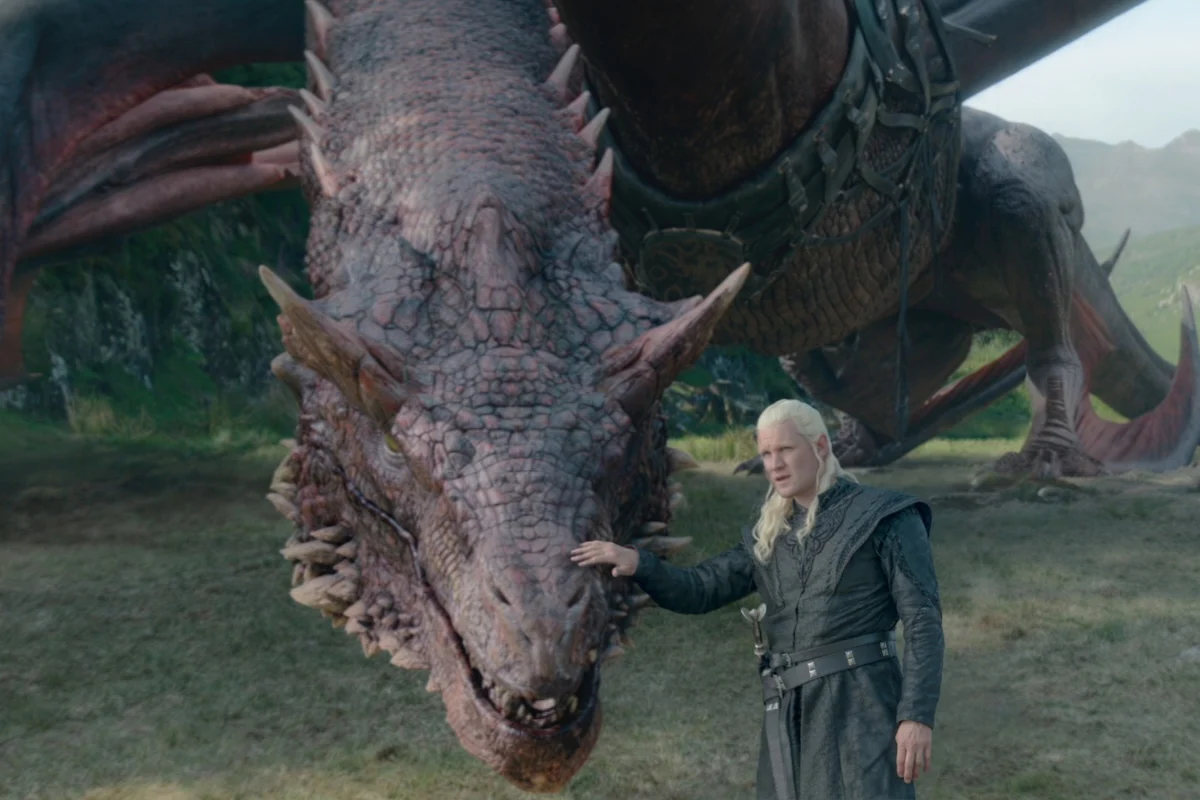
The undisputed centerpiece of "The Dragon in Winter" was the colossal four-dragon battle featuring Caraxes, Syrax, Seasmoke, and Sheepstealer. This sequence stands as one of the most compelling and visually stunning dragon fights in the entire Game of Thrones universe, effectively addressing any lingering criticisms about House of the Dragon‘s pacing.
Among the myriad breathtaking details, the subtle reminder that dragon blood smokes upon exposure to open air was particularly potent. This easily overlooked detail from Martin’s books, alongside their iron-rich black bones, serves as a crucial reminder: dragons are not natural creatures of Westeros. They are entities forged of fire, unbound by natural law, even the fantastic laws of their own world. This makes their presence both awesome and terrifying, an alien force of destruction.
Notably, this epic battle has no direct counterpart in the original Fire & Blood narrative. In the books, Sheepstealer, as Nettles’s mount, remains loyal to Rhaenyra until she is driven off due to Rhaenyra’s suspicion of betrayal (both as Daemon’s supposed mistress and in the wake of Ulf’s treachery). The show’s decision to have Sheepstealer survive, despite Rhaena’s inability to fully tame him, introduces an intriguing deviation. Given Rhaena’s eventual arc in the novel, Sheepstealer’s survival presents a narrative conundrum. His survival suggests either a future role for the untamed beast or a "kinder end" than being summarily dispatched by three trained dragons.
Sheepstealer’s altered arc in the show serves as a powerful inversion of his book counterpart, yet ultimately reinforces the same core idea. In the novels, Nettles, despite her dubious Targaryen lineage, tames the wild Sheepstealer, providing evidence that dragon-riding might not be exclusive to Targaryen blood. The show, by depicting Rhaena’s failure to truly tame Sheepstealer – her inability to prevent him from attacking her family’s dragons – casts doubt on the Targaryens’ ultimate mastery over dragonkind. It suggests that while they can ride domesticated dragons, they are not inherently masters of all dragons, particularly the wild ones. Poor, underbite-y, ungroomed, and perpetually angry Sheepstealer becomes a symbol of this untamed, unpredictable power.
The episode also offered the first detailed look at Dreamfyre, previously glimpsed only briefly and shrouded in darkness in Season One. As the second-oldest living dragon after Vhagar, Dreamfyre is described in Fire & Blood as slender, with blue scales and a silvery crest. The show’s design is bolder and more unique, featuring upturned horns along her skull and neck, giving her the appearance of a "nightmare elk." Additionally, a hooded crest around her eyes evokes a cobra, contributing to one of the series’ most distinct and compelling dragon physiologies. The show’s commitment to diverse and imaginative dragon designs remains a consistent highlight.

Equally stunning, though less novel for book readers, was the "resurrection" of Sunfyre and his devastating destruction of Lord Mooton’s army. Gyldayn’s description of the resurrected Sunfyre as "a broken thing… huge wounds were visible along his neck… where his right eye should have been was only an empty hole, crusted with black blood" is perfectly captured by the show. The resuscitated Sunfyre is a monstrous, scarred creature, mirroring his rider, Aegon II. The scene is shot with low lighting worthy of a horror movie, as Sunfyre looms menacingly out of the shadows, a perfect reveal after years of anticipation for book readers.
Official Creative Decisions and Their Implications
The episode’s deviations from George R.R. Martin’s Fire & Blood are significant, representing deliberate creative choices by the showrunners. The expanded role and unique visions of Helaena, the altered arc of Sheepstealer, and the direct on-screen consummation of Rhaenyra and Mysaria’s relationship all serve to deepen character motivations and amplify thematic resonance. These choices are not merely divergences but are "official responses" to the source material, aiming to enhance emotional impact and provide fresh perspectives for an audience familiar with the books.
The show’s decision to portray Rhaenyra as a progressively crueler and less likable figure, without fundamentally betraying her core character, demonstrates a nuanced approach to adapting her complex personality. This portrayal implies a deliberate attempt to explore the corrupting influence of power and the harsh realities of leadership in wartime, making her journey a more tragic and morally ambiguous one.
The episode’s events carry profound implications for the season finale and the future trajectory of the Dance of the Dragons. Daemon’s revealed betrayal, Ulf’s turncloak moment, Corlys’s capture, the sacrifice of another Queensguard knight, and the effective disarming of a potential dragonrider ally (Rhaena without a tamed Sheepstealer) all signify a critical turning point for Rhaenyra’s cause. Her increasingly desperate decisions are "coming home to roost," leaving her in a precarious and vulnerable position.
Conclusion: A Storm on the Horizon
"The Dragon in Winter" stands as another masterfully crafted episode, expertly building simmering tension before the inevitable storm breaks. The show’s nuanced portrayal of Rhaenyra’s descent into tyranny, highlighting the consequences of her increasingly desperate choices, sets a grim stage for what is to come. With Daemon’s loyalty shattered, Ulf’s treachery exposed, Corlys Velaryon captured, and a potential dragonrider ally rendered effectively powerless, Rhaenyra’s position grows increasingly perilous.

As the season hurtles towards its finale, the questions loom large: Can Rhaenyra recover from these cascading betrayals and losses? What will be the ultimate fate of Helaena, whose prophetic visions offer both insight and dread? And what further horrors and spectacles await as the Dance of the Dragons reaches its bloody climax? The stage is set for a finale that promises to be as devastating as it is unforgettable.