
Ereshkigal: The Unyielding Queen of the Mesopotamian Underworld
Introduction: Sovereign of the Great Below
Ereshkigal, known also as Irkalla and Allatu, stands as a formidable and indispensable figure in the ancient Mesopotamian pantheon: the undisputed Queen of the Dead. Her very name, translating as "Queen of the Great Below" or "Lady of the Great Place," evokes the vast, inescapable dominion over which she presides. Far from a realm of exceptional beauty, the "great" in her title refers to the immense, sprawling expanse of the underworld, a realm of eternal gloom and no return. Ereshkigal’s primary responsibilities were absolute: to eternally house the souls of the deceased within her shadowy kingdom and, with equal ferocity, to prevent the living from breaching its boundaries and uncovering the profound, often stark, truths of the afterlife. Her rule was a cornerstone of Mesopotamian cosmology, embodying the finality and gravity of existence itself.
Main Facts: The Unseen Architect of Eternity
Ereshkigal’s domain, known as Kurnugia ("Land of No Return"), Irkalla, or Allatu, lay beneath the Mountains of Sunset in the west. It was depicted as an immense, subterranean expanse where the souls of the dead endured a desolate existence, their sustenance meagre – drinking muddy puddles and subsisting on dust. From her imposing palace, Ganzir, strategically located at the very entrance to the underworld, Ereshkigal governed these countless souls. This formidable abode was protected by seven meticulously guarded gates, each overseen by her loyal and ever-vigilant servant, Neti.
Her reign was initially solitary, a testament to her inherent power and authority. However, this changed with the arrival of the war god Nergal (also known as Erra), who became her consort and co-ruler for a cyclical six months of the year. This divine partnership was not merely a romantic union but a crucial element in the cosmic balance, integrating the forces of earthly destruction with the immutable laws of the underworld.
Ereshkigal’s lineage is significant, marking her as the elder sister of the vibrant and often tempestuous goddess Inanna (later Ishtar). She was first wed to Gugalanna, the Great Bull of Heaven, who was tragically slain by the hero Enkidu in the epic tale of Gilgamesh. This act of violence directly led to the birth of their son, Ninazu. Later, she was also associated with Enlil, with whom she bore Namtar, her trusted messenger and son. Another consort, whose identity is less clear, fathered her daughter Nungal (Manungal), an underworld deity focused on punishing the wicked while also surprisingly linked to healing and retribution. Yet, it was Nergal who remained her most consistent and ultimately willing partner in the grim splendor of her realm.
Throughout Mesopotamian history, Ereshkigal held a unique and profoundly feared position within the pantheon. She represented the ultimate, inevitable destination for all beings, a point of no return that instilled both dread and deep respect. This fear was so pervasive that it even influenced the creation, or rather the lack of creation, of her iconography.

Chronology: Tracing the Queen’s Legacy
Ereshkigal’s presence in Mesopotamian belief systems can be traced back to some of the earliest written records. Her first explicit mention appears in the Sumerian poem The Death of Ur-Nammu, dating to the reign of Shulgi of Ur (c. 2094-2046 BCE). However, scholars generally agree that her veneration predates this, likely extending into the Akkadian period (c. 2350/2334-2154 BCE), where her Akkadian name, Allatu, might appear in earlier fragmented texts.
By the Old Babylonian period (c. 1894-1595 BCE), Ereshkigal was unequivocally established as the reigning Queen of the Dead, a widely recognized and potent deity. This solidified status lends considerable weight to the argument that the famed Queen of the Night relief, from the era of Hammurabi (1792-1750 BCE), indeed depicts her. This period also marks a fascinating stage in Mesopotamian religious evolution. While later eras saw goddesses diminish in status relative to their male counterparts, early evidence consistently highlights the prominence and power of female deities, with Ereshkigal standing as a paramount example.
A particularly striking aspect of Ereshkigal’s mythology is her singular role as a female ruler of the underworld. Across numerous other ancient cultures – from the Hittites (Sauska) to the Phoenicians (Astarte), Greeks (Aphrodite), Romans (Venus), and even the Egyptians (Isis) – popular goddesses often inspired similar figures. Yet, the underworlds of these same cultures were almost universally governed by male gods, such as Hades in Greek mythology or Osiris in Egyptian belief. Ereshkigal stands alone as the supreme female sovereign of the netherworld, a unique distinction that persisted even after Nergal joined her as consort, marking her as an enduring symbol of primordial feminine authority over death itself.
Supporting Data: Mythological Narratives and Archaeological Insights
The Descent of Inanna: Justice in the Abyss
Ereshkigal, though feared, commanded immense respect, particularly as a dispenser of cosmic justice. The Descent of Inanna, a Sumerian poem from circa 1900-1600 BCE, provides the most vivid and celebrated portrayal of her uncompromising nature. Modern interpretations often view Inanna’s journey as a symbolic quest for self-discovery. However, a close reading of the original text reveals a different narrative, one that critiques Inanna’s hubris and ultimately praises Ereshkigal’s unwavering adherence to the laws of the underworld.
In Mesopotamian literature, Inanna/Ishtar is frequently depicted as a goddess driven by self-interest. In The Epic of Gilgamesh, her rejected advances lead her to unleash the Bull of Heaven, Gugalanna (Ereshkigal’s first husband), upon Uruk, causing widespread devastation and ultimately the death of Enkidu, sending Gilgamesh on his quest for immortality. The Descent of Inanna continues this characterization. The poem details Inanna’s ill-advised journey to the underworld, ostensibly to attend Gugalanna’s funeral—a death for which she herself was indirectly responsible.
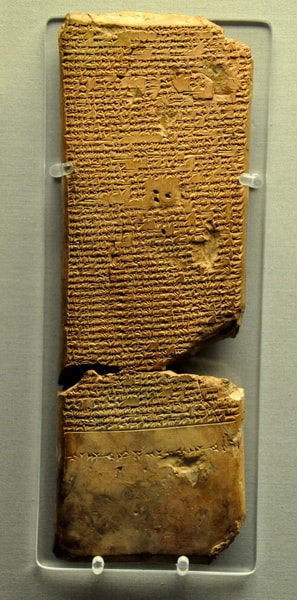
Upon Inanna’s arrival at the gates of Kurnugia, Ereshkigal, far from welcoming her sister, instructs her loyal gatekeeper Neti to enforce the strict laws of the underworld. At each of the seven gates, Inanna is commanded to shed an article of clothing or an ornament, systematically stripping her of her earthly power, status, and identity. By the time she stands before Ereshkigal’s throne, she is completely naked, vulnerable, and devoid of all earthly authority. The annuna, the venerable judges of the underworld, swiftly pass judgment against her, recognizing her guilt in Gugalanna’s demise. Ereshkigal, as the embodiment of this ultimate justice, executes her sister, transforming her into a "corpse, a piece of rotting meat," and hangs her on the wall as a stark reminder of the underworld’s immutable laws.
Inanna’s resurrection is not a triumph of her own, but a testament to the loyalty of her servant Ninshubur and the cleverness of the god Enki. Enki dispatches two androgynous demons, the galla, to the underworld. They find Ereshkigal in a state of profound distress, described as experiencing the pains of labor, her body uncovered, her hair dishevelled. The galla, following Enki’s precise instructions, empathize with her suffering. In gratitude, Ereshkigal offers them any gift they desire. They request Inanna’s corpse, which Ereshkigal, bound by her promise, grants. The galla revive Inanna with the food and water of life, but the underworld’s laws demand a replacement. Inanna, upon her return to the living world, selfishly chooses her consort Dumuzi, who must spend six months in the underworld, with his sister Geshtinanna taking his place for the other six. The poem concludes not with praise for Inanna, but with a powerful acclamation of Ereshkigal: "Holy Ereshkigal! Great is your renown! Holy Ereshkigal! I sing your praises!" This ending underscores the poem’s true message: Ereshkigal’s authority and the unyielding nature of cosmic justice.
The Marriage of Ereshkigal and Nergal: A Union of Realms
Ereshkigal’s solitary rule eventually gives way to a partnership with the war god Nergal. Multiple versions of their union exist, including a romantic seduction where Nergal visits the underworld, engages in seven days of lovemaking, departs, and then returns. However, the most detailed and influential version, found in texts from the Neo-Babylonian period (c. 626-539 BCE) and echoed in earlier fragments from Egypt (Amarna Letters, 15th century BCE) and Sultantepe (7th century BCE), paints a picture of divine manipulation orchestrated by Enki.
The story begins with the gods hosting a grand banquet, to which Ereshkigal cannot attend due to her inability to leave the underworld, and the other gods cannot descend without risking permanent entrapment. Enki devises a solution: Ereshkigal sends her son and messenger, Namtar, to collect her share of the feast. Upon Namtar’s arrival, all the gods respectfully rise, save for Nergal, who shows blatant disregard. Insulted, Namtar returns to Ereshkigal, who, furious at the disrespect shown to her and her realm, demands that Nergal be sent to the underworld for her to punish, even kill.
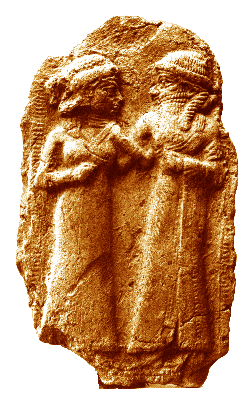
The gods, recognizing the legitimacy of Ereshkigal’s demand, acquiesce. Enki, however, foreseeing the outcome, secretly provides Nergal with fourteen demon escorts, two for each of the underworld’s seven gates. As Nergal descends, he strategically posts two demons at each gate, preventing them from being barred behind him. He confronts Namtar and Ereshkigal in her throne room, overpowering Namtar and dragging the queen to the floor, axe raised. Ereshkigal, in a desperate plea, offers herself as his wife and co-ruler if he spares her life. Nergal accepts, and their union is sealed with a kiss.
This myth, much like the Greek tale of Demeter and Persephone, explains the cyclical nature of seasons. Nergal, a god of war and pestilence, was often a disruptive force on Earth. Enki’s elaborate scheme is often interpreted as a clever way to temper Nergal’s destructive impulses by binding him to the underworld. Nergal’s ability to leave for six months of the year (due to his demons keeping the gates open and Ereshkigal’s consent) allows him to return to the surface, aligning with the seasonal occurrence of war and strife. Conversely, his absence for the other six months brings a period of relative peace, mirroring the agricultural cycles and the period of dormant earth.
The Burney Relief: A Glimpse of the Unseen Queen
Despite her paramount importance, universally agreed-upon iconography for Ereshkigal is remarkably scarce. This absence is a direct consequence of the profound fear she inspired. In Mesopotamian belief, creating an image of a deity was believed to invite the subject’s direct attention. While this was desirable for benevolent gods, invoking the Queen of the Dead was an act of extreme peril.
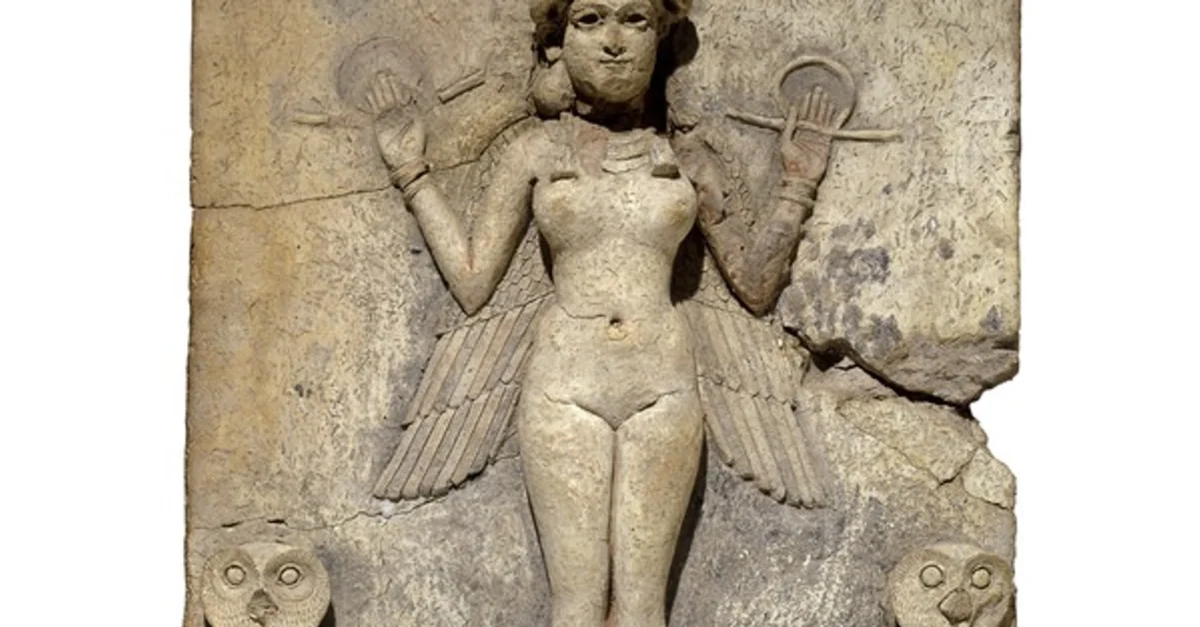
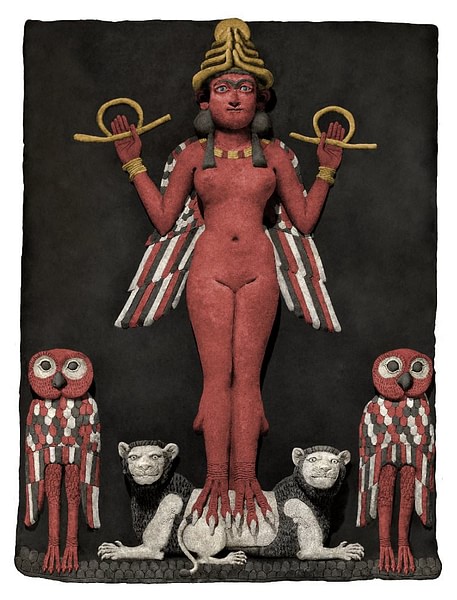
The most compelling candidate for Ereshkigal’s depiction is the Burney Relief, also known as The Queen of the Night, dating from the reign of Hammurabi (1792-1750 BCE). This terracotta relief portrays a naked, winged woman with downward-pointing wings, standing atop two lions, flanked by owls, and holding symbols of power. Images of mountains lie beneath the lions. The downward-pointing wings are a key identifier for underworld deities, and the association with nocturnal predators (owls) and powerful beasts (lions) speaks to her formidable nature. While some scholars debate whether it depicts Inanna or the demon Lilith, the strong chthonic symbolism, coupled with the era’s firm recognition of Ereshkigal as the underworld sovereign, makes her the most probable subject. The very rarity of such images underscores the ancient Mesopotamians’ reverence and apprehension towards their ultimate sovereign.
Official Responses and Societal Perceptions
The Mesopotamian fear of Ereshkigal was not merely superstitious dread but a fundamental aspect of their spiritual and moral framework. She was the ultimate enforcer of cosmic order, ensuring that the boundary between life and death remained inviolable. This role fostered a significant "cult of the dead" which, paradoxically, sought to appease Ereshkigal by caring for those within her realm.
Understanding that the dead subsisted on dust and muddy water, the living meticulously performed rituals, pouring fresh water and placing food upon tombs. These offerings were believed to trickle down to the mouths of the departed, providing comfort. Priests dedicated their lives to the cult of the dead, performing lamentations and dirges to console the deceased and reciting incantations to improve their lot in Ereshkigal’s dread kingdom. However, as scholar E. A. Wallis Budge notes, the deepest, underlying motivation for these "pious acts" was self-preservation: "The chief object of all such pious acts was to benefit the dead but underneath it all was the fervent desire of the living to keep the dead in the underworld. The living were afraid lest the dead should return to this world and it was necessary to avoid such a calamity at all costs."
Ereshkigal’s governance was a constant reminder to the living to lead righteous lives. Her realm was designed not only to keep the dead in but also the living out. While the deceased were generally expected to remain, the concept of a "ghost" or restless spirit was recognized. If a ghost appeared, it was rarely a random occurrence. Unless it was a rogue spirit that had somehow escaped Irkalla, its return was understood to be sanctioned by Ereshkigal, a sign that an injustice on Earth had gone unpunished or that proper burial rites or rituals of remembrance had been neglected. This reinforced Ereshkigal’s role as a guardian of justice, even extending her influence into the lives and moral conduct of the living.
Implications: The Enduring Legacy of the Underworld Queen
Ereshkigal’s significance extends far beyond her immediate mythological narratives. She represents an ancient and profound understanding of destiny, cosmic order, and the delicate balance between life and death. Her stories, while rooted in Sumerian and Akkadian traditions, touch upon universal human concerns about mortality, justice, and the consequences of actions.
Her unique position as the sole female ruler of the underworld in major ancient Near Eastern traditions highlights a crucial aspect of early Mesopotamian religious thought. In a world where patriarchal structures often dominated, Ereshkigal’s absolute authority over the ultimate destination speaks volumes about the power attributed to primordial feminine forces. Even as goddesses like Inanna/Ishtar were widely worshipped for fertility, war, and love, Ereshkigal commanded a different, more primal reverence, embodying the unyielding, inevitable end that awaits all.
The myths surrounding Ereshkigal, particularly The Descent of Inanna and The Marriage of Ereshkigal and Nergal, served not only as explanations for natural phenomena (like seasons or cycles of war) but also as moral allegories. They underscored the importance of humility, respect for divine law, and the inescapable consequences of hubris. Ereshkigal, in these narratives, is not merely a vengeful deity but a steadfast enforcer of the cosmic order, demonstrating that even gods must abide by fundamental rules.
Her influence, while not always overtly acknowledged in later Western traditions, can be seen in the very concept of a structured afterlife, where souls are judged and reside in a designated realm. The elaborate rituals and offerings to the dead, driven by the desire to appease the underworld’s sovereign, reveal a deep psychological engagement with mortality that continues to resonate in various forms today. Ereshkigal, the Queen of the Great Below, remains a powerful testament to the Mesopotamian genius for crafting a comprehensive and deeply spiritual worldview, where even in the darkest corners of existence, there was an unyielding, sovereign power ensuring order and eternal consequence.


Leave a Comment