
Heavy Gear Blueprint File: A Deep Dive into Dream Pod 9’s Visionary Aesthetics and Niche Utility
February 5th, 2002 – In an era of burgeoning tabletop role-playing games (RPGs), where immersive world-building and intricate mechanics vied for player attention, Dream Pod 9 consistently distinguished itself. Renowned for its commitment to visual excellence, the Canadian publisher carved a significant niche with its critically acclaimed game lines: Heavy Gear, Jovian Chronicles, and Tribe 8. Among its innovative array of supplementary products, the "blueprint files" stood out as a testament to the company’s dedication to tangible, high-quality visual aids. The Heavy Gear Blueprint File, originally reviewed in early 2002, serves as a quintessential example of this unique approach, offering fans a detailed, poster-sized glimpse into the iconic machinery of the Terra Nova setting. While lauded for its stunning artwork and potential for atmosphere-building, the product also sparked a perennial question among enthusiasts: beyond its undeniable aesthetic appeal, what was its practical utility at the gaming table?
This article revisits the Heavy Gear Blueprint File, exploring its historical context, delving into its meticulous design, analyzing its perceived value, and considering its lasting implications for both Dream Pod 9’s legacy and the broader RPG industry.
Main Facts: Unveiling the Blueprint File’s Core Identity
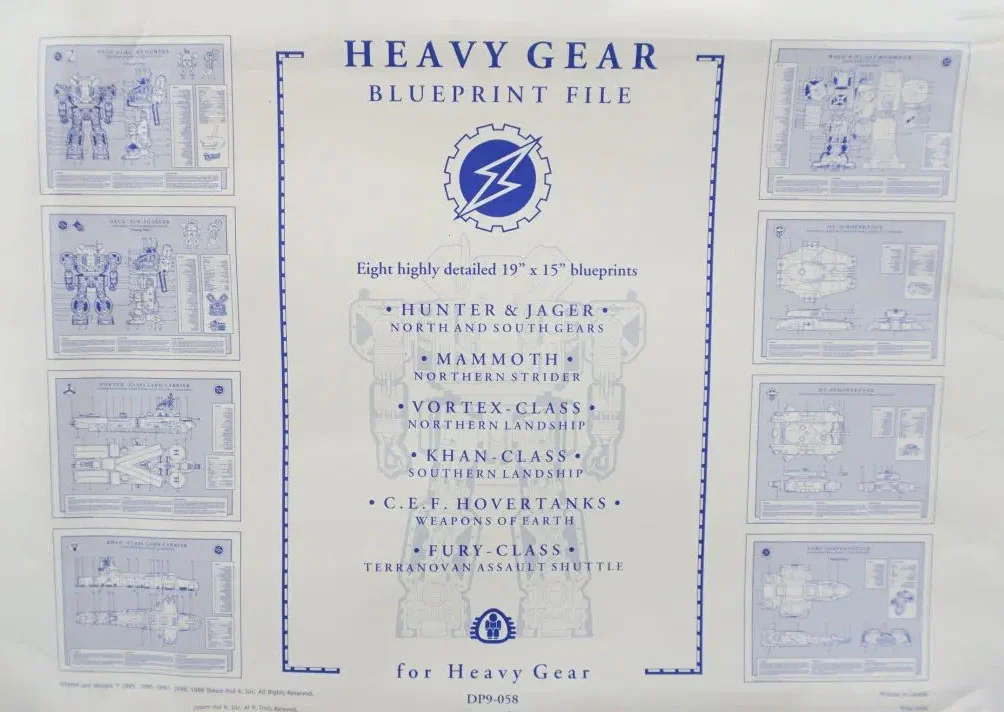
At its heart, the Heavy Gear Blueprint File is a meticulously crafted collection of eight large-format blueprints, each detailing a prominent vehicle or combat machine from the Heavy Gear universe. Released by Dream Pod 9 at a price point of $9.95 (Product Code: DP9-058), this supplementary product was not a rulebook or an adventure module, but rather a purely visual and atmospheric offering.
Each file arrived packaged in a simple yet informative 8.5” x 11” white envelope, the front of which served as both a title page and a miniature "table of contents." This ingenious design allowed prospective buyers to preview scaled-down versions of the eight blueprints contained within, mitigating any uncertainty about the product’s contents. Inside, folded neatly, were eight individual 19” x 15” (poster-sized) blueprints. These detailed schematics showcased a range of iconic Heavy Gear assets, including the ubiquitous Hunter gear, the formidable Jager gear, the colossal Mammoth strider, the majestic Vortex landship, the imposing Khan landship, the advanced CEF hovertank, and the sleek Fury-class assault shuttle.
Beyond intricate line art, each blueprint was enriched with supplementary background text, precise technical specifications, and explanatory passages, providing lore and functional details that deepened the understanding of these machines within the Heavy Gear narrative. The product’s primary appeal lay in its visual fidelity and the sheer tactile experience of unfolding a large, detailed schematic. While undeniably a collector’s item and a potential display piece, its practical application within actual gameplay remained a point of discussion, prompting the original reviewer’s candid query: "What the heck do you do with it?" This tension between exquisite aesthetics and niche functionality forms the central thesis of the Heavy Gear Blueprint File‘s enduring legacy.
Chronology: Dream Pod 9’s Journey and the Rise of Immersive Worlds
To fully appreciate the Heavy Gear Blueprint File, it’s essential to contextualize it within the history of Dream Pod 9 and the tabletop RPG landscape of the late 20th and early 21st centuries.
The Genesis of Dream Pod 9 and its Vision
Dream Pod 9, founded in Montreal, Canada, in 1995, quickly established itself as a publisher with a distinct vision. Unlike many competitors who focused solely on rules and lore, DP9 placed a strong emphasis on visual storytelling and high-quality artwork from its inception. The company’s founders, driven by a passion for science fiction and mecha anime, aimed to create rich, immersive worlds that were not just mechanically sound but also visually captivating. This commitment manifested in detailed illustrations, compelling character designs, and meticulously rendered vehicle schematics that became a hallmark of their products. Their debut titles, Heavy Gear (1995), Jovian Chronicles (1997), and Tribe 8 (1998), quickly garnered a loyal following, each offering a unique blend of narrative depth, intricate mechanics, and, crucially, stunning artwork.
Heavy Gear: A Universe Forged in Steel and Conflict
Among DP9’s triumvirate, Heavy Gear rapidly became its flagship property. Set on the distant desert world of Terra Nova, the game presented a gritty, realistic take on mecha combat, eschewing the fantastical elements often associated with the genre in favor of a more grounded, militaristic sci-fi aesthetic. Players commanded "gears" – bipedal combat vehicles – in a perpetual struggle between the Northern and Southern Leagues, with the enigmatic Colonial Expeditionary Force (CEF) looming as an external threat. The game’s success wasn’t just in its engaging tactical combat system (the "SilCORE" engine); it was equally in the depth of its lore, the political intrigue, and the believable design of its technology. Fans became "gearheads," obsessed with the nuances of each gear model, its specifications, and its role on the battlefield.
The Era of Physical Supplements: Expanding the Experience
The late 1990s and early 2000s marked a golden age for supplementary RPG products. Publishers sought innovative ways to expand their game worlds beyond core rulebooks. This period saw a proliferation of detailed maps, dedicated lore books, faction guides, and visual aids. Dream Pod 9, with its inherent artistic strengths, was uniquely positioned to excel in this market. Their "blueprint files" emerged as a particularly innovative offering, moving beyond traditional map packs to provide highly detailed technical drawings. These weren’t just illustrations; they were presented as in-universe documents, designed to immerse players deeper into the technological realism of Terra Nova. The blueprint files offered a tangible connection to the fictional world, a physical artifact that players could hold and examine, mirroring the meticulous detail that military enthusiasts might find in real-world technical manuals.
Evolution and Enduring Legacy
Heavy Gear‘s journey didn’t stop with the RPG. It spawned a popular miniatures wargame, several video games, and numerous later editions of the tabletop RPG, including Heavy Gear Blitz! and Heavy Gear Roleplaying Game. This continuous evolution underscored the enduring appeal of its universe and designs. The Heavy Gear Blueprint File, released during the game’s early ascendancy, became a relic of this vibrant period, a physical artifact from a time when print was king and high-quality supplementary products were eagerly sought by dedicated fans. Its existence also subtly foreshadowed the shift towards more visually rich gaming experiences, even as the digital age began to cast its long shadow over the industry.
Supporting Data: A Meticulous Examination of Form and Function
The Heavy Gear Blueprint File is a product best understood through a detailed dissection of its components and a critical evaluation of its multifaceted value propositions.
Unpacking the Package: Design and Contents
The presentation of the Heavy Gear Blueprint File was both practical and aesthetically pleasing. The 8.5” x 11” white envelope, while simple, served a crucial function. Its front cover not only bore the product title but also featured miniature representations of all eight blueprints housed within. This "table of contents" was a smart design choice, allowing consumers to immediately grasp the visual style and scope of the product without needing to open it. It served as a clear visual guide, eliminating ambiguity and catering to impulse purchases based on visual appeal alone.
Inside, the eight 19” x 15” blueprints were meticulously folded. The choice of subjects was strategic, covering a broad spectrum of Heavy Gear‘s iconic machinery:
- Hunter Gear: The quintessential "Gear" of Terra Nova, representing the workhorse combat vehicle that players most often piloted. Its inclusion was essential for any fan.
- Jager Gear: A heavier, more specialized Gear, showcasing the diversity and evolution of bipedal combat walkers.
- Mammoth Strider: Emphasizing the larger scale of combat, the Mammoth strider highlighted the multi-crew heavy assault vehicles that dominated certain battlefields.
- Vortex Landship: A mobile fortress, the Vortex underscored the massive scale of some engagements and the strategic importance of these land-based behemoths.
- Khan Landship: Another formidable landship, reinforcing the concept of vast, mobile bases of operation.
- CEF Hovertank: Representing the technologically advanced Colonial Expeditionary Force, this blueprint introduced variety in faction design and propulsion systems.
- Fury-class Assault Shuttle: Expanding beyond ground combat, the shuttle provided a glimpse into aerospace operations, demonstrating the comprehensive nature of the Heavy Gear setting.
Each blueprint was a masterclass in technical illustration. Rendered in classic blueprint style—often blue lines on a white background or white lines on a dark background—they presented multiple views (orthographic projections, cross-sections, cutaways), labeled components, and intricate mechanical details. Accompanying these visuals were blocks of background text, providing lore, design philosophies, and operational histories. Technical specifications, such as dimensions, weight, armament, and performance data, were clearly presented, grounding these fantastical machines in a believable, almost engineering-like reality. Explanatory passages further elucidated specific features or design choices, deepening the immersion. The overall effect was one of authentic military schematics, pulled directly from the archives of Terra Nova.
The Value Proposition: Aesthetic Appeal
The Heavy Gear Blueprint File‘s primary and most undeniable strength lay in its aesthetic appeal. Dream Pod 9’s reputation for "visual excellence" was not merely upheld but amplified by this product. These blueprints were, in essence, works of art for the "gearhead" and sci-fi enthusiast.
- Collector’s Item and Display Piece: Their poster size and detailed artwork made them "elegantly suitable for either framing or for actual reference." For dedicated fans, framing their favorite gear or landship blueprint and displaying it in an office, game room, or personal study was a natural impulse. They served as tangible manifestations of their passion, much like a limited-edition print or a prop replica from a beloved franchise.
- Ambience and Atmosphere: Beyond personal display, these blueprints could actively contribute to the gaming experience. As the original review noted, "displaying them on the walls of your game room will help add ambience and atmosphere to your Heavy Gear campaign." Surrounding players with these detailed schematics before or during a session could subconsciously deepen their immersion, making the fictional world feel more real and immediate. It’s a form of environmental storytelling, preparing the mental landscape for the adventure to come.
- Fandom Identity: Owning such a product was also a statement of fandom. It transcended simple gameplay to become part of a larger appreciation for the Heavy Gear universe as a whole. For many, collecting such items is an integral part of their engagement with a beloved intellectual property.
The Value Proposition: Gaming Utility
While the aesthetic value was clear, the practical gaming utility of the blueprints required more creative application, leading to the reviewer’s query, "What the heck do you do with it?" However, several valid uses existed:
- Props and Hand-outs: This was arguably their most direct in-game application. A Game Master (GM) could use a blueprint as a visual aid during a briefing, showing players the layout of a target landship they were about to infiltrate or the specifications of a new gear model they were assigned. Handing a player a detailed schematic of their character’s gear could enhance their connection to the machine and provide a visual reference for damage, repairs, or upgrades.
- Tactical Reference: While not providing rules, the detailed specifications could serve as quick in-character references. If players needed to know the exact dimensions of a Mammoth strider for a flanking maneuver or the weapon hardpoints of a CEF hovertank, the blueprints offered a visually engaging way to convey that information.
- Immersive Detail for Specific Scenarios: As highlighted in the original review, if an adventure was "based off of a landship – in which case the landship blueprints can become primary reference points for the campaign." Imagine a campaign where the players are part of the crew of a Khan landship, and having its blueprint unfurled on the table allows for detailed tactical discussions about deck plans, engineering sections, or armory locations. This elevates the game from abstract descriptions to tangible spatial awareness.
The Niche of "Nice-to-Have"
Ultimately, the Heavy Gear Blueprint File occupied a distinct niche within the RPG product spectrum. It wasn’t a "must-have" in the way a core rulebook or an essential adventure module was. Its utility was largely supplementary, enhancing immersion rather than driving mechanics. This led to the conclusion that its purchase was highly subjective: "Take a look at the cover in the store. If it looks like the type of product you’re going to get some use out of, pick it up. If not, don’t. You’re not going to be missing anything." This honest assessment underscored that while the product was of exceptional quality in its execution, its appeal was primarily to the dedicated enthusiast, the collector, and the GM willing to invest in enriching the atmosphere of their campaign. Its "Substance" rating of 4, compared to a "Style" rating of 5, perfectly encapsulated this balance: visually stunning, but functionally specific.
Official Responses: Dream Pod 9’s Enduring Design Philosophy
While no specific "official response" from Dream Pod 9 regarding the 2002 review exists, the Heavy Gear Blueprint File is a clear manifestation of the publisher’s long-standing design philosophy and their commitment to certain core tenets.
The Primacy of Visuals and Detail
From its inception, Dream Pod 9 prioritized visual aesthetics and intricate detail. This wasn’t merely a preference but a foundational principle that permeated all their product lines. They understood that for science fiction and mecha genres, the visual representation of technology, environments, and characters was paramount to establishing credibility and immersion. Products like the blueprint files were a direct extension of this philosophy. They weren’t just decorative; they were conceived as "in-universe" documents, designed to make the fictional technology of Terra Nova feel as real and meticulously engineered as possible. This approach fostered a deeper connection between players and the game world, allowing them to visualize the intricate mechanisms and impressive scale of the gears and landships they controlled.
Catering to the Enthusiast and Collector
Dream Pod 9 cultivated a loyal fanbase of "gearheads" and dedicated hobbyists. The publisher understood that this core audience appreciated depth, realism, and high-quality physical artifacts. The blueprint files, with their specialized content and premium presentation, were explicitly designed to appeal to this demographic. They recognized that a segment of their market valued collectible items that celebrated the intellectual property beyond just gameplay mechanics. These products contributed to a sense of ownership and pride among fans, reinforcing their identity as part of the Heavy Gear community. The relatively affordable price point ($9.95 in 2002) also made them accessible collectibles, allowing many fans to indulge their passion without a significant financial outlay.
Enhancing World-Building and Immersion
Dream Pod 9’s broader goal was always to create incredibly rich and believable worlds. The blueprint files served this objective by adding layers of verisimilitude. By providing detailed schematics and technical data, they empowered GMs to describe scenarios with greater precision and offered players a tangible reference point for their characters’ equipment. This focus on "show, don’t tell" through high-quality art and detailed supplementary materials was a hallmark of DP9’s approach to world-building. It allowed the company to craft settings that felt lived-in and fully realized, encouraging players to delve deeper into the lore and mechanics of Terra Nova. The blueprints were not just pictures; they were windows into the engineering and strategic thinking that underpinned the Heavy Gear universe.
A Testament to Craftsmanship
In an industry often driven by rapid production cycles, Dream Pod 9 consistently demonstrated a commitment to craftsmanship. The quality of the paper, the precision of the printing, and the artistic talent evident in the blueprint files all spoke to a dedication to producing excellent physical products. This commitment helped build and maintain the publisher’s reputation for visual excellence and solidified its position as a company that cared deeply about the presentation and quality of its game worlds. The blueprint files were, in essence, a tangible representation of Dream Pod 9’s artistic integrity and its desire to offer fans something truly special.
Implications: Legacy, Modern Relevance, and the Future of Physical Supplements
Two decades after its initial review, the Heavy Gear Blueprint File offers valuable insights into the evolution of RPG supplementary products, the enduring appeal of physical artifacts, and the challenges of niche market offerings in a rapidly digitizing world.
The Enduring Appeal of Physical Artifacts
In an age dominated by digital assets, PDFs, and virtual tabletops, the Heavy Gear Blueprint File serves as a poignant reminder of the unique value of physical products. There is an undeniable tactile pleasure in unfolding a large blueprint, tracing its lines, and absorbing its details. This experience cannot be fully replicated by zooming in on a digital image. For collectors, physical items possess an inherent scarcity and tangible presence that digital files lack. The "Heavy Gear keychain" mentioned by the original reviewer—a solid metal object cherished for years—perfectly encapsulates this human connection to physical memorabilia. The blueprint files tap into this same desire for tangible connection to a beloved fictional universe, becoming cherished items for those who own them.
Influence on RPG Design and Industry Standards
Dream Pod 9’s unwavering commitment to visual quality, exemplified by products like the blueprint files, arguably set a higher bar for the industry. While not every publisher could match DP9’s artistic output, their success demonstrated that detailed, high-quality artwork and supplementary visuals could significantly enhance a game’s appeal and immersion. This influence can be seen in the increased prevalence of high-quality art books, detailed maps, and visually rich campaign settings that are now common across the RPG landscape. DP9 showed that investing in the "look and feel" of a game was just as important as perfecting its mechanics.
The Collector’s Market and Vintage RPGs
Today, the Heavy Gear Blueprint File, along with other vintage Dream Pod 9 products, commands attention in the secondary collector’s market. Rare or well-preserved copies can fetch prices significantly higher than their original retail value, reflecting their status as sought-after artifacts from a bygone era of RPG publishing. This speaks to the enduring legacy of Heavy Gear and the nostalgic appeal of physical products from the "golden age" of tabletop gaming. For many, these items are not just game accessories; they are pieces of gaming history.
Modern Equivalents and the Digital Shift
In the contemporary RPG landscape, the "blueprint file" concept has largely evolved into digital formats. Publishers now offer high-resolution digital art packs, 3D models for virtual tabletops, and interactive maps that can be zoomed, layered, and annotated. While these digital tools offer unparalleled convenience and accessibility, they often lack the unique tactile and aesthetic appeal of a physical, poster-sized blueprint. The shift highlights a fundamental difference in consumption: immediate utility and widespread access versus curated, tangible immersion and collector value. Modern equivalents often prioritize gameplay functionality and ease of use, whereas the Heavy Gear Blueprint File leaned heavily into atmospheric immersion and fan appreciation.
The Future of Physical Supplements
The Heavy Gear Blueprint File raises a pertinent question about the future of niche, high-quality physical supplements. Is there still a viable market for products that prioritize aesthetic over immediate mechanical utility? The answer appears to be yes, albeit for a smaller, dedicated segment of the hobby. Limited-edition art books, elaborate map sets, and premium collector’s editions continue to find success, demonstrating that a desire for beautiful, tangible artifacts persists. Publishers who understand and cater to this niche can still thrive, proving that while digital is convenient, physical remains cherished.
In conclusion, the Heavy Gear Blueprint File stands as a unique and visually stunning product that perfectly encapsulates Dream Pod 9’s dedication to immersive world-building and artistic quality. While its practical in-game utility might have been specific and niche, its value as a collector’s item, an atmospheric enhancer, and a testament to a particular era of RPG publishing is undeniable. It remains a cherished item for those who connect with its aesthetic and thematic depth, a physical echo of a time when the detailed schematics of a Hunter gear or a Vortex landship could transport a player directly to the gritty, war-torn plains of Terra Nova.



Leave a Comment