
Go’s Grandest Online Showdown: Elite Professionals Clash in "Battle of the Sexes" to Redefine the Game’s Future
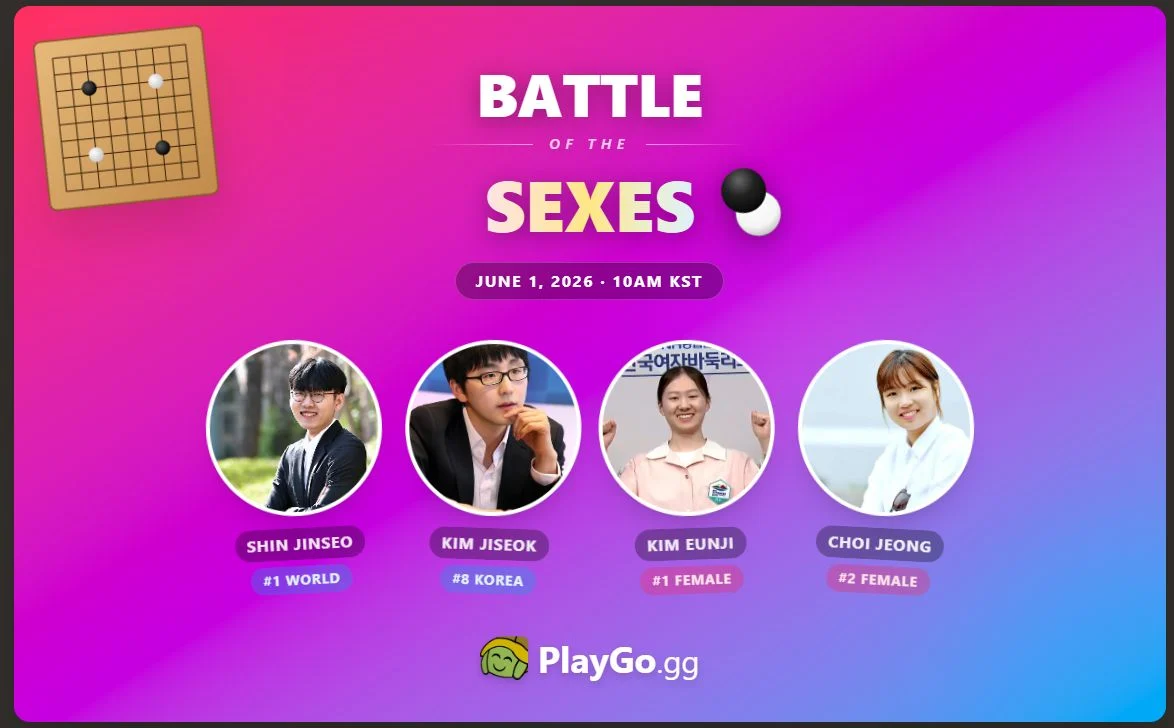
Seoul, South Korea – June 1, 2026 – The ancient game of Go, a bastion of strategic depth and intellectual prowess, is poised for a monumental moment as four of its most formidable professionals, two men and two women, prepare to face off in a high-stakes online tournament. Hosted live on PlayGo.gg, this highly anticipated event, provocatively titled the "Battle of the Sexes," aims not only to crown a champion but to dramatically showcase the rapidly diminishing gap between the very best male and female players in the world. Set against a backdrop of evolving dynamics in competitive Go, this tournament represents a significant cultural and sporting milestone, challenging long-held assumptions and heralding a new era of parity.
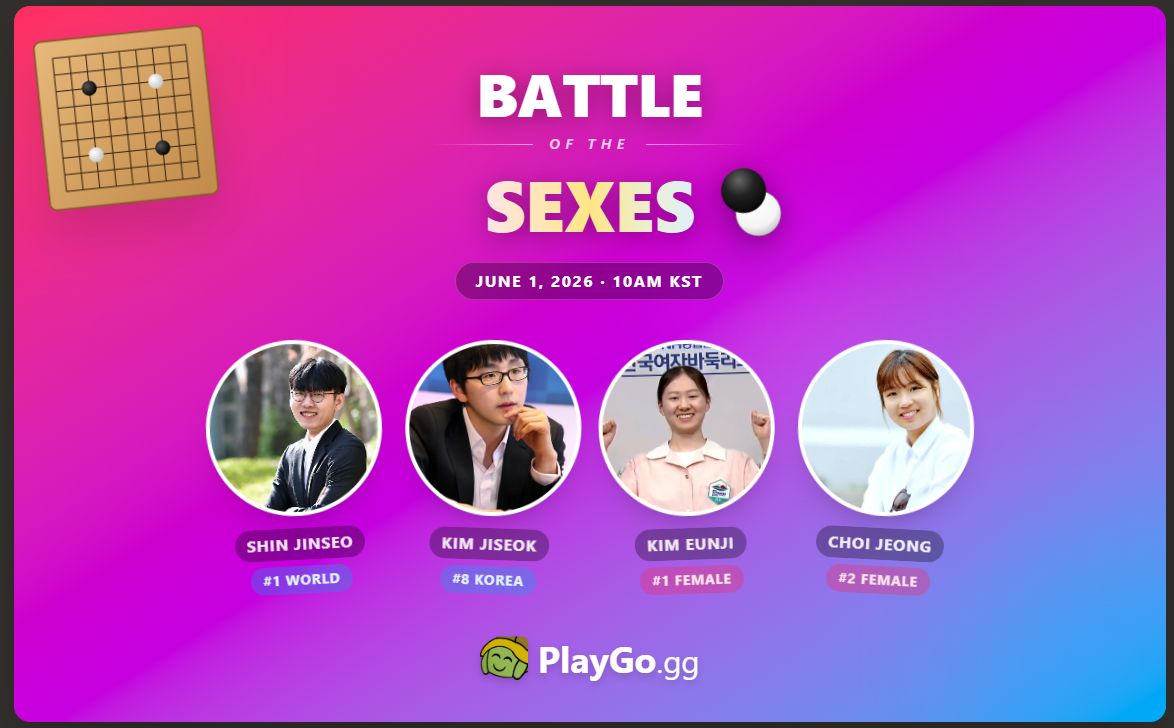
The digital arena of PlayGo.gg will be the stage for this unprecedented encounter, bringing together an assembly of talent that embodies both current dominance and future potential. The lineup features Shin Jinseo, widely considered the greatest Go player of all time; Kim Jiseok, a former Samsung Cup champion and seasoned national team captain; Choi Jeong, the most decorated female player in modern Go history and a trailblazer in mixed-gender competitions; and Kim Eunji, the prodigious 19-year-old who currently holds the title of world’s top female player. Their clash on June 1, 2026, promises not just thrilling strategic battles but a profound statement on the competitive evolution of a game deeply rooted in tradition.
While the moniker "Battle of the Sexes" might evoke a bygone era, its intention is decidedly forward-looking. As Eric Wainwright, Marketing Director at PlayGo.gg, explains, the event is meticulously crafted to highlight "the strategic depth and competitive evolution of Go, a classic strategy game that shares strong crossover appeal with Chess, Checkers and other board games." More critically, Wainwright emphasizes, "It also demonstrates how, with greater access to resources and opportunities, the very best female players in the world can now compete with the very best male players – a development that has not been the case until very recently." This tournament is thus more than just a competition; it is a live demonstration of progress, a testament to talent nurtured, and a vivid snapshot of Go’s dynamic present and future.
The Main Facts: A Landmark Event Unfolds
The "Battle of the Sexes" tournament, hosted by the premier online Go platform PlayGo.gg, is slated for June 1, 2026, and will be live-streamed globally. This four-player, double-elimination event brings together an elite quartet of professional Go players: two of the world’s top men, Shin Jinseo and Kim Jiseok, and two of the world’s top women, Choi Jeong and Kim Eunji. The primary objective, beyond the fierce competition for supremacy, is to underscore the significant advancements made by female players, illustrating how the historical performance gap between genders in professional Go is rapidly closing, if not entirely eradicated at the highest echelons.
PlayGo.gg, accessible via its website and YouTube channel (@PlayGo_gg), will serve as the central hub for spectators worldwide, with real-time commentary and expert analysis accompanying the live gameplay. Further engagement opportunities will be provided through a dedicated Discord channel, fostering a global community discussion around this historic event. The double-elimination format ensures that every player has a second chance through a lower bracket, guaranteeing maximum drama and strategic resilience will be tested before a grand champion is crowned.
The selection of these four particular players is deliberate, designed to showcase a spectrum of excellence and experience. Shin Jinseo, at 26, is an undisputed titan of the game, holding the world #1 rank for seven consecutive years and boasting nine international major titles. His presence signifies the ultimate benchmark in contemporary Go. Kim Jiseok, a highly respected veteran and a former Samsung Cup champion, adds a layer of seasoned strategic depth to the male contingent. On the female side, Choi Jeong is a living legend, having secured seven women’s major titles and, crucially, becoming the first woman to reach a mixed major final in 2022, defeating several top male professionals along the way. Completing the lineup is the phenom Kim Eunji, a mere 19 years old, who is not only the current world #1 female player but is already ranked within Korea’s top 20 overall, signaling a bright and transformative future for the game. This convergence of talent, experience, and groundbreaking achievement sets the stage for a truly unforgettable tournament, transcending mere competition to become a cultural touchstone for Go.
Chronology: Tracing the Path to Parity in Go
The journey to an event like the "Battle of the Sexes" is long, rooted in centuries of tradition and recent decades of profound change within the world of Go. Invented over 4,000 years ago in China, Go has historically been a deeply revered intellectual pursuit, often intertwined with philosophy, art, and strategy. For much of its history, particularly in professional and highly competitive circles, Go, like many intellectual and strategic games, was predominantly a male domain. Access to formal training, professional leagues, and top-tier competition was largely restricted or implicitly biased against women.
The professionalization of Go, primarily in East Asia (Korea, Japan, China) during the 20th century, saw the establishment of ranking systems, professional certifications, and prestigious tournaments. While a few pioneering women did break through, they often faced significant hurdles and were outliers rather than part of a robust female competitive landscape. The gap between the top male and female players was not merely observed; it was often treated as an immutable "fact of life," a natural consequence of perceived differences in competitive aptitude or sheer numbers.
However, the tide began to turn significantly in the late 20th and early 21st centuries. Increased societal recognition of gender equality, coupled with dedicated efforts within the Go community, led to a gradual but steady expansion of opportunities for female players. Women’s specific tournaments, such as the Women’s Myeongin and Women’s Guksu in Korea, and similar events in Japan and China, provided crucial platforms for female professionals to hone their skills, gain experience, and compete for substantial prize pools. These tournaments fostered a generation of strong female players, raising the overall standard of play.
A pivotal moment arrived in 2022 with Choi Jeong’s historic run. Her journey to the final of a major mixed-gender tournament was not just a personal triumph but a seismic event for the Go world. By systematically defeating established male titans like Ichiriki Ryo, Yang Dingxin, and Byun Sangil – players who consistently rank among the world’s best – Choi Jeong unequivocally demonstrated that the ceiling for female players was far higher than previously imagined. Her performance was a tangible, undeniable proof point that elite women could not only compete but could outright defeat the world’s top men. This single event served as a powerful catalyst, inspiring a new wave of aspiring female players and prompting a re-evaluation of gender dynamics at the highest levels of the game.
The rise of online Go platforms, exemplified by PlayGo.gg, further accelerated this shift. These platforms democratized access to high-quality opponents, advanced training tools, and global competition, irrespective of geographical location or traditional gatekeepers. They provided a fertile ground for talent to emerge and flourish, allowing young players like Kim Eunji to rapidly ascend the ranks, challenging established norms at an unprecedented pace. Kim Eunji’s current status as the world’s #1 female player at just 19, already making inroads into the overall top 20 in Korea, is a direct result of these evolving opportunities and a testament to the talent pipeline now available to women. The "Battle of the Sexes" tournament, therefore, is not an isolated event but a culmination of these historical shifts, a celebration of progress, and a bold statement about the future trajectory of Go. It is a moment where the game acknowledges its past, embraces its present, and confidently steps into a future where talent knows no gender.
Supporting Data: Evidence of a Shifting Landscape
The claims of a closing gender gap in Go are not merely aspirational; they are increasingly supported by compelling data points and the remarkable achievements of players like those competing in the "Battle of the Sexes." The very presence of Choi Jeong and Kim Eunji at this elite level, challenging male players widely regarded as the best in history, provides the most vivid evidence.
Player Profiles and Their Impact:
- Shin Jinseo (World #1, 7 years; 9 International Majors; 26 years old): Shin Jinseo represents the pinnacle of contemporary Go. His seven consecutive years as World #1 are a testament to unparalleled consistency and strategic genius. Known for his aggressive yet precise style, often referred to as "Shin’s Blitz," he has redefined the standards of professional play. His participation in this tournament is crucial; it means the female players are not facing lesser opponents, but the absolute gold standard, making any victory against him profoundly significant. His consistent dominance has pushed the entire professional circuit to evolve, making the challenge even greater for his opponents.
- Kim Jiseok (2014 Samsung Cup Champion; Former Korea National Team Captain): Kim Jiseok embodies the depth of top-tier male talent. His Samsung Cup victory is a major career highlight, and his eight years as captain of Korea’s national team speak to his leadership, experience, and strategic insight. He is a formidable opponent, known for his solid fundamentals and tactical acumen, ensuring that the male contingent offers a diverse and robust challenge.
- Choi Jeong (Most Decorated Female Go Player; 7 Women’s Majors; First Woman in Mixed Major Final): Choi Jeong is the living embodiment of the progress discussed. Her seven women’s major titles underscore her dominance within female-only competitions. However, her true impact resonates from her 2022 performance, where she became the first woman to reach a mixed major final. The list of male professionals she defeated – Ichiriki Ryo, Yang Dingxin, and Byun Sangil – are not just any players; they are consistently ranked among the world’s top 10-20, each with their own major titles and fierce reputations. Her ability to overcome such high-caliber opposition unequivocally demonstrated that gender is no barrier to reaching the absolute apex of Go strategy. Her fighting spirit and unwavering determination have made her a global icon, inspiring countless aspiring female players.
- Kim Eunji (Current World #1 Female; 19 years old; Ranked Top 20 in Korea): Kim Eunji represents the new wave. At just 19, her rapid ascent to the world #1 female ranking is extraordinary. Her inclusion in Korea’s overall top 20 signifies that her talent transcends gender-specific categories. Her youth and aggressive, innovative style mark her as a player with immense potential to further shatter records and cement the idea of true gender parity at the top of the game. Her presence illustrates that the pipeline for female talent is not only robust but producing world-class players at younger ages than ever before.
Statistical Trends and Broader Context:
Eric Wainwright’s observation that "Female participation, performance and prize pools globally have transformed over the last decade" is borne out by observable trends. While precise global statistics on professional Go are often granular and specific to national associations, the overall trajectory is clear:
- Increased Professionalization: More women are entering professional Go ranks across Korea, Japan, and China, benefiting from improved training infrastructure and youth programs.
- Rising Prize Pools: Women’s tournaments are seeing increased prize money, reflecting a greater investment and recognition of female talent. This incentivizes more players to pursue professional careers.
- Growing Visibility: High-profile matches involving female professionals, especially in mixed-gender events, are gaining more media attention and viewership, amplifying their impact and inspiring others.
- Online Platform Impact: Platforms like PlayGo.gg provide invaluable data on player strength, progress, and activity. This objective data helps to dismantle preconceived notions about gender-based performance ceilings by showcasing actual competitive results. The sheer volume of games played online offers unprecedented opportunities for practice and growth, accessible to anyone with an internet connection, irrespective of traditional barriers.
- AI Training Tools: The advent of sophisticated Go AI has democratized high-level training. Players of all genders now have access to powerful tools for analysis, game review, and strategic development that were previously only available through human grandmasters. This objective, unbiased training resource further levels the playing field, allowing talent to flourish based purely on dedication and analytical ability.
These combined factors provide a robust body of evidence supporting the narrative that the "Battle of the Sexes" is not a speculative experiment but a reflection of a genuine and ongoing transformation within the world of Go.
Official Responses: Voices from the Heart of the Game
The "Battle of the Sexes" tournament has garnered significant attention, prompting key figures within the Go community, particularly PlayGo.gg, to articulate the event’s profound significance. Eric Wainwright, Marketing Director at PlayGo.gg, has been particularly vocal in framing the tournament as more than just a competitive spectacle.
"This event matters because for most of Go’s history, the gap between the top male and top female players was treated as a fact of life," Wainwright stated, emphasizing the historical context. "But that fact is starting to change. Female participation, performance, and prize pools globally have transformed over the last decade, and the results on the board are starting to show it." This statement underscores PlayGo.gg’s commitment to acknowledging and celebrating this evolution, using their platform to provide tangible proof.
Wainwright elaborated on PlayGo.gg’s vision, highlighting how the platform itself facilitates this progress. "PlayGo.gg is not just a place to play Go; it’s a hub for competitive evolution. We believe that by providing accessible, high-quality online environments, we can unlock potential in players from all backgrounds. This tournament is a natural extension of that philosophy." He pointed to the game’s intrinsic qualities as a universal draw. "Go’s strategic depth appeals to a wide audience, much like Chess or Checkers. It’s a game of infinite possibilities, demanding intuition, calculation, and resilience. Seeing these attributes demonstrated by both male and female players at the absolute highest level is incredibly inspiring."
While direct quotes from the competing professionals are not yet available, their participation itself speaks volumes. Choi Jeong’s long history of challenging male dominance, culminating in her historic 2022 major final appearance, marks her as a standard-bearer for female aspiration. Her decision to compete in this event signifies her continued dedication to proving that talent transcends gender. One can infer her perspective might center on the importance of creating more such opportunities and inspiring the next generation of female players to pursue their dreams without limitation.
Similarly, Kim Eunji’s presence as the youngest competitor and current world #1 female player is a powerful statement. Her rapid rise and fearless approach to the game embody the potential unleashed by increased access and evolving mindsets. Her participation likely reflects a youthful confidence in her abilities and an eagerness to test herself against the absolute best, regardless of who they are.
From the male perspective, Shin Jinseo and Kim Jiseok’s willingness to engage in this "Battle of the Sexes" tournament is equally significant. It signals a recognition and respect for the rising strength of their female counterparts. For a player of Shin Jinseo’s stature, participating in such an event lends immense credibility to the premise that the competitive landscape is indeed changing. His presence implies that he views Choi Jeong and Kim Eunji as legitimate threats, not just as female players, but as formidable professionals in their own right. Kim Jiseok, as a respected veteran, brings a similar gravitas, acknowledging the evolving nature of the game he has dedicated his life to. Their engagement suggests a collective understanding within the professional Go community that the era of treating gender disparity as a "fact of life" is unequivocally over, replaced by an embrace of true meritocracy.
Collectively, these official responses and implied stances from the players themselves paint a picture of a Go community that is actively fostering inclusion, celebrating achievement, and using its most public stages to demonstrate a commitment to equality at the highest levels of competition.
Implications: Reshaping the Future of Go and Beyond
The "Battle of the Sexes" tournament on PlayGo.gg carries implications that extend far beyond the final score. This event is a powerful catalyst, set to reshape perceptions within the Go community and potentially influence broader discussions about gender equality in competitive intellectual pursuits worldwide.
Impact on the Go Community:
Firstly, the tournament will serve as an unprecedented source of inspiration for aspiring female Go players. Witnessing Choi Jeong and Kim Eunji compete on equal footing with titans like Shin Jinseo and Kim Jiseok provides tangible proof that the highest echelons of Go are accessible, irrespective of gender. This visibility can encourage greater female participation at all levels, from casual online play to dedicated professional training. The event will likely lead to a further breakdown of any lingering stereotypes within the Go community itself, fostering a more inclusive and equitable environment where talent is the sole arbiter of success.
Secondly, it will undoubtedly boost the global viewership and mainstream attention for Go. The unique narrative of challenging gender norms, combined with the sheer caliber of the players, makes for compelling viewing. This increased exposure can attract new fans to the game, potentially expanding its reach beyond its traditional East Asian strongholds and contributing to its growth as a legitimate esport. The discussions generated around the event will also enrich the Go discourse, pushing conversations about strategy, player development, and the future of the game into new territories. Furthermore, the success of this format could pave the way for more mixed-gender tournaments at the highest level, making such encounters a regular feature rather than a groundbreaking exception.
Broader Societal Implications:
Beyond the immediate world of Go, this tournament functions as a powerful microcosm for gender equality in competitive fields generally. Go, an ancient game demanding profound strategic thinking, intuition, and mental fortitude, has often been seen as a pure test of intellect. By demonstrating parity at its apex, the "Battle of the Sexes" offers a compelling counter-narrative to any lingering societal biases about inherent gender differences in cognitive abilities for complex tasks. It underscores the critical importance of equal access to resources, training, and opportunities as the primary driver of competitive outcomes, rather than innate biological differences.
The event highlights the role of sports and games as powerful platforms for challenging stereotypes and promoting social change. Just as breakthroughs in other sports have broadened perspectives on physical capabilities, this Go tournament can shift perceptions regarding intellectual competitive prowess. It reinforces the message that given the same support and pathways, women can achieve and surpass levels previously thought to be exclusive to men.
Future of Go and Online Platforms:
The tournament also underscores the transformative role of online platforms like PlayGo.gg in the future of competitive Go. By hosting such a high-profile event online, PlayGo.gg not only democratizes access for players and spectators globally but also showcases the potential for Go to thrive in the digital age. Online play removes geographical barriers, allowing for diverse talent pools to emerge and for players to compete against a wider array of opponents, accelerating skill development.
Moreover, the increasing sophistication of Go AI for training and analysis will continue to level the playing field. These unbiased digital mentors provide objective feedback and strategic insights, allowing any dedicated player, regardless of their background or access to human coaches, to refine their game. This technological advancement further emphasizes that talent and dedication, rather than external factors, will increasingly define success in Go.
In conclusion, the "Battle of the Sexes" is more than just a Go tournament; it is a landmark event marking a pivotal moment in the game’s long history. It is a celebration of evolving talent, a testament to the power of inclusion, and a clear signal that the future of Go is one of fierce, equitable competition where the only thing that matters is the brilliance of the stones on the board. As the world watches on June 1, 2026, the strategic battles played out will not only crown a champion but will irrevocably redefine what is possible in the timeless game of Go.




Leave a Comment