
Honoring Sacrifice: A Deeper Look into Memorial Day and the Enduring Legacy of Service
By James Scott Bell, @jamesscottbell
As Memorial Day weekend descends upon the nation, a familiar tapestry of tradition unfolds. Barbecues will ignite, the aroma of grilled delicacies will fill the air, and the joyous sounds of children at play will echo. Yet, amidst this vibrant celebration of summer’s unofficial start, lies a profound opportunity and a solemn responsibility: to imbue this holiday with its true meaning, particularly for the younger generations. Memorial Day is not merely a day off; it is a sacred observance dedicated to remembering and honoring those who made the ultimate sacrifice in service to our nation.
The origins of this poignant commemoration are deeply rooted in the ashes of the American Civil War. In the aftermath of that devastating conflict, a nation grappling with immense loss began a quiet ritual of remembrance. Citizens would venture to the graves of fallen soldiers, adorning them with flowers and wreaths, a tender gesture of respect and grief. This practice, initially known as "Decoration Day," was formally recognized by proclamation, with May 30th designated as the day of observance. By the close of the 19th century, the term "Memorial Day" gained traction, reflecting a broader sentiment of commemorating all who died in military service. Congress officially adopted this designation, eventually establishing the last Monday in May as the federal holiday we observe today.
Echoes of Courage: Personal Legacies of Service and Sacrifice
The weight of heroic deeds in times of war often evokes a deep emotional response, and for many, this connection to sacrifice is woven into the very fabric of their family history. For James Scott Bell, the author of this reflection, the lineage of service stretches back to the earliest days of American independence. His ancestor, William Bell, a tailor by trade, arrived on American shores from County Armagh, Ireland, in the 1760s. Settling in Philadelphia, he established a business that would soon intersect with the nascent nation’s struggle for freedom.
During the harrowing winter encampment of the Continental Army at Valley Forge, a critical juncture in the Revolutionary War, William Bell was called upon to serve his country in a unique capacity. His brother, John Bell, was a soldier under the command of General George Washington. Recognizing the dire need for essential supplies and a functional uniform for his brother, William set to work crafting an officer’s attire. However, Philadelphia was under British occupation, its borders strictly guarded by sentinels, making any movement of goods or personnel towards the beleaguered Valley Forge, a mere thirty miles away, an almost impossible feat.
It was John Bell’s wife, a woman whose quiet bravery would become a cornerstone of this family narrative, who devised an ingenious solution. While William meticulously worked on the uniform, she began a series of clandestine journeys. Posing as an ordinary woman engaged in her daily errands, she would walk past the watchful British sentinels, her basket laden with seemingly innocuous sundries. Each trip allowed her to procure much-needed groceries and other provisions. When the uniform was finally complete, she undertook a daring act of defiance. Concealing the finely tailored garment between her skirts and petticoats, she once again approached the guarded perimeter. With a practiced nonchalance, she passed the sentinel, her basket carrying its usual contents. This time, however, her path diverged. She continued her journey, walking the arduous thirty miles to Valley Forge, a silent testament to her courage and devotion, delivering both sustenance and the vital uniform to her husband. This act of remarkable resourcefulness and unwavering loyalty highlights the often-unsung contributions of women during times of conflict, their quiet determination playing a crucial role in the larger narrative of freedom.
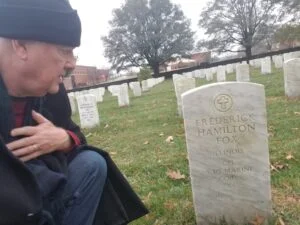
The thread of military service continued through subsequent generations. James Scott Bell’s great-great-grandfather, James Winfield Scott, served under General William Tecumseh Sherman during the tumultuous campaigns of the Civil War. His grandfather, Arthur Scott Bell, answered the call to duty in World War I, serving in the Army. The family’s connection to sacrifice was further deepened by his great-uncle, Frederick Hamilton Fox, a Marine who tragically fell in the brutal Battle of Belleau Wood. His final resting place is the hallowed ground of Arlington National Cemetery, a poignant reminder of the immense cost of freedom.
The author’s personal connection to the weight of war is further illustrated by his literary pursuits. He identifies his book, Glimpses of Paradise, as his proudest achievement, not only for its scope and the dedication it demanded but also for its poignant exploration of the World War I era. The novel, which begins in 1916 Nebraska and concludes in the glittering landscape of 1920s Hollywood, features a significant World War I sequence. However, Bell candidly admits to never having experienced the visceral realities of battle himself. This raises a fundamental question for any writer: how does one authentically portray experiences that lie outside the realm of personal lived reality?
The Craft of Remembrance: Bridging the Gap Between Experience and Narrative
Bell’s approach to this challenge underscores a core tenet of responsible storytelling: the pursuit of accuracy and empathy, even in the absence of direct experience. He articulates a powerful philosophy: "I believe a writer should be free to write about any kind of character or experience, so long as they make the effort to get things right." This commitment to diligent research, meticulous detail, and a deep dive into the emotional and psychological landscape of his subjects is paramount.
For Glimpses of Paradise, this meant immersing himself in the historical context of World War I. It involved extensive research into military tactics, the daily lives of soldiers, the psychological toll of trench warfare, and the societal impact of the conflict. It required understanding the sights, sounds, and smells of the battlefield, not through personal memory, but through the collective memory preserved in historical accounts, letters, diaries, and photographs. The goal is not to claim the experience as one’s own, but to honor the truth of those who lived it, to translate their sacrifices and struggles into a narrative that resonates with authenticity and emotional truth.
The author’s personal connection to this theme is further amplified by a visual element accompanying his reflection: a photograph of a gravestone. While the caption simply states "Ted Fox grave," the implied connection to his great-uncle Frederick Hamilton Fox, who died in the Battle of Belleau Wood and is buried at Arlington, lends a profound weight to this image. It serves as a tangible, silent witness to the sacrifices made, a stark reminder of the individual lives that comprise the vast numbers we commemorate on Memorial Day. The photograph acts as a powerful anchor, grounding the abstract concept of national sacrifice in a concrete, personal reality.
A Continuum of Sacrifice: From Revolutionary Resolve to Modern Conflicts
The historical narrative of Memorial Day is inextricably linked to a continuum of American military engagement. The bravery displayed by William Bell’s sister-in-law during the Revolution, risking her life to deliver essential aid, is a precursor to the countless acts of courage and selflessness that have defined American service throughout its history. From the desperate struggles of the Civil War, which birthed the initial observances, to the global conflicts of the 20th and 21st centuries, the willingness of individuals to put their lives on the line for the ideals of freedom and security has remained a constant.
The author’s own family history illustrates this enduring legacy. The Civil War service of James Winfield Scott, the World War I enlistment of Arthur Scott Bell, and the ultimate sacrifice of Frederick Hamilton Fox at Belleau Wood are not isolated incidents but threads in a larger tapestry of national commitment. Each generation has faced its own unique challenges and threats, and each has responded with a spirit of duty and a willingness to bear arms in defense of the nation.
The Battle of Belleau Wood, in particular, stands as a stark testament to the ferocity of World War I and the extraordinary courage of the Marines who fought there. The battle, which took place in July 1918, was a pivotal moment in the Allied offensive against the German forces. The Marines, despite facing relentless artillery fire and machine-gun attacks, fought with unparalleled tenacity, earning the nickname "Teufel Hunden" (Devil Dogs) from the Germans. The immense casualties sustained by both sides underscore the brutal reality of modern warfare and the profound personal cost of such conflicts. The fact that Frederick Hamilton Fox is buried at Arlington National Cemetery signifies that his sacrifice, like those of so many others, is recognized and honored at the highest level of national remembrance.
The Enduring Call to Remember: Beyond the Holiday Weekend
As the author poses the question, "What about you?", he extends an invitation to every reader to engage with the true spirit of Memorial Day. It is a call to move beyond the superficial trappings of the holiday and to delve into the profound historical and personal narratives that underpin it. This requires an active effort to educate ourselves and the younger generations about the sacrifices made, not as a somber obligation, but as an essential act of civic duty and human gratitude.
The implications of this remembrance are far-reaching. By understanding the sacrifices of those who came before us, we gain a deeper appreciation for the freedoms we enjoy. We recognize that these liberties were not freely given but were earned through the blood, sweat, and tears of countless individuals. This understanding fosters a sense of responsibility to uphold these ideals and to protect the nation that those sacrifices secured.
Furthermore, acknowledging the experiences of soldiers and their families, even through the medium of literature, helps to humanize the abstract concept of war. It reminds us that behind every statistic, every casualty count, there is a story, a life, a family left behind. It encourages empathy and a more nuanced understanding of the complexities of conflict and its enduring impact.
In conclusion, Memorial Day is a powerful reminder of the debt we owe to the men and women who have served and sacrificed for our nation. It is a day to pause, to reflect, and to honor their courage, their dedication, and their ultimate devotion. As we gather for our traditional observances, let us also commit to fostering a deeper understanding of Memorial Day’s true meaning, ensuring that the legacy of sacrifice continues to inspire and inform generations to come. The stories of individuals like William Bell’s sister-in-law, James Winfield Scott, Arthur Scott Bell, and Frederick Hamilton Fox are not just historical footnotes; they are the bedrock upon which our nation’s freedoms are built, and their memory deserves to be cherished and perpetuated.




Leave a Comment