
"Kiraz: The Lost City" – A Deep Dive into HârnWorld’s Dwarven Epic and a Contentious Design Philosophy
FOR IMMEDIATE RELEASE
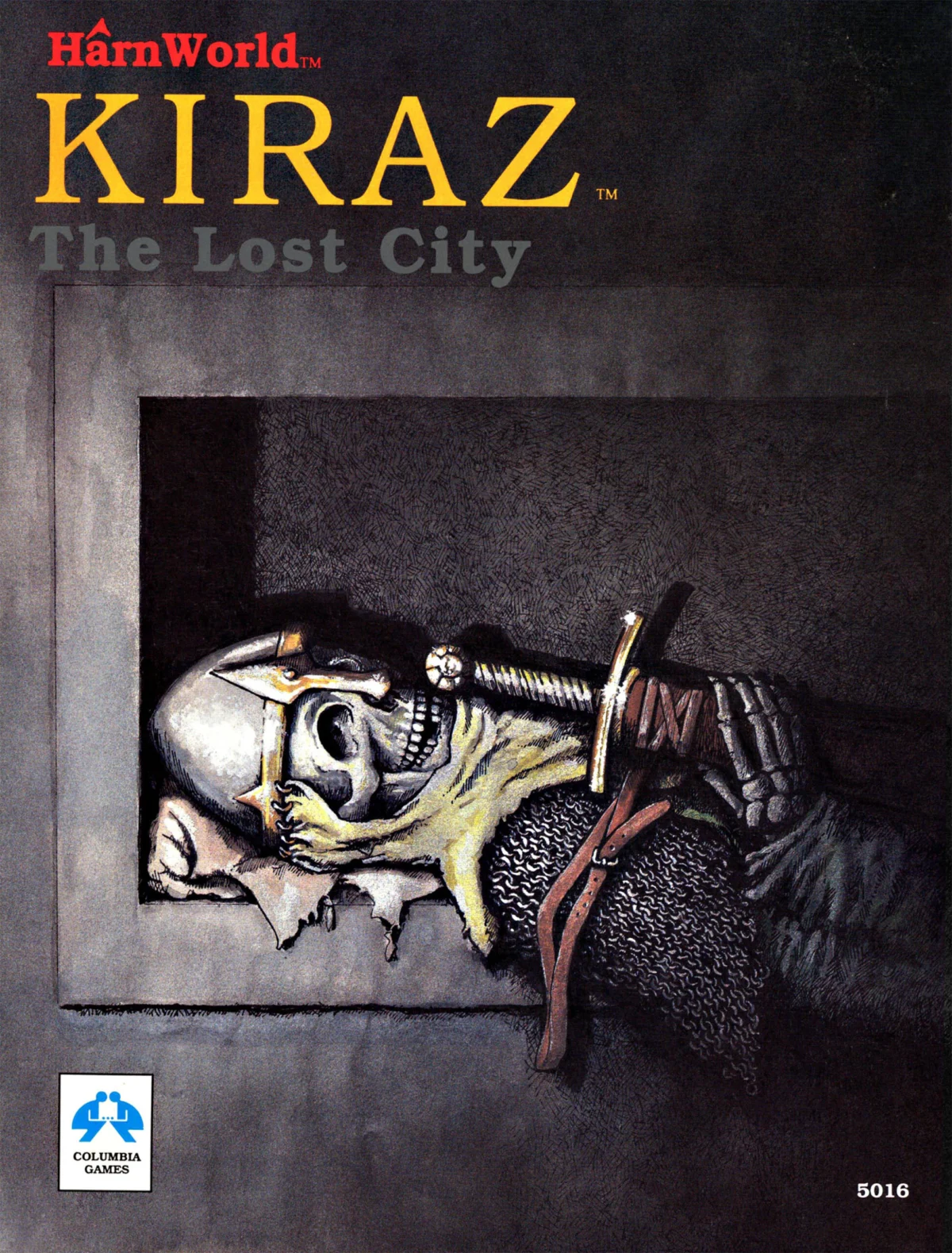
HârnWorld’s "Kiraz: The Lost City" remains a pivotal yet perplexing artifact in the annals of tabletop role-playing game design. Originally published in 1989 by Columbia Games, and subjected to a critical re-evaluation in 2001, this module stands as a testament to both exceptional world-building and a controversial approach to supplement creation. Billed as the second adventure in the In Search of Panaga trilogy, it predominantly functions as a sourcebook for the titular lost dwarven city, Kiraz. However, its enduring legacy is less about its narrative completeness and more about the profound paradox at its heart: a meticulously crafted, utterly captivating setting presented with such sparsity that it leaves game masters (GMs) simultaneously inspired and deeply unsatisfied.
The Core Revelation: Unearthing Kiraz’s Enduring Legacy and Lingering Critique
Kiraz: The Lost City invites players and GMs alike into the majestic, yet tragic, remnants of Hârn’s oldest dwarven citadel. Authored by the venerable N. Robin Crossby, the module promises a delve into a bygone era of dwarven grandeur, now scarred by centuries of abandonment and orcish encroachment. What it delivers, according to a seminal review from October 10th, 2001, is a tantalizing glimpse, a meticulously detailed skeleton of a world begging to be fleshed out. The reviewer famously encapsulated this experience with the poignant metaphor: "It’s like starving yourself for three days, and then eating a pecan. Kiraz makes you hungry for information, but leaves you unsatisfied when all is said and done."
This sentiment captures the essence of the Kiraz experience. The module excels in its foundational elements: breathtaking maps, logical city layouts, and a rich, evocative history. These aspects are universally lauded, painting a vivid picture of a once-thriving civilization. Yet, the overwhelming consensus, echoed since its initial release and through subsequent re-evaluations, points to a glaring deficiency: the vast tracts of information conspicuously absent. This isn’t merely a matter of brevity; it’s a design philosophy that intentionally leaves significant gaps, ostensibly to empower GM customization, but practically, to impose an unforeseen burden of creative development. The module, therefore, represents a unique intersection of brilliant conceptualization and a contentious execution, challenging long-held expectations of what a published RPG supplement ought to provide.
A Journey Through Time: The Genesis and Review of Kiraz
The story of Kiraz: The Lost City is intertwined with the rich tapestry of the HârnWorld setting and the evolving landscape of tabletop RPG publishing. To fully appreciate its impact, one must first understand its origins and the context of its critical reception.
HârnWorld’s Enduring Lore
HârnWorld, created by N. Robin Crossby and published by Columbia Games, stands as a titan among fantasy RPG settings. Known for its rigorous realism, meticulous detail, and low-fantasy tone, Hârn offers a world steeped in medieval history, complex political intrigue, and gritty survival. Unlike many high-fantasy settings, Hârn eschews overt magic and fantastical races in favor of a believable, dangerous, and internally consistent world. Columbia Games, a Canadian publisher, has been a steadfast purveyor of this unique vision, consistently delivering high-quality, if often challenging, supplements that expand the Hârnic universe. N. Robin Crossby, the visionary behind Hârn, was celebrated for his unparalleled commitment to verisimilitude and his ability to craft worlds that felt genuinely lived-in. Kiraz emerged from this fertile ground, promising a deep dive into the dwarven lore that is integral to Hârn’s history.
Publication and Reception
Kiraz: The Lost City first saw publication in 1989, a period in RPG history marked by burgeoning creativity and diverse design philosophies. Modules from this era often varied wildly in their approach to detail, sometimes offering comprehensive narratives and others providing more open-ended frameworks. The original review, published more than a decade later in October 2001, reflects a slightly more mature industry, one where GMs had grown accustomed to a certain level of completeness in their purchased supplements. The re-evaluation in 2001 also occurred during a significant shift towards more structured adventure paths and detailed campaign settings, particularly with the rise of D20 system products that often aimed for exhaustive content. This temporal gap between publication and review highlights a tension: Kiraz was perhaps a product of its time in some respects, but its core design choice remained contentious even by the standards of its release.
The In Search of Panaga Trilogy
Adding another layer of complexity, Kiraz was positioned as the second installment in the In Search of Panaga trilogy of modules. This framing initially suggests a coherent narrative arc, with Kiraz serving a crucial middle chapter. However, as the original reviewer noted, the product’s primary utility and bulk lay in its sourcebook content for the lost city itself, rather than its function as a linear adventure. Author N. Robin Crossby himself acknowledged this dual purpose in his preface, stating, "It was like this: Columbia wanted me to do Kiraz, and I wanted to complete the next volume of In Search of Panaga. Both modules were late. So, I thought, why not set the Horns of Ikarus in the Lost City?" This pragmatic decision, born out of a need to consolidate projects, inadvertently shaped Kiraz into a hybrid product, one whose strength as a setting guide ultimately overshadowed its role as an adventure module. The reviewer’s admission of being "largely unqualified to review the adventure portion" due to lacking the other trilogy parts underscores this inherent design compromise.
Deconstructing the Module: Content and Critique
The 28-page module of Kiraz: The Lost City is neatly divided into three primary articles: Kiraz (14 pages), Ushet (4 pages), and Horns of Ikaras (5 pages), supplemented by two pages of full-color illustrations and two blank "GM Notes" pages. A granular examination of each section reveals the brilliance of Crossby’s world-building alongside the frustrations of his design philosophy.
The Kiraz Sourcebook: A Glimpse of Dwarven Grandeur
The eponymous "Kiraz" section forms the undisputed core of the module, comprising half of its total page count. It delves into the harrowing history and intricate geography of the oldest dwarven citadel in Hârn.
-
Historical Context: The narrative begins approximately six centuries prior to the current Hârnic era, detailing Kiraz’s golden age as the zenith of dwarven civilization. This prosperity was brutally interrupted by Lothrim the Foulspawner, whose orcish armies laid siege to the city, ultimately leading to its devastating fall. Though the dwarves eventually exacted their vengeance upon Lothrim, the trauma of the "Carnage of Kiraz" led them to seal away the city’s halls, transforming it into a somber monument to lost glory. Today, the vast majority of its ancient passages lie deserted, save for the lower levels where orcish incursions have begun to break through the ancient seals. This tragic history provides a compelling backdrop for any adventure.
-
Architectural Marvels: The sourcebook dedicates significant attention to the physical layout of Kiraz. Three pages are spent on its general history and the surrounding area, followed by a cut-away map of the entire complex and a one-page summary of its major features. The subsequent pages then meticulously detail several key areas within the city, each accompanied by specific maps and concise summaries:
- The High Halls: The seat of power, encompassing the Great Hall, Royal Apartments, and the Council Chamber—once vibrant hubs of royal authority and governance.
- Gallreda Complex: A residential area for high-ranking officials, including the Hall of Galreda and the Hall of Zelanthu, hinting at the structured society that once flourished here.
- West Gate: The primary entrance, a testament to dwarven engineering and defense, now likely a dangerous chokepoint.
- Ranzad Complex: The bustling marketplace and social heart of Kiraz, described as its largest cavern, offering tantalizing possibilities for exploration and hidden treasures.
- Minehead: As its name implies, this was the industrial engine of the city, featuring workshops, ore storage, and access to the rich veins that fueled dwarven prosperity.
- The Catacombs: Not merely communal graves, but also the sacred Royal Tombs. This section highlights the Hall of the Godstone, an ancient earthmaster site predating even dwarven civilization, considered the birthplace of Hârn’s Khuzdul (dwarves). This location offers profound lore implications and potential supernatural encounters.
-
Reviewer’s Praise: The quality of this material is unequivocally praised. The reviewer exclaims, "All of the material which is found here is excellent. Beyond par. The maps are beautiful and superbly executed. The logic and detail of the city is meticulous: Crossby refuses to simply wave his hands in the construction of this city; instead insisting that the city make sense." This insistence on realism and internal consistency is a hallmark of Crossby’s design, making Kiraz feel like a truly plausible, if fantastical, location. The achievement, the reviewer notes, is that "you will have the sense that a place like Kiraz really could exist. This is, by no means, a small or unvaluable accomplishment."
-
The Gnawing Absence: However, this profound admiration is immediately tempered by the module’s most significant flaw: "The problem with this supplement is not the quality of what is present, but the vast amounts of information which is — quite literally — missing." Despite the detailed maps and historical snippets, the specific inhabitants, challenges, treasures, and interactive elements that bring an RPG location to life are largely absent. This leaves a meticulously drawn blueprint without the furniture, inhabitants, or narrative threads to populate it.
Ushet: The Gateway and the Template
The four-page "Ushet" article focuses on the Rock of Ushet, a former dwarven hunting lodge once connected to Kiraz via spent mining tunnels. Following the fall of Kiraz, its entrance was sealed, only to be recently breached by orcs who have now taken up residence.
This section serves a dual purpose. Firstly, Ushet acts as the designated point of entry to Kiraz for characters embarking on The Horns of Ikaras adventure. Secondly, and perhaps more importantly, Ushet is presented as a generic template for the numerous other dwarven hunting lodges scattered across the region. These lodges are sites of ongoing conflict between various barbarian tribes, both orcish and human. The module provides enough solid detail to make Ushet a functional location, whether used specifically or as a blueprint for other sites. The reviewer notes, "There’s nothing phenomenal in this section — but it’s all solid material, and very useful as either a specific or generic resource." This section, while brief, is a practical and well-executed component of the module.
Horns of Ikaras: An Outline, Not an Adventure
The "Horns of Ikaras" section, at five pages, is the adventure component of the module and the part that garnered the most significant criticism. The reviewer, despite not having played the preceding part of the trilogy, found himself "thoroughly unimpressed by what I see here."
The core issue is that Horns of Ikaras functions more as a skeletal outline than a fully fleshed-out adventure. It includes a one-page summary of events from the first adventure, a page describing the NPC who provides the adventure hook, a page of player handouts, and a brief one-page summary of the adventure itself. This minimalist approach leaves GMs with little actionable content. The adventure’s progression is distilled to its barest essentials: "Several months have passed since the last adventure. The PCs should have heard some rumors about the Big Bad Guy’s activities (kidnapping three beautiful women, stealing some rare animals, and burning town officials in Aleath). They go to Kiraz — most likely gaining entrance via Ushet — where they need to find a key to gain access to the room where the Horn is kept." This level of summarization places the entire burden of development, encounter design, and narrative pacing squarely on the GM’s shoulders, transforming a purchased adventure into a personal design project.
The Publisher’s Stance vs. The Game Master’s Reality
The critical reception of Kiraz is inextricably linked to Columbia Games’ stated design philosophy, a policy that, while intending to empower GMs, inadvertently became the source of much frustration.
The "Design Methodology": Empowering Customization or Imposing Labor?
Columbia Games explicitly articulated their approach: "In keeping with our long term policy, there is lots of room for the GM to customize his own version of the Golden City — even if a player should get hold of a copy of this module, it won’t help him much." This policy suggests a deliberate choice to provide a framework rather than a complete product, arguing that it fosters creativity and prevents "player spoilers."
However, the reviewer, representing a significant portion of the GM community, vehemently disagrees with this rationale. "Folks, this just doesn’t cut it for me. The whole point of buying a supplement is so that I don’t have to do design work." He elaborates that while preventing player meta-gaming is a "laudable goal," GMs are perfectly capable of altering information themselves. More crucially, he points out that "changing and rearranging information is vastly easier than being forced to create material out of wholecloth." This highlights a fundamental disconnect between the publisher’s vision and the practical needs of a busy GM. A supplement is typically purchased to reduce preparation time, offering fully developed content that can be integrated with minimal effort. Kiraz, by design, demands significant additional effort, essentially selling a framework rather than a finished product.
Industry Perspectives on Supplement Design
The debate surrounding Kiraz‘s design methodology is not unique to this module but reflects a broader, ongoing discussion within the RPG industry. Different publishers and designers champion various approaches:
- Sandbox vs. Railroad: Some modules provide vast, open-ended settings (sandboxes) with minimal plot, allowing GMs to craft their own narratives within them. Others offer highly structured, linear adventures (railroads) with pre-determined encounters and outcomes. Kiraz attempts to be a sandbox sourcebook, but its lack of detail even for a sandbox makes it challenging.
- GM Empowerment vs. GM Burden: The core of the Kiraz debate lies here. While "GM empowerment" sounds appealing, when it translates to creating vast swathes of content from scratch for a paid product, it quickly becomes a "GM burden." Modern supplements often strive for a balance, providing rich detail while still offering hooks and suggestions for GMs to personalize their campaigns.
- Evolution of Expectations: Over the decades, GM expectations for published materials have generally increased. Players and GMs alike now expect detailed non-player character (NPC) stat blocks, fully described locations, pre-written dialogue, plot hooks, random encounter tables, and comprehensive background information that goes beyond mere outlines. Kiraz, particularly its adventure component, falls short of these contemporary benchmarks, even for a product of its era. The original review, written in 2001, already reflected this shift in expectations compared to what might have been considered acceptable in 1989.
Implications and Enduring Legacy
Despite its contentious design, Kiraz: The Lost City has carved out a unique and enduring legacy within the HârnWorld community and the broader RPG landscape. Its implications for GMs, players, and the publisher are multifaceted.
The Burden on the Game Master
The most immediate implication of Kiraz‘s design is the significant burden it places on the GM. While the module provides an unparalleled foundation for Kiraz, it necessitates hours, if not days, of additional preparation. GMs must populate the vast dwarven halls with inhabitants, create specific challenges and encounters, develop detailed descriptions for each room, assign motivations to NPCs, and flesh out the skeletal adventure hooks. This transforms the act of running Kiraz from merely preparing a published adventure into essentially designing one from scratch, using Crossby’s excellent maps and lore as a starting point. For GMs with limited time, this can be a daunting, even prohibitive, task.
Value Proposition and Target Audience
At a price point of $14.98 for 28 pages in 1989 (equivalent to significantly more in today’s currency), Kiraz presented a complex value proposition. For GMs seeking a plug-and-play adventure, it was undoubtedly poor value. However, for a specific niche – the dedicated HârnWorld aficionado, or a GM keen to integrate a deeply realistic dwarven citadel into their own campaign regardless of system – the value shifts. The reviewer ultimately concluded that despite its shortcomings, it offered "solid value for your money," particularly for those interested in the Kiraz source material itself. It caters to a GM who views supplements as inspiration and robust frameworks rather than complete narratives, someone willing and able to invest the necessary creative labor.
Kiraz’s Place in HârnWorld Lore
Within the HârnWorld setting, Kiraz holds immense significance. As the oldest dwarven citadel, its history is deeply interwoven with the origins and culture of the Khuzdul. The module, despite its brevity, successfully conveys this gravitas. It provides crucial background for understanding dwarven civilization, its past glories, and its enduring sorrows. For players immersed in Hârn, Kiraz isn’t just another dungeon; it’s a sacred, tragic site, a powerful symbol of their heritage. The details, sparse as they are, are potent and evocative, ensuring Kiraz’s place as a memorable and lore-rich location.
A Precedent for Future Design
Kiraz‘s design approach, while criticized, also serves as a fascinating case study in RPG publishing. It highlights the tension between providing comprehensive detail and fostering GM creativity. While many modern supplements lean towards greater completeness, there remains a segment of the industry that embraces the "toolkit" approach, offering robust frameworks that require GM input. Kiraz can be seen as an early, albeit extreme, example of this philosophy. Its impact might not have directly spawned numerous imitators of its specific incompleteness, but it certainly contributed to the ongoing conversation about how much is "enough" in a published module.
Re-evaluating Kiraz in the Modern Era
In the current landscape of RPGs, where digital tools and community-generated content abound, Kiraz might find a new lease on life. Modern GMs, often accustomed to modifying, homebrewing, and drawing from diverse sources, might be better equipped to handle its demands. The high-quality maps, foundational lore, and logical layout – assets that remain timeless – can now be more easily supplemented with online resources, virtual tabletop assets, and collaborative community efforts to flesh out the missing details. The enduring appeal of its core concept, married with contemporary tools, might allow Kiraz to finally reach its full potential as a playable, immersive experience.
Conclusion: A Pecan Worth Tasting, Despite the Hunger
Kiraz: The Lost City stands as a unique and paradoxical offering from Columbia Games and N. Robin Crossby. It is a product defined by its central contradiction: an exceptionally well-designed core, meticulously crafted and rich in detail, yet presented with such economy that it leaves the user craving more. The "starving yourself for three days and then eating a pecan" metaphor remains startlingly accurate, capturing the essence of an experience that is both intensely satisfying in its quality and deeply frustrating in its incompleteness.
The original review, despite its pointed criticism regarding the amount of missing content, ultimately recommended Kiraz. The reviewer’s final assessment was a nuanced one: "Although I take issue with the fact that so many things are simply left undeveloped, what is developed here is — quite simply — superb. For $15 this presents a solid value for your money, and anyone thinking of including a dwarven citadel in their own campaign could only hope to benefit from this book. Certainly anyone interested in Kiraz in and of itself as part of the world of Hârn should snatch up a copy of this book without a second thought."
With a "Style" rating of 4 and a "Substance" rating of 4 (a rating the reviewer later reflected upon, noting the price for 30 pages but reaffirming the sheer quality of the core material), Kiraz is not a perfect product. It is, however, a testament to brilliant world-building hindered by a peculiar design choice. It is a module that asks a lot of its GMs, demanding creative investment beyond what many expect from a purchased supplement. Yet, for those willing to undertake that labor, the rewards are substantial: a truly believable, deeply immersive lost dwarven city, ready to be brought to life in their HârnWorld campaigns. Kiraz remains, in essence, a delicious, albeit small, taste of grandeur, leaving an indelible impression and a lingering hunger for more.


Leave a Comment