
The Prophet of the Post-Historical: Vilém Flusser’s Visionary Critique of the Digital Age
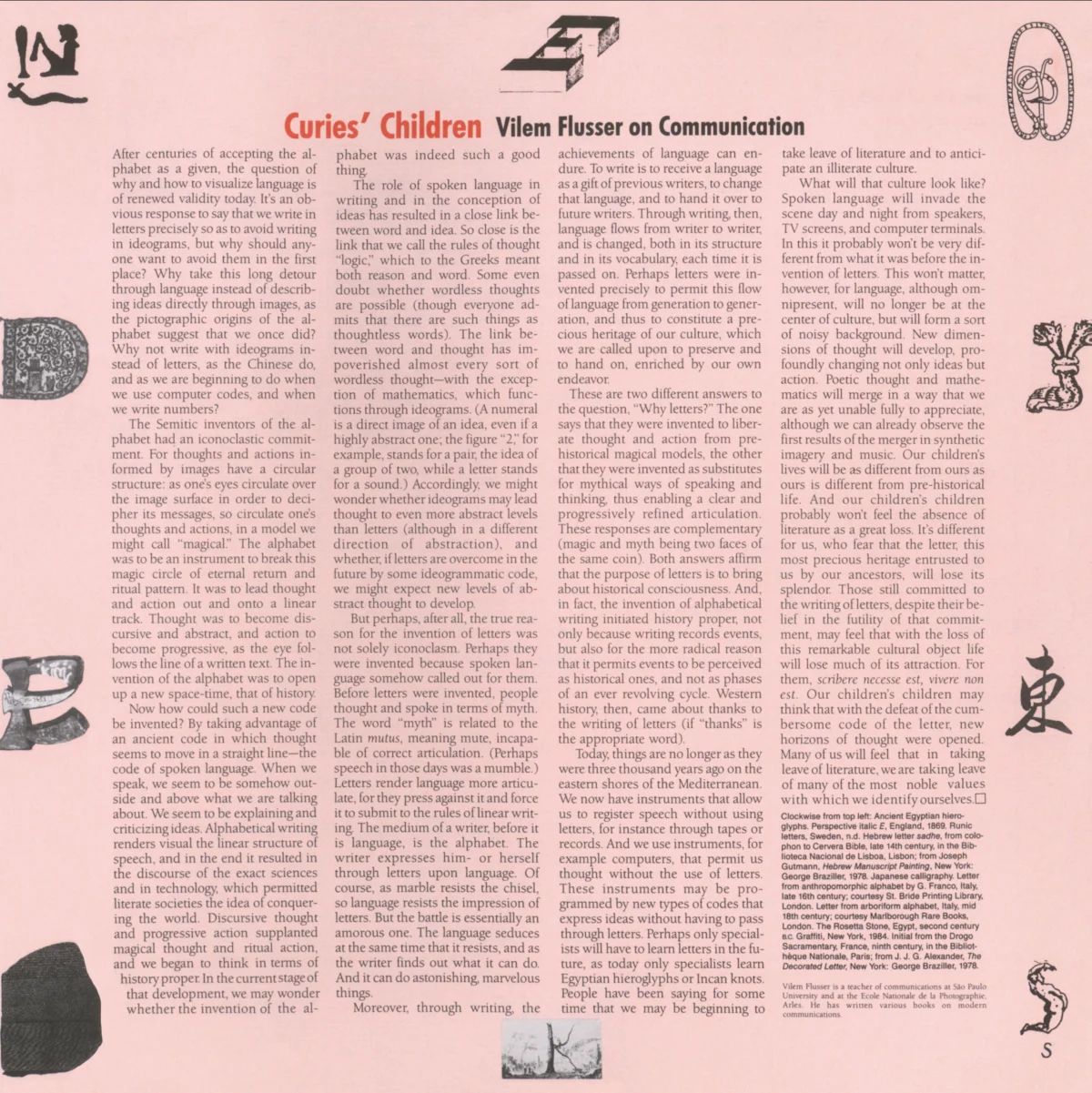
In the late 1980s, while the world was still grappling with the nascent transition from analog to digital—a period defined by the hum of fax machines and the slow rise of personal computing—a voice emerged from the pages of Artforum magazine that seemed to speak from the distant future. That voice belonged to Vilém Flusser, a Czech-born philosopher and media theorist whose column, “Curie’s Children,” ran from 1986 to 1992.
Today, as society navigates the complexities of social media algorithms, the erosion of attention spans, and the rise of generative artificial intelligence, Flusser’s meditations have transitioned from avant-garde theory to chillingly accurate prophecy. His 1987 essay, “What Comes After Z.,” serves as a cornerstone for understanding the current "illiterate" era—a time when the written word is no longer the primary vessel for culture, but rather a ghost in the machine of a multimedia-saturated world.
Main Facts: The "Curie’s Children" Legacy
Between 1986 and 1992, Vilém Flusser contributed a series of short, dense meditations to Artforum under the title “Curie’s Children.” The name itself was a metaphor for the radioactive nature of new media—energetic, transformative, and potentially lethal to established cultural norms. Flusser’s project was nothing less than an autopsy of Western literacy and a birth announcement for a new kind of human consciousness.
The second installment of this column, “What Comes After Z.,” published in January 1987, remains one of his most influential works. In it, Flusser explored the history of the alphabet and the seismic shift occurring as society moved away from linear writing toward "technical images"—digital renderings, computer screens, and telecommunications.
Flusser’s primary argument was that the invention of the alphabet roughly 3,500 years ago created "history" by allowing humans to think in lines—cause and effect, beginning and end. He warned that the digital "instruments" emerging in the 1980s were not merely tools for faster writing, but were actually "permitting us thought without the use of letters." This, he argued, would lead to a "post-historical" era where the logic of the sentence is replaced by the logic of the pixel and the program.
Chronology: From the Alphabet to the Apparatus
To understand Flusser’s work, one must view it within the timeline of media evolution and his own tumultuous life.
- 1920–1940: Born in Prague to a Jewish family, Flusser’s early life was defined by the high culture of European literacy. The Nazi occupation forced him to flee, eventually leading him to Brazil, where he spent several decades.
- 1960s–1970s: In Brazil, Flusser began developing his theories on communication and phenomenology. He became fascinated by how the "apparatus" (the camera, the computer) dictates the behavior of the "operator" (the human).
- 1986: Flusser begins "Curie’s Children" for Artforum. At this time, the "desktop publishing revolution" is just beginning.
- January 1987: "What Comes After Z." is published. Flusser diagnoses the decline of the "linear" mind.
- 1991–1992: Flusser dies in a car accident near the Czech-German border, just as the World Wide Web is being introduced to the public. His final columns are published posthumously.
- 2010s–Present: The rise of TikTok, Instagram, and AI-generated content brings Flusser’s "post-literate" world into full view, sparking a renewed interest in his archive.
Supporting Data: The Theory of Technical Images
Flusser’s "What Comes After Z." is built upon his broader philosophical framework regarding "Technical Images." Unlike traditional images (paintings or drawings), which are maps of the world, technical images (photographs, videos, digital screens) are "metaprograms."
The Death of Linearity
Flusser argued that writing is a linear activity. When we read, we follow a line from left to right, which reinforces a sense of time as a sequence of events. This is the foundation of "History." However, the computer screen is a surface, not a line. Information on a screen is processed as a "mosaic" or a "network." Flusser’s data suggested that as we spend more time with screens, our ability to engage in "linear" historical thinking—deep reading, long-form logic, and sustained narrative—would atrophy.
The "Noisy Background" of Language
One of the most striking predictions in the 1987 essay is Flusser’s description of the future of speech. He anticipated a time when "spoken language will invade the scene day and night from speakers, TV screens, and computer terminals."
He did not see this as a return to a vibrant oral tradition. Instead, he argued that language would cease to be the "center of culture" and would instead become a "sort of noisy background." In the contemporary context, this is reflected in the "second orality" of the internet—podcasts, TikTok voiceovers, and the constant stream of "content" where words are used more for their rhythmic or atmospheric effect than for their precise semantic meaning.
Official Responses and Critical Reception
The reception of Flusser’s work has evolved from niche media theory to a fundamental pillar of contemporary art criticism.
Initial Artforum Reaction
In the 1980s, Flusser’s columns were often seen as provocations. Artforum readers, primarily composed of artists and gallery owners, were confronted with a theorist who suggested that the very concept of "Fine Art" was tied to a dying literate culture. While some dismissed his work as overly pessimistic or dense, others recognized that he was providing a vocabulary for the "New Media" art that was beginning to emerge.
The Scholarly Revival
Following his death, scholars like John Rajchman have revisited the "Curie’s Children" archive to highlight Flusser’s relevance to the digital turn. Rajchman noted that Flusser was one of the few thinkers who understood that the computer was not just a "super-typewriter" but a machine for "calculating and projecting" new realities.
In a 2012 retrospective for Artforum, Rajchman argued that Flusser’s genius lay in his ability to see that the digital revolution was not just technological, but ontological. It changed what it meant to "be" a human. Modern media theorists now cite "What Comes After Z." as a seminal text in the study of "post-literacy," alongside the works of Marshall McLuhan and Walter Benjamin.
Implications: The "Illiterate" Era and the Future of Meaning
The implications of Flusser’s work in the twenty-first century are profound and, in many ways, troubling. His 1987 essay predicted the "insidious effects" of platforms that prioritize multimedia content over the written word.
The Erosion of Attention
Flusser’s "thought without the use of letters" is perfectly embodied in the modern user interface. We no longer "read" a computer; we navigate it through icons, swipes, and gestures. This shift has led to what psychologists call "continuous partial attention." When language becomes a "noisy background," the ability to engage in the critical, slow-moving thought required for democratic discourse begins to fail.
The Rise of the "Apparatus"
Perhaps Flusser’s most terrifying implication is the idea of the "Apparatus." He argued that as we move "After Z," we become operators of programs we do not understand. Whether it is an Instagram algorithm or a Large Language Model (LLM) like GPT-4, we are interacting with "black boxes." In this post-literate world, the human is no longer the writer of the script, but a functionary of the machine’s program.
Is There a Future for the Alphabet?
Flusser did not necessarily believe that writing would disappear entirely, but rather that it would become a specialized, "sacrificial" activity. Just as Latin became a language for the elite after the fall of Rome, deep literacy may become a niche skill in a world dominated by technical images.
The current trend toward "short-form" everything—from 15-second videos to X (formerly Twitter) threads—suggests that Flusser’s "post-Z" world is already here. We are living in the "noisy background" he envisioned, where the transmission of meaning is secondary to the speed of the transmission itself.
Conclusion
Vilém Flusser’s "Curie’s Children" was more than a column; it was a warning. By revisiting "What Comes After Z.," we are forced to confront the reality that our digital tools are not neutral. They are reshaping our brains, our history, and our capacity for meaning.
As we look back at his 1987 predictions from the vantage point of the 2020s, the "illiteracy" Flusser described does not look like a lack of education, but like a new, screen-based form of existence. The question remains: if we have moved beyond the alphabet, beyond the "Z" of our historical timeline, what—if anything—will we use to write the next chapter of the human story? Or have we, as Flusser feared, stopped writing altogether, content to let the apparatus do the thinking for us?



Leave a Comment