
Headline: The Paradox of Modernity: Evaluating the Intersection of Literary Elitism, Educational Inflation, and the Erosion of Consumer Standards
Main Facts: A Critique of Contemporary Social Norms
In a comprehensive reflection on the state of modern culture, veteran commentator and "Comic Strip of the Day" columnist Mike Peterson has synthesized a series of editorial observations regarding the shifting landscape of American life. His analysis, rooted in the satirical lens of contemporary cartoonists such as Ruben Bolling, Lalo Alcaraz, and David Sipress, identifies a growing tension between "performative" participation and the actual substance of modern experiences.
The core of the critique centers on four primary pillars: the intellectual posturing surrounding classic literature, the "inflation" of educational milestones, the decline of efficiency in the service and travel industries, and the historical evolution of consumer credit. Peterson argues that society has entered an era of "participation trophies" and "performative reading," where the appearance of achievement or sophistication often outweighs the reality of the experience. From the "monsters" of unread classic novels like James Joyce’s Ulysses to the logistical frustrations of modern air travel and fast-food "park-and-wait" cycles, the commentary suggests a systemic degradation of standards masked by increased ceremony and monopolistic market shifts.
Chronology: From Deregulation to Participation Culture
To understand the current state of social and economic frustration, one must trace the chronological shifts that have occurred over the last half-century.
The 1970s: The Credit "Wild West"
The narrative begins in the early 1970s, an era Peterson describes as the "Golden Age of Student Credit." During this period, credit card companies engaged in the aggressive, unsolicited distribution of cards to college seniors. This era predated the rigorous credit-score modeling and digital verification systems used today. The result was a period of financial chaos where students—often under the legal age of 21 for binding contracts—utilized cards with relative impunity. Merchants relied on physical booklets of "bad numbers" that were frequently months out of date, allowing for a culture of uncollectible debt and card-swapping that stands in stark contrast to today’s high-surveillance financial environment.
The 1980s: The Peak of Airline Competition
By the mid-1980s, the airline industry reached a zenith of competitive diversity. Following the Airline Deregulation Act of 1978, carriers like People Express offered "no-frills" budget options that allowed travelers to prioritize cost over comfort. Peterson notes that during his relocation in 1987, the market allowed for a clear distinction: if time was the priority, one flew "the big boys"; if budget was the priority, one accepted delays in Newark or O’Hare. This era of choice has since been supplanted by a monopolistic structure that Peterson argues has placed all passengers in the "idiots section."
The Late 20th Century: The Evolution of the "8th Grade Exit"
Historically, eighth-grade graduation served a functional purpose: it was the point at which many students exited the formal education system to enter the workforce. However, as truancy laws evolved and high school education became the universal standard, the ceremony remained while its significance vanished. This has led to the modern phenomenon of "milestone inflation," where elementary and middle school transitions are celebrated with a level of formality once reserved for terminal degrees.
Supporting Data: The "Hawking Index" and Service Industry Lag
The assertions regarding "performative" culture are supported by broader sociological trends and industry data.
Literary Elitism and the "Hawking Index"
Peterson’s reference to Mark Twain’s definition of a classic—"something that everybody wants to have read and nobody wants to read"—is backed by modern metrics. Mathematician Jordan Ellenberg famously proposed the "Hawking Index," which uses Kindle data to determine how much of a book a reader actually finishes. James Joyce’s Ulysses, mentioned by Peterson, consistently ranks as one of the most started but least finished books in the English canon. This supports the theory that "classic" status is often a tool for social signaling rather than a reflection of genuine engagement.
The Fast Food "Efficiency Gap"
The "park-and-wait" phenomenon in fast food—where customers are asked to pull into a designated spot to wait for their order—represents a data-driven shift in corporate metrics. By moving a car out of the drive-thru lane, franchises can "stop the clock" on their internal service-time trackers, creating an illusion of efficiency for corporate headquarters while the actual customer experience is delayed. Peterson points out a specific failure in this logic: the "fries-first" strategy, where sides are bagged early and allowed to cool while the kitchen completes the main entree, resulting in a product that is neither fast nor fresh.
Airline Consolidation
The "no-idiots section" joke reflects the reality of the modern aviation market. In the 1980s, there were dozens of competing airlines. Today, four major carriers control over 80% of the U.S. market. This consolidation has led to "unbundling," where previously standard services (such as seat selection) are now monetized as "extras," effectively forcing all budget-conscious travelers into a singular, stripped-down experience.
Official Responses and Sociological Perspectives
While there is no single "official" spokesperson for the state of modern life, sociologists and industry analysts have offered perspectives that align with Peterson’s critique.
On Educational Milestones:
Educational psychologists have frequently debated the "participation trophy" culture. Critics argue that formal ceremonies for elementary school "graduations" can lead to "achievement inflation," where children become conditioned to expect rewards for expected behavior rather than exceptional effort. Conversely, some educators defend these ceremonies as vital for building community and encouraging students in high-risk districts where any milestone is a victory.
On Religious Folklore vs. Science:
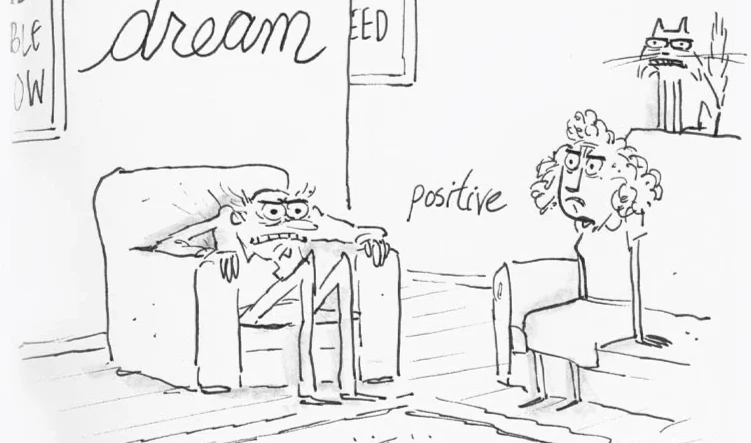
In response to the "Juxtaposition of the Day" regarding scripture, religious scholars often distinguish between mythos and logos. Columnist David Sipress suggests that modern society struggles with this distinction, often attempting to apply scientific or historical literalism to stories that were originally intended as folkloric or metaphorical. This "category error" leads to a conflict between faith-based "affirmations" and the reality of human suffering, a mystery that Peterson suggests is better handled with Grover-like simplicity than with pseudo-scientific positive thinking.
Implications: The Future of Consumer and Intellectual Engagement
The implications of these shifts suggest a future where the "middle ground" of experience is disappearing.
- The Death of the "Budget" Tier: In both the airline and food industries, the "get what you pay for" model is being replaced by a "pay more for what you used to get" model. As fuel prices remain volatile and market consolidation continues, the era of cheap, efficient travel and truly "fast" food may be permanently over.
- The Downsizing of the Physical Library: Peterson’s personal move toward "recirculating" his library highlights the ongoing tension between physical and digital media. While Kindle offers convenience, the "recirculation" of books to non-profit stores maintains a cultural ecosystem that digital DRM (Digital Rights Management) prohibits.
- The Need for "Grover-Level" Authenticity: The concluding reference to the Muppet Grover’s "Near and Far" sketch serves as a metaphor for the need to return to basic, verifiable truths. In a world of complex debt, performative reading, and inflated milestones, the most "trustworthy" path forward may be one that embraces simplicity and rejects the "hoopla" of modern participation culture.
Ultimately, Peterson’s critique serves as a call for a return to intellectual honesty—where we admit we haven’t read Moby Dick, acknowledge that 8th grade is not the end of the road, and demand that "fast food" actually be fast. As the "Humpday" reflections conclude, the message is clear: society must distinguish between the "ceremony" of progress and progress itself.
About the Author: Mike Peterson has been the author of the "Comic Strip of the Day" column since 2010, providing daily analysis of the intersection between art, politics, and social norms.



Leave a Comment