
The Architecture of the Subconscious: Exploring the Provocative Surrealism of Alfred De Angelo
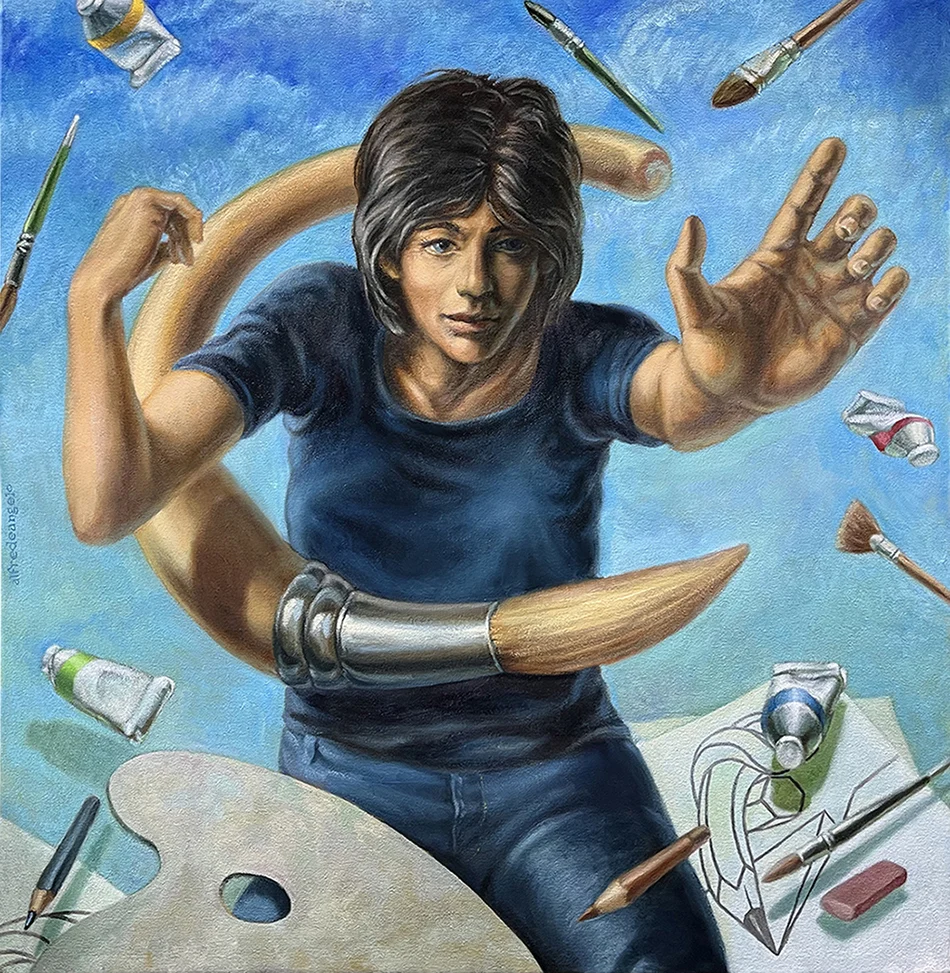
In the contemporary landscape of fine art, where the boundaries between the digital and the tactile frequently blur, the works of Alfred De Angelo stand as a testament to the enduring power of traditional mastery married to avant-garde vision. A prominent figure in the modern surrealist movement, De Angelo does not merely paint scenes; he constructs "doorways" into a compelling visual world that challenges the viewer’s perception of reality. His portfolio, characterized by a remarkable technical fluency and an unapologetic embrace of the sensual, invites a deep, often unsettling, meditation on the nature of existence.
By synthesizing the rigorous academic traditions of New England’s premier art institutions with a deeply personal, almost hermetic, symbolic language, De Angelo has carved out a niche that is both beguiling and bewildering. This article examines the career, philosophy, and stylistic contributions of an artist whose work seeks to look "through" the veneer of the everyday to capture the essential mysteries of the human condition.
Main Facts: The Aesthetic of Provocative Beauty
Alfred De Angelo’s work is defined by its ability to transport the observer into what critics often describe as a "sensual world of provocative beauty." Unlike the jarring, often violent surrealism of the early 20th century, De Angelo’s approach is one of lure and invitation. His images are delineated with a fluency that speaks to a high level of technical expertise, ensuring that even at their most abstract or confusing, the craftsmanship remains unimpeachable.
The Visual Portal
The central metaphor of De Angelo’s work is the "doorway." His paintings are not intended to be static objects for passive consumption; rather, they are designed to function as apertures. Through these portals, viewers are pulled out of their "well-worn patterns of thought." This disruption of the mundane is the primary goal of his practice. By presenting images that press against the limits of human understanding, De Angelo grants his audience "permission to be amazed—and confused—and delighted."
Technical Expertise
A hallmark of De Angelo’s style is the seamless execution of his imagery. Whether he is depicting the curve of a human form or the impossible geometry of a dreamscape, there is a palpable sense of control. This expertise allows the surreal elements to carry a weight of "truth," making the "bewildering" aspects of his work feel intentional and grounded in a logic that, while private, is undeniably consistent.
Chronology: A Foundation in Academic Excellence
The development of Alfred De Angelo’s "private vocabulary" of images is rooted in a prestigious academic trajectory. His formal education provided the technical scaffolding upon which his surrealist explorations are built.

The Formative Years: Massachusetts College of Art
De Angelo’s journey began at the Massachusetts College of Art (MassArt), where he earned his Bachelor of Fine Arts (BFA). As one of the oldest and most respected public art schools in the United States, MassArt provided De Angelo with a foundational grounding in the mechanics of visual representation. It was here that he likely began to hone the "remarkable fluency" that defines his current work, mastering the interplay of light, shadow, and anatomy.
Advanced Mastery: Rhode Island School of Design (RISD)
Following his undergraduate success, De Angelo pursued his Master of Fine Arts (MFA) at the Rhode Island School of Design (RISD). Consistently ranked as one of the top art and design schools globally, RISD is known for its rigorous critique environment and its emphasis on conceptual depth. For De Angelo, this period represented a shift from technical acquisition to philosophical inquiry. The transition from BFA to MFA marks the point where his "private vocabulary" began to coalesce, moving beyond mere representation toward the "essential mystery" he cites in his artist’s statement.
Professional Maturity and the Digital Era
In the years following his formal education, De Angelo has established a significant presence within the surrealist community. His work has been featured prominently by platforms such as Surrealism Today, placing him alongside other contemporary masters like Jacob Holster and Christian Quintin. His online presence, centered at artistpainter.ws, serves as a modern gallery, bridging the gap between his physical studio and a global audience of collectors and enthusiasts.
Supporting Data: The Mechanics of the "Private Vocabulary"
To understand De Angelo’s impact, one must analyze the components of his "private vocabulary." He describes his process as an attempt to express "localized and subjective" experiences through a series of impressions on a personal scale.
The Subjective vs. The Universal
De Angelo’s artist statement posits that life experiences are inherently localized. However, his paintings aim to translate these subjective moments into a universal language of surrealism. By using symbols that may seem "bewildering" to the uninitiated, he actually invites the viewer to project their own meanings onto the canvas, creating a unique dialogue between the artist’s intent and the viewer’s subconscious.
Comparative Context
In the broader context of contemporary surrealism, De Angelo’s work provides a fascinating counterpoint to his peers:

- Jacob Holster: While Holster explores "painterly AI aesthetics" and the "human terrain" of digital renders, De Angelo remains rooted in the tactile expertise of the brush.
- Christian Quintin: Quintin’s work focuses on the "feeling of memory" and déjà vu. De Angelo, conversely, focuses on the "provocative beauty" of the present moment of observation—the "amazement" of the now.
- Jesús Aguado: Aguado seeks to reconcile accessibility with profundity. De Angelo is less concerned with immediate accessibility, opting instead to let his viewers "press against the limits of their understanding."
Official Responses: The Artist’s Statement as Manifesto
The most authoritative interpretation of De Angelo’s work comes from the artist himself. His statement serves as a roadmap for navigating his complex visual terrain.
"Our experiences in life are usually localized and subjective, creating a series of impressions on a personal scale. I am continually developing a private vocabulary of images with which I attempt to express different aspects of these experiences."
This admission of a "private vocabulary" is crucial. It signals to the viewer that they are entering a world with its own internal rules. De Angelo does not seek to provide a literal translation of his life but rather a symbolic embodiment of it.
"With my surrealist paintings I try to look ‘through’ outward appearances and somehow embody the essential mystery of existence."
This objective—looking "through" appearances—is what elevates De Angelo’s work from mere fantasy to true surrealism. While fantasy creates new worlds, surrealism interrogates the current world by stripping away its "outward appearances" to reveal the "essential mystery" beneath. This official stance by the artist reinforces the idea that his work is a metaphysical inquiry as much as it is a visual one.
Implications: Surrealism in the 21st Century
The work of Alfred De Angelo has significant implications for the trajectory of contemporary art. In an era where "glossy digital imagery" often dominates the surrealist genre, De Angelo’s reliance on academic expertise and a deeply personal symbolic language offers a different path forward.

The Rejection of Passive Consumption
By creating art that is intentionally "confusing," De Angelo rejects the modern trend toward "snackable," easily digestible content. His paintings demand time. They require the viewer to sit with their confusion until it transforms into "delight." This implication suggests a return to the "slow art" movement, where the value of a piece is measured by the depth of the psychological experience it provokes.
The Legacy of New England Surrealism
De Angelo’s background at MassArt and RISD connects him to a specific lineage of American artistic excellence. His success suggests that the rigorous, technique-focused education provided by these institutions remains vital for the development of artists who wish to push the boundaries of conceptual art. He represents a bridge between the historical surrealism of the mid-20th century and the evolving needs of the 21st-century audience.
Future Directions
As De Angelo continues to develop his vocabulary, the art world can expect further explorations into the "essential mystery of existence." His work challenges other artists to look beyond the surface and to develop their own "private vocabularies" rather than relying on established tropes. For collectors and enthusiasts, De Angelo remains a beacon of "provocative beauty," proving that the "bewildering" can also be profoundly "impressive."
In conclusion, Alfred De Angelo is not just a painter of dreams; he is a cartographer of the subconscious. His education, his technical mastery, and his commitment to the "essential mystery" of life ensure that his work will continue to serve as a vital doorway for those seeking to escape their "well-worn patterns of thought." Whether through the lens of a gallery or the screen of a digital device, the world of De Angelo remains a compelling, sensual, and necessary destination for the modern soul.


Leave a Comment