
The Architecture of the Unconscious: Hans Rickheit’s Return to the World of Cochlea & Eustachia
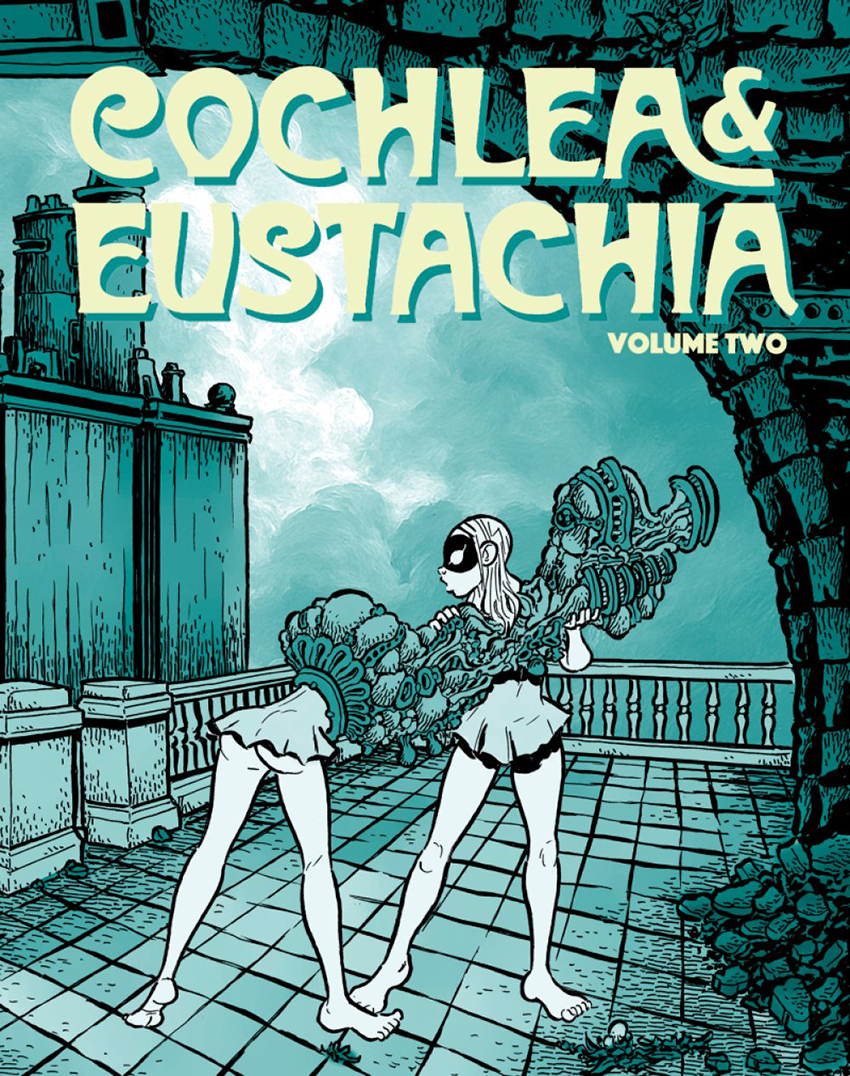
The release of Cochlea & Eustachia Volume 2 marks a significant milestone in the career of Hans Rickheit, one of the most singular and uncompromising voices in contemporary alternative comics. Published under his own Chrome Fetus imprint in 2026, this volume collects the artist’s recent serialized webcomics, offering a comprehensive look at the evolution of his most enduring and enigmatic characters. For the discerning reader—specifically those who find beauty in the grotesque and meaning in the nonsensical—Rickheit’s work remains a sublime example of the medium’s potential to explore the darker recesses of the human psyche.
Main Facts: The Return of the Underworld’s Betty and Veronica
At the heart of Rickheit’s oeuvre are Cochlea and Eustachia, a pair of identical twins who navigate a world that defies the laws of physics, logic, and morality. Described by critics as the "Betty and Veronica of the underworld," these characters serve as the reader’s guides through a landscape defined by surrealism, erotica, and visceral body horror.
Unlike traditional protagonists, Cochlea and Eustachia are not defined by their growth or their moral compass. Instead, they are agents of pure instinct—ids in overdrive who wander through a cavernous, Victorian-style mansion that functions more like a haunted funhouse than a residence. The latest volume continues this tradition, eschewing standard narrative arcs in favor of a series of vignettes that prioritize atmosphere and psychological resonance over plot.
The collection is a testament to Rickheit’s mastery of the "silent" or "near-silent" comic form. While the characters occasionally speak, their dialogue often serves to deepen the mystery rather than clarify it. The result is a work that invites multiple readings, with each pass revealing new layers of subtext, sadness, and existential dread.
Chronology: The Evolution of a Macabre Visionary
To understand the significance of Cochlea & Eustachia Volume 2, one must look at the long-form development of Hans Rickheit’s career, which began in the underground zine culture of the late 20th century.
- Early Beginnings (The 1990s): Rickheit began creating and self-distributing comics while still in high school. His early work established the aesthetic of "Chrome Fetus," a brand that would eventually become his publishing imprint. It was during this period that the prototypes for Cochlea and Eustachia first appeared, emerging from a fascination with anatomical diagrams and 19th-century engravings.
- The Xeric Grant and "Chloe" (2001): Rickheit’s profile rose significantly when he won the prestigious Xeric Grant for his graphic novella, Chloe. This work showcased his ability to blend mechanical detail with organic horror, a stylistic hallmark that would define his later projects.
- The Seattle Alt-Weekly Era (2002): In 2002, the Cochlea & Eustachia comic strip began appearing in The Stranger, Seattle’s influential alternative weekly. This exposure brought his surrealist sensibilities to a wider, more diverse audience and solidified the twins as icons of the Pacific Northwest’s underground art scene.
- The Fantagraphics Years (2003–2014): In 2003, Fantagraphics Books published The Squirrel Machine, a work widely considered to be Rickheit’s masterpiece. This was followed by various other titles and eventually the first collected volume of Cochlea & Eustachia in 2014. These publications established Rickheit as a peer to other surrealist masters like Jim Woodring and Tony Millionaire.
- The Digital Transition and Volume 2 (2015–2026): Following the first volume, Rickheit moved much of his output to the web, serializing new adventures of the twins online. Cochlea & Eustachia Volume 2 is the culmination of over a decade of this digital-first work, curated and printed to meet the demands of a dedicated cult following.
Supporting Data: Analysis of Aesthetics and Themes
Rickheit’s work is characterized by a "transcendent quality" that bridges the gap between the salacious and the profound. While the presence of erotica and body horror is undeniable, these elements are rarely used for mere shock value. Instead, they serve a larger thematic purpose: the exploration of the "inner misfit."
The Setting as Character
The setting of Volume 2 is a massive, sprawling Victorian mansion or castle. It is a space filled with endless corridors, forbidden rooms, and "dank and creepy nooks and crannies." This architecture is not merely a backdrop; it is a physical representation of the subconscious mind. The girls "pad about" these confines, reacting to their environment with a mixture of naivety and cruelty. The mansion acts as a closed system where the normal rules of society are suspended, allowing the twins to engage in their "mad pursuits" without consequence.
The Rejection of the Journey
In contemporary storytelling, characters are expected to undergo a "journey of self-discovery." Rickheit explicitly rejects this trope. Cochlea and Eustachia do not evolve; they do not become "better versions of themselves." They are more likely to "thoughtlessly rip and tear their way through whatever catches their very nebulous minds." This lack of evolution is central to the horror of the work. The characters are trapped in a cycle of perpetual reaction, unable to achieve self-reflection. As the author notes, they would "just as soon make friends with a rat than stoop too close to self-reflection."
Iconography and the "Fronky" Phenomenon
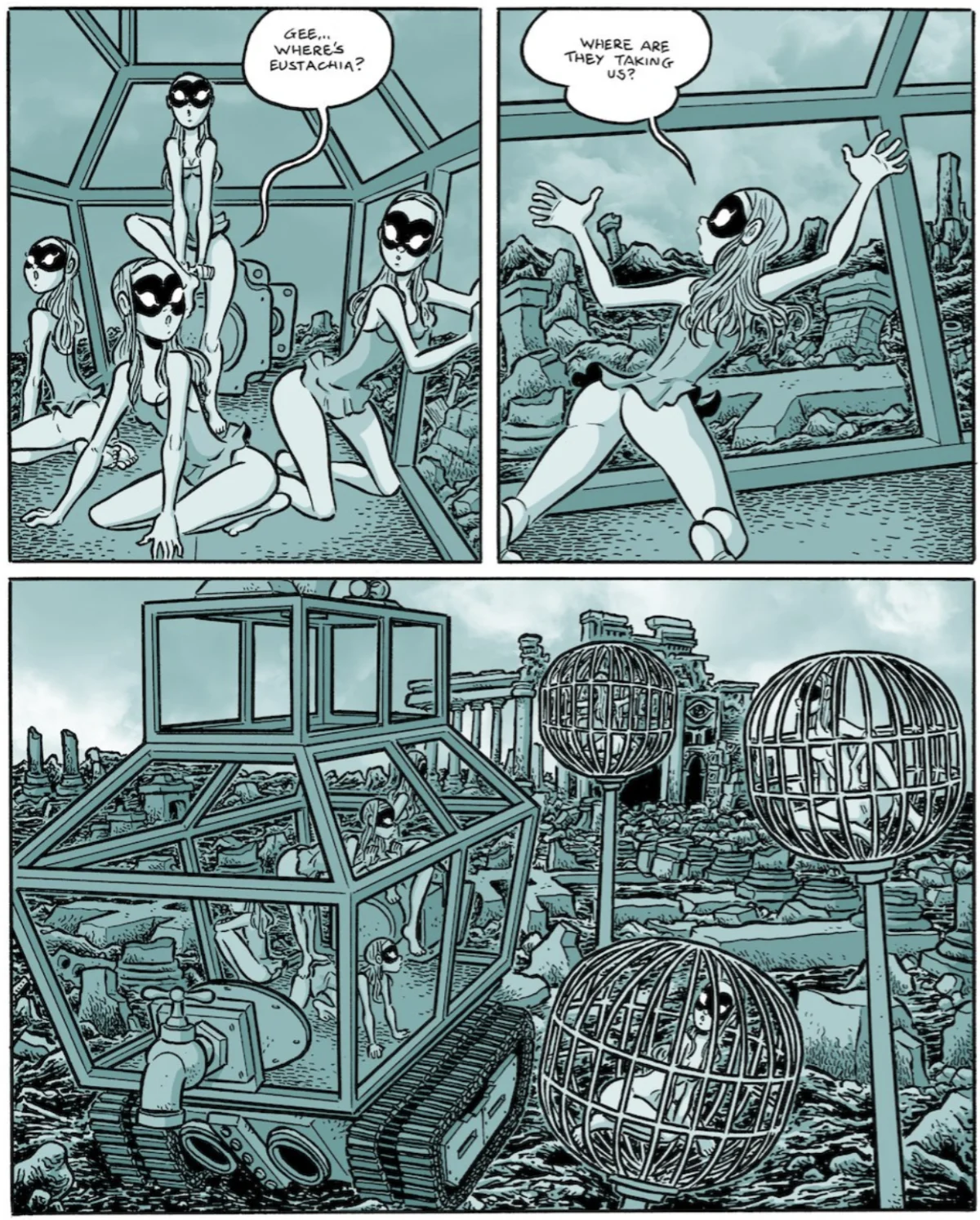
The introduction of characters like "Fronky"—a mysterious man with a head shaped like a diving helmet, adorned with antlers and a bulging eye—highlights Rickheit’s talent for creating bizarre yet memorable iconography. Fronky’s presence in Volume 2 adds a layer of absurd humor to the proceedings. In one notable scene, Cochlea (or perhaps Eustachia) uses a chamber pot, only for Fronky to retrieve the specimen for "further study." This interaction encapsulates the Rickheit experience: it is at once repulsive, humorous, and strangely compelling.
Official Responses and Critical Context
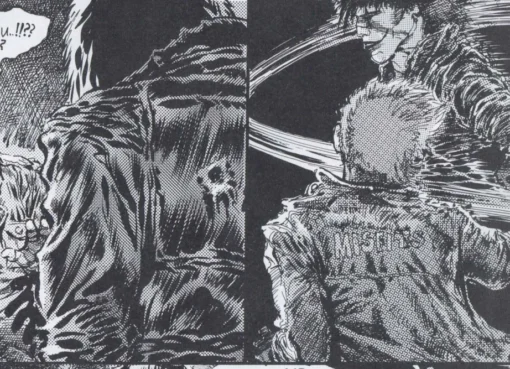
While Rickheit’s work exists outside the mainstream, it has garnered significant acclaim within the "literary" comics community. Critics have long praised his technical proficiency—specifically his intricate cross-hatching and his ability to render complex mechanical structures—as well as his uncompromising dedication to his vision.
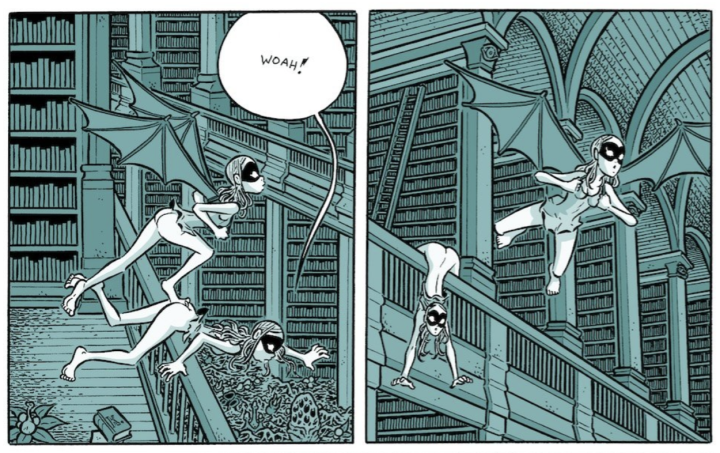
In reviews of the second volume, critics have noted that Rickheit has become even more comfortable with ambiguity. The "vacant eyes" of the twins are often cited as a masterstroke of character design; they are blank slates upon which the reader can project their own anxieties or desires. As Henry Chamberlain observes in The Comics Journal, "no answer can sometimes be the most liberating response. You don’t have to know everything! It’s all there on the page."
Furthermore, the transition to self-publishing through Chrome Fetus for this volume has been seen as a move toward total creative autonomy. By controlling the production and distribution, Rickheit ensures that the "dread and debauchery" of his world remains undiluted by editorial interference.
Implications: The Legacy of Transgressive Surrealism
The publication of Cochlea & Eustachia Volume 2 has several implications for the future of the medium and for Rickheit’s own legacy.
First, it reaffirms the viability of the "mature reader" market for works that do not fit into the standard genres of memoir or superhero fiction. Rickheit’s success suggests that there is a stable, dedicated audience for "art-house" comics that challenge the reader’s comfort levels.
Second, the work serves as a bridge between different eras of underground comics. By invoking the pin-up tradition of characters like Lil’ Abner’s Daisy Mae and blending it with modern body horror and surrealist philosophy, Rickheit creates a dialogue between the past and the present. He takes characters that are "pleasing to the eye" and forces the viewer to engage with the "subconscious" and the "carnal."
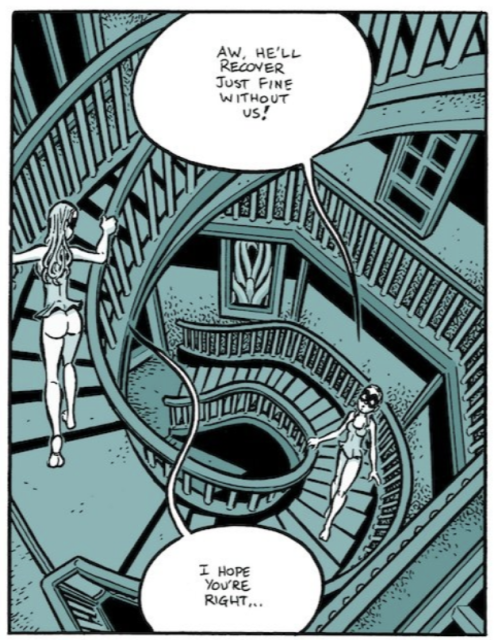
Finally, the world of Cochlea & Eustachia continues to expand. The second volume concludes with a sequence involving an "endless army of duplicate versions" of the twins—naked, masked, and running rampant through the mansion. This suggests that the "mad pursuits" of the duo are far from over. Rickheit has created a self-sustaining mythology that can seemingly produce an infinite number of scenarios, as long as there are "inner misfits" willing to explore them.
In conclusion, Cochlea & Eustachia Volume 2 is more than just a collection of webcomics; it is a deep dive into a uniquely disturbing and beautiful imagination. Hans Rickheit remains a master of the uncomfortable, a creator who dares his audience to tap into their own inhibitions and find the "devilish beauty" in the dark.


Leave a Comment