Ancient Text Unveils Horrific Lore of Merihim, the Shepherd of Malignancy
A recently unearthed and meticulously analyzed ancient text, described as a "slim volume bound in a white sheened with a silver-grey which is slick and greasy to the touch," has shed disturbing light on a primordial entity known as Merihim. Identified as the "youngest of the Galchutt," this shambling creature is revealed to be a master of pestilence and mutation, whose abhorrent labors shaped the very fabric of disease within a cosmic framework of slumbering elder powers and chaotic subservience.
The chilling revelations contained within the manuscript, provisionally titled The Book of Fiends by contemporary scholars, detail Merihim’s role as a dedicated servitor to the enigmatic "Masters" and "Princes" of a forgotten epoch. His existence, inextricably linked to the "Cavern of Dripping Darkness" (Eurl-kallat Dath), paints a grim picture of deliberate, systematic corruption, offering a profound, if terrifying, insight into the genesis of blight and decay in a universe governed by entities beyond human comprehension. The text serves not merely as a historical account but as a stark warning, hinting at a future "Time of Dissolution" when Merihim’s dark service may once again be called upon.
Main Facts: The Genesis of Pestilence
The central figure illuminated by this arcane manuscript is Merihim, a being of immense antiquity and profound malevolence. Described as a "shambling creature," Merihim holds the ominous title of the "Shepherd of Malignancy," a designation that accurately reflects his primary function: the cultivation, perfection, and dissemination of diseases and mutations. The text asserts his lineage as the "youngest of the Galchutt," placing him within a hierarchy of primordial, perhaps cosmic, entities whose influence predates recorded history.
Merihim’s dominion is the cavernous expanse of Eurl-kallat Dath, translated as the "Cavern of Dripping Darkness." This unhallowed locale is not merely a dwelling but a vast, living laboratory where pestilence is cultivated with an abhorrent artistry. Here, Merihim’s "crafty mind" was set to work by the Galchutt themselves, transforming raw, cancerous mutations into "motile forms" and orchestrating "demonic phages" in "wars of fecund prosperity." This description suggests a horrifyingly active and deliberate process of biological warfare and genetic corruption, orchestrated on a scale that defies natural evolutionary processes.
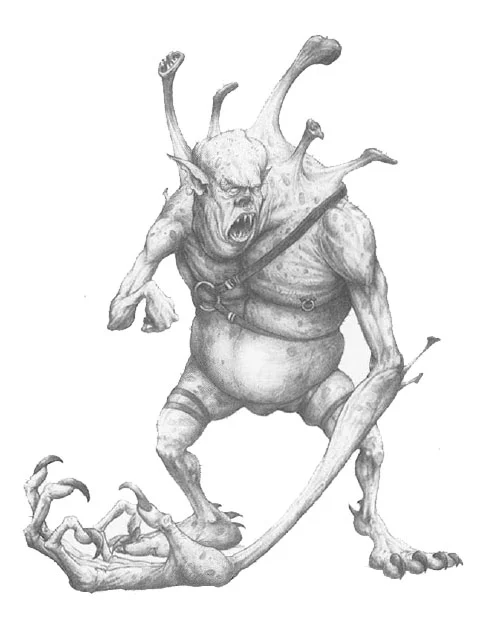
The manuscript further details Merihim’s grotesque physical form, a direct manifestation of his corrupting nature. Marked by the "touch of Abhoth," a shriveled right arm stands in stark contrast to an immensely twisted left, symbolizing a fundamental imbalance in his very essence. His back, a "miasmic fecundity," sprouts six prehensile, tooth-mawed stems, each a conduit to putrid organs that serve as breeding grounds for unimaginable diseases. These "maws of cancerous life" can expel a lethal "smotherfume," a noxious cloud of concentrated pestilence. This physical description underscores Merihim’s identity as both a creator and embodiment of biological horror.
Crucially, the text reveals Merihim’s "Ascension" – not a divine elevation, but a solemn pledge of fealty to the slumbering "Princes" and "Masters." This act, undertaken willingly even amidst a "Time of Loss," binds him to a "servitude of oblivion" until a prophesied "Time of Dissolution" when his services will be remembered and recalled. This narrative arc positions Merihim as a critical, albeit quiescent, threat, whose reawakening could herald an unprecedented era of plague and chaos.
Chronology: A History of Devotion and Decay
The narrative of Merihim unfolds across aeons, beginning in an era predating human memory, when cosmic entities held sway and the very concept of life was subject to their malevolent designs.
The Long Quiet and Merihim’s Genesis
The story commences "in the days when the Masters had passed and the Long Quiet had fallen upon all the Caverns of the Galchutt." This sets the stage for Merihim’s emergence, not as a primary architect, but as a dedicated inheritor of a grand, sinister legacy. Within the "deepest clefts of the earth," specifically Eurl-kallat Dath, Merihim toiled as the "truest of their servitors," tending to the "vile works which had been left to his care." This suggests an inheritance of a pre-existing portfolio of cosmic corruption, entrusted to his "crafty mind." His designation as the "youngest of the Galchutt" implies a later arrival or creation compared to his kin, perhaps specifically engineered for the specialized task of biological warfare and mutation.
Eurl-kallat Dath: The Cauldron of Contagion
The text dedicates significant attention to Merihim’s domain, Eurl-kallat Dath. This "Cavern of Dripping Darkness" is depicted as a place where "pestilence hung thick in the air," a tangible, suffocating presence. It was here that Merihim was tasked to "work" by the Galchutt, transforming theoretical malignancy into manifest horror. Within its depths, "cancerous mutations were given motile form," indicating a transformation from inert biological anomaly to active, infectious agents. Furthermore, "demonic phages waged wars of fecund prosperity," a chilling metaphor for the rapid, aggressive proliferation and evolution of engineered pathogens, designed not for survival, but for overwhelming, self-sustaining destruction. The cavern itself appears to be an organic extension of Merihim’s will, a vast, living incubator for cosmic disease.
The Works of Merihim: Architect of Blight
Merihim’s dedication to his craft is underscored by the sheer scale and ingenuity of his creations. From the "incubation vats and wild proving fields" of Eurl-kallat Dath, he "perfected all manner of diseases and mutations." This implies a systematic, almost scientific, approach to biological horror, where pathogens are not merely spawned but refined, optimized for maximum destructive potential. The manuscript highlights two specific aspects of his craft: he "wrought the arts of Jessuk to fungal life" and "exercised the corruption of nature’s order with its own hand."
The "arts of Jessuk" remain largely unexplained, but their application to "fungal life" suggests a mastery over parasitic organisms, molds, and spores capable of widespread environmental and biological devastation. This could range from rapidly spreading blights that devastate ecosystems to insidious fungal infections that corrupt living tissue from within. "Exercising the corruption of nature’s order with its own hand" speaks to a more insidious form of subversion, where Merihim manipulates natural biological processes and evolutionary pathways to turn them against themselves. This could involve accelerating mutation rates, inducing cancerous growths, or designing pathogens that exploit fundamental biological weaknesses, effectively weaponizing life against itself.
The Corruption of Merihim: A Manifestation of Malignancy
Merihim’s physical form is not merely a vessel but a living testament to his intimate connection with corruption. His body is irrevocably scarred by the "touch of Abhoth," a cryptic reference to another elder entity, implying a direct exposure or perhaps a blessing/curse from a being of ultimate chaos and decay. This "touch" manifests as a profound physical disfigurement: his right arm, "shriveled with palsy," reflects an "unbalanced essence in the equations of life." This suggests a fundamental disequilibrium within his very being, perhaps a consequence of his relentless work with biological corruption, or an inherent flaw bestowed by his origins. In stark contrast, his left arm has grown to "immense, twisted proportions," a compensatory overgrowth mirroring the chaotic expansion of his malevolent purpose.
Further detailing his grotesque anatomy, his hunched back is described as "miasmic fecundity," a source of continuous, putrid emanations. From this corrupted mass sprout six prehensile, fleshy stems, each terminating in a "toothy maw." These stems are not mere appendages; they are "direct conduits to fetid and corrupted organs," internal breeding grounds where the most virulent diseases are incubated. From these "maws of cancerous life," Merihim can unleash the "smotherfume," a concentrated cloud of "noxious, polluted disease." This physical description solidifies Merihim’s role as a walking, breathing engine of contagion, a living plague vector capable of spreading destruction with every breath.
The Ascension of Merihim: A Vow of Oblivion
The culmination of Merihim’s active existence is his "Ascension," a pivotal moment described in the text. This occurred "in the time when the Princes were drawn into their web and the Masters in their chains were taken into their slumber." This signifies a period of transition, where the dominant cosmic powers receded into a dormant state, perhaps trapped or voluntarily withdrawing. During this epoch, Merihim "still labored within his cavern," continuing his vile work even as his superiors retreated.
His tireless service did not go unnoticed. The "Princes, though caught still in their web, looked out upon the world and saw this mighty service." Recognizing his unwavering dedication, they "reached out to the Shepherd of Malignancy." In response, Merihim "answered their call and fulfilled the rites of fealty unto their name." This act was not forced but a willing commitment: "he became the one who willingly entered the Slumber, pledging the vows of the Natharl’nacna even in the Time of Loss and binding himself to a servitude of oblivion."
The "vows of the Natharl’nacna" remain mysterious, but they clearly entail a profound commitment to dormancy, a state of suspended animation awaiting a future call. This "servitude of oblivion" is a long-term strategic maneuver, ensuring Merihim’s preservation until the "Time of Dissolution." The text promises that "when the Time of Dissolution comes, the truth of his service shall be remembered," implying his reawakening and a renewed, perhaps intensified, role in a cosmic upheaval. This "Ascension" therefore represents a strategic withdrawal, a promise of future devastation rather than a permanent retirement.
Supporting Data: The Lore of Cosmic Corruption
The manuscript offers not just a chronicle of Merihim but also expands upon the terrifying cosmology within which he operates, providing critical "supporting data" that contextualizes his existence and purpose.
The Galchutt and the Masters: Architects of Cosmic Order (and Disorder)
While Merihim is the focus, the text frequently alludes to the "Galchutt" and the "Masters." These entities appear to be the elder powers, the progenitors of the cosmic order – or disorder – that Merihim serves. Their retreat into "slumber" and "chains" suggests a past epoch of immense power, followed by a decline or strategic withdrawal. Merihim’s continued labor even after their initial departure highlights his unwavering loyalty and the enduring nature of their vile agenda. The "Caverns of the Galchutt" imply a vast, subterranean network, perhaps extending across dimensions, where these entities once held court and performed their terrible experiments. Merihim, as the "youngest," might represent a refinement or specialization of the Galchutt’s overall chaotic goals, focusing specifically on biological corruption.
The Touch of Abhoth: A Source of Primal Chaos
The "touch of Abhoth" is a crucial detail, linking Merihim to an even more primal source of cosmic horror. In various mythologies, Abhoth is often depicted as the "Source of Uncleanness," a primordial, shapeless entity from which all manner of monstrosities and filth originate. For Merihim to bear its "touch" suggests a direct infusion of this ultimate chaos and decay into his very being. This connection explains his profound physical corruption and his intrinsic ability to manipulate and generate disease. It’s not merely that Merihim creates pestilence; he is pestilence, imbued with the raw, generative power of cosmic filth. His "unbalanced essence" could be a consequence of attempting to channel or contain this boundless, formless corruption, resulting in the grotesque dichotomy of his shriveled and overgrown limbs.
The Smotherfume and the Arts of Jessuk: Weaponized Biology
The description of the "smotherfume" and the "arts of Jessuk" provides concrete examples of Merihim’s specialized skills. The smotherfume is not a simple gas; it is a "cloud of noxious, polluted disease," implying a complex biological weapon capable of rapid, widespread contagion and debilitating effects. Its expulsion from "maws of cancerous life" reinforces the idea of Merihim as a living biological weapon factory. The "arts of Jessuk" applied to "fungal life" could involve engineering hyper-virulent spores that rapidly consume organic matter, induce hallucinatory states, or trigger systemic organ failure. These are not random afflictions but carefully crafted instruments of destruction, designed to dismantle life and order from within. The "corruption of nature’s order with its own hand" could manifest as plagues that cause rampant, uncontrolled growth in some organisms while inducing rapid decay in others, effectively turning ecosystems into self-destructive cycles of horror.
The Faith of Anarchy: Philosophical Underpinnings of Merihim’s Service
Perhaps the most chilling "supporting data" comes in the form of a philosophical injunction: "Let all who would serve the will of Chaos think of the Shepherd. Reflect upon the Faith of Anarchy and covet only that deepest of all communions in which the will of Gods shall be forsaken as tyranny and the will of Demons hold resplendent liberty." This passage elevates Merihim’s service beyond mere biological warfare to a profound ideological statement. The "Faith of Anarchy" is presented as a creed that rejects the structured order imposed by "Gods" (implying traditional deities or forces of creation/order) as "tyranny." In its place, it champions the "resplendent liberty" offered by the "will of Demons" (representing chaos, destruction, and self-serving indulgence). Merihim, the diligent "Shepherd," becomes an exemplar of this faith, his methodical corruption a path to ultimate, unbound freedom from imposed order. This suggests a grander, cosmic struggle between order and chaos, with Merihim playing a crucial, if grotesque, role.
Official Responses: Interpretations and Warnings
While "official responses" in a traditional journalistic sense are impossible for a fictional entity, the text itself provides internal "design notes" and philosophical pronouncements that serve as a form of meta-commentary and directive within its own lore.
The Book of Fiends: A Scholarly Assessment
The original context notes, "Merihim is from The Book of Fiends. I’ve spoken many times before about how fantastic this bestiary is. This is another example of how much use I’ve gotten out of it over the years." This indicates that the "slim volume" is part of a larger, well-regarded compendium of monstrous entities. From a journalistic perspective, this suggests that the revelations about Merihim are not isolated but part of a broader, established fictional canon. The high praise for The Book of Fiends implies that the details about Merihim are meticulously crafted and deeply integrated into a consistent, terrifying cosmology. Scholars studying this fictional universe would likely treat The Book of Fiends as a primary, authoritative source, validating the terrifying insights it provides into entities like Merihim. The consistent utility of the source over "years" also speaks to the depth and adaptability of its lore for narrative purposes.
The Princes’ Acknowledgement and the Vows of Natharl’nacna
The acknowledgement by the "Princes" of Merihim’s "mighty service" and his subsequent pledging of "the vows of the Natharl’nacna" represent an official endorsement and contractual agreement within the cosmic hierarchy. These "vows," though unexplained, signify a binding commitment, a formal compact that guarantees Merihim’s strategic dormancy until the predetermined "Time of Dissolution." This isn’t merely a creature going to sleep; it’s a sanctioned, purposeful withdrawal, a pact with higher powers that underscores his importance in their grand design. The "official response" from these elder entities is one of recognition and investment, indicating that Merihim is a vital asset whose capabilities are deemed necessary for future events.
The Proclamation of the Faith of Anarchy
The concluding philosophical statement, "Let all who would serve the will of Chaos think of the Shepherd. Reflect upon the Faith of Anarchy and covet only that deepest of all communions in which the will of Gods shall be forsaken as tyranny and the will of Demons hold resplendent liberty," functions as an official creed or doctrine. It’s an open invitation, a call to arms for those who would embrace chaos. This isn’t merely Merihim’s personal belief; it’s a guiding principle presented as an alternative to existing cosmic orders. The "Shepherd" is held up as an ideal, a paragon of chaotic devotion, and his story is presented as a foundational text for those who would follow the path of "resplendent liberty" through anarchic destruction. This section serves as a direct "official response" from the proponents of chaos, articulating their philosophical opposition to established deities and their vision for a liberated, chaotic universe.
Implications: The Looming Threat of Dissolution
The discovery and interpretation of the Merihim manuscript carry profound implications, particularly concerning the prophesied "Time of Dissolution" and the cosmic struggle between order and chaos.
The Imminent Threat of Reawakening
The most immediate and terrifying implication is the future reawakening of Merihim. His "servitude of oblivion" is not eternal, but a temporary state awaiting the "Time of Dissolution." While the exact timing and nature of this epoch remain obscure, the text explicitly states that "the truth of his service shall be remembered," indicating his return to active duty. When Merihim emerges from his slumber, he will not be a weakened relic but a perfected engine of plague, having potentially refined his creations over countless eons of dormancy or having been preserved in a state of ultimate readiness. His return would unleash an unprecedented wave of "noxious, polluted disease" and "cancerous life," threatening to corrupt and dismantle all forms of life and established order. This presents a clear and present danger, albeit one deferred to an unknown future.
The Destabilization of Cosmic Order
Merihim’s role in the "Faith of Anarchy" suggests that his reawakening is tied to a larger agenda: the overthrow of the "will of Gods" and the establishment of "resplendent liberty" under the "will of Demons." This implies a potential cosmic war, where Merihim’s biological weapons would be deployed to weaken and shatter the foundations of any existing, ordered reality. His ability to "exercise the corruption of nature’s order with its own hand" could mean turning the very building blocks of creation against themselves, leading to a profound and irreversible destabilization of the universe. The "Time of Dissolution" could therefore be an era of fundamental cosmic entropy, orchestrated by entities like Merihim.
A Challenge to Existential Philosophy
Beyond physical devastation, the lore of Merihim poses a significant philosophical challenge. The "Faith of Anarchy" directly confronts the notion of benevolent deities and established cosmic order, labeling them as "tyranny." It offers an alternative vision where ultimate freedom is found in the embrace of chaos and destruction. This existential threat is not just to life, but to meaning itself. If Merihim’s path is indeed one to "resplendent liberty," it forces a terrifying re-evaluation of what constitutes freedom, order, and purpose in a universe potentially dominated by such entities. The existence of such a doctrine, supported by a being of Merihim’s caliber, could inspire cults and movements dedicated to hastening the "Time of Dissolution," further complicating any efforts to counter the looming threat.
In conclusion, the Merihim manuscript is far more than a mere mythological text; it is a dark prophecy, a biological blueprint for cosmic annihilation, and a philosophical treatise on the allure of absolute chaos. Its contents serve as a chilling reminder of the ancient evils that slumber beneath the veneer of reality, patiently awaiting their moment to reshape the universe in their grotesque image. The "Shepherd of Malignancy" is not a forgotten horror, but a patiently waiting instrument of an ultimate, terrifying liberation.