"Assault on the Aerie of the Slave Lords": A Pivotal, Imperfect Chapter in D&D’s Storied History
Originally Published: March 16th, 2002 (Review Date); Module Published: 1981
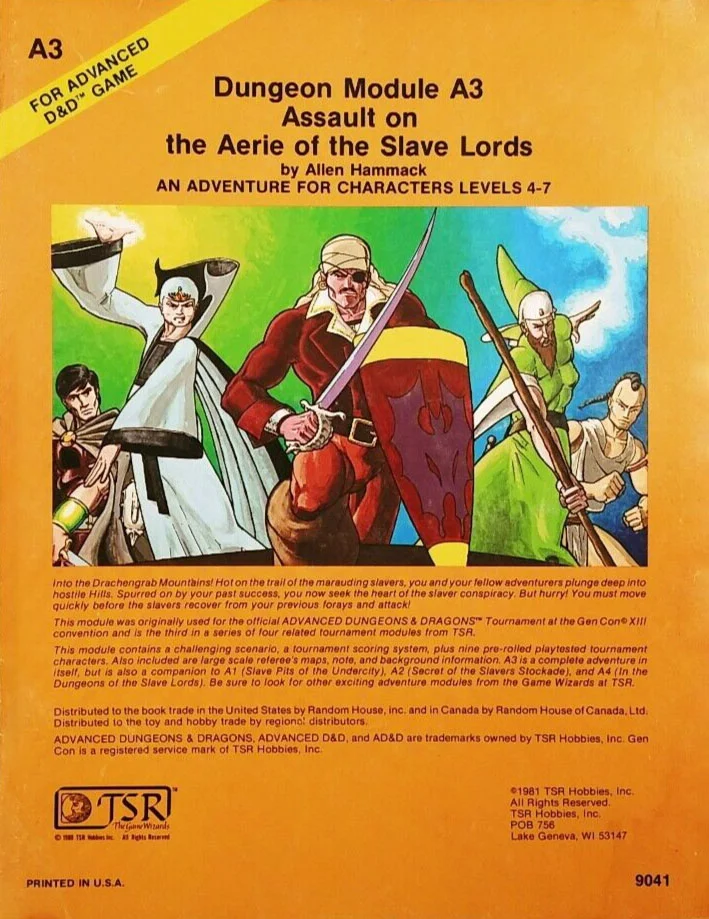
The annals of tabletop role-playing games are filled with legendary campaigns, and few stand as tall in the collective memory of Dungeons & Dragons enthusiasts as the "A-series": Against the Slave Lords. A foundational campaign for countless adventurers, this series, originally designed for tournament play, thrusts players into a desperate struggle against a shadowy, sinister organization. While the initial installments, A1: Slave Pits of the Undercity and A2: Secret of the Slavers Stockade, are widely lauded for their robust design and engaging narratives, the third chapter, A3: Assault on the Aerie of the Slave Lords, presents a more complex legacy. Designed by Allen Hammack and published by TSR in 1981, A3 is often remembered as the point where the campaign’s celebrated quality began to waver, offering a mix of brilliant concepts and frustrating execution.
This retrospective examination delves into the structure, design choices, and lasting impact of A3: Assault on the Aerie of the Slave Lords, building upon critical insights originally published in 2002. It seeks to understand why this module, despite its significant flaws, remains a notable, if challenging, piece of D&D history, and what lessons it offers for adventure design decades later.
A Campaign Unfolds: The Chronology of the Slaver Saga
The "Against the Slave Lords" series, officially designated as the A-series, is a four-part saga that forms a continuous narrative arc, propelling player characters (PCs) from initial encounters with slavers to confronting their ultimate masters. This chronological progression is crucial to understanding the context of A3.
From Pits to Stockade: Preceding Adventures
The journey begins with A1: Slave Pits of the Undercity, an adventure widely praised for its classic dungeon crawl elements and compelling introduction to the slaver menace. Players start by investigating disappearances and soon uncover a vast underground network dedicated to capturing and selling sentient beings. This module masterfully sets the tone, establishing the slavers as a formidable and cruel enemy, while providing ample opportunities for combat, exploration, and nascent role-playing.
Following the successes of A1, the adventure continues in A2: Secret of the Slavers Stockade. Here, the PCs, having gained valuable intelligence and perhaps freed some captives, transition to a more strategic infiltration mission. The focus shifts to a heavily guarded stockade, where they must navigate a complex fortress, gather more clues, and further dismantle the slaver operations. A2 builds upon the foundation of A1, deepening the mystery and raising the stakes, offering a satisfying blend of tactical combat and investigative role-playing. Both modules are generally considered strong examples of early AD&D adventure design, requiring little more than minor adjustments from the Dungeon Master (DM) to run effectively.
A3: The Assault Begins
A3: Assault on the Aerie of the Slave Lords marks a significant turning point in the campaign, both narratively and in terms of its design reception. Published in 1981, at a time when Advanced Dungeons & Dragons was rapidly expanding its module library, A3 was intended to escalate the conflict dramatically. Having garnered leads from A2, the PCs are now on a proactive hunt, venturing deep into the treacherous Pomarj – a notorious wasteland infested with hostile humanoid tribes. Their ultimate goal: to locate and infiltrate the hidden stronghold of the Slave Lords themselves.
The module’s narrative is conceptually structured into three distinct acts, each designed to challenge the players in different ways as they close in on the slaver leadership:
- The Caves of Drachensgrab: This initial phase involves penetrating the "rocky slope of a steep hill" in the Pomarj, where the hidden entrance to the slaver stronghold is rumored to lie. It’s envisioned as an advanced spelunking expedition, fraught with environmental hazards and unexpected encounters.
- The Hidden City of Suderham: Should the PCs successfully navigate the subterranean labyrinth, they emerge into an entire city concealed within the mountains. This section tasks the players with maintaining a low profile, gathering intelligence, and finding a way into the Slave Lords’ inner sanctum.
- The Catacombs: The final approach to the Slave Lords’ council chamber is through a network of sewers and catacombs beneath Suderham, presenting a gauntlet of traps and defenses leading directly to the heart of the enemy’s power.
This ambitious three-part structure promises an epic conclusion to the direct pursuit of the slavers. However, as contemporary and retrospective analyses highlight, the execution of this grand vision proved to be a mixed bag, introducing elements that would test the patience and ingenuity of many DMs and players alike.
Deconstructing the Design: Strengths and Weaknesses
The critical assessment of A3: Assault on the Aerie of the Slave Lords often hinges on its striking dichotomy: a brilliant overarching concept marred by questionable specifics and design choices that frequently undermine player agency and logical consistency.
The Labyrinth of Drachensgrab: A Study in Illogic
The first section of A3, "The Caves of Drachensgrab," is perhaps the most heavily criticized. While conceptually sound – an infiltration through a natural, treacherous environment – its detailed execution is where the module often falters. The review notes describe it as "advanced spelunking with as many illogical twists as Allen Hammack could dream up," triggering "Absurdity Meters" for its barrage of "illogical contrivance."
To elaborate, consider the examples provided:
- Gnolls: While the Pomarj is indeed home to humanoid tribes, their specific placement and behavior within a hidden, highly secured entrance to a slaver stronghold often strains credulity. Are they guards? Random encounters? Their presence needs to be logically integrated into the slaver’s defense strategy, which the module reportedly fails to do adequately. Their inclusion often feels arbitrary rather than organic.
- Salt Slides: These environmental hazards, while potentially interesting, require careful justification. How do they form in a hidden cave system? Are they naturally occurring or deliberately engineered by the slavers? Without a clear explanation, they can feel like a random obstacle placed purely for effect, breaking immersion.
- Bizarre and Improbable Traps: The general complaint about "bizarre and improbable traps" suggests a lack of realism or internal consistency. Traps should ideally reflect the intelligence and resources of their creators, and serve a clear defensive purpose. If they are overly complex, nonsensical, or easily triggered by the designers themselves, they can become frustrating puzzles rather than engaging challenges.
- Piercers: These classic D&D monsters, disguised as stalactites, are a staple of subterranean adventures. However, their repeated or overly dense placement can quickly become monotonous, feeling like a cheap trick rather than a genuine threat.
- Storoper: A "roper which looks like a stalagmite instead of a tree" is a prime example of an attempt at novelty that risks absurdity. While Dungeons & Dragons thrives on imagination, the "storoper" highlights a design tendency to invent new, often less convincing, variations of existing monsters without a compelling ecological or narrative reason. A roper’s natural camouflage as a tree stump works because trees exist on surfaces; a stalagmite roper might stretch the suspension of disbelief if not presented with extreme care and logical explanation within the cave’s ecosystem.
The cumulative effect of these elements is a section that, for many DMs, becomes essentially "unplayable as written." The constant need to rationalize or redesign these encounters to make them believable within the game world places an undue burden on the Dungeon Master, detracting from the overall enjoyment and flow of the adventure.
Suderham: A Glimmer of Brilliance
In stark contrast to the Drachensgrab caves, "The Hidden City of Suderham" emerges as the module’s undeniable highlight and its most significant strength. This section showcases Hammack’s ability to craft truly awe-inspiring environments, demonstrating a masterful command of world-building that elevates the entire adventure.
The concept of "an entire city hidden away in the heart of the mountains and serving the Slave Lords’ every whim" is, by itself, a stroke of genius. It implies immense power, secrecy, and resources on the part of the slavers, elevating them beyond mere dungeon inhabitants to a truly formidable organization. The module’s execution of this concept is robust:
- Complete Encounter Key: The inclusion of "a complete encounter key for the entire city, detailing every building" is a gold standard for urban adventures. This level of detail provides DMs with a rich tapestry of information, allowing for dynamic role-playing, infiltration, espionage, and social interaction. Players aren’t just moving through rooms; they’re navigating a living, breathing, albeit sinister, community. This detail fosters genuine player agency, allowing them to choose their approach, gather intelligence, and interact with the city’s inhabitants, rather than being pushed along a predetermined path.
- Premise Strength: The sheer premise of a hidden city is inherently strong, evoking a sense of wonder and danger. For players emerging from the claustrophobic caves to behold "the Hidden City sprawled out beneath them," a "moment of silence invariably settles over the group." This powerful emotional response is a testament to effective environmental storytelling and visual design, even if only through descriptive text and maps.
- Player’s Map: The provision of a Player’s Map for Suderham is another crucial element contributing to its success. A visual representation allows players to strategize, explore, and immerse themselves more fully in the environment, fostering a sense of discovery and tactical planning that is often absent when relying solely on verbal descriptions.
The Hidden City portion of A3 works because it provides a logical, believable (within its own fantasy context) framework for player interaction and investigation. It allows for creativity and role-playing, making it a standout section that compensates, to some extent, for the flaws elsewhere.
The Catacombs and the Tournament’s Shadow
The final approach, through "The Catacombs" beneath Suderham, brings players closer to the Slave Lords’ Council Chamber. Here, the designer "is able to find a bit more logic on which to hang his improbabilities" because, in a hidden sewer and catacomb system, "there should be no regular, legitimate traffic." This justification allows for a more plausible placement of traps and defenses, as the Slave Lords would naturally fortify their direct access routes with extreme measures, knowing only intruders would venture there. This section, while potentially still prone to Hammack’s flair for unusual obstacles, benefits from a stronger narrative rationale for its challenges.
However, the climax of the module introduces another significant point of contention: the "tournament background" of the A-series. These modules were originally designed for competitive D&D tournaments, which often necessitated a degree of narrative control to ensure all teams progressed to the next stage or concluded their session within time limits. This design constraint manifests in A3‘s ending with a stark choice for the DM: either "railroading a loss here (thus prompting A4: In the Dungeon of the Slave Lords)" or "letting the PCs mop up the Slave Lords."
This "railroaded loss" is a severe flaw from a modern, and even many contemporary, role-playing perspectives. It undermines player agency, negates the cumulative efforts of the PCs, and forces a predetermined outcome that can feel unfair and frustrating. While the module designers intended this to seamlessly transition into A4, where the captured PCs would then have to escape, it does so at the cost of player choice and satisfaction in A3. The review correctly points out that "the module isn’t going to provide you with any guidance here" on how a DM might restructure the encounter to avoid such a heavy-handed outcome, leaving the burden of narrative correction entirely on the DM. This highlights a common pitfall of early module design, where narrative necessity (especially for series progression) sometimes overshadowed the core principle of player freedom in tabletop RPGs.
Finally, the critique notes that the "Slave Lords simply don’t affect the course of the module at all." Despite the title, Assault on the Aerie of the Slave Lords, the adventure often feels like "nothing more than a mediocre dungeon crawl." The promise of a dynamic assault, with the enemy actively reacting and defending, is largely unfulfilled. The Slave Lords remain static obstacles rather than active antagonists, further diminishing the sense of an epic confrontation and making the title feel somewhat misleading.
Official Response and Design Philosophy
Understanding A3 requires placing it within the broader context of TSR’s module production in the early 1980s and the evolving design philosophy of Dungeons & Dragons.
TSR’s Vision for Adventure Modules
In the nascent days of AD&D, TSR was rapidly expanding its product line, creating a vast library of adventures to support the burgeoning popularity of the game. This period was characterized by a diverse range of designers, each bringing their unique vision and style. Allen Hammack, the author of A3, was one of these contributors, having also designed other notable modules. The "A-series" itself was conceived as a high-stakes campaign, initially developed for the official D&D Open tournament at Gen Con XIII in 1980. This tournament origin profoundly influenced the design of all A-series modules, particularly in how they handled progression and player outcomes.
The pressures on designers during this era included:
- Rapid Production: The demand for new content was high, leading to relatively short development cycles.
- Varied Design Approaches: There wasn’t a single, universally codified "best practice" for adventure design; experimentation was common.
- Tournament Constraints: The need to create adventures that could be run efficiently, scored, and lead to specific outcomes for tournament play often meant sacrificing some elements of open-ended role-playing in favor of more structured, linear progression. The "railroaded loss" in A3 is a direct consequence of this, ensuring that players would transition to A4 (which was also a tournament module focusing on escape).
From an "official response" perspective (as in, the implicit design intent from TSR), A3 was likely viewed as a crucial narrative bridge, designed to move the campaign forward to its final, challenging chapter. Its strengths, particularly the innovative Hidden City, showcased the potential for grander, more complex environments than typical dungeon crawls. Its weaknesses, while apparent in retrospect, might have been seen as acceptable compromises for the sake of tournament functionality and campaign continuity at the time.
Critical Reception and Enduring Legacy
The original review, published in 2002, offers a retrospective critical assessment, highlighting how design choices that might have been overlooked or accepted in 1981 are viewed through a more refined lens decades later. The shift in what constitutes "good" adventure design – emphasizing player agency, logical consistency, and dynamic narratives over rigid progression – makes A3‘s flaws more pronounced.
Despite these criticisms, A3 holds an enduring, if complex, legacy. For many, it was one of their first D&D modules, and its groundbreaking elements, like the Hidden City, left a lasting impression. The review author’s personal anecdote – purchasing it from a used bin, poring over its pages, and struggling to understand the underground city – speaks to this enduring allure. It represents a formative experience for many GMs, even if it required significant effort to make it playable.
The module’s recommendation as a "worthwhile purchase" for $5 (in 2002, for its digital re-release) underscores this point. The value proposition isn’t that it’s a perfect, ready-to-play adventure, but rather that it contains enough "raw material" and "good ideas" – primarily the structural outline and the stellar Hidden City content – to justify the investment. It’s a "fixer-upper" module, providing a solid foundation upon which a dedicated DM can build, adapting and refining its less successful elements. This perspective acknowledges that even flawed classics can contribute significantly to a DM’s toolkit and creative process, serving as a springboard for their own unique campaigns. The continued availability of such modules on platforms like DMsGuild further solidifies their place in the game’s history, allowing new generations to experience and interpret these seminal works.
Implications for Game Design and Player Experience
The design of A3: Assault on the Aerie of the Slave Lords offers valuable insights and lessons that remain relevant for adventure designers and DMs today, touching upon core tenets of tabletop role-playing.
The Delicate Balance of Logic and Imagination
A3 serves as a compelling case study in the delicate balance between creative imagination and internal logical consistency. While Dungeons & Dragons is inherently fantastic, players still require a degree of believability within the established rules of the world. When creative elements, such as the "storoper" or "salt slides," lack a plausible explanation or seem arbitrarily placed, they can shatter the suspension of disbelief.
Lessons for designers:
- Grounding Fantasy: Even the most fantastical elements benefit from a logical underpinning. Why does this creature exist here? How does this trap function? What is its purpose?
- Purposeful Placement: Every encounter and environmental detail should ideally serve a narrative or thematic purpose, rather than simply existing as a random obstacle.
- DM Burden: Designers must consider the amount of "fix-it" work they are implicitly offloading onto the DM. Overly illogical or poorly explained sections can lead to DM burnout and a less satisfying experience for players.
Player Agency vs. Narrative Control
The issue of the "railroaded loss" at the module’s climax is a critical lesson in player agency. In a game built on player choice and consequence, forcing a predetermined outcome, especially a defeat, can be incredibly frustrating. It negates the players’ efforts, diminishes their sense of accomplishment, and undermines the very premise of role-playing freedom.
Lessons for designers:
- Meaningful Choices: Provide players with genuine choices that have significant consequences, both positive and negative.
- Failing Forward: If a specific outcome is desired for narrative progression (e.g., capture to lead into an escape module), design it so that even "failure" feels earned, or at least provides alternative paths, rather than being imposed.
- DM Guidance: If a module presents a complex narrative pivot, offer DMs advice on how to handle it gracefully, allowing for player agency while still steering the story in the intended direction. This could involve multiple failure states, or alternative successes that still lead to the next chapter.
The Enduring Appeal of Classic D&D
Despite its identified flaws, A3 also exemplifies the enduring appeal of classic D&D modules. It demonstrates that even imperfect adventures can hold significant value due to:
- Nostalgia and Historical Significance: These modules are artifacts of RPG history, representing the foundational texts that shaped the hobby.
- Raw Potential: A good core idea, like the Hidden City of Suderham, can be so compelling that it outweighs weaker elements, serving as a powerful inspiration for DMs to adapt and improve upon.
- DM Creativity: Modules like A3 inadvertently foster DM creativity, challenging them to take a base concept and make it their own, customizing it for their group. This act of adaptation is a fundamental skill for many DMs, and these older modules often provide ample opportunity for it.
The fact that A3 continues to be discussed, reviewed, and made available decades after its initial publication speaks to the lasting power of its core concepts and its place in the collective consciousness of D&D. It’s a testament to the game’s ability to inspire imagination, even when the initial blueprints are less than perfect.
Conclusion
A3: Assault on the Aerie of the Slave Lords stands as a complex and somewhat contradictory chapter in the legendary "Against the Slave Lords" campaign. While A1 and A2 are celebrated for their strong execution, A3 marks a discernible dip in consistency, presenting a module that is at once ambitious in scope and flawed in detail. Its "Caves of Drachensgrab" suffer from a barrage of illogical contrivances, and its climax is marred by the specter of a railroaded narrative, a remnant of its tournament origins.
Yet, to dismiss A3 entirely would be a disservice. Its overarching structure—the journey through treacherous caves, infiltration of a hidden city, and final assault through catacombs—is conceptually brilliant. More importantly, the "Hidden City of Suderham" stands out as a genuine masterpiece of adventure design, offering a richly detailed, awe-inspiring environment that provides ample opportunities for player agency and immersion. This singular strength, combined with the module’s historical significance, makes it a valuable, albeit challenging, piece of D&D lore.
Ultimately, A3: Assault on the Aerie of the Slave Lords serves as a potent reminder of the evolving art of adventure design. It highlights the delicate balance between creative freedom and logical consistency, and the paramount importance of player agency. While it demands significant effort from the Dungeon Master to reach its full potential, its raw ideas and moments of brilliance ensure its continued relevance as both a historical artifact and a challenging, yet rewarding, "fixer-upper" for those willing to wield the editor’s pen. The saga of the Slave Lords, despite this uneven chapter, remains a cornerstone of D&D’s legacy, prompting adventurers to prepare for the final, desperate struggle in A4: In the Dungeons of the Slave Lords.