Beyond the Digital Void: How Infinidream.ai is Reimagining the Silent Screen
In the modern interior, the computer monitor is a dominant but often dormant architectural feature. When not in use, these high-resolution displays—capable of producing millions of colors and deep, cinematic blacks—typically revert to a "dead" state: a literal black void or, perhaps worse, a utilitarian clock face that serves as a stark reminder of time’s passage. This "dead screen problem" has long been an aesthetic hurdle for both home offices and professional environments.
Enter Infinidream.ai, a new application for Mac and Windows that seeks to transform these idle displays into "living" AI paintings. Developed by generative art pioneer Scott Draves, Infinidream.ai is not a mere slideshow or a collection of looping videos. Instead, it utilizes generative artificial intelligence to create a continuous, evolving stream of ambient art that shifts in real-time, effectively turning a workstation into a piece of kinetic sculpture.
Main Facts: The Emergence of Ambient AI Art
Infinidream.ai represents a significant shift in how we interact with secondary digital spaces. While the primary use of a computer is active—work, communication, or entertainment—Infinidream addresses the hours of "passive" time when a machine is powered on but the user is not engaged.
A New Class of Software
The application functions as both a dedicated fullscreen art player and a traditional screensaver. Unlike existing solutions that rely on pre-recorded footage, Infinidream employs generative algorithms to ensure that the art is never static. Each visual sequence is unique, drifting and morphing through states that feel deliberate yet unpredictable.
Key Features and Accessibility
- Platform Support: Available for both macOS and Windows.
- Generative Engine: The software uses AI to "breathe" life into artworks, allowing them to evolve over time rather than repeating on a loop.
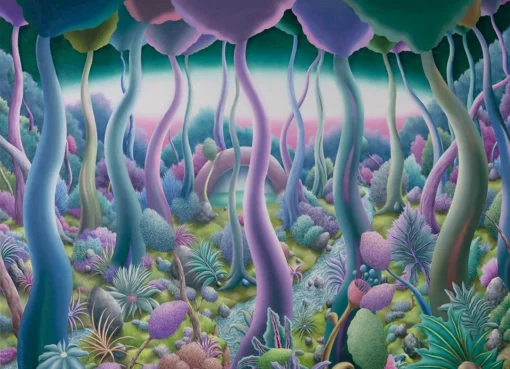
- Curated Styles: The platform features a diverse range of styles from dozens of AI artists, ranging from moody abstractions to hypnotic, surrealist landscapes.
- Customization: Users can adjust the "tempo" of the art—ranging from a slow, glacial drift that changes the mood of a room over hours, to more energetic movements that mimic burning fire or flowing water.
- Freemium Model: The app is free to try with an account, lowering the barrier for entry for users curious about integrating AI art into their daily environments.
Chronology: From Distributed Supercomputers to AI Dreams
To understand the significance of Infinidream.ai, one must look at the lineage of its creator, Scott Draves. A New York-based artist and software engineer, Draves has spent over three decades at the intersection of mathematics, code, and aesthetics.
1999: The Birth of Electric Sheep
In 1999, Draves launched Electric Sheep, one of the most ambitious experiments in the history of generative art. Named after Philip K. Dick’s novel Do Androids Dream of Electric Sheep?, the project was a distributed computing screensaver. It linked hundreds of thousands of computers worldwide into a single networked supercomputer.
Each participating machine would render a small piece of an evolving fractal animation (a "sheep"). Users would vote on their favorite animations, and the underlying genetic algorithm would "breed" the most popular sheep to create new generations. At its peak, the network included over 450,000 computers. The project was so culturally and technically significant that it was exhibited at major institutions, including the Museum of Modern Art (MoMA) and the Los Angeles County Museum of Art (LACMA).
2000s–2020: The Evolution of Generative Tools
Throughout the early 21st century, Draves continued to refine the "Flame" algorithm (which he invented) and explored the possibilities of algorithmic art. However, the limitation of this era was the computational cost of rendering high-fidelity visuals in real-time. Art was often pre-rendered or restricted to specific mathematical patterns like fractals.
2024: The AI Inflection Point
With the explosion of Generative AI and the increase in consumer-grade GPU power, the technical barriers that existed during the Electric Sheep era have dissolved. Infinidream.ai serves as the spiritual successor to Draves’ earlier work. It transitions from the purely mathematical world of fractals into the broader, more evocative world of AI-generated imagery, leveraging the same instinct for evolving, "living" art but with the vastly expanded creative palette of modern machine learning models.
Supporting Data: The Technology and the Artist Collective
The technical foundation of Infinidream.ai distinguishes it from standard "ambient" apps found on smart TVs or tablets.
Real-Time Generation vs. Static Loops
Traditional ambient videos (such as "fireplace" or "aquarium" loops) suffer from the "seam" problem—the moment the video restarts, the human brain often notices the repetition, breaking the immersion. Data from cognitive psychology suggests that "soft fascination"—the kind provided by natural movements like swaying trees or moving clouds—helps in restoring attention and reducing stress. By using generative AI, Infinidream provides this soft fascination without the distracting repetition of a video loop.
The Artist Ecosystem
Infinidream is not a closed system; it acts as a gallery for a curated group of AI artists. By integrating dozens of different styles, the app avoids the visual fatigue that comes from a single aesthetic. The styles are categorized by "moods," allowing the user to select visuals that complement their current environment or emotional state.
Resource Efficiency
A common concern with generative software is the strain on system resources. Infinidream is designed to run in the background, optimized for modern desktop architectures to ensure that it adds "ambient energy" without causing significant fan noise or slowing down other applications—a critical requirement for a tool designed to live on a primary workstation.

Official Responses and Creative Philosophy
Scott Draves views the "dead screen" not just as a missed opportunity for decor, but as a failure of the digital environment to adapt to human presence.
The "Calder Mobile" Comparison
Draves often compares Infinidream to a Calder mobile or a kinetic sculpture. "Think of art that is never quite the same twice, that has duration as well as form," the project’s documentation states. This philosophy emphasizes that the art is a process, not a product. It is meant to be experienced over time, much like the changing light in a room.
The Gallery Mentality
Regarding the intensity of the visuals, the Infinidream team notes that most art demands active attention. Infinidream is designed to do the opposite. It is described as having "as much lighting as a gallery"—intended to run quietly in the peripheral vision. "It’s the kind of thing that makes a space feel different without demanding anything from you," Draves explains.
This approach aligns with the concept of "Calm Technology," a term coined by researchers at Xerox PARC, which describes technology that stays in the periphery of our attention but is available when needed.
Implications: The Future of the Ambient Workspace
The launch of Infinidream.ai has broader implications for interior design, mental health, and the fine art market.
1. Digital Interior Design
As remote work becomes a permanent fixture for millions, the home office has transitioned from a temporary setup to a permanent room requiring curation. Infinidream suggests a future where digital screens are treated as dynamic "wallpaper" or windows into virtual spaces, rather than just tools for spreadsheets and video calls. This could lead to a new category of "ambient hardware"—displays designed specifically to run generative art in living spaces.
2. The Democratization of Fine Art
Historically, owning a "living" or kinetic art piece was the province of wealthy collectors and museums. By moving this experience to the desktop, Draves is democratizing the concept of the "evolving painting." Any user with a standard PC can now host a museum-grade generative experience that would have required a dedicated server rack twenty years ago.
3. AI as a Collaborative Tool
Infinidream also highlights a positive use case for AI in the creative arts. Rather than replacing the artist, the platform provides a new medium for artists to reach audiences. The AI acts as the "brush" that allows the artist’s vision to shift and change autonomously, creating a symbiotic relationship between human curation and machine execution.
4. Psychological Well-being
In an era of "notification fatigue," the presence of a non-demanding, beautiful visual source can act as a digital palate cleanser. By replacing the stress-inducing "giant white numerals" of a clock with abstract, shifting forms, Infinidream may offer a subtle but effective way to lower cortisol levels in high-pressure work environments.
Conclusion: Beauty as a Utility
The core argument of Infinidream.ai is simple: "Your screen is on anyway. It might as well be beautiful."
As we continue to surround ourselves with high-powered displays, the way we utilize their idle time will become an increasingly important part of our digital hygiene. Scott Draves and the team behind Infinidream.ai are betting that the future of the screen isn’t dark—it’s a dreaming, evolving canvas. By bridging the gap between the groundbreaking networked experiments of the 90s and the sophisticated AI of the 2020s, Infinidream.ai offers a glimpse into a world where our technology doesn’t just work for us, but breathes with us.
For those looking to reclaim their digital space from the "black void," Infinidream.ai is available now for download, marking the next chapter in the long, strange, and beautiful history of generative art.