
Bridging Narrative Worlds: Unpacking the Nuances of Eastern and Western Story Structures
By Oliver Fox
In an increasingly interconnected world, the art of storytelling finds itself at a fascinating crossroads. For years, many writers and critics have grappled with the dominance of Western narrative frameworks, particularly the ubiquitous Monomyth, often perceived as the sole blueprint for compelling storytelling. This has led to a growing curiosity about alternative structures, with a particular spotlight on the East Asian model known as Kishōtenketsu. This article delves into the intricacies of both Western and Eastern narrative approaches, examining their philosophical underpinnings and exploring whether they are indeed disparate opposites or complementary facets of the human experience.
The Monomyth’s Reign and the Call for Diversity
The landscape of contemporary narrative structure often appears dominated by variations of the Monomyth, a cyclical hero’s journey famously popularized by Joseph Campbell. This structure typically involves a protagonist leaving their ordinary world, facing trials and tribulations, achieving a significant goal, and returning home transformed. As writer K.M. Weiland notes in her introduction to this piece, requests to explore Eastern story structures, specifically Kishōtenketsu, have been a recurring theme among her readership. This reflects a broader desire for narrative diversity and a potential weariness with the perceived predictability of the Monomyth.

Oliver Fox, a returning guest contributor, has long been an advocate for a deeper understanding of narrative shape. He observes a common sentiment among writers lamenting the lack of structural diversity, often contrasting the pervasive Monomyth with models like Kishōtenketsu. The latter is frequently lauded as a "plotless" structure, a concept that often sparks debate, with some proponents suggesting that critics simply "don’t get it." Fox’s exploration aims to move beyond this potentially divisive rhetoric, seeking to understand the philosophical foundations and relational dynamics between these distinct storytelling traditions.
Deconstructing Western Narrative: The Proactive Monomyth
At the heart of much Western storytelling lies a proactive, conflict-driven approach, often distilled into frameworks like Dan Harmon’s "Story Circle," a popular simplification of the Monomyth. This structure emphasizes a journey characterized by desire, conflict, and suspense, propelling the narrative forward through a series of dramatic questions.
The Story Circle (Harmon): A Linear Progression of Action

- You: The protagonist in a zone of comfort.
- Need: They want something.
- Go: They enter an unfamiliar situation.
- Search: They look for what they need.
- Find: They get what they wanted.
- Take: They pay a heavy price for it.
- Return: They go back to their familiar situation.
- Change: They have changed.
This model, exemplified by epic quests like The Lord of the Rings, hinges on the protagonist’s active pursuit of a clearly defined objective. The narrative thrives on the tension generated by the obstacles encountered on this path. The driving engine of these stories is often the exploration of dramatic questions such as:
- Will the protagonist achieve their goal?
- What sacrifices will they have to make?
- How will they overcome the insurmountable odds?
- What will be the ultimate consequence of their actions?
The Monomyth, in its various forms, is a testament to a worldview that values individual agency, the pursuit of ambition, and the transformative power of overcoming external challenges.
Unveiling Kishōtenketsu: The Gentle Flow of East Asian Narrative
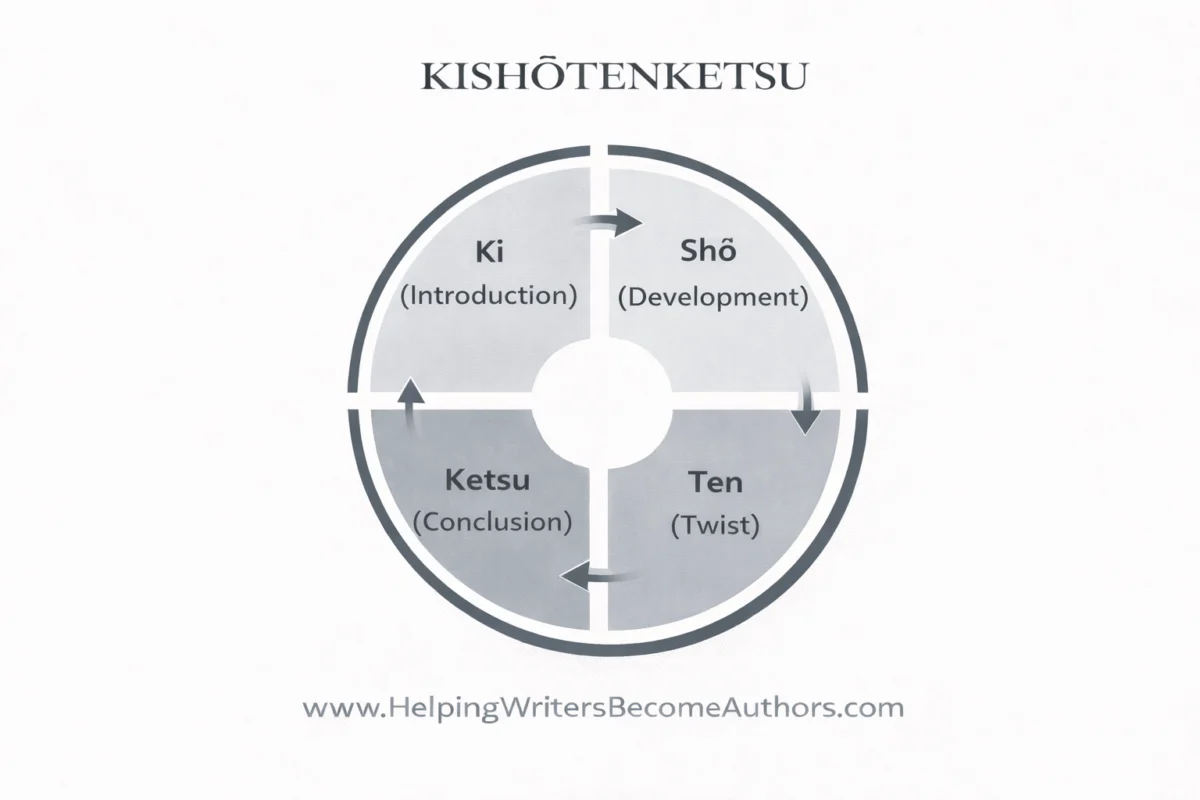
In contrast to the direct, conflict-oriented Western model, Kishōtenketsu presents a different, yet equally potent, approach to narrative. Originating from classical Chinese poetry and prevalent across East Asian storytelling, this four-act structure prioritizes development and contrast over escalating conflict. Its power lies in a pivotal "twist" or "turn" that reframes the preceding narrative.

Kishōtenketsu: A Four-Act Cycle of Development and Revelation
- Ki (起 – Introduction): This act introduces the characters, setting, and the initial premise of the story. It establishes the status quo and familiarizes the audience with the narrative world.
- Shō (承 – Development): Here, the story builds upon the introduction. Events unfold, characters engage with their environment, and the initial themes are explored and expanded. This act focuses on the progression of the narrative without necessarily introducing overt conflict.
- Ten (転 – Twist/Turn): This is the crucial turning point of Kishōtenketsu. It introduces an unexpected development, a new perspective, or a surprising revelation that recontextualizes everything that has come before. This twist is not necessarily a conflict but a shift in understanding or circumstance.
- Ketsu (結 – Conclusion): The final act integrates the elements introduced and developed, and critically, resolves the implications of the "Ten" act. It brings the story to a satisfying close, often with a sense of reflection or integration.
A widely cited example of Kishōtenketsu is Studio Ghibli’s Kiki’s Delivery Service. Kiki, a young witch, embarks on her coming-of-age journey to find her magical talent in a new town. Unlike a typical Monomyth protagonist with a specific, quantifiable goal, Kiki’s journey is more about adaptation and self-discovery. She relocates, takes a job as a delivery girl, and the narrative’s pivotal twist arrives when, for reasons that are subtly explored, she loses her ability to fly on her mother’s broomstick. The final act focuses on her grappling with this loss and finding a new path forward. The preceding acts are characterized by quiet vignettes that allow the audience to understand Kiki and her interactions with the townspeople, fostering a sense of gentle narrative progression.
The absence of a predefined, high-stakes goal in Kiki’s Delivery Service, and by extension in Kishōtenketsu, allows for a different kind of narrative engagement. The focus shifts from "try-fail cycles" to observing how characters adapt and develop within their circumstances.

Structural Divergences: Timing of Disruption
A key structural difference lies in the timing of the most significant disruption or turning point. In the Monomyth, this disruption typically occurs early in the narrative, often with the "Call to Adventure." This immediately sets the protagonist on their transformative path, creating immediate stakes and driving the plot forward with urgency.
Conversely, in Kishōtenketsu, the most significant moment of disruption or recontextualization arrives much later in the story, within the "Ten" act, just before the final resolution. This creates a mirrored structural rhythm. While the Monomyth’s disruption incites action and propels the protagonist outwards, the Kishōtenketsu twist invites introspection and re-evaluation, often leading to a more internal shift or a change in perspective rather than an external conquest. This difference in emphasis on the timing and nature of disruption highlights the distinct philosophical underpinnings of each structure.
Philosophical Foundations: Telos vs. Harmony
The divergent structural approaches are deeply rooted in distinct philosophical traditions. Western narrative, heavily influenced by thinkers like Aristotle, often embodies the concept of telos, or the "final cause." This philosophical idea posits that everything has an inherent purpose or end goal toward which it strives. In storytelling, this translates to characters actively pursuing a defining objective that grants their lives ultimate meaning. The virtuous ideal is often one of determined individuals striving to achieve a clear, self-defined end.

Eastern philosophical traditions, such as Taoism, Confucianism, and Buddhism, tend to emphasize harmony. Lao Tzu advocated for wu wei, or effortless action, suggesting a harmonious alignment with the natural order by flowing with events rather than resisting them. Confucius highlighted social harmony through fulfilling one’s role within the community and social hierarchy. The Buddha taught non-attachment to desires as a path to harmony with reality, freeing oneself from suffering by relinquishing the grasping nature of craving. In these traditions, fulfillment is often found not in the relentless pursuit of individual goals, but in flowing with life’s rhythms, maintaining balanced relationships, and relinquishing the need for external validation or material gain.
Beyond Opposites: A Synthesis Through Vajrayana Buddhism
At first glance, the Monomyth and Kishōtenketsu, along with their associated philosophical underpinnings, appear to be diametric opposites. One champions the active, ambitious individual overcoming obstacles, while the other celebrates the adaptable individual flowing with life’s currents. One appears driven by external conflict and the other by internal realization or contextual shifts.
However, Oliver Fox proposes a more nuanced perspective, drawing parallels with the principles of Vajrayana Buddhism. He suggests that these narrative structures, rather than being irreconcilable opposites, represent complementary phases of a larger human cycle. Vajrayana Buddhism articulates this through "The Way of Method" and "The Way of Release."

- The Way of Method: This aligns with the active, striving nature of Western narrative structures. Practitioners engage in transformative practices, visualizing themselves as heroes or deities, undertaking symbolic quests, and overcoming inner obstacles. This is akin to the protagonist’s journey in the Monomyth, where effort, ritual, and active engagement lead to transformation.
- The Way of Release: This resonates with the more receptive, flowing nature of Kishōtenketsu. Here, striving is let go, and individuals rest in an open awareness, having internalized qualities through method. Integration replaces effort, and the focus shifts to embodying learned wisdom and compassion in the world. This mirrors the narrative resolution in Kishōtenketsu, where the twist leads to a period of integration and understanding.
Vajrayana Buddhism posits that both these modes are essential. The cycle involves actively engaging in transformation (Method) and then resting in that transformed state (Release). Crucially, it acknowledges that after a period of integration, one may need to embark on new quests, initiating another cycle of striving and becoming.
Conclusion: A Harmonious Cycle of Narrative and Human Growth
Ultimately, Western and Eastern narrative structures may not be opposing forces but rather distinct articulations of a shared human process.
- Western structures, like the Monomyth, often emphasize the "Becoming" phase: the active pursuit of transformation, the journey of striving, and the overcoming of external challenges. This is where the hero answers the call, faces trials, and seeks to achieve a definitive goal.
- Eastern structures, such as Kishōtenketsu, often highlight the "Being" phase: the integration of experience, the adaptation to new realities, and the quiet unfolding of understanding. This is where the protagonist experiences a shift in perspective, finds harmony, and embodies their learned wisdom.
Together, these narrative models paint a picture of a dynamic, living cycle: striving and resting, becoming and being, journeying and abiding. We set out to transform, return to integrate what we have gained, and eventually depart again for the next stage of development. The Monomyth captures the impetus for change, while Kishōtenketsu illustrates the process of living within and understanding that change.

As K.M. Weiland further explores in her complementary masterclass, understanding these different phases of transformation is key to crafting compelling characters. Whether a character is driven by an ego-driven desire to conquer or a soul-driven choice to grow, recognizing these distinct modes of transformation can deepen a story’s thematic resonance and mythic power. The distinction between "karmic" arcs, where external forces necessitate change, and "dharmic" arcs, where characters consciously choose the path of transformation, offers a valuable framework for writers seeking to explore the multifaceted nature of human growth, mirroring the very ebb and flow depicted in the world’s diverse narrative traditions.
Ultimately, the conversation is not about East versus West, or Monomyth versus Kishōtenketsu. It is about recognizing the rich tapestry of human experience and how different cultures have found unique and profound ways to capture its essence through the art of storytelling. By understanding these structures not as rivals but as complementary perspectives, writers can unlock new possibilities and enrich their own narrative endeavors.




Leave a Comment