
Buckminster Fuller’s Timeless Vision: Visualizing Humanity’s Trajectory on Spaceship Earth
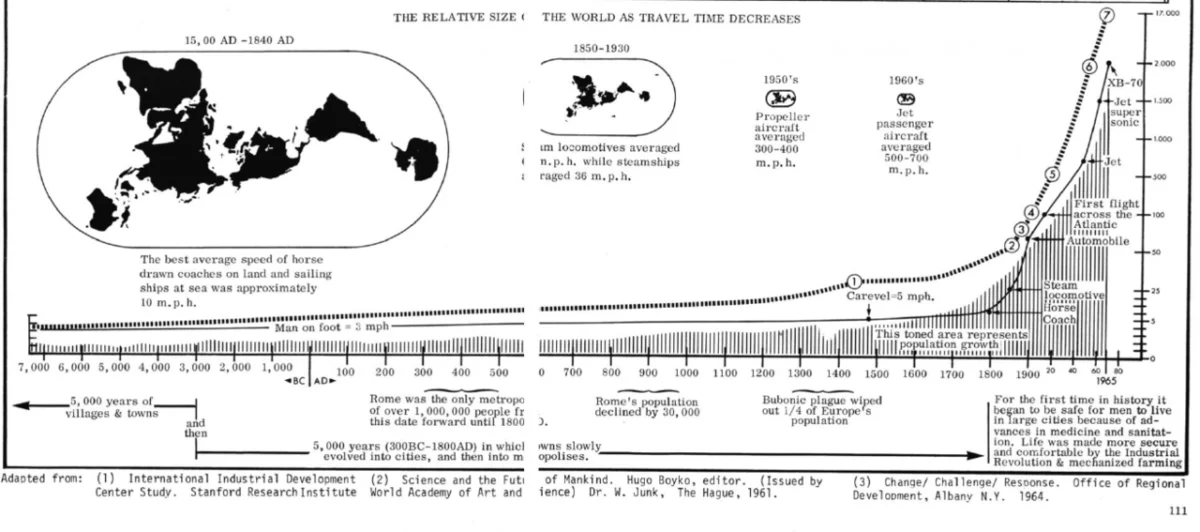
A seminal 1965 animated visualization by Buckminster Fuller offers a stark, yet hopeful, perspective on human population growth and our interconnected destiny, resonating with profound relevance today.
In a world increasingly grappling with the complexities of global sustainability, resource management, and the long-term consequences of human activity, the insights of visionary thinkers from the past hold an enduring power. Among these, R. Buckminster Fuller, the renowned architect, systems theorist, and inventor, stands out for his prescient understanding of our planet as a finite system. A remarkable testament to his foresight is an animated visualization created in 1965, which meticulously charts the exponential growth of the human population across millennia. This silent, yet potent, data visualization, originally conceived to promote a more accurate global perspective through his revolutionary Dymaxion map, continues to serve as a critical reminder of our shared responsibility and the urgent need for a long-term, holistic approach to planetary stewardship.
The Genesis of a Global Perspective: Fuller’s Imperative
Buckminster Fuller, often lauded as the "James Brown of industrial design" for his boundless energy and transformative ideas, dedicated much of his life to understanding and articulating the interconnectedness of humanity and its environment. Two of his most prominent concerns converged in this 1965 film: the accelerating, exponential spread of human population across the Earth’s finite landmass, and the critical need to adopt a revised global perspective. This revised perspective was intrinsically linked to his groundbreaking Dymaxion map, a projection designed to represent the Earth’s surface with unprecedented accuracy, free from the distortions inherent in traditional cartography.
As the Buckminster Fuller Institute aptly states, the Dymaxion map was intended "to visualize the whole planet with greater accuracy, so that we humans will be better equipped to address challenges as we face our common future aboard Spaceship Earth." This evocative phrase, "Spaceship Earth," a concept popularized by Fuller, encapsulates his profound understanding of our planet as a singular, self-contained vessel navigating the cosmos. He used this metaphor to underscore our interdependence and the shared responsibility we bear for the well-being of this fragile ecosystem, the only one known to sustain life.
Fuller’s insistence on a global perspective was not merely an intellectual exercise; it was a call to action rooted in a deep concern for the long-term consequences of human endeavors. In his seminal 1969 work, Operating Manual for Spaceship Earth, he eloquently articulated this sentiment: "We are all astronauts." Yet, he observed, we often fail to comprehend the far-reaching implications of our actions on our collective spacecraft. He argued that a primary reason for humanity’s struggles was a tendency towards "short-sightedness," where immediate gains are prioritized over long-term sustainability, leading to unforeseen and overwhelming costs down the line. This perspective is vividly illustrated in the accompanying graphic from 1965, a collaborative effort with artist and sociologist John McHale, which depicts the "shrinking of our planet by man’s increased travel and communication speeds around the globe." Fuller’s work, therefore, urged a fundamental shift in our thinking, moving beyond narrow, specialized viewpoints to embrace a comprehensive understanding of our global interconnectedness.
A Chronicle of Growth: Visualizing Humanity’s Ascent
The animated visualization itself is a powerful, silent narrative. It unfolds a compelling visual chronicle of human population growth, beginning in 1000 BCE and extending to Fuller’s contemporary period of 1965. This extended timeline allows viewers to grasp the sheer magnitude of human expansion, moving from a relatively sparse global presence to the beginnings of a demographic explosion. The visual representation transforms abstract numbers into a tangible, dynamic depiction of our species’ journey.
Fuller’s approach to data visualization was not merely about presenting facts; it was about fostering a new way of seeing and understanding complex phenomena. He recognized that traditional methods of presenting information often failed to convey the interconnectedness of systems and the long-term implications of trends. His work, therefore, was revolutionary in its attempt to bridge the gap between scientific data and public comprehension, making complex global issues accessible and actionable.
The accompanying image, created collaboratively with John McHale, further contextualizes this demographic surge by illustrating the impact of technological advancements. This graphic, also from 1965, highlights the "shrinking of our planet by man’s increased travel and communication speeds around the globe." This concept of a "shrinking planet" speaks to the increasing ease and speed with which humans can traverse the globe and exchange information, effectively diminishing the perceived distances between disparate parts of the world. The implication is that as our world becomes more interconnected, so too do our actions and their consequences. The observation that this shrinking might be "near microscopic by now" underscores the exponential acceleration of these trends in the decades since Fuller’s original work.
Fuller’s vision extended even further, encompassing a broader sweep of human history. As Rikke Schmidt Kjærgaard notes in her analysis, Fuller combined population data with technological breakthroughs from as far back as 500,000 BCE to 1965. This extended temporal scope allows for a more profound understanding of the long-term forces shaping human civilization and our relationship with the planet. By integrating population dynamics with the evolution of communication and transportation technologies, Fuller provided a panoramic view of humanity’s increasing impact on the Earth.
Supporting Data and the "Shrinking Planet" Phenomenon
The "shrinking planet" concept, vividly illustrated by the 1965 graphic, is supported by a wealth of data that Fuller and McHale meticulously gathered and interpreted. Their work predated much of the widespread adoption of global communication networks and rapid transit systems that characterize the modern era. However, even in the mid-20th century, the seeds of this interconnectedness were already being sown.
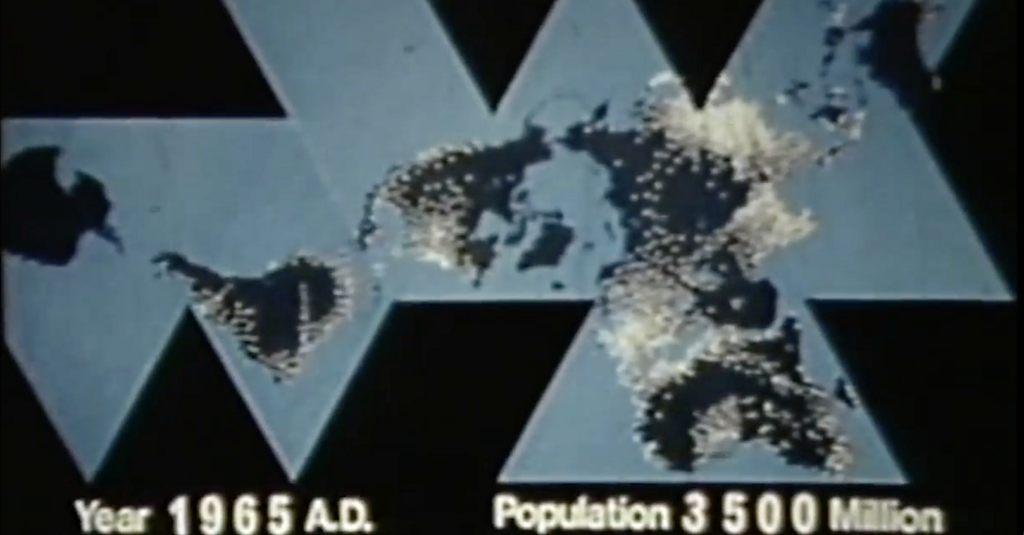
The period between 1000 BCE and 1965 saw a dramatic increase in global population. While precise figures from antiquity are difficult to ascertain, estimates suggest that the world population was around 50 million in 1000 BCE. By the start of the Common Era, it had risen to approximately 200 million. The subsequent centuries witnessed a more gradual increase, but by 1800, the population had reached about 1 billion. The 19th and 20th centuries, however, saw an unprecedented acceleration, with the global population surpassing 2 billion by 1927 and reaching over 3 billion by 1960. Fuller’s visualization captures this inflection point, where the curve of human population growth began to steepen dramatically.
Simultaneously, advancements in transportation and communication were shrinking the world. The development of steamships, railways, and later, commercial aviation, dramatically reduced travel times. The invention of the telegraph, telephone, radio, and nascent television technologies facilitated near-instantaneous communication across vast distances. This confluence of factors meant that human activity, ideas, and their consequences were spreading with increasing rapidity, making the "planet" feel smaller and more interconnected than ever before.
Fuller’s collaborative work with John McHale was crucial in translating these abstract trends into comprehensible visual forms. McHale, an artist and sociologist with a keen interest in visual communication and social change, brought a unique perspective to their joint projects. Their graphics, like the one depicting the shrinking planet, were not just informative; they were designed to provoke thought and inspire a reevaluation of our place in the world. These visualizations served as powerful tools for demonstrating how technological progress, while offering numerous benefits, also amplified the scale and scope of human impact on a global level.
Implications and Fuller’s Vision for a Resilient Planet
The profound implications of Fuller’s work, particularly his population visualization and his concept of "Spaceship Earth," extend far beyond the historical context of 1965. His insights into exponential growth and interconnectedness serve as a critical lens through which to examine contemporary challenges.
Fuller’s foresight in identifying the potential pitfalls of narrow specialization is particularly relevant in today’s complex world. He argued that a system of "narrow specializations ensures that skill sets are not comprehended comprehensively… or they are realized only in negative ways, in new weaponry or the industrial support only of war faring." This critique of fragmented knowledge and its potential for destructive application resonates deeply in an era marked by rapid technological advancement, geopolitical tensions, and environmental crises that demand interdisciplinary solutions.
However, Fuller was not one to dwell on problems without envisioning solutions. His work was fundamentally optimistic, driven by a belief in humanity’s capacity for innovation and intelligent design. He saw the planet as a "system, and a resilient one," and believed that through thoughtful design and a comprehensive understanding of its workings, humanity could thrive sustainably. His vision offered a path forward where "everyone on the planet can live in comfort and security without consuming (then not renewing) the Earth’s resources." This aspirational goal, though seemingly ambitious, underpins his lifelong commitment to finding practical, scalable solutions for global well-being.
The core of Fuller’s proposed solution lay in adopting a "long view." He urged a departure from short-term gains and profits, advocating instead for assessments of our planet’s state that consider the long-term consequences of our actions. This perspective shift is crucial for addressing issues like climate change, biodiversity loss, and resource depletion, which require sustained, multi-generational efforts. His visualizations, by demonstrating the vast expanse of time over which human population has grown, serve as a powerful reminder that the decisions made today have profound and lasting repercussions.
A Call to Action for the 21st Century
Buckminster Fuller’s 1965 animated visualization of human population growth, coupled with his profound conceptualization of "Spaceship Earth," remains remarkably prescient. In an era where the consequences of unchecked growth and unsustainable practices are increasingly evident, Fuller’s work offers not only a stark depiction of our trajectory but also a beacon of hope and a call to action.
His emphasis on a holistic, global perspective, facilitated by accurate representations of our planet, is more critical than ever. The Dymaxion map, and the spirit of comprehensive understanding it embodies, encourages us to see ourselves not as isolated inhabitants of disparate regions, but as integral parts of a single, interconnected system. This perspective is essential for fostering the cooperation and collective action needed to address the complex challenges we face.
Furthermore, Fuller’s critique of short-sightedness and narrow specialization serves as a vital reminder to prioritize long-term sustainability over immediate gratification. His belief in the power of design and innovation to create a more equitable and sustainable future continues to inspire. As we navigate the complexities of the 21st century, the lessons embedded within Buckminster Fuller’s timeless visualizations and writings offer a powerful framework for rethinking our relationship with the planet and ensuring a prosperous and secure future for all aboard Spaceship Earth. His legacy compels us to take the long view, embrace our collective responsibility, and actively design a more resilient and harmonious future.




Leave a Comment