Dungeons & Dragons Unveils Contrasting Visions for 2024 Player’s Handbook with Dual Cover Art Reveal
FOR IMMEDIATE RELEASE
RENTON, WA – [Current Date] – Wizards of the Coast, the venerable publisher behind the world’s most popular tabletop roleplaying game, Dungeons & Dragons, has unveiled a compelling dual approach to the visual identity of its upcoming 2024 Player’s Handbook. Following the recent reveal of the standard edition’s action-packed cover, the company has now showcased the alternate cover art, presenting a remarkably different, more introspective take on the adventuring experience. This strategic decision to offer two distinct covers underscores a nuanced understanding of D&D’s diverse player base and the multifaceted nature of the game itself.
Main Facts
Introduction: A Tale of Two Covers
The highly anticipated 2024 Player’s Handbook, a cornerstone of the Dungeons & Dragons core rulebook refresh, is set to arrive with a striking choice for players and collectors alike. While the standard edition’s cover art emphasizes the high-stakes combat and heroic clashes for which D&D is widely known, its recently revealed alternate counterpart offers a tranquil, character-driven scene that highlights camaraderie, exploration, and the quieter moments of adventuring. This dual presentation not only caters to varying aesthetic preferences but also symbolically encapsulates the broad spectrum of experiences Dungeons & Dragons offers, from epic battles against monstrous foes to intimate moments shared among companions. The strategic staggered release, offering the alternate cover first through local game stores, further signals a commitment to supporting the foundational retail channels of the tabletop gaming community.
The Standard Cover: A Call to Arms
The initial unveiling of the 2024 Player’s Handbook’s standard cover artwork, crafted by the renowned artist Tyler Jacobsen, immediately set an energetic tone for the forthcoming edition. This dynamic illustration plunges viewers directly into the heart of a classic D&D confrontation. It features a diverse party of iconic characters, instantly recognizable to long-time fans, including the stalwart Strongheart the Knight, the formidable Elkhorn the Dwarf Warrior, and the regal Yolande the Elven Queen. These heroes are depicted mid-battle, poised against a horde of Kobolds, one of Dungeons & Dragons’ most enduring and numerous adversaries. The scene is further elevated by the presence of a magnificent golden dragon, positioned behind the adventurers, its benevolent stance implying either an ally or a powerful guardian overseeing the skirmish.
Jacobsen’s composition is a masterclass in evoking the core fantasy elements of D&D. The vibrant colors, dynamic poses, and clear narrative of impending conflict strongly emphasize the action-adventure aspects of the game. It’s a visual declaration that this edition embraces the thrill of combat, the bravery of heroes, and the epic scale of dungeon delving and monster slaying. For many, this imagery perfectly aligns with their initial introduction to D&D—a game primarily about fighting monsters, finding treasure, and saving the day. The cover is designed to ignite the imagination of those who relish tactical combat, heroic feats, and the visceral excitement of confronting danger head-on, serving as a powerful visual anchor for the game’s long-standing reputation as the ultimate fantasy battle simulator. It’s a classic, archetypal representation of the genre, immediately signaling to both newcomers and veterans what lies within: a world of adventure where courage is tested and legends are forged through steel and spell.
The Alternate Cover: A Moment of Serenity
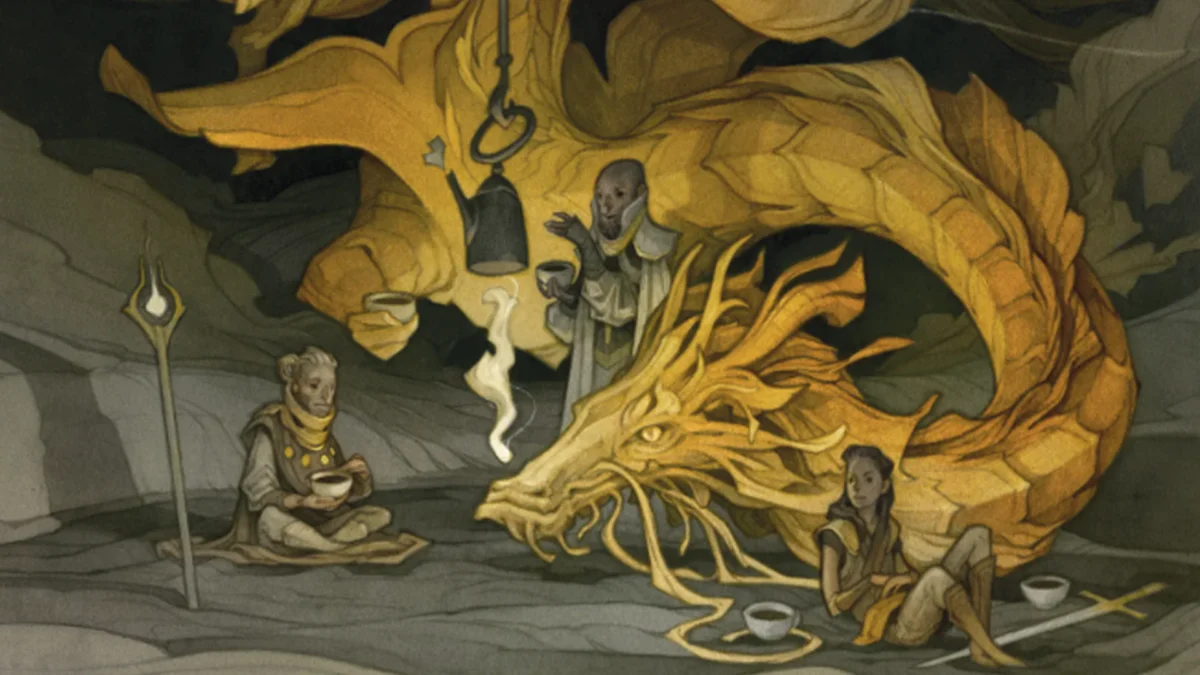
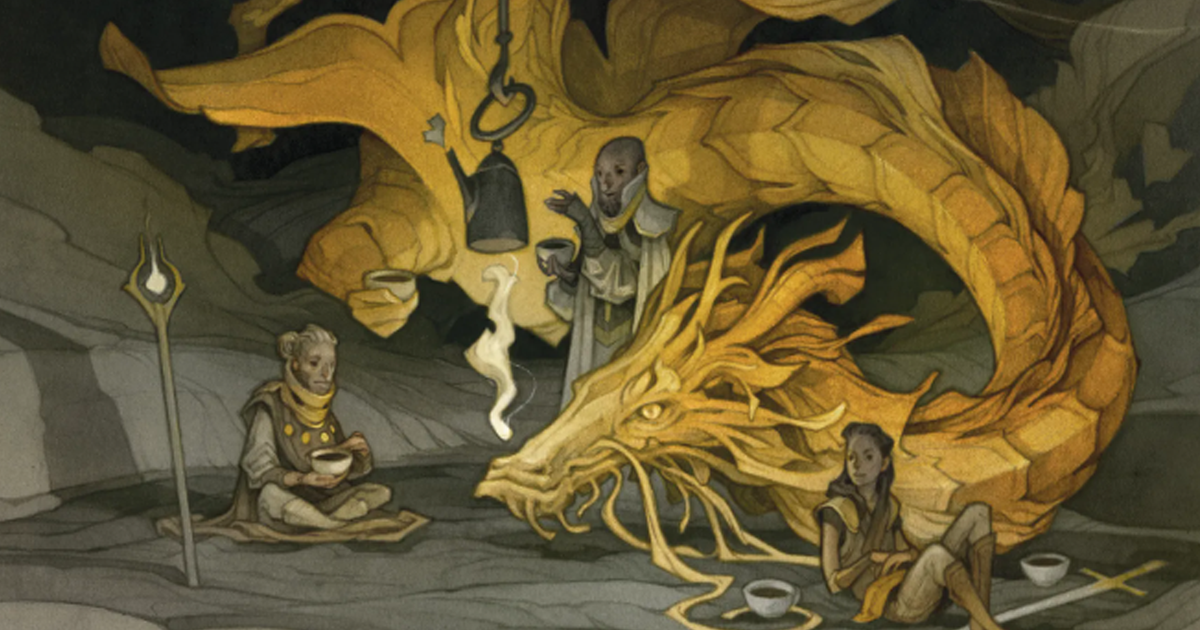
In stark contrast to the standard edition’s overt declaration of war, the alternate cover for the 2024 D&D Player’s Handbook, beautifully rendered by artist Wylie Beckert, presents a vision of D&D often cherished but less frequently depicted on front covers: the tranquil, character-driven moments of camaraderie and exploration. Beckert’s artwork transports the viewer to a serene cave setting where a classic adventuring party—comprising the quintessential wizard, cleric, fighter, and rogue—are not engaged in combat, but rather sharing a moment of peaceful respite. They are gathered around a modest pot of tea, exchanging stories or perhaps planning their next move, their faces reflecting quiet contemplation or companionable ease.
The golden dragon, a recurring motif from the standard cover, makes an appearance here too, but in a profoundly different context. Instead of a battle-ready ally, this majestic creature is depicted as a gentle giant, delicately holding a normal-sized teacup in one massive paw, its presence contributing to the scene’s whimsical charm rather than its tension. Adding to the delightful absurdity, the party’s agile rogue is playfully perched on the dragon’s immense body, underscoring the deep trust and unconventional relationships that often form within adventuring groups. Beckert’s distinctive style, characterized by its intricate details, dreamlike quality, and narrative depth, transforms a simple tea break into an evocative tableau. This cover appeals to players who find as much joy in the roleplaying, storytelling, and social interaction aspects of D&D as they do in combat. It celebrates the journey, the bonds forged between characters, and the sense of wonder that exploration brings, offering a visually compelling argument that D&D is as much about shared experiences and quiet discovery as it is about epic conflict. It’s a testament to the game’s capacity for introspection, world-building, and the profound personal stories that unfold around the table.
The Purpose of Dual Covers
The decision by Wizards of the Coast to issue both a standard and an alternate cover for the 2024 Player’s Handbook is a shrewd strategic move, reflecting a deep understanding of its diverse market. Primarily, these dual offerings cater to the varying aesthetic preferences within the expansive Dungeons & Dragons community. Some players are drawn to the heroic, action-packed fantasy epitomized by the standard cover, while others resonate more with the whimsical, character-focused, and narrative-rich imagery of the alternate edition. By providing distinct visual identities, WotC ensures that a broader spectrum of players can find a version that speaks to their personal vision of what D&D represents.
Beyond individual taste, alternate covers serve as highly coveted collector’s items. For dedicated fans and enthusiasts, these special editions represent a unique piece of D&D history, often featuring art from celebrated illustrators that deviates from the traditional house style. This collectibility drives additional sales and fosters a sense of exclusivity among those who acquire them. Furthermore, the alternate versions typically offer no mechanical differences from their standard counterparts; their value lies almost entirely in their unique aesthetic and their status as premium, often limited-run products. This strategy allows Wizards of the Coast to appeal to both the casual player seeking the core rules and the avid collector eager for a visually distinct artifact, effectively broadening the product’s market reach and reinforcing its cultural significance within the hobby. It’s a testament to the idea that the cover isn’t just a wrapper, but an integral part of the product’s identity and appeal.
Key Release Information
The rollout strategy for the 2024 Dungeons & Dragons Player’s Handbook underscores a deliberate effort by Wizards of the Coast to bolster local game stores (LGS), which serve as crucial hubs for the tabletop gaming community. The alternate version of the new D&D Player’s Handbook is slated for an exclusive early release through these independent retailers, becoming available on September 3rd. This two-week head start provides local game stores with a unique selling proposition, drawing enthusiasts into their establishments before the wider market launch.
Following this initial exclusive period, the standard edition of the Player’s Handbook, alongside the alternate version, will see its broader release across all retail channels, including major online retailers and larger chain stores, on September 17th. This staggered release not only incentivizes players to visit their local game stores, thereby supporting these vital community businesses, but also builds anticipation and excitement for the general release. It’s a well-calibrated approach designed to maximize engagement, reward community loyalty, and ensure a robust launch for one of D&D’s most significant publications in recent memory. This dual-pronged release strategy highlights WotC’s understanding of the symbiotic relationship between a global brand and its grassroots retail network.
Chronology
Evolution of D&D’s Visuals
The visual identity of Dungeons & Dragons, prominently displayed on its core rulebook covers, has undergone a remarkable evolution since its inception in the mid-1970s. Early editions, such as the original "White Box" and the Advanced D&D First Edition, featured iconic but often stark artwork that reflected the game’s nascent stages. Artists like David A. Trampier and Larry Elmore established a visual language of heroic fantasy, depicting grim adventurers, menacing dragons, and perilous dungeons. These covers, while legendary, often had a more utilitarian or illustrative feel, setting the stage for adventure rather than defining a specific mood.
With subsequent editions, particularly 2nd and 3rd Edition, the artwork became increasingly polished and cinematic, driven by artists like Clyde Caldwell, Jeff Easley, and Todd Lockwood. These covers often showcased more dynamic action scenes, detailed character designs, and richer fantasy landscapes, reflecting a growing sophistication in fantasy art and a broader appeal for the game. The 4th Edition covers leaned into a more stylized, action-oriented aesthetic, aligning with the edition’s focus on tactical combat.
The 5th Edition, released in 2014, marked a significant shift towards a more inclusive and diverse visual representation, while still honoring the game’s roots. Covers for the Player’s Handbook, Dungeon Master’s Guide, and Monster Manual presented a blend of classic iconography with modern artistic sensibilities, aiming for broad appeal. The introduction of alternate covers for 5th Edition supplements, starting notably with Xanathar’s Guide to Everything and continuing through Tasha’s Cauldron of Everything (for which Wylie Beckert also contributed), Fizban’s Treasury of Dragons, and Mordenkainen Presents: Monsters of the Multiverse, signaled a deliberate strategy to offer diverse artistic interpretations and cater to collector demand. This history demonstrates a continuous effort by Wizards of the Coast to evolve D&D’s visual presentation, ensuring it remains fresh, relevant, and appealing to an ever-expanding global audience, while simultaneously paying homage to its rich legacy. The 2024 covers are the latest iteration of this ongoing visual journey, reflecting both tradition and innovation.
The 2024 Refresh Cycle
The unveiling of the 2024 Player’s Handbook covers is a pivotal moment within a larger, ongoing initiative by Wizards of the Coast to refresh the core rulebooks of Dungeons & Dragons. This comprehensive update, often referred to as "One D&D" during its initial playtesting phases, aims to evolve the game’s mechanics, streamline rules, and enhance the overall player experience while maintaining compatibility with the beloved 5th Edition. The 2024 core rulebooks—the Player’s Handbook, Dungeon Master’s Guide, and Monster Manual—are not intended to be an entirely new edition but rather a refined and enriched iteration of the existing framework, incorporating years of player feedback and design insights.
Prior to the Player’s Handbook reveal, Wizards of the Coast had already generated considerable excitement with announcements and glimpses of the updated Dungeon Master’s Guide and Monster Manual. These previous reveals hinted at a commitment to both visual and mechanical enhancements across the entire core line. The Dungeon Master’s Guide, for instance, is expected to offer more robust tools and guidance for DMs, while the Monster Manual will likely present updated stat blocks and lore for classic creatures. The staggered release of information and artwork for these foundational texts serves to build a sustained narrative of anticipation and engagement within the D&D community. Each reveal is carefully orchestrated to highlight specific aspects of the refresh, from improved clarity in rules to updated lore and, as seen with the Player’s Handbook, a fresh artistic direction. This methodical approach allows WotC to manage expectations, address community concerns, and progressively showcase the thoughtful evolution of the game, positioning the 2024 refresh as a significant, yet respectful, step forward for the franchise.
Previous Alternate Art Successes
The concept of alternate cover art for Dungeons & Dragons publications, while not a brand-new phenomenon, gained significant traction and became a celebrated feature during the 5th Edition era. This strategy truly blossomed with supplementary rulebooks and adventure modules, proving to be a resounding success among the D&D community and retailers alike. The alternate cover for Xanathar’s Guide to Everything (2017), featuring a stylized, almost abstract depiction of the beholder Xanathar, was an early indicator of this success. It offered a stark visual contrast to the standard cover and quickly became a sought-after collector’s item, often exclusive to local game stores.
This trend continued with subsequent releases, including Mordenkainen’s Tome of Foes (2018), Eberron: Rising from the Last War (2019), and especially Tasha’s Cauldron of Everything (2020), where Wylie Beckert’s intricate and evocative artwork graced the alternate cover. Beckert’s distinct style, characterized by its whimsical yet profound narrative quality, perfectly complemented the book’s themes of magical experimentation and personal customization, making it a fan favorite. Other notable successes include the alternate covers for Van Richten’s Guide to Ravenloft (2021) and Fizban’s Treasury of Dragons (2021), each offering unique artistic interpretations that enhanced the thematic content of the books. These alternate covers have consistently been met with enthusiasm, not only for their artistic merit but also for their role in promoting local game stores through timed exclusivity. They allow artists to experiment with different aesthetics, provide collectors with unique editions, and reinforce the idea that D&D is a game of boundless imagination, capable of supporting a multitude of visual styles and interpretations. The consistent success of these alternate art initiatives paved the way for their inclusion in the foundational 2024 Player’s Handbook, solidifying their place as an integral part of D&D’s product line and marketing strategy.
Supporting Data
The Art of D&D: A Visual Legacy
The artwork within Dungeons & Dragons, and particularly on its covers, is far more than mere decoration; it is a fundamental pillar of the game’s identity and an essential component of the player experience. For many, the cover of a D&D rulebook is their first gateway into a fantastical world, setting immediate expectations and igniting the imagination long before a single die is rolled or a character sheet is filled out. It communicates the game’s genre, tone, and core themes, effectively serving as a visual synopsis. A cover depicting a heroic party battling a dragon screams "epic fantasy adventure," while one showcasing a mysterious, ancient tome whispers "lore and forgotten knowledge."
Moreover, D&D art plays a crucial role in inspiring players and Dungeon Masters. It provides visual cues for character creation, monster descriptions, and environmental details, helping to flesh out the mental landscapes of the game. Iconic creatures like the Beholder, the Mind Flayer, and the Displacer Beast are instantly recognizable not just by their names but by their distinct visual representations that have evolved over decades of artwork. The quality and style of the art can significantly influence a player’s engagement, drawing them deeper into the game’s narrative and lore. In essence, D&D’s art creates a shared visual language that transcends individual campaigns, fostering a collective understanding of its vast multiverse. It is the silent storyteller, the world-builder, and the emotional conductor that transforms abstract rules into vibrant, living adventures, proving that in tabletop roleplaying, the pictures are often as powerful as the words.
Artist Spotlights: Tyler Jacobsen and Wylie Beckert
The choice of Tyler Jacobsen and Wylie Beckert to illustrate the dual covers of the 2024 Player’s Handbook highlights Wizards of the Coast’s commitment to both classic heroism and artistic innovation within D&D.
Tyler Jacobsen, the artist behind the standard cover, is celebrated for his dynamic and action-oriented fantasy illustrations. His work often features bold compositions, dramatic lighting, and a strong sense of narrative motion, making him a natural fit for D&D’s combat-heavy reputation. Jacobsen has a rich portfolio that includes contributions to other major fantasy properties, demonstrating his proficiency in crafting scenes of high adventure and heroic conflict. His style is characterized by its clarity and directness, ensuring that the epic scope of his subjects is immediately understood and appreciated. For the 2024 Player’s Handbook, Jacobsen’s ability to render iconic characters engaged in a visceral battle perfectly encapsulates the traditional image of D&D as a game of daring feats and thrilling encounters. His work resonates with players who are drawn to the spectacle and excitement of fantasy combat, making the standard cover a powerful visual statement of the game’s enduring appeal to heroism.
Wylie Beckert, responsible for the alternate cover, offers a distinctly different, yet equally compelling, artistic vision. Beckert is known for her highly imaginative, often surreal, and exquisitely detailed narrative illustrations. Her work frequently incorporates intricate patterns, rich symbolism, and a dreamlike quality that invites viewers to linger and uncover hidden meanings. She possesses a unique ability to infuse scenes with both whimsy and profound depth, making her a perfect choice for illustrating the more introspective and character-driven aspects of D&D. As previously mentioned, her work on the alternate cover for Tasha’s Cauldron of Everything was particularly well-received, showcasing her capacity to create art that is both beautiful and thought-provoking. For the 2024 Player’s Handbook, Beckert’s portrayal of adventurers sharing tea with a dragon in a cave epitomizes her talent for transforming mundane moments into magical ones. Her style appeals to players who value the storytelling, character development, and imaginative world-building elements of D&D, providing a visual counterpoint that emphasizes the game’s capacity for quiet wonder and heartfelt camaraderie. Together, Jacobsen and Beckert provide a comprehensive artistic representation of the D&D experience, showcasing its breadth from epic confrontation to intimate exploration.
Community Reception and Fan Engagement
The unveiling of both the standard and alternate covers for the 2024 D&D Player’s Handbook has sparked considerable discussion and engagement within the vibrant Dungeons & Dragons community across various online platforms, forums, and social media channels. Initial reactions indicate a clear divergence in preferences, broadly segmenting players into those who favor the "Team Action" aesthetic of Tyler Jacobsen’s cover and those who gravitate towards the "Team Tea Party" charm of Wylie Beckert’s illustration.
Many players express strong enthusiasm for Jacobsen’s cover, praising its return to classic heroic fantasy tropes, its dynamic composition, and the immediate sense of adventure it conveys. Comments frequently highlight the nostalgia factor and the appeal of seeing iconic characters in a battle scene, reinforcing the game’s core identity for many. Conversely, Beckert’s alternate cover has garnered significant adoration for its unique charm, imaginative narrative, and its celebration of the often-overlooked moments of quiet camaraderie and roleplaying. Fans commend its whimsical nature, the unexpected depiction of a dragon sipping tea, and the overall warmth it evokes. This cover particularly resonates with players who prioritize storytelling, character interaction, and the lighter, more social aspects of the game.
The discussion is not merely about aesthetic preference but also about what each cover represents for the future direction of D&D. Some view the standard cover as a reaffirmation of D&D’s combat roots, while others see the alternate cover as a sign of the game’s evolving inclusivity and its recognition of diverse playstyles. This enthusiastic, albeit divided, reception underscores the deep emotional connection players have with the game’s visual identity. It also provides valuable qualitative data for Wizards of the Coast, illustrating the broad spectrum of desires and expectations within their player base, and confirming the success of their dual-cover strategy in engaging a wider audience. The debate itself fosters community cohesion, as players passionately articulate their preferences, sharing their personal interpretations of what D&D means to them.
Market Strategy: Collector’s Editions and Exclusives
The deliberate strategy of offering dual covers for the 2024 Player’s Handbook, particularly with the alternate version’s staggered release, is a sophisticated market maneuver by Wizards of the Coast designed to maximize sales, foster brand loyalty, and strategically support its retail partners. This approach leverages several key principles of consumer psychology and retail dynamics.
Firstly, Collector’s Editions inherently create a sense of scarcity and exclusivity. By positioning the alternate cover as a distinct, often limited, artistic variant, WotC appeals directly to collectors and dedicated fans who are willing to pay a premium or make an extra effort to acquire unique editions. This not only boosts unit sales but also enhances the perceived value of the product line, transforming a rulebook into a desirable collectible item.
Secondly, the Local Game Store (LGS) Exclusive release for the alternate cover is a critical component of this strategy. Local game stores are the lifeblood of the tabletop gaming community, serving as gathering places, event organizers, and essential points of sale. By granting LGS a two-week exclusive window, WotC provides these businesses with a powerful incentive for customer footfall. Players eager to get their hands on the alternate cover earliest are compelled to visit their local stores, which can lead to additional purchases of accessories, other games, or even participation in in-store events. This strategy strengthens the relationship between WotC and its retail network, ensuring the continued health and vibrancy of the physical retail ecosystem that supports D&D.
Furthermore, this dual approach effectively segments the market. The standard cover caters to the general audience, accessible through all major channels, ensuring broad availability. The alternate cover, with its specific artistic appeal and release strategy, targets a more niche, yet highly engaged, segment of the market. This combined approach allows Wizards of the Coast to achieve widespread market penetration while simultaneously cultivating a loyal, enthusiastic collector base and reinforcing its commitment to the grassroots of the D&D community. It’s a masterful blend of mass-market appeal and targeted niche engagement, ensuring the 2024 Player’s Handbook launch is a comprehensive commercial success.

Official Responses
Wizards of the Coast’s Vision
While specific, detailed statements from Wizards of the Coast regarding the dual covers for the 2024 Player’s Handbook are often delivered through interviews and digital announcements, the overarching vision for the 2024 core rulebook refresh is clear: to evolve Dungeons & Dragons while honoring its legacy, making it more accessible, inclusive, and enjoyable for an even broader audience. The dual cover strategy perfectly aligns with this vision.
The standard cover, with its emphasis on heroic combat and iconic characters, represents a reaffirmation of the core D&D experience that has captivated millions for decades. It speaks to the game’s foundational elements of adventure, challenge, and triumph, ensuring that new and returning players recognize the epic fantasy at its heart. It’s a nod to the public perception of D&D as a game of sword and sorcery.
Conversely, the alternate cover, portraying a peaceful, character-driven scene of camaraderie, highlights WotC’s commitment to showcasing the full breadth of the D&D experience. It acknowledges that D&D is not solely about combat; it’s equally about storytelling, character development, social interaction, exploration, and the deep bonds formed around the table. This cover reflects a more inclusive understanding of what "playing D&D" means, appealing to those who prioritize roleplaying, world-building, and the shared narrative over purely tactical engagements. It also subtly signals a desire to welcome players who might be intimidated by an overly aggressive or combat-focused aesthetic.
In essence, the dual covers serve as a visual manifestation of WotC’s intent to broaden D&D’s appeal without alienating its traditional fanbase. They communicate a message that the game is rich and varied enough to encompass both epic battles and quiet, reflective moments, catering to diverse playstyles and preferences. This thoughtful approach to visual identity is a key part of the larger strategy to ensure D&D remains vibrant, relevant, and welcoming for generations to come, reflecting a nuanced understanding of its ever-growing global community.
Artist Statements (Inferred)
While direct quotes from Tyler Jacobsen and Wylie Beckert specifically about these 2024 Player’s Handbook covers are typically released closer to the publication date, their known artistic philosophies and previous statements provide strong insights into their likely intentions.
Tyler Jacobsen, with his robust history in heroic fantasy art, would likely emphasize the thrill of adventure and the enduring spirit of heroism in his cover for the standard edition. He might articulate a desire to capture the immediate excitement and iconic imagery that defines D&D for many, drawing upon the game’s rich lore and classic archetypes. His process would likely involve meticulously crafting dynamic poses and compositions that convey narrative tension and the readiness for battle, aiming to evoke a visceral response from players eager for epic encounters. He would likely speak to the challenge and reward of illustrating legendary characters and monsters in a way that feels both fresh and reverent to the game’s history, making the viewer feel like they are stepping directly into a high-stakes moment of an adventure.
Wylie Beckert, known for her unique, often whimsical and narrative-rich style, would probably discuss her intention to highlight the quieter, more intimate, and equally vital aspects of adventuring in her alternate cover. She might express a fascination with the interpersonal dynamics of a party, the moments of respite, and the unexpected friendships that form in fantastic worlds. Her approach would likely involve creating a scene that tells a story beyond just action, inviting viewers to ponder the characters’ relationships, their shared experiences, and the subtle magic in everyday adventuring life. Beckert might articulate a desire to offer an alternative perspective on D&D, one that celebrates imagination, wonder, and the collaborative storytelling at the heart of the game, rather than solely its combat. She would likely speak to the joy of depicting a dragon in a gentle, unexpected role, challenging traditional perceptions and underscoring the boundless creativity inherent in D&D. Both artists, through their distinct styles, are likely to convey a deep respect for the D&D universe and a passion for bringing its diverse facets to life through their unique artistic lenses.
Design Philosophy Behind the Covers
The overarching design philosophy behind the dual covers for the 2024 D&D Player’s Handbook is one of comprehensiveness and player choice. Wizards of the Coast understands that Dungeons & Dragons is not a monolithic experience; it caters to a vast spectrum of playstyles, preferences, and interpretations. Therefore, the covers are designed to reflect this rich diversity.
The standard cover, by Tyler Jacobsen, embodies the "action and adventure" pillar of D&D. Its design brief likely focused on creating an instantly recognizable, high-energy scene that appeals to the broadest segment of the audience—those who are drawn to heroic fantasy, combat encounters, and dungeon delving. This cover acts as the primary ambassador for the game, communicating its core appeal as an epic quest simulator. It aims for broad legibility and immediate impact, reassuring long-time fans that the spirit of classic D&D remains, while exciting newcomers with its promise of thrilling exploits.
The alternate cover, by Wylie Beckert, represents the "roleplaying, exploration, and camaraderie" pillar. Its design brief was likely to offer a contrasting, more nuanced perspective, showcasing the game’s capacity for intimate storytelling, character development, and the moments of quiet wonder or humor that often define a campaign. This cover is targeted at players who prioritize narrative, social interaction, and the imaginative elements of D&D. It challenges the conventional perception of a D&D cover, suggesting that the game is as much about sharing tea with a dragon as it is about fighting one.
Together, these covers work in tandem to present a holistic view of the D&D experience. They communicate that the 2024 Player’s Handbook is a comprehensive guide to a game that encompasses both thrilling combat and profound character moments. This dual design philosophy demonstrates a mature understanding of the brand’s identity and its diverse audience, aiming to make the new edition feel both familiar and refreshingly inclusive. It’s a strategic visual statement that D&D is truly a game for everyone, regardless of their preferred mode of adventure.
Implications
Impact on Player Experience
The introduction of dual covers for the 2024 Player’s Handbook is poised to have a multifaceted impact on the player experience, influencing everything from initial impressions for newcomers to long-term engagement for veterans. For new players, these covers offer distinct entry points into the D&D universe. Someone drawn to the high-octane action of the standard cover might approach the game with an expectation of combat-heavy scenarios, while a player captivated by the whimsical camaraderie of the alternate cover might seek out more roleplaying-intensive campaigns. This visual pre-framing can help align player expectations with their preferred playstyle, potentially leading to more satisfying initial experiences.
For existing players, the choice between covers reinforces the idea that their individual interpretation of D&D is valid and valued. It allows them to select a cover that best reflects their personal connection to the game—whether they are "min-maxers" who love tactical combat or "roleplayers" who thrive on character depth and narrative. This sense of personalization can deepen their attachment to the product and the brand. Furthermore, the alternate cover’s emphasis on non-combat scenarios may subtly encourage DMs and players to explore a wider range of narrative possibilities, reminding them that D&D is not solely defined by monster slaying but also by exploration, social interaction, and cooperative storytelling. Ultimately, the dual covers enhance the player experience by offering choice, validating diverse playstyles, and broadening the perceived scope of what Dungeons & Dragons can be.
The Future of D&D’s Aesthetic
The dual cover strategy for the 2024 Player’s Handbook signals a significant potential shift in the future aesthetic and marketing of Dungeons & Dragons. It suggests that Wizards of the Coast is increasingly willing to move beyond a singular, archetypal visual representation of the game in favor of a more expansive and nuanced artistic palette. This could mean several things for future D&D products.
Firstly, we are likely to see more thematic diversity in core book covers. Instead of every Player’s Handbook needing to depict an epic battle, future editions or reprints might explore themes like exploration, magic, lore, or even the mundane, yet essential, aspects of adventuring. This allows for greater artistic freedom and a broader appeal. Secondly, it solidifies the role of alternate covers as an integral, rather than peripheral, part of the product line. This strategy has proven successful in supplements, and its application to a core rulebook elevates its status, making it almost an expectation for major releases. This