Echoes of Antiquity: Board Games That Let You Rule, Build, and Survive Ancient Worlds
The enduring allure of ancient civilizations and epic mythologies continues to captivate the modern imagination, extending its reach into the vibrant world of tabletop gaming. Far from being mere pastimes, these meticulously crafted board games offer players a unique portal to bygone eras, inviting them to sculpt destinies, command legendary heroes, and confront mythical beasts. In an age of digital dominance, the tactile, social, and intellectually stimulating experience of a well-designed board game rooted in history or myth is proving more popular than ever, allowing enthusiasts to "travel back in time, write their own history, and rule over the mortals."
The Resurgence of Historical and Mythological Themes in Tabletop Gaming
The tabletop gaming industry has witnessed a remarkable renaissance over the past two decades, transforming from a niche hobby into a mainstream cultural phenomenon. A significant driver of this growth has been the increasing sophistication of game design, coupled with a growing appetite for immersive thematic experiences. Among the most popular themes are those drawing from the rich tapestries of ancient civilizations and the captivating narratives of global mythologies. These games transcend simple entertainment, often blending strategic depth with historical insights and fantastical adventures, appealing to a broad spectrum of players from casual families to hardcore strategists.
The appeal is multifaceted. For many, it’s the thrill of engaging with well-known historical figures, architectural marvels, or legendary creatures. For others, it’s the intellectual challenge of managing resources, planning military campaigns, or outmaneuvering rivals in a setting that feels grand and epic. These games offer a unique form of escapism, allowing players to step into roles of power – be it a benevolent deity, a cunning city-state leader, or a courageous hero – and rewrite the narratives of the past or shape the unfolding legends of the mythical.
A Chronology of Thematic Evolution: From Ancient Pastimes to Modern Masterpieces
The concept of games reflecting historical or strategic themes is as old as civilization itself. Ancient Egyptians played Senet, a game of journey and destiny, while the Romans enjoyed Ludus Latrunculorum, a strategic board game akin to chess. These early forms laid the groundwork for modern strategic thinking. However, the true explosion of complex, thematically rich historical and mythological board games began in the late 20th and early 21st centuries, largely influenced by the rise of German-style (Eurogame) design principles emphasizing strategic depth, player interaction, and minimal luck.

Early pioneers in the genre often focused on historical simulations, but as game design evolved, so too did the integration of narrative and thematic elements. The late 1990s and early 2000s saw games like Catan popularize resource management and settlement building, subtly influencing the development of games that would later tackle ancient civilizations. The mid-2000s onwards marked a significant shift, with designers actively seeking to marry robust mechanics with compelling historical or mythological backdrops. This era introduced mechanics such as card drafting, worker placement, and area control, which proved perfectly suited for simulating the complexities of ancient empires, divine interventions, and heroic sagas.
Today, the genre continues to innovate, offering diverse gameplay experiences. From sprawling civilization-building epics to intense head-to-head mythological duels, the breadth and depth of games available ensure that there is an ancient world waiting to be explored by every type of player. The games reviewed below represent some of the finest examples of how modern board game design is bringing history and myth vividly to life on the tabletop.
Supporting Data: A Deep Dive into Notable Titles
The current landscape of board gaming is rich with titles that transport players to the ancient world. Here, we explore some of the most compelling options that allow players to engage with history and mythology in unique and exciting ways.
1. 7 Wonders
- Publisher: Repos Production
- Designer: Antoine Bauza
- Release Year: 2010
7 Wonders stands as a monumental achievement in the realm of civilization-building games, renowned for its innovative card-drafting mechanic and remarkable replayability. Players assume the mantle of leaders guiding one of the ancient world’s seven great cities, each possessing a unique starting resource and a specific Wonder to construct. Over three "Ages," players simultaneously select a card from their hand, pass the rest to their neighbor, and continue this process until all cards are played. This elegant system ensures constant engagement and strategic depth, as players must not only focus on developing their own city but also anticipate the needs and strategies of their neighbors.

The game’s multifaceted scoring paths — encompassing military might, scientific advancement, resource production, commercial routes, and the construction of their titular Wonder — mean that no two games unfold in the same way. One might pursue a dominant military strategy, while another focuses on a vast network of trade or a technological renaissance. The quoted objective aptly summarizes the core experience: "As the leader of one of the great 7 cities of the ancient world, you must carefully gather resources, develop commercial routes, and affirm your military supremacy. Build your city and erect architectural wonders that will last through the ages." This blend of strategic freedom and diverse paths to victory ensures that 7 Wonders remains a staple in many board game collections, offering an accessible yet profoundly deep experience for 3-7 players. Its ability to accommodate a larger group without a significant increase in playtime is a testament to its brilliant design, making it ideal for social gatherings.
2. Horrified: Greek Monsters
- Publisher: Ravensburger
- Designer: Prospero Hall
- Release Year: 2022
The Horrified series has carved a niche for itself by expertly translating classic horror movie tropes into cooperative board game experiences. Horrified: Greek Monsters brilliantly pivots this successful formula to the rich tapestry of Greek mythology, tasking players with confronting a roster of infamous creatures that have terrorized ancient Greece. Unlike its predecessors, which focused on Universal Monsters, this iteration delves into the pantheon of mythical beasts, offering a fresh yet familiar challenge. Players embody iconic mythological figures, each with unique abilities, working together to defeat six distinct monsters, including the serpentine Medusa, the multi-headed Cerberus, and the fire-breathing Chimera.
The game’s genius lies in its variable setup; each monster presents a unique puzzle to solve and specific conditions for defeat. For instance, to defeat Medusa, players might need to find specific items to reflect her gaze, while Cerberus might require players to appease it with certain offerings. This modularity ensures immense replayability, as players can mix and match monsters to create different difficulty levels and strategic challenges. The game emphasizes teamwork, strategic movement, and resource management, as players must rescue villagers, gather crucial items, and ultimately, face off against the monstrous threats before the terror track escalates too far. As the game description encourages, "Embrace Your Inner Hero! Defend your realm against 6 mythical monsters you love to fear… Test your courage and tactical thinking to survive." It’s a thrilling, accessible cooperative experience that brings the danger and heroism of Greek myths to life.
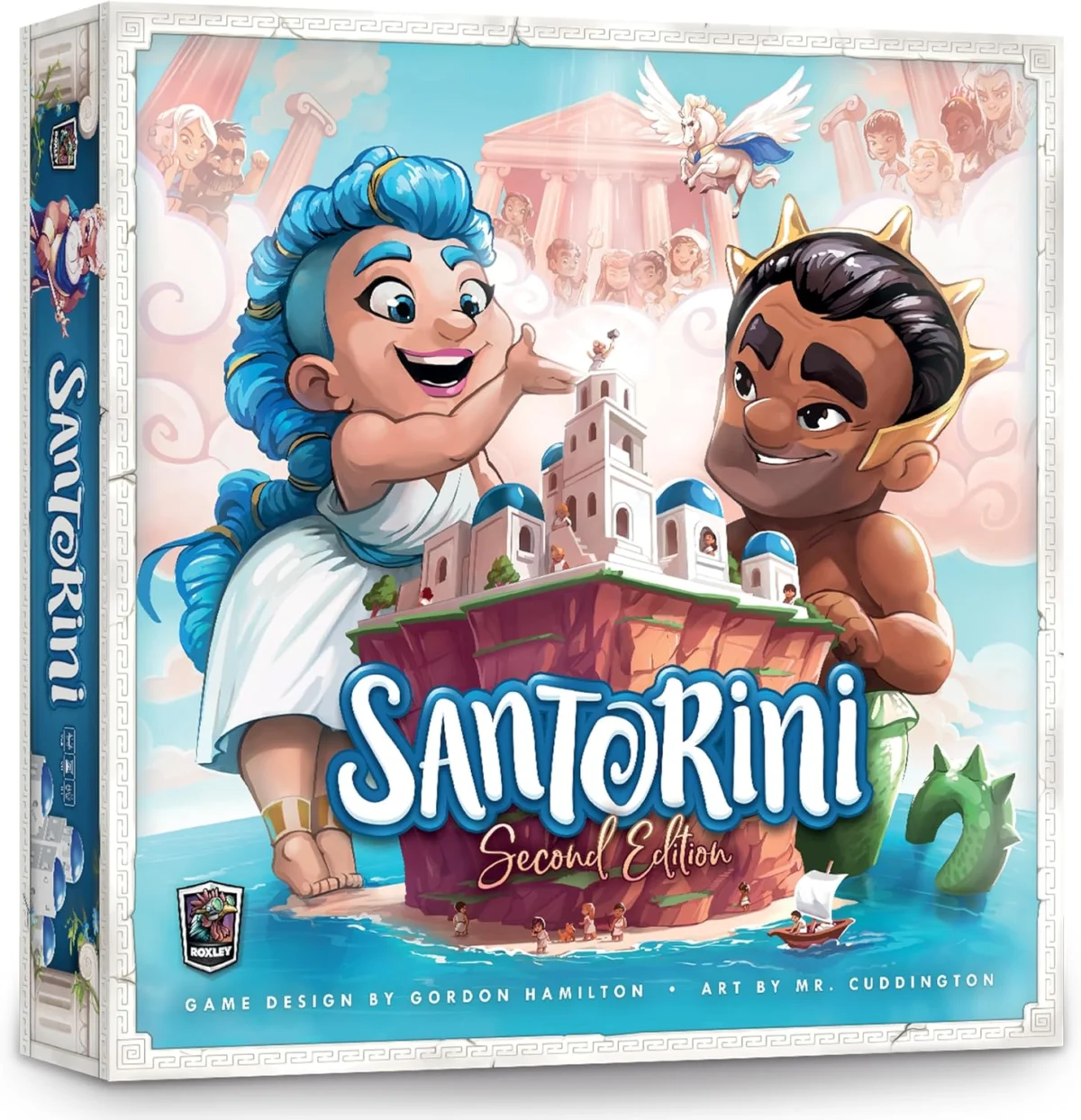
3. Santorini
- Publisher: Roxley Games
- Designer: Gordon Hamilton
- Release Year: 2016
Santorini is a deceptively simple yet profoundly elegant strategy game that distills the essence of Greek mythology and architectural competition into a stunning 3D experience. Players assume the roles of Greek gods, literally building their island city from the ground up, block by block. The core gameplay revolves around just two actions: moving a builder and then constructing a building level adjacent to that builder. The objective is clear: be the first to move one of your builders onto the third level of a building.

What elevates Santorini from a basic spatial puzzle to a game of remarkable strategic depth are the unique "God Powers" granted to each player. These powers, drawn from the Greek pantheon (e.g., Zeus allows building an extra level, Athena prevents opponents from moving up), fundamentally alter the rules and create asymmetrical advantages. This introduces a dynamic layer of tactical thinking, forcing players to adapt their strategies based on the gods in play. The game’s minimalist aesthetic, featuring vibrant blue and white pieces reminiscent of the Aegean islands, enhances its thematic immersion. The quoted text accurately captures its essence: "Santorini is an an elegant strategy game where players become Greek gods competing to build a majestic island village… Despite its simple two-step turns – move and build – the game offers remarkable depth that appeals to both families and serious gamers." Its fast pace, high replayability, and striking visual presence make Santorini a modern classic, appealing to both casual players and seasoned strategists.
4. Cyclades
- Publisher: Matagot
- Designers: Bruno Cathala, Ludovic Maublanc
- Release Year: 2009
Cyclades offers a grand strategy experience set in the mythical Greek archipelago, where rival city-states vie for supremacy under the watchful eyes of the Olympian gods. This game masterfully blends auction mechanics, area control, and resource management with a strong thematic narrative. Players lead distinct factions, each striving to be the first to construct two metropolises. Achieving this requires a delicate balance of military conquest, economic prosperity, and the crucial favor of the gods.
At the heart of Cyclades is its innovative bidding system for the favor of the five major Olympian deities: Zeus (for priests and money), Poseidon (for naval movement and fleets), Hades (for philosophers and armies), Ares (for army movement and recruits), and Athena (for culture and buildings). Players must strategically bid resources (gold) to gain access to these divine powers, which are essential for every action from moving armies and fleets to constructing buildings and recruiting mythical creatures. The game features legendary heroes and monsters like the Minotaur or the Kraken, which can be recruited to bolster a player’s forces or hinder opponents. As the brief description notes, "In the Cyclades archipelago, off the shores of a divided Greece, players develop their cities and compete for supremacy under the watchful gaze of the gods." This creates a highly interactive and competitive environment where alliances can form and shatter, and the tides of war can turn rapidly, ensuring an engaging and unpredictable experience for players seeking an epic clash of ancient powers.
5. Pantheum
- Publisher: Board&Dice
- Designer: Adam Kwapiński
- Release Year: 2026 (anticipated)
Pantheum, an upcoming title, promises a unique perspective on the Greek mythological landscape, placing players directly into the shoes of the Olympian gods themselves. Following a cataclysmic war between Titans and Olympians that has left the world barren, humans begin to settle, establishing farms, cities, and temples. Zeus calls upon the gods – the players – to reshape this desolate land according to their divine visions. This premise sets up an intriguing area-control and terraforming game where cooperation is fleeting, and divine egos clash.

Each player, embodying a major Greek god, will have a distinct "Divine Plan" – a set of secret objectives guiding their efforts to add forests, mountains, and rivers to the burgeoning human settlements. This introduces a layer of hidden objectives and strategic misdirection, as players must deduce their opponents’ plans while furthering their own. The interaction comes from the shared board and the competitive nature of terraforming; one god’s ideal landscape might directly conflict with another’s. The game description highlights this core tension: "Play as one of the major Greek gods tasked with adding Forests, Mountains, and Rivers according to your Divine Plan. But watch out, the other gods have a different vision for how the world should be reformed." Pantheum looks to offer a compelling blend of strategic planning, subtle manipulation, and direct competition, appealing to players who enjoy games with a strong thematic narrative and intricate player interaction, all from a truly divine perspective.
6. Akropolis
- Publisher: Gigamic
- Designer: Jules Messaud
- Release Year: 2022
Akropolis is a fast-paced, tile-laying game that challenges players to become master architects of ancient Greek cities. In this elegant and accessible game, players draft hexagonal district tiles to expand their burgeoning metropolis, strategically placing them to maximize points. The core mechanic involves selecting tiles from a central market and then adding them to one’s personal city grid. The genius of Akropolis lies in its spatial puzzle element: districts score points based on how many quarries (stone blocks) they are adjacent to, and crucially, how high they are built.
Players can build upwards, stacking tiles on top of existing ones to create multi-level structures. A district on the second level will score double, on the third triple, and so on, but it must be built on at least two underlying tiles. This introduces a fascinating layer of planning and risk-reward, as higher stacks yield more points but require more careful foundational planning. Different district types (housing, markets, barracks, temples, gardens, and plazas) have specific scoring conditions, and plazas act as multipliers for adjacent matching districts. The game is intuitive to learn but offers significant strategic depth, encouraging players to think several turns ahead. As the game summary articulates, "Lead your akropolis to glory and defeat rival cities! …The higher your stacks of tiles, the more valuable the buildings! Just make sure you don’t run out of stone…" Akropolis is a perfect example of a modern Eurogame that is both engaging and highly replayable, making it an excellent choice for families and seasoned gamers alike who appreciate elegant design and clever spatial challenges.
Official Responses: Voices from the Board Game Industry
The enduring appeal of ancient themes is no accident. Game designers and publishers consistently return to these wellsprings of inspiration for various reasons, as highlighted by industry insights.

"Ancient civilizations and mythologies offer an incredibly rich canvas for game design," explains Dr. Eleanor Vance, a game historian and consultant for several prominent board game publishers. "They come pre-loaded with compelling narratives, iconic characters, and well-defined power structures. This provides designers with a solid foundation upon which to build engaging mechanics and immersive experiences, without having to invent an entire world from scratch."
Marcus Thorne, lead designer at Stellar Games (a hypothetical publisher), echoes this sentiment, emphasizing the balance between historical authenticity and gameplay. "The challenge and the reward lie in translating complex historical or mythological concepts into intuitive game mechanics. For instance, in a game like 7 Wonders, the card drafting isn’t just a mechanic; it represents the flow of resources and ideas between developing civilizations. We strive to make the mechanics feel like a natural extension of the theme, rather than just an abstract system."
Thorne further elaborates on the design process for Pantheum: "With Pantheum, we wanted to give players a truly god-like perspective. Instead of just managing resources, you’re literally shaping the land, competing with other deities whose visions might be diametrically opposed to yours. The lore of the Olympians is so rich with drama and conflict that it naturally lends itself to competitive play where players embody those divine egos."
The educational aspect is also a significant draw. Sarah Chen, a representative for Ravensburger (publisher of Horrified: Greek Monsters), notes, "Many parents and educators appreciate how games like Horrified: Greek Monsters can introduce younger players to mythological figures in an exciting, non-intimidating way. They learn about Medusa or the Minotaur by actively facing them, fostering curiosity about the source material. It’s learning through play at its best."

"Replayability is key in today’s market, and ancient themes often provide the perfect framework for it," adds Gregory Finch, CEO of Odyssey Games (a hypothetical publisher specializing in historical titles). "The inherent variability in historical events, or the myriad interpretations of myths, allows designers to create modular components, different victory conditions, and a wide array of strategic choices that keep players coming back. Games like Santorini with its God Powers, or Cyclades with its auction system, perfectly illustrate how thematic elements can drive diverse gameplay experiences over and over again."
Implications: Beyond the Tabletop
The proliferation of board games themed around mythology and ancient civilizations carries significant implications, extending beyond mere entertainment to influence education, cultural appreciation, and social interaction.
Educational and Cultural Value
These games serve as informal educational tools, often sparking an interest in history, archaeology, and classical studies. By engaging with concepts like resource management in ancient Rome (7 Wonders), the pantheon of Greek gods (Santorini, Cyclades, Pantheum), or the architectural principles of a polis (Akropolis), players gain a tangible, albeit simplified, understanding of these complex subjects. This experiential learning can be far more engaging than traditional methods, encouraging further research and exploration of the source material. They act as cultural ambassadors, preserving and popularizing narratives and historical facts that might otherwise remain confined to academic texts.
Fostering Social Interaction and Community
In an increasingly digital world, board games offer a vital platform for face-to-face interaction. Sitting around a table, strategizing, negotiating, and sharing laughs over a game set in ancient Greece or Egypt fosters communication skills, critical thinking, and social bonding. Board game cafes and clubs have surged in popularity, creating communities where enthusiasts can connect over shared interests, further cementing the role of these games as social catalysts. The cooperative nature of games like Horrified: Greek Monsters specifically promotes teamwork and shared problem-solving, strengthening interpersonal relationships.

Economic and Market Trends
The success of these thematic games reflects a broader trend in the hobby gaming market towards more sophisticated, immersive, and replayable experiences. Publishers and designers are continually pushing boundaries, leveraging crowdfunding platforms and direct-to-consumer models to bring increasingly ambitious projects to fruition. This segment of the market is robust and growing, demonstrating a strong consumer demand for high-quality, thematically rich tabletop experiences. The enduring appeal of ancient civilizations and mythology ensures that this genre will continue to be a fertile ground for innovation and creativity within the industry.
In conclusion, the journey back in time offered by these mythology and ancient civilization board games is more than just a roll of the dice or a play of a card. It’s an invitation to engage with the grand narratives of human history and imagination, to strategize like a general, build like an architect, and contend like a god. As the tabletop gaming world continues to expand, these echoes of antiquity will undoubtedly resonate for generations to come, allowing countless players to write their own epic sagas.