Beyond the Capes: Sam Glanzman’s USS Stevens and the Unvarnished Truth of War Comics
In an era saturated with cinematic universes and sprawling superhero sagas, the definition of heroism has become largely synonymous with superhuman feats and fantastical costumes. From Superman to Iron Man, Batman to Wonder Woman, these iconic figures dominate popular culture, offering adolescent daydreams of invincibility and moral clarity. Yet, as renowned cartoonist Will Eisner once mused, "I never understood why the hell anyone would run around fighting crime." This sentiment, echoed by many who appreciate the nuanced complexities of human experience, points to a crucial distinction: the difference between escapist fantasy and the stark, often brutal, realities of heroism forged in genuine conflict.
While the appeal of caped crusaders is undeniable, a deeper, more profound form of heroism often lies in the stories of real people confronting real dangers. Within the pages of comic books, a genre often dismissed as juvenile, lies a powerful counter-narrative, particularly in the war comics of the mid-20th century. Among the most impactful and enduring of these are the works of Sam Glanzman, a World War II veteran whose four-page USS Stevens stories for DC Comics offered a chillingly authentic glimpse into naval combat and the psychological toll of war. These brief, potent narratives served not as mere filler, but as a vital dose of reality, challenging readers to look beyond the bombast of battle and confront the human cost of conflict.
Beyond Capes and Cowls: The True Heroes of the Comic Page
For many young readers of the Silver and Bronze Ages of comics, the appeal extended far beyond the exploits of the Justice League or the Avengers. While superheroes offered a vibrant escape, other genres provided different forms of engagement. The war comic, in particular, carved out a significant niche, offering narratives that, even with their occasional embellishments, often felt more grounded. DC Comics, for instance, cultivated a reputation for slightly more realistic war stories than its contemporary, Marvel, even while featuring the likes of the "Haunted Tank" or "Dinosaur Island." Titles like Our Army at War, featuring Sergeant Rock and Easy Company, depicted a grittier Wehrmacht, contrasting sharply with some of Marvel’s more exaggerated foes. For a generation of boys, the intricate details of Russ Heath’s drawings of German tanks and planes often held as much fascination as any superhero pin-up.
However, even within these relatively realistic war narratives, a certain level of heroic idealization persisted. Sergeant Rock might endure countless battles with only a flesh wound, and the Unknown Soldier would perpetually outwit dull-witted Nazis. It was into this landscape that Sam Glanzman introduced a seismic shift in perspective. His USS Stevens stories, typically relegated to the back pages of titles like Our Army at War, G.I. Combat, Our Fighting Forces, and Star Spangled War Stories, offered something altogether different: the unvarnished truth. These were not tales of glory or triumph, but intimate, often harrowing, vignettes born from lived experience.
A Sailor’s Odyssey: Sam Glanzman’s Journey from War to Art
Sam Glanzman’s career in the comic book industry spanned an impressive five decades, from the late 1930s to the late 1990s. A prolific artist and writer, he contributed to various genres for publishers such as Charlton, Marvel, Dell, and DC. However, a pivotal hiatus in his career occurred in the early 1940s, precipitated by the global conflagration of World War II.
From Drawing Board to Destroyer: The USS Stevens Experience
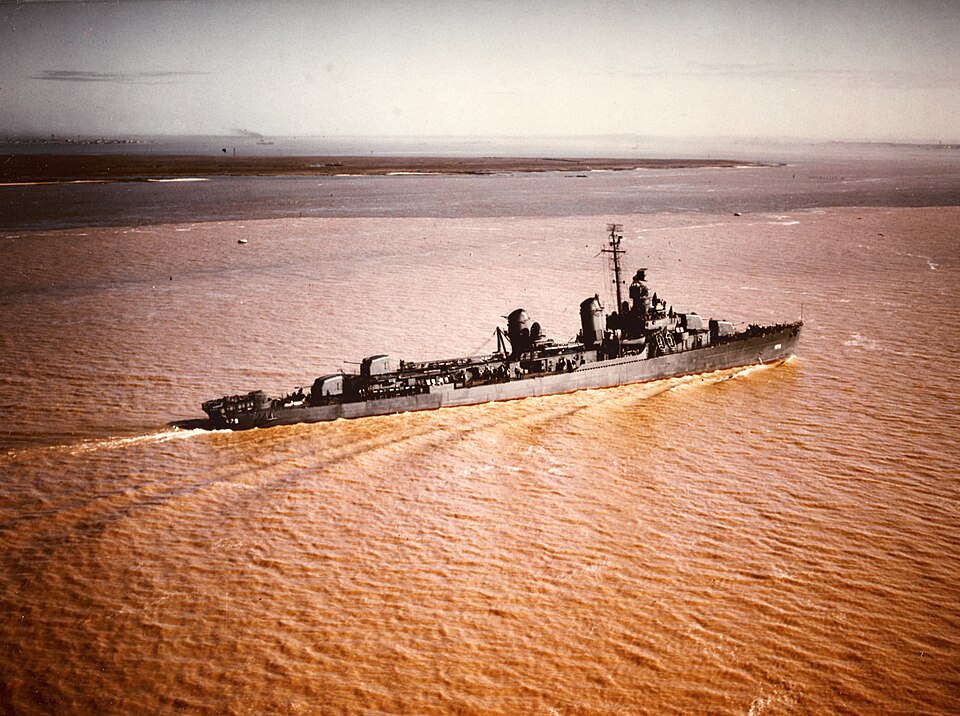
At the age of 20, Glanzman put aside his drawing pens and joined the U.S. Navy. He served aboard the Fletcher-class destroyer USS Stevens, a vessel that would become the eponymous subject of his most renowned work. From 1943 until the war’s conclusion, the Stevens was an active participant in the brutal naval campaigns that characterized the Central and South Pacific theaters. Glanzman witnessed firsthand the relentless tightening of the noose around the Empire of Japan, serving in pivotal engagements across Tarawa, Kwajalein, Tulagi, Rabaul, Hollandia, Guam, and the Philippines. The Stevens and its crew undertook a myriad of wartime duties, from ferrying troops and conducting bombardments to battling submarines and carrying out escort and minesweeping missions. Glanzman experienced virtually every facet of naval warfare, an experience that would irrevocably shape his worldview and, consequently, his artistic output.
The Post-War Canvas: Realism in the Bronze Age
When Sam Glanzman returned to civilian life in 1946, he was, understandably, a changed man. The horrors and tedium, the camaraderie and the terror of war, had left an indelible mark. Initially, due to poor pay in the comics industry, he worked as a manual laborer. However, by the late 1950s, he returned to comics, gradually gravitating towards war titles. It was in the 1970s, during the Bronze Age of comics, that Glanzman began producing the four-page USS Stevens tales for DC Comics, stories that would come to be regarded as his most highly acclaimed work. These vignettes stood in stark contrast to the more idealized portrayals of war, injecting a raw, almost documentary-like realism that had rarely been seen in mainstream comics.
Unvarnished Truths: The Power of Four Pages
These short features, often appearing at the tail end of a comic book, might have been perceived by some as mere "filler." However, Glanzman’s profound personal investment and unflinching honesty imbued them with a purpose far beyond simply padding out page counts. They were, in essence, a direct channel from a veteran’s memory to the impressionable minds of young readers, designed to show "what war was really like."
"What Do They Know about War?": Exploitation and Disillusionment
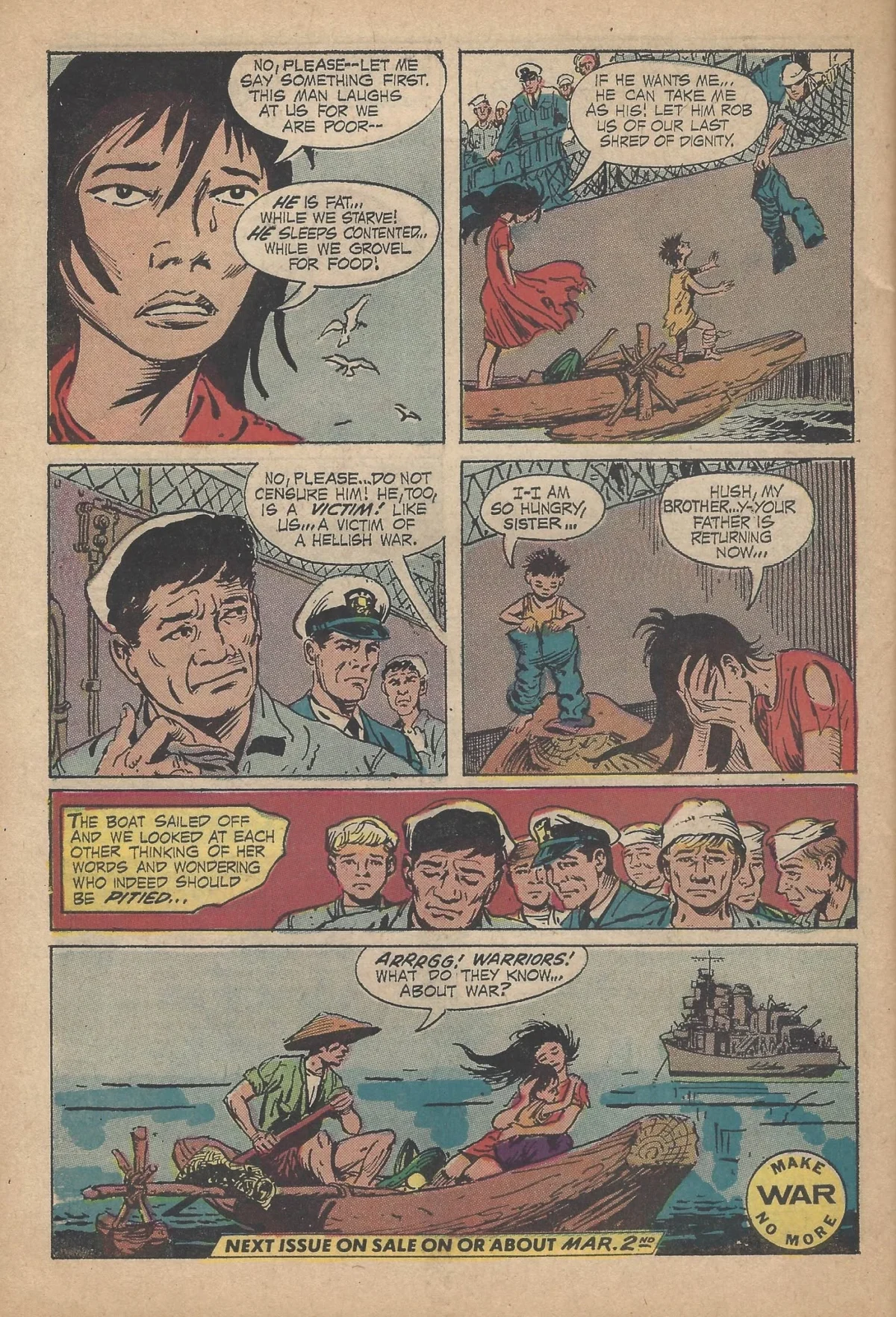
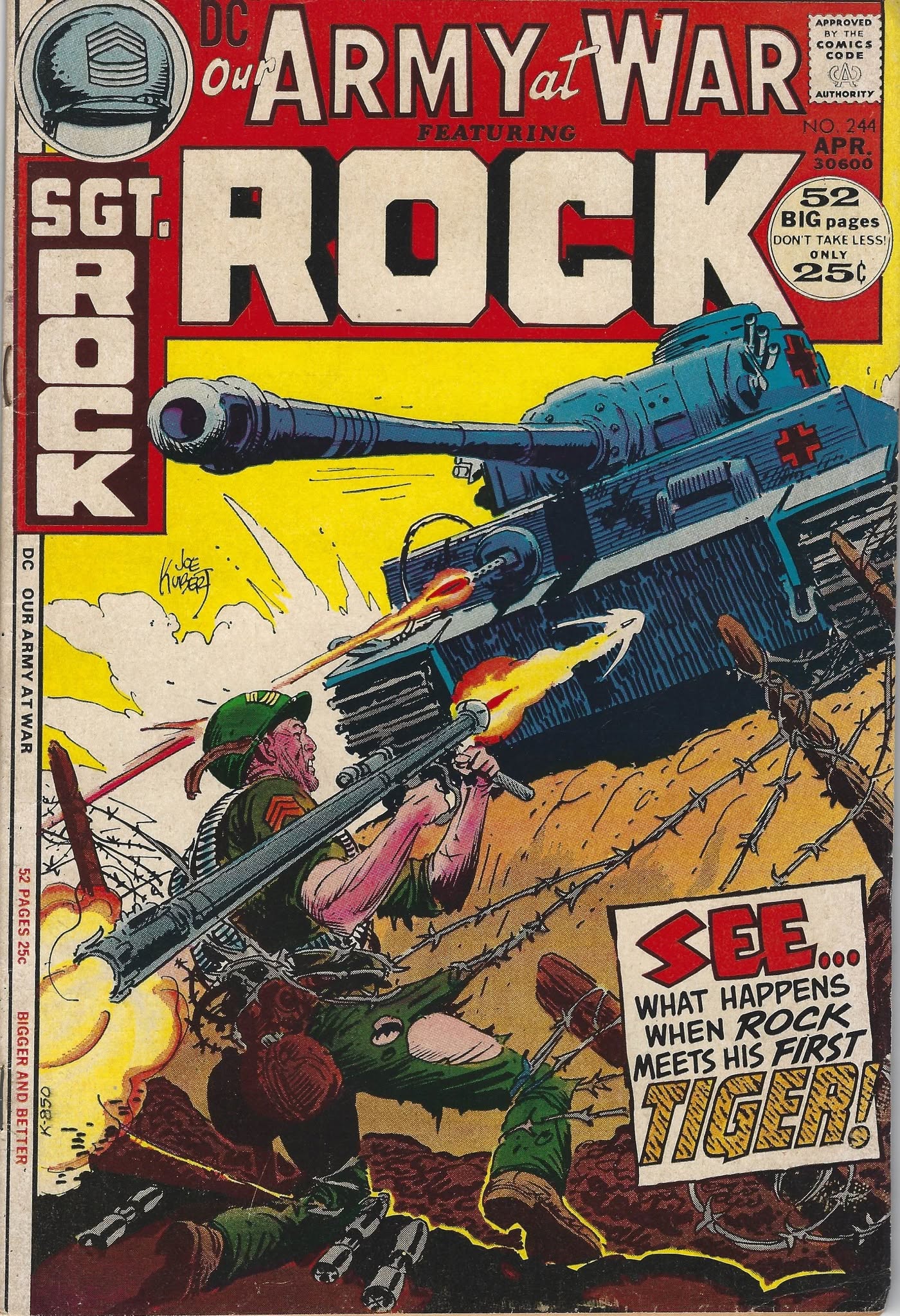
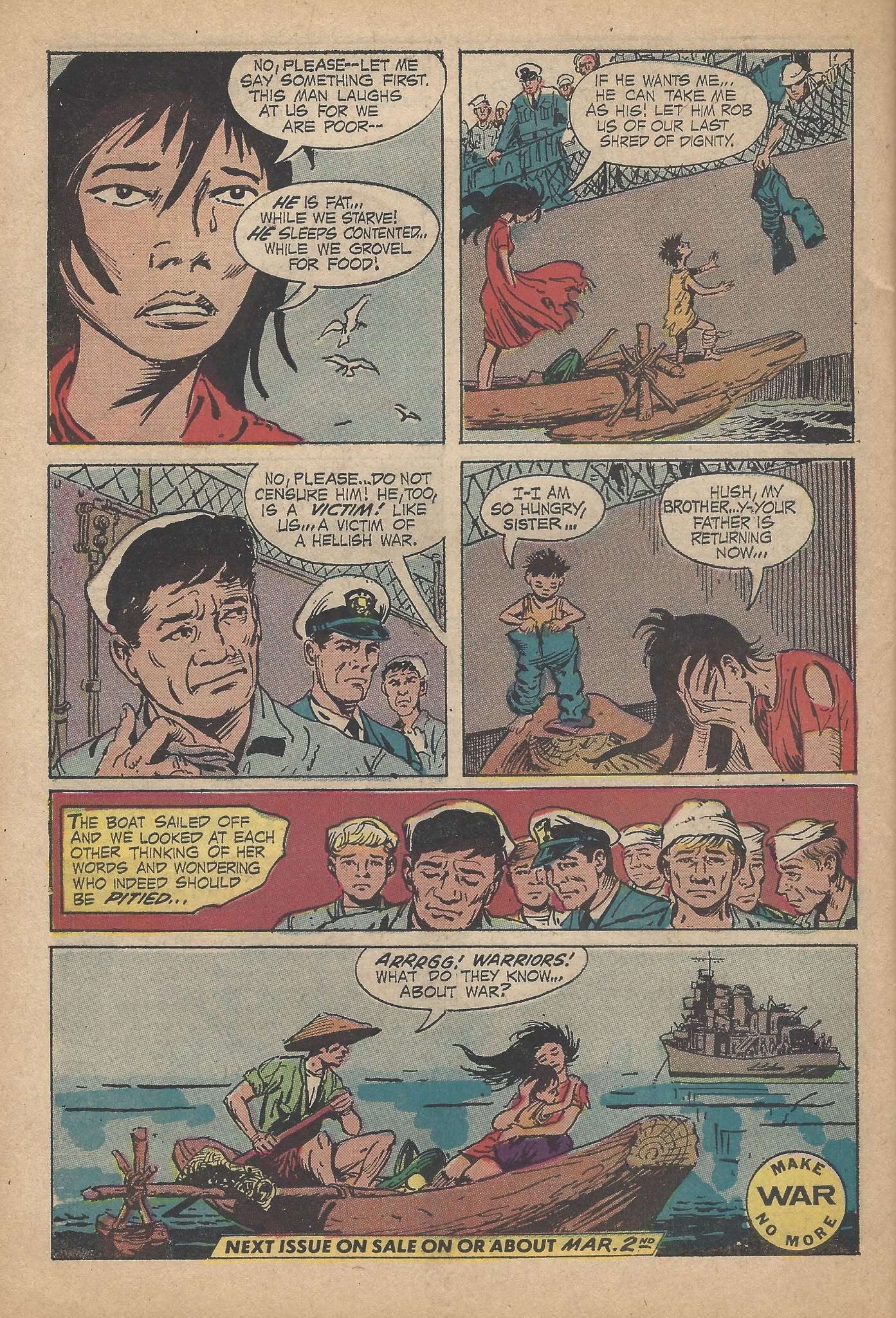
One of the most memorable of these tales, "What Do They Know about War?" from Our Army at War #244 (April 1972), immediately follows a bombastic Sergeant Rock story. Here, the Stevens waits at an island to join a convoy when a native family approaches in a dugout canoe. As the father attempts to trade, a sailor crudely propositions his teenage daughter. Her response, laden with a "hopeless exhaustion" rather than anger, highlights the profound disparity between the sailors’ full bellies and the family’s hunger and poverty. As they paddle away, the father, a helpless victim of the conflict, utters a bitter, haunting question: "Warriors! What do they know… about war?" This story contains no gunfire, no heroics; only eighteen panels of uncomfortable reality, a moral gut-punch that left a lasting impression on readers accustomed to clear-cut battles. It masterfully exposes the moral ambiguities and exploitative undercurrents that are an often-overlooked aspect of conflict, far removed from any conventional notion of valor.
"Accident": The Senselessness of Destruction
In "Accident," from Our Army at War #259 (August 1973), Glanzman confronts the arbitrary nature of wartime destruction. A peaceful Chinese junk is tragically misidentified as an enemy vessel and obliterated by a naval barrage, killing all the fishermen aboard. Glanzman’s accompanying narration cuts to the core of the tragedy: innocent lives destroyed "by accident! The sort of accident that occurs in all wars… to all sides! A senseless act… within a senseless act!" This story is a stark reminder that war’s victims are not always combatants, and that the fog of war often leads to irremediable, meaningless loss. It stripped away any romantic notion of precision or just cause, revealing the inherent chaos and collateral damage.
"The Sea Is Calm… the Sky Is Bright…": The Uncommunicable Trauma
Perhaps one of Glanzman’s most psychologically devastating stories is "The Sea Is Calm… the Sky Is Bright…" from Our Army at War #257 (June 1973). An off-duty sailor attempts to write a letter home to his mother. Faced with the daunting question, "What can I write about?", he relives the day’s horrors: a kamikaze attack obliterating a nearby ship, a gun crew shredded by machine gun fire, flag-draped bodies consigned to the indifferent ocean, his own desperate, fear-stricken prayers for survival. Knowing these experiences are utterly incommunicable to those safe at home, he writes the heartbreakingly mundane lie: "Dear Mom; I’m fine. The sea is calm… the sky is bright…" This narrative perfectly encapsulates the profound isolation and psychological burden of war, the chasm between those who fight and those who wait, and the often-necessary facade of normalcy maintained to protect loved ones from unimaginable truths. It’s a poignant testament to the invisible wounds of war.
"King of the Hill": The Absurdity of Random Death
In "King of the Hill," published in Star Spangled War Stories #174 (October 1973), Glanzman delves into the absurd paradoxes that define wartime existence. A work detail from the Stevens on an island encounters an ape. A marine, seeking levity, engages in a playful "king of the hill" game with the animal, provoking laughter from onlookers. The playful interaction quickly devolves into a burst of savage rage from the ape, who kills the marine before anyone can intervene. The profound shock of the men is palpable: "The small knot of men were shocked beyond belief… a fun-loving, foolish marine who had survived the real horrors of Guadalcanal did not survive a make-believe-game of king of the hill!" This story highlights the cruel capriciousness of death in war, where one can survive the most brutal combat only to succumb to an utterly random, nonsensical accident.
"Where…?": The Universal Silence of Death
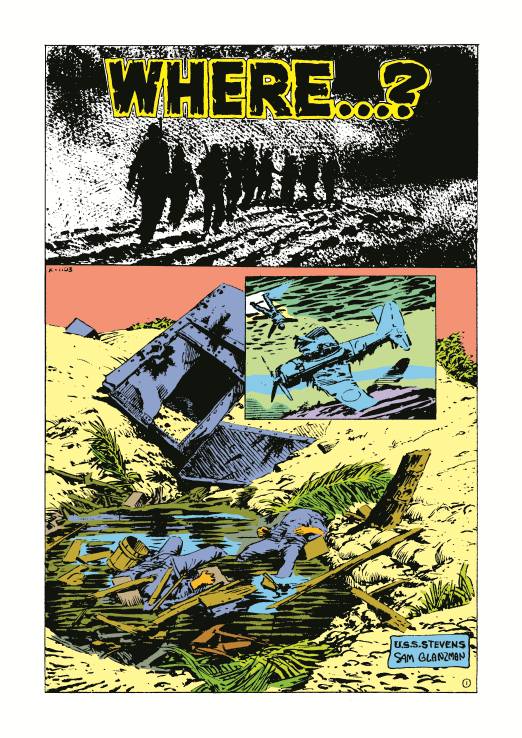
Sometimes, Glanzman abandoned words altogether, as he did in "Where…?" from Our Army at War #262 (November 1973). This four-page sequence is a silent, chilling panorama of death: soldiers, civilians, in Europe, in Asia, on land, at sea. Faceless, silent, and still, these anonymous figures represent the ultimate, universal product of the industry of war. It is a powerful, minimalist statement on the sheer scale and indiscriminate nature of human loss, a stark visual elegy that transcends language and cultural barriers.
The Daily Grind of War: Beyond Combat
While Glanzman depicted combat with an "almost hallucinatory intensity," many of his USS Stevens stories focused not on battle, but on the monotonous, often soul-crushing routine of military life. His characters were shown gambling, joking, loafing, drinking, arguing, telling tall tales, and performing their common, boring tasks – or finding ingenious ways to evade them, a practice known in the military as "shamming." These narratives explored how a group of men, essentially imprisoned together on a ship, found ways to endure their intermittently dangerous but more commonly dull and stultifying job without succumbing to madness.
This focus on the personal dynamics of diverse individuals thrown together by circumstance echoes works like Thomas Heggen’s classic novel Mister Roberts, also set on a ship in the Pacific during World War II. Both Glanzman and Heggen understood that the human element – the petty squabbles, the shared jokes, the longing for home, the struggle for sanity – was as integral to the war experience as any battle. Glanzman’s ability to convey these nuanced social dynamics and psychological pressures within just four pages was a testament to his exceptional storytelling prowess and deep empathy.
A Legacy Reclaimed: Recognition and Enduring Impact
For decades, these powerful, understated USS Stevens stories remained somewhat under the radar, appreciated by a dedicated readership but lacking the widespread critical attention given to other comic book genres. However, Glanzman’s enduring impact eventually garnered the recognition it deserved.
The initial "official response" to Glanzman’s work often came in the form of simply publishing his short pieces, perhaps without full appreciation for their profound weight. Yet, their continued appearance in various DC war titles throughout the 1970s speaks to an implicit editorial acknowledgment of their quality and perhaps their unique value.
Later, more explicit validation arrived. In 1987, Marvel Comics, recognizing the significance of his personal narrative, published Glanzman’s A Sailor’s Story as part of its esteemed Marvel Graphic Novel series. This longer, more unified narrative allowed Glanzman to expand upon his Navy experiences with greater scope, further cementing his reputation as a vital voice in war literature. This work, alongside other neglected gems in the Marvel Graphic Novel series, remains ripe for rediscovery.
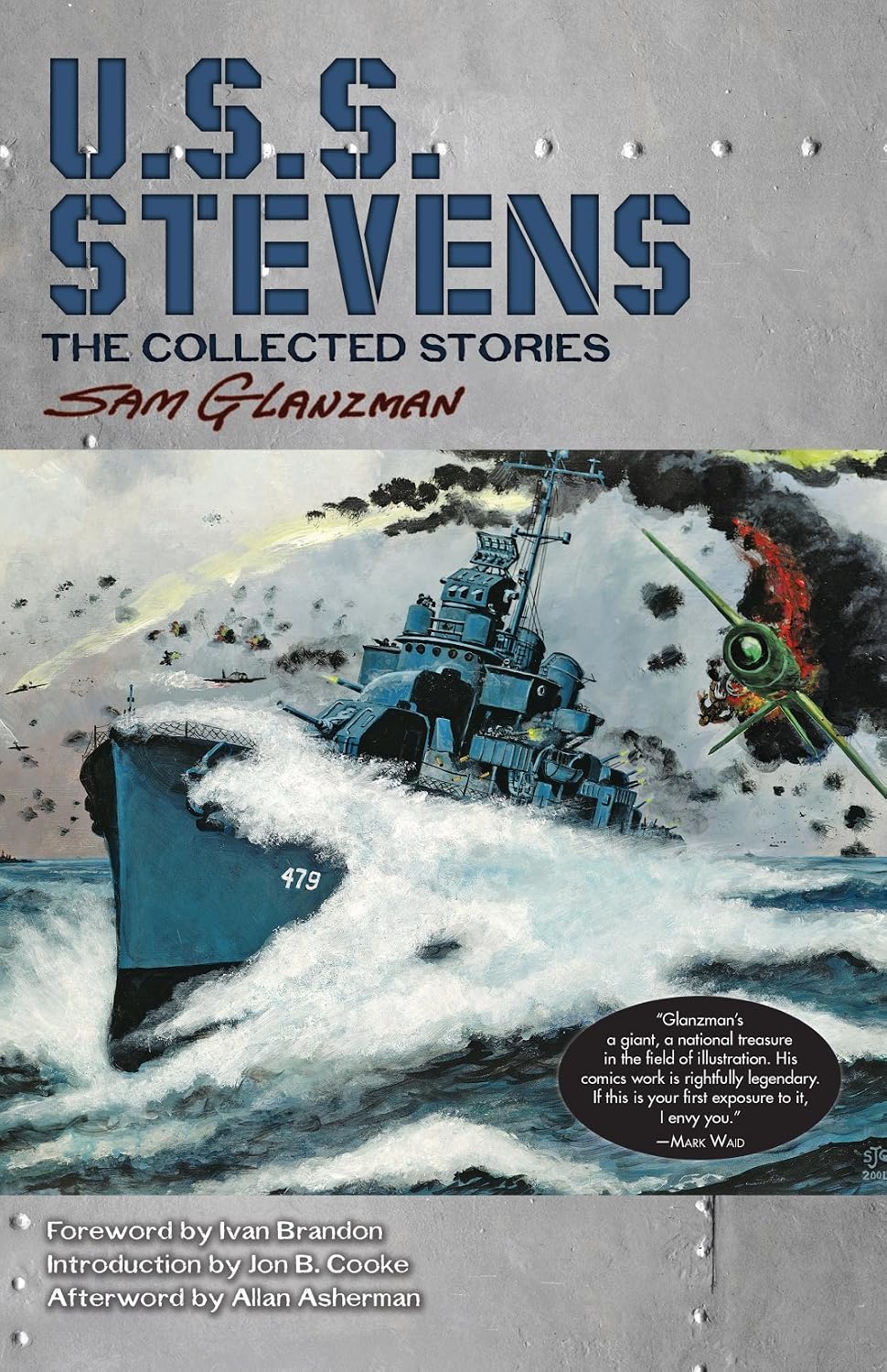
The ultimate testament to Glanzman’s legacy arrived in 2016, shortly before his death. Dover Publications gathered more than sixty of his USS Stevens stories into a single, comprehensive 384-page volume: U.S.S. Stevens: The Collected Stories. This monumental collection was not just an essential acquisition for comic book aficionados; it was, unequivocally, hailed as one of the great books about World War II, a powerful historical document and a work of art that stands on its own merits, transcending the medium of its origin.
Redefining Heroism: Glanzman’s Timeless Message
In an age where cultural discourse is dominated by fictional heroes with extraordinary powers, Sam Glanzman reminds us where true heroism lies. It is not in the flight of Superman or the might of Thor, but in the quiet endurance, the profound sacrifice, and the often-unseen struggles of ordinary young men who left their lives behind – their factories, farms, offices, and shops – when their country called. Glanzman, himself a veteran, honored these individuals through the medium he knew and loved. He took up his pen after the war, not to glamorize conflict, but to give a generation of naïve, impressionable young readers a genuine taste of how it really was.
Glanzman’s work, alongside that of other veterans who became comic artists like Jack Kirby, Nick Cardy, Dick Ayers, and Will Eisner, represents a unique and invaluable contribution to both comics and historical narrative. They were the real superheroes of the comic book world, not because of fantastical abilities, but because they bore witness to history and had the courage and artistry to translate that truth onto the page.
In our current era of "bloated story arcs" that stretch across multiple titles and often vanish from memory as soon as they’re consumed, Sam Glanzman’s ability to craft memorable, impactful statements about the most profound aspects of the human condition within the confines of just four pages serves as a powerful lesson. His stories demonstrate that true impact comes not from scale or spectacle, but from authenticity, compassion, and an unwavering commitment to truth. U.S.S. Stevens: The Collected Stories is not just a collection of comic book tales; it is a vital, timeless exploration of war, humanity, and the enduring power of art to illuminate our shared experience.
Thomas Parker is a native Southern Californian and a lifelong science fiction, fantasy, and mystery fan. When not corrupting the next generation as a fourth-grade teacher, he collects Roger Corman movies, Silver Age comic books, Ace doubles, and despairing looks from his wife. His last article for us was The Limits of Vision: Arthur C. Clarke’s Imperial Earth.