
Echoes of the Unforgotten: The 24th Biennale of Sydney and the Architecture of "Rememory"
The 2024–2026 iteration of the Biennale of Sydney has emerged as one of the most intellectually ambitious and politically charged editions in the exhibition’s storied history. Under the banner of "Rememory"—a term borrowed from Toni Morrison’s Pulitzer Prize-winning novel Beloved—the Biennale seeks to navigate the porous boundaries between personal trauma, collective history, and the physical spaces where these memories reside.
Curated by Hoor Al Qasimi, the first Emirati director in the Biennale’s history, the exhibition spans five major venues across the Greater Sydney region. It serves not only as a showcase of contemporary global art but as a rigorous investigation into how stories, once repressed or neglected, can be resuscitated to challenge the status quo. From the industrial echoes of the White Bay Power Station to the hallowed halls of the Art Gallery of New South Wales, the Biennale functions as a vehicle for encountering the subjectivities of others, often forcing the audience to "bump into" memories that are not their own.
Main Facts: A Transcontinental Vision of History
The 24th Biennale of Sydney is defined by its geographical breadth and its focus on the "Global South," a term that Al Qasimi has championed throughout her career. The exhibition is distributed across five primary sites:
- White Bay Power Station: A newly restored industrial landmark in the inner city, providing a raw, cavernous backdrop for large-scale installations.
- Chau Chak Wing Museum: Located at the University of Sydney, this venue bridges the gap between contemporary practice and academic inquiry.
- Art Gallery of New South Wales (AGNSW): Utilizing the new Naala Badu building, the Biennale integrates itself into the heart of Australia’s traditional art establishment.
- Campbelltown Arts Centre: A vital hub in Western Sydney that focuses on community-engaged and politically resonant works.
- Penrith Regional Gallery: A new addition to the Biennale’s circuit, expanding the event’s footprint further into the city’s outskirts.
The theme, "Rememory," goes beyond simple nostalgia. In Morrison’s definition, a "rememory" is a memory that exists as a physical presence in the world, independent of the person who first experienced it. Al Qasimi’s curation interprets this through the lens of "stories without storytellers," focusing on archival fragments, neglected histories, and the enduring connection between people and the land.

Chronology: From Appointment to Opening Controversy
The journey toward the 2026 Biennale began with the appointment of Hoor Al Qasimi, the founder of the Sharjah Art Foundation. Her selection signaled a shift toward a more internationalist, specifically Middle Eastern and African, perspective.
2023–2024: The Curatorial Foundation
Al Qasimi brought decades of experience from the Sharjah Biennial and the Aichi Triennale. Her initial research focused on connecting the Australian experience of colonization and Indigenous land rights with similar struggles across the Middle East, Southeast Asia, and North Africa.
Late 2025: The Media Backlash
As the artist list was finalized, parts of Australia’s conservative press launched a preemptive strike against Al Qasimi. Critics pointed to her background as a member of the ruling family of Sharjah (UAE) to suggest a "cultural bias." Accusations surfaced that the show would become a platform for anti-Israel sentiment, despite the curator’s stated focus on universal themes of displacement and historical recovery. These critiques highlighted a "recrudescent racism" within the media landscape, attempting to delegitimize the expertise Al Qasimi was hired to provide.
March 2026: The Opening and Public Reception
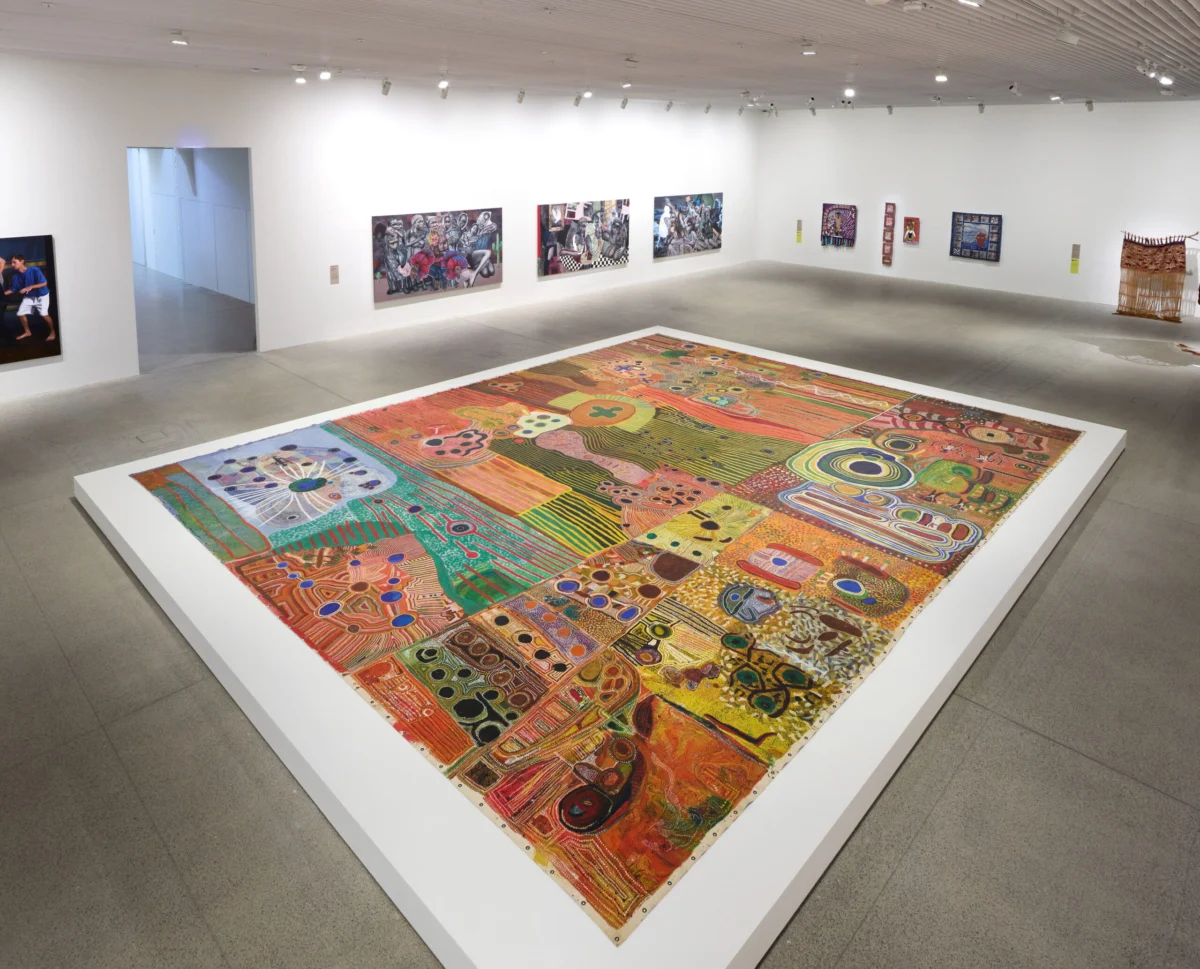
Upon opening, the exhibition silenced many critics through the sheer depth and quality of the works. Far from being a narrow political polemic, the Biennale proved to be an expansive narrative tapestry. The inclusion of landmark works like the Ngurrara Canvas II and local projects like Person to Person grounded the international theme in specific Australian realities.

Supporting Data: The Building Blocks of Narrative
The exhibition’s power lies in its use of "expanded witnessing"—the idea that art can serve as legal, social, and historical evidence. Several key works illustrate this data-driven approach to memory:
The Ngurrara Canvas II (1997)
Perhaps the most significant piece in the show, this 10×8 meter painting was created by 44 Indigenous artists from the Great Sandy Desert. It was not merely an aesthetic object but a legal document. Used as evidence in the Native Title Tribunal, it proved the Ngurrara people’s continuous connection to "Country." The land was eventually returned to its traditional owners in 2007 and 2012, marking a rare moment where "rememory" achieved tangible, legal restitution.
Erased Slogans (2008–2026)
Filipino artist Kiri Dalena presented a haunting archive of protest. By digitally removing the text from historical photos of Manila demonstrations prior to Ferdinand Marcos’s 1972 martial law, Dalena created images of activists holding blank placards. This work highlights the "historical amnesia" that occurs when the state silences dissent, while her accompanying Books of Slogans allow the audience to physically re-engage with the suppressed language.
Person to Person (2026)
Sydney-based artists Merilyn Fairskye and Michiel Dolk contributed a 70-minute video mural focusing on the suburb of Woolloomooloo. This work functions as a longitudinal study of urban activism. By contrasting archival footage of 1970s union strikes with contemporary interviews, the artists show how a working-class community resisted high-rise development to preserve their "rememory" of the harborside.

Official Responses and the Ethics of Representation
The 2026 Biennale has sparked intense debate regarding who has the right to tell certain stories. This was most evident in the response to Code Black/Riot, a collaborative project by Hoda Afshar, Vernon Ah Kee, and Behrouz Boochani.
The project examines the incarceration of Indigenous youth in Far North Queensland. When early iterations were shown, social media critics questioned whether Afshar—an Iranian-born artist—should be telling the story of Indigenous Australians. However, the official response from the artistic community and the Biennale leadership emphasized the "responsibility of the artist."
Supporting Statistics on Youth Detention:
The work is underscored by harrowing data from the Australian Institute of Health and Welfare. In 2024, First Nations children aged 10–17 accounted for 60% to 65% of the youth detention population, despite making up only 6.6% of the general youth population. By bringing together an Indigenous artist (Ah Kee), a former refugee (Boochani), and a documentary-focused artist (Afshar), the Biennale argued that "rememory" is a collective burden. The story belongs to the victims, but the responsibility to witness belongs to everyone.
Implications: Art as a Vehicle for Subjectivity
The 24th Biennale of Sydney suggests that the future of global art lies in the "archive"—not as a dusty repository of the past, but as a living, breathing entity. The implications of this edition are three-fold:

- The Decentering of the Western Narrative: By integrating Middle Eastern, North African, and Southeast Asian perspectives, Al Qasimi has successfully challenged the Eurocentric "international" style that has dominated biennials for decades.
- The Physicality of History: Following Morrison’s concept, the exhibition demonstrates that history is not something we read; it is something we "bump into." The use of White Bay Power Station—a site of labor and industrial sweat—complements the themes of struggle present in the artworks.
- The Rejection of Amnesia: In an era of "alternative facts" and digital ephemerality, the Biennale asserts the importance of the material record. Whether through the Ngurrara painting or Dalena’s Books of Slogans, the exhibition demands that we acknowledge the "stories without storytellers."
As Susan Best, Professor of Art History at Griffith University, notes, the idea of "rememory" really comes into its own when a story belongs to someone else, yet we are forced to face it. The 2026 Biennale of Sydney does not just ask us to look at art; it asks us to inhabit the memories of the marginalized, ensuring that these "physical" remnants of the past are never truly lost to the shadows of history.


Leave a Comment