
"Fascinating Folklore": A Landmark Compendium Unveils Ancient Wonders Through Modern Art
FOR IMMEDIATE RELEASE
London, UK – [Insert Date of Publication] – A groundbreaking new compendium, "Fascinating Folklore," is set to captivate audiences worldwide, offering an unprecedented journey into the heart of global myths and legends. Crafted by the renowned talents of comic world luminaries John Reppion and PJ Holden, this ambitious project transcends traditional storytelling, blending meticulously researched essays with breathtaking graphic novel artistry to create an immersive and enlightening experience. What began as a creative pact, ignited by the vibrant online community of the #FolkloreThursday hashtag, has blossomed into an extraordinary volume that promises to leave readers spellbound by the magic of folklore like never before.
Published by Liminal 11, "Fascinating Folklore" is more than just a book; it is a meticulously curated sensory feast, an unparalleled pathway into the enchanting realms of ancient wisdom, forgotten heroes, and spectral entities. From the epic sagas of warrior queens and monstrous beasts to the whispered secrets of plantlore and the poignant tales of wronged deities, Reppion and Holden invite readers to discover the profound narratives that have shaped human culture for millennia.
The compendium delves into diverse legends such as the indomitable Boudicca, the heroic Beowulf, and the enthralling world of plantlore, where Mandrake, Willow, and Yedua whisper secrets of ancient wisdom. It explores haunting ghosts like the Japanese Okiku and the Wandjing spirits of Western Australia, alongside profound deities like Anteros, the resolute guardian of slighted love. With its innovative format and expansive scope, "Fascinating Folklore" is poised to become an essential addition to the libraries of folklorists, comic enthusiasts, and anyone with a curiosity for the mystical and the magnificent.
Readers are invited to explore compelling excerpts below and order their copy today from Liminal 11’s official website.
The Genesis of a Compendium: From Digital Spark to Bound Volume
The journey of "Fascinating Folklore" from a nascent idea to a tangible, beautifully illustrated book is a testament to the power of online communities and collaborative vision. The genesis of this unique project lies in the dynamic and ever-popular #FolkloreThursday hashtag, a weekly online phenomenon that has cultivated a global community of enthusiasts, academics, and storytellers dedicated to sharing and celebrating the rich tapestry of world folklore.
For years, #FolkloreThursday has served as a digital hearth, drawing together individuals from disparate backgrounds to explore the myths, legends, and traditions of various cultures. It’s a space where ancient tales find new life, where obscure deities are rediscovered, and where the collective human heritage is actively preserved and disseminated. It was within this vibrant digital ecosystem that John Reppion and PJ Holden, two figures highly respected within the comic book industry, found a common passion and the inspiration for a collaborative endeavor.
Their initial creative pact, born from this shared interest and the fertile ground of #FolkloreThursday, was not merely to retell stories but to re-envision them. They sought to bridge the gap between academic rigor and popular accessibility, between the profound narratives of folklore and the visually dynamic medium of comics. The decision to combine informative essays with graphic storytelling was a deliberate one, aiming to engage readers on multiple levels, offering both scholarly depth and immediate visual impact.
The choice of Liminal 11 as publisher further solidified the project’s unique vision. Known for their esoteric and artfully designed publications that often explore themes of spirituality, mythology, and self-discovery, Liminal 11 provided the perfect home for a book that aimed to explore the magical and mysterious aspects of human heritage through an innovative lens. Their commitment to high-quality production and distinctive aesthetic aligns perfectly with the artistic and intellectual ambitions of "Fascinating Folklore," ensuring that the physical book itself is an artifact worthy of its captivating content. The evolution from a digital spark to a beautifully bound volume underscores a modern approach to cultural preservation, demonstrating how contemporary platforms can ignite projects that ultimately enrich our understanding of the past.
The Architects of Wonder: John Reppion & PJ Holden
At the heart of "Fascinating Folklore" are its two "masterful minds": John Reppion and PJ Holden. Their collaboration is not merely a convergence of talents but a synergy of distinct yet complementary expertise, making them uniquely suited to tackle a project of this scope and ambition.
John Reppion is widely recognized as a masterful storyteller and a keen scholar of folklore, mythology, and the occult. His writing career spans various genres, but he has consistently demonstrated a profound connection to the historical and the arcane. Reppion is known for his meticulously researched narratives, often delving into forgotten corners of history and mythology to unearth compelling tales. His bibliography includes contributions to popular comic series and graphic novels, where he has consistently woven intricate plots with rich character development. His previous works often showcase an ability to make complex historical or mythological themes accessible and engaging for a modern audience, a skill that is paramount in "Fascinating Folklore." His role in the compendium is evidently that of the primary essayist, providing the robust factual and historical context that underpins each folklore entry. His deep understanding of the subject matter ensures that the "informative essays" are not only engaging but also academically sound, offering readers genuine insights into the origins and significance of these ancient tales.
PJ Holden, on the other hand, is celebrated as one of the most dynamic and versatile artists in the comic book world. His distinctive style, characterized by its expressive linework and ability to convey mood and action with remarkable clarity, has graced the pages of numerous acclaimed titles. Holden’s work on iconic series like Judge Dredd for 2000 AD and his contributions to titles for major publishers like DC Comics have cemented his reputation as an artist who can bring any narrative to vivid life. His art is not merely illustrative; it is narrative in itself, capable of capturing the essence of a story, the emotion of a character, or the atmosphere of a scene with striking impact. In "Fascinating Folklore," Holden’s "breathtaking comics" are crucial. They serve not just as visual accompaniments but as integral components of the storytelling, translating the rich prose of Reppion’s essays into a visual language that can evoke the wonder, terror, and beauty inherent in folklore. The interplay between Reppion’s words and Holden’s art creates a unique rhythm, allowing readers to transition seamlessly between scholarly exploration and vivid imaginative experience.
Their combined experience in the comic industry, coupled with their shared passion for folklore, makes them ideal collaborators for "Fascinating Folklore." Reppion’s narrative depth and Holden’s visual prowess ensure that the compendium is both intellectually stimulating and aesthetically captivating, truly embodying the description of "masterful minds."
A Deep Dive into Ancient Narratives: Supporting Data from the Compendium
"Fascinating Folklore" distinguishes itself by offering not just a collection of tales, but an intricate exploration of their origins, variations, and cultural impact. The excerpts provided offer a tantalizing glimpse into the depth and breadth of this approach.
The Island Monster: Aspidochelone, Zaratan, and the Cautionary Tale
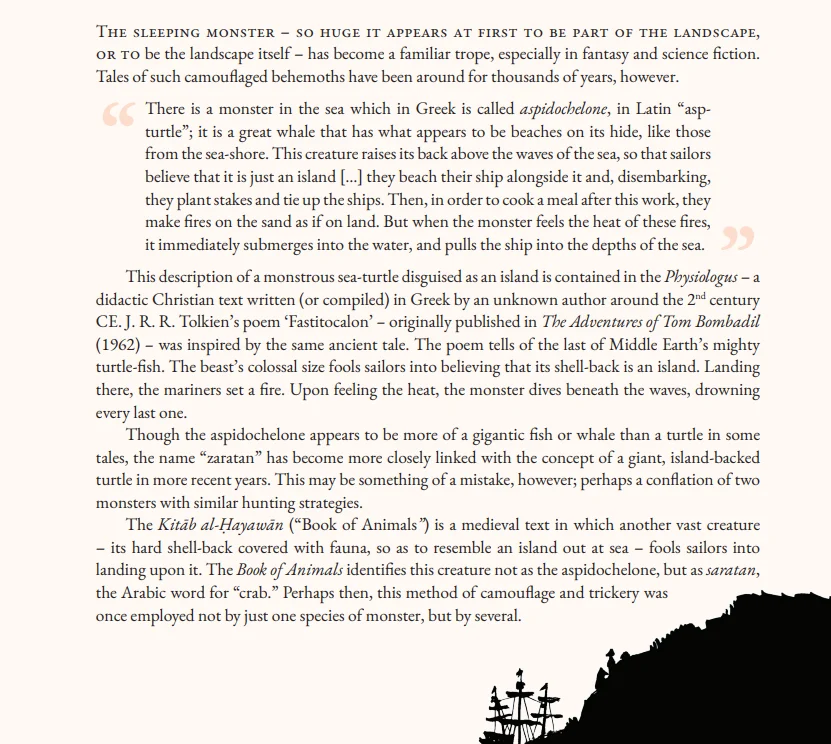
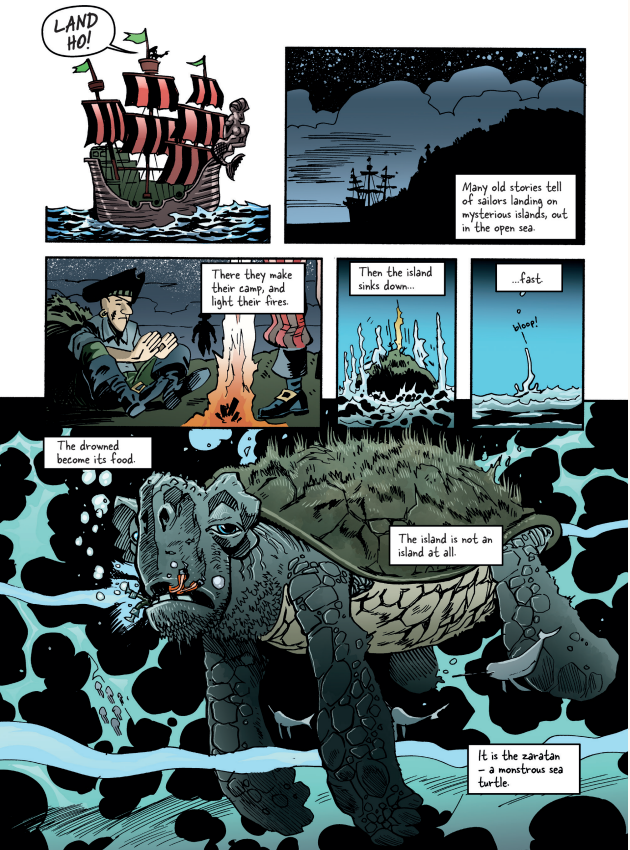
One of the most compelling narratives presented is that of the Aspidochelone, a colossal sea creature so immense that its back appears as an island, luring unsuspecting sailors to their doom. This ancient legend, described in the Greek Physiologus (a didactic Christian text from the 2nd century CE), is a potent cautionary tale, warning against deception and the hidden dangers of the natural world. The Physiologus itself is a significant work, an early bestiary that uses allegorical descriptions of animals, real and mythical, to teach Christian morals. The Aspidochelone, in this context, often symbolizes the Devil, enticing souls with false promises before dragging them into perdition.
The archetype of the island-monster resonates across various mythologies. One can draw parallels to the biblical Leviathan, a primordial sea creature, or even the world-turtle myths found in diverse cultures, which depict the earth resting on the back of a giant tortoise. These narratives speak to humanity’s awe and fear of the vast, unfathomable ocean and its hidden dangers.
The legend’s enduring appeal is evident in its influence on later literature. J.R.R. Tolkien, a master of myth-making, famously drew inspiration from this ancient tale for his poem ‘Fastitocalon,’ published in The Adventures of Tom Bombadil (1962). Tolkien’s creature, the last of Middle Earth’s mighty turtle-fish, similarly tricks mariners who light fires on its shell-back, only to be dragged beneath the waves. This demonstrates how core mythological tropes are reinterpreted and sustained through literary traditions.
The text also highlights a fascinating linguistic and conceptual nuance with the term Zaratan. While often associated with the giant island-turtle, the excerpt clarifies that the Arabic Kitāb al-Ḥayawān ("Book of Animals") identifies a similar camouflaged monster not as an aspidochelone but as a "saratan," the Arabic word for "crab." This suggests a potential conflation of different monstrous species employing similar predatory strategies, or perhaps a broader mythological motif of deceptive, landscape-mimicking creatures. This level of detail in the book underscores the intricate web of folklore, where tales evolve, merge, and transform across cultures and languages, often revealing shared human anxieties and wonders.
Anteros: The Unsung Deity of Reciprocal Love
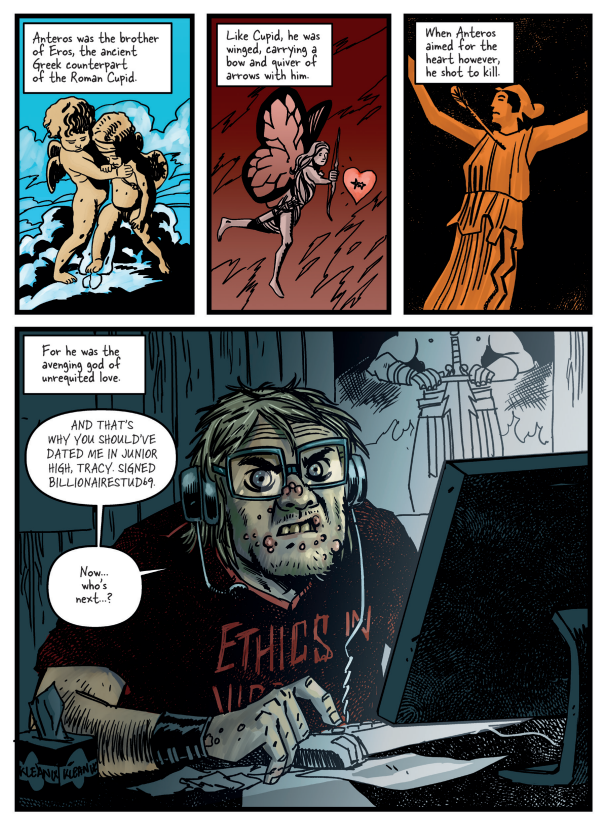
Another captivating entry illuminates the lesser-known Greek deity, Anteros, the brother of the famed Eros. While Eros, the winged god of desire, has evolved into the cherubic Cupid of Valentine’s cards, Anteros represents a more profound and complex aspect of love: reciprocal affection and divine retribution for unrequited love. His name, meaning "love returned," encapsulates his primary charge: to punish those who scorn the affections of another.
Anteros’s lineage traces back to Aphrodite, the goddess of love and beauty, and Ares, the god of war. He is one of the Erotes, a group of winged deities assisting Aphrodite, each embodying a specific facet of love or desire, such as Hedylogos (sweet talk), Pothos (longing), and Hymenaeus (weddings). Anteros’s role as the avenger of slighted love adds a layer of moral justice to the often-fickle realm of romantic desire. He is often depicted with lead arrows or a club of solid gold, symbolizing the heavy consequences of emotional neglect.
The compendium also reveals a compelling historical misattribution: the famous statue atop the Shaftesbury Memorial Fountain in Piccadilly Circus, London, widely known as Eros, is, in fact, Anteros. Cast in aluminum in 1892, the figure was chosen to represent love given blindly, or without expectation of return, as a metaphor for the philanthropy of Lord Shaftesbury. This detail not only corrects a common misconception but also highlights how mythological figures can be reinterpreted and imbued with new symbolic meaning in different cultural contexts, reflecting societal values and aspirations. Anteros, in this light, offers a more mature and ethical dimension to the concept of love than his more famous brother.

Okiku: The Vengeful Echo of Injustice
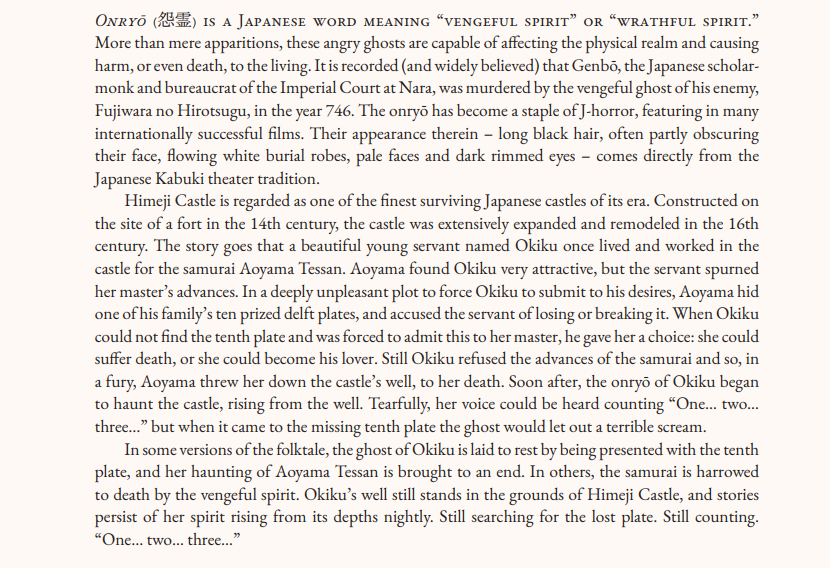
The chilling tale of Okiku, a Japanese onryō (vengeful spirit), offers a poignant exploration of injustice, betrayal, and the enduring power of a wronged spirit. The story is set in the historic Himeji Castle, one of Japan’s finest surviving feudal castles, which adds a layer of tangible history to the supernatural narrative.
Okiku, a beautiful young servant, finds herself the object of samurai Aoyama Tessan’s unwanted affections. When she spurns him, Aoyama orchestrates a cruel plot: he hides one of his family’s ten prized delft plates and accuses Okiku of its loss or breakage. Facing a choice between becoming his lover or suffering death, Okiku bravely refuses. In a fit of rage, Aoyama throws her down the castle well, leading to her tragic demise.
Soon after, Okiku’s onryō begins to haunt the castle, rising from the well. Her tearful voice is heard nightly, counting "One… two… three…" until she reaches the missing tenth plate, at which point her lament transforms into a terrifying scream. This motif of counting, often associated with obsessive or unresolved tasks, is a powerful element in folklore, signifying an endless torment.
The concept of the onryō is central to Japanese folklore and horror. Unlike mere apparitions, onryō are wrathful spirits capable of affecting the physical realm, causing harm, illness, or even death to the living. Their distinctive appearance—long black hair often obscuring the face, flowing white burial robes, pale countenances, and dark-rimmed eyes—has become a staple of J-horror cinema, influencing internationally successful films like Ringu and Ju-On. The historical account of Genbō, a Japanese scholar-monk allegedly murdered by the onryō of his enemy Fujiwara no Hirotsugu in 746 CE, underscores the deep-seated belief in these powerful spirits.
The Okiku legend, with its variations (some where she finds peace, others where Aoyama is haunted to death), serves as a potent reminder of the consequences of abuse of power and the cultural belief in justice beyond the grave. Her well still stands in Himeji Castle, a chilling monument to an enduring tale that continues to resonate with visitors and locals alike, still searching, still counting.
A Tapestry of Global Lore
Beyond these detailed examples, "Fascinating Folklore" promises a rich tapestry of global narratives. The inclusion of figures like Boudicca, the Celtic queen who led a fierce uprising against Roman occupation, and Beowulf, the legendary Geatish hero battling monsters in Anglo-Saxon epic poetry, highlights the compendium’s commitment to showcasing heroic myths that define national identities. The exploration of plantlore, featuring mystical flora like Mandrake, Willow, and Yedua, delves into the ancient wisdom connecting humanity to the natural world, revealing the magical and medicinal properties attributed to plants through centuries. The mention of Wandjing spirits from Western Australia signifies the book’s expansive reach into Indigenous cultures, acknowledging the rich spiritual traditions from across the globe. This diverse selection reinforces the universal human experience of storytelling and the myriad ways cultures seek to understand their world, their fears, and their hopes.
Critical Acclaim and Publisher’s Vision: Official Responses
While "Fascinating Folklore" is a new release, the anticipation and early reception within the folklore and comic communities point to its significant impact. The promotional material itself, crafted with a tone of reverence and excitement, acts as an ‘official response’ to the quality and importance of the work.
Liminal 11, the publisher, has a clear vision for its catalogue: to present esoteric and profound subjects in accessible and beautifully designed formats. Their decision to publish "Fascinating Folklore" is a testament to their belief in its unique value. A spokesperson for Liminal 11 might articulate their enthusiasm, stating, "We are immensely proud to bring John Reppion and PJ Holden’s ‘Fascinating Folklore’ to readers. This project perfectly embodies our mission to explore the mystical and the meaningful through innovative artistic expression. It’s a bridge between ancient wisdom and contemporary art, making these vital stories accessible to a new generation."
The authors themselves, John Reppion and PJ Holden, implicitly convey their passion through the dedication and depth evident in the excerpts. Reppion, with his scholarly approach, likely views the book as a crucial step in democratizing folklore, making it less intimidating for newcomers while offering fresh perspectives for seasoned enthusiasts. Holden, through his dynamic illustrations, ensures that these stories leap off the page, proving that academic rigor and artistic flair are not mutually exclusive but rather enhance one another. Their ‘response’ is the very work itself: a testament to their belief in the power and relevance of folklore.
Furthermore, the genesis of the book from the #FolkloreThursday community ensures a built-in audience and a warm reception. This online collective, already deeply engaged with the subject matter, is likely to embrace a publication that validates and expands upon their shared interest. Early reviews and social media buzz within this community are expected to be overwhelmingly positive, praising the book’s innovative format, its detailed research, and its stunning artwork. This collaborative origin story creates a direct line of communication between creators, publisher, and audience, fostering a sense of shared ownership and excitement for the project. "Fascinating Folklore" isn’t just a book; it’s a celebration of a community’s collective passion, brought to life by two of its most gifted interpreters.
Implications: The Enduring Power of Story in the Modern Age
"Fascinating Folklore" carries significant implications, not only for the fields of folklore studies and comic book publishing but also for the broader cultural landscape. Its innovative blend of academic essay and graphic novel art positions it as a pioneering work that redefines how ancient narratives can be presented and consumed in the 21st century.
Firstly, the compendium serves as a vital bridge between academic folklore and popular culture. Historically, folklore research has often been confined to scholarly texts, sometimes inaccessible to the general public. Reppion and Holden’s approach breaks down these barriers, presenting complex historical and mythological contexts in an engaging, visually appealing format. This accessibility is crucial for inspiring new generations to engage with their cultural heritage, fostering an appreciation for the narratives that have shaped human civilization. By making figures like the Aspidochelone, Anteros, and Okiku relatable and visually arresting, the book ensures that these stories continue to live and evolve, rather than fading into obscurity.
Secondly, the project showcases the versatility and intellectual depth of the comic book medium. Often pigeonholed as entertainment primarily for children or a niche audience, "Fascinating Folklore" elevates graphic storytelling to a respected platform for serious academic and cultural exploration. It demonstrates that comics are not just for superheroes but can be powerful tools for education, cultural preservation, and the nuanced interpretation of complex subjects. This could inspire other creators to explore similar cross-disciplinary projects, pushing the boundaries of what the medium can achieve.
Thirdly, the book’s global scope has implications for promoting cross-cultural understanding and empathy. By presenting tales from Greek antiquity, Japanese feudalism, Indigenous Australian spirituality, and ancient European epics side-by-side, "Fascinating Folklore" highlights both the diversity and the universality of human experience. It underscores how different cultures grapple with similar themes of love, loss, justice, fear, and wonder through their unique mythological lenses. In an increasingly interconnected world, understanding these shared narrative threads can foster greater appreciation for diverse traditions.
Finally, the success of "Fascinating Folklore," born from the #FolkloreThursday hashtag, validates the power of digital communities in cultural preservation and creation. It demonstrates how online platforms can serve as fertile ground for intellectual exchange, collaborative projects, and the revitalization of ancient traditions. This model could inspire further initiatives where passionate online communities coalesce to produce tangible, high-quality works that enrich the broader cultural discourse.
In essence, "Fascinating Folklore" is more than just a collection of stories; it is a testament to the enduring power of myth and the human need to understand our place in the world through narrative. It implies a future where the rich tapestry of folklore is not just preserved but actively celebrated and reinterpreted, ensuring that these fascinating tales continue to enlighten, entertain, and inspire for generations to come.
For more information, press inquiries, or to order your copy of "Fascinating Folklore," please visit Liminal 11’s website.


Leave a Comment