From Sensationalism to Superficiality: The Decline of Ryan Murphy’s ‘Monster’ Anthology
The true crime genre, once a niche for documentary filmmakers and investigative journalists, has been transformed into a sprawling, high-budget cinematic universe by Netflix and showrunner Ryan Murphy. What began with the harrowing, albeit controversial, Dahmer — Monster: The Jeffrey Dahmer Story has ballooned into an anthology franchise that seems increasingly burdened by its own branding. With the release of its fourth installment, Monster: The Lizzie Borden Story, the series appears to have moved beyond the "unflinching gaze" it once promised, settling instead into a repetitive, superficial exploration of trauma and violence that struggles to justify its own existence.
Main Facts: The Evolution of a Franchise
The Monster franchise was not originally conceived as an anthology. Following the unexpected massive viewership of the Jeffrey Dahmer installment, Netflix retroactively rebranded the series to establish a recurring brand. This branding strategy allowed Murphy and co-creator Ian Brennan to pivot from the Milwaukee cannibal to other high-profile American "monsters."
Season 2, Monsters: The Lyle and Erik Menendez Story, shifted the focus to the 1989 Beverly Hills parricide, while Season 3, Monster: The Ed Gein Story, returned to the mid-century Midwest to explore the "Plainfield Ghoul." However, a hallmark of the Murphy-Brennan formula is the refusal to stick to a single subject. The Dahmer season awkwardly integrated John Wayne Gacy and Ed Gein; the Menendez season detoured into the O.J. Simpson media circus; and the Gein season illuminated the atrocities of Nazi lamp-maker Ilsa Koch.
Season 4, The Lizzie Borden Story, continues this trend of "killer-looping" by introducing Aileen Wuornos and the 16th-century "Blood Countess," Elizabeth Báthory. Despite the historical distance between these figures, the series attempts to weave them into a singular narrative tapestry of female rage and systemic oppression. Yet, as the franchise grows more crowded with famous names, the depth of its psychological inquiry appears to be thinning.

Chronology: From 19th-Century Massachusetts to Modern Florida
The narrative structure of Season 4 is an ambitious, if disjointed, chronological hopscotch. The primary timeline is set in 1892 Fall River, Massachusetts, focusing on the domestic tinderbox of the Borden household. Lizzie Borden, played by Ella Beatty, is depicted as a woman trapped in a stifling environment of emotional and physical abuse.
The series chronicles the escalating tensions between Lizzie and her father, Andrew Borden (Charlie Hunnam), and her stepmother, Abby (Rebecca Hall). The timeline meticulously tracks the days leading up to the infamous August 4 ax murders, while simultaneously branching off into two distinct subplots:
- The 16th Century: The introduction of Bridget Sullivan (Vicky Krieps), the Borden family’s maid, serves as a bridge to the story of Elizabeth Báthory (also played by Krieps). The series uses this historical detour to suggest a spiritual lineage of female killers who were driven to madness by their social standing.
- The Late 20th Century: In its most daring—and perhaps most criticized—move, the series introduces Aileen Wuornos (Sarah Paulson) in the fourth episode. Wuornos is presented as a "fan" of Lizzie Borden, traveling to the Borden home a century after the crimes. This timeline attempts to draw a direct line from the "Victorian Spinster" to the "Highway Prostitute," suggesting that the patriarchal structures that failed Lizzie in the 1890s are the same ones that condemned Wuornos in the 1990s.
Supporting Data: Cast Performances and Narrative Tropes
The strength of any Ryan Murphy production typically lies in its casting, and The Lizzie Borden Story is no exception, even if the material fails the actors.
The Borden Household
Ella Beatty delivers a performance characterized by a "perpetual blankness," intended to convey the dissociation of a trauma victim. However, she is frequently overshadowed by her veteran co-stars. Charlie Hunnam’s Andrew Borden is a grotesque caricature of Victorian patriarchy. A funeral parlor director by trade, he is shown literally hacking the limbs off cadavers to fit them into standardized caskets—a heavy-handed metaphor for his treatment of the women in his life.

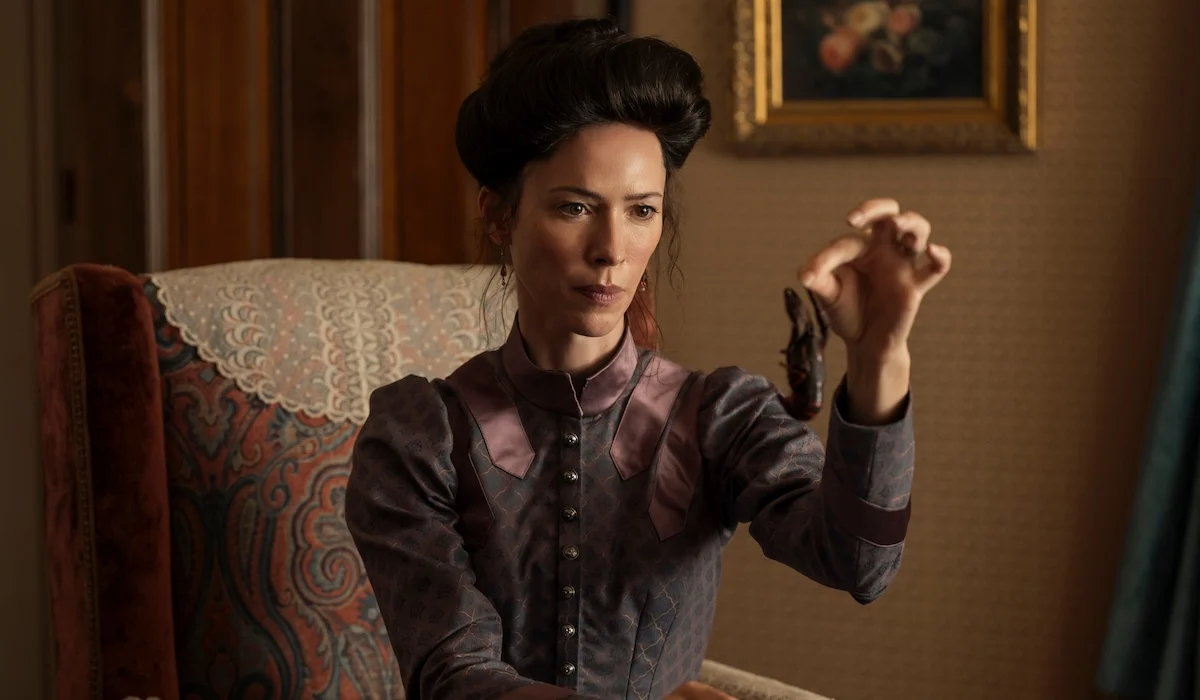
The standout, however, is Rebecca Hall as Abby Borden. Hall leans into the "camp-adjacent" aspirations of the series, portraying Abby as a cartoonish villain. In one sequence, she forces a maid to drink tea made from the dust wiped off the furniture; in another, she tosses scalding soup in a servant’s face. While Hall’s performance is a "commanding delight," it underscores the tonal inconsistency of a show that oscillates between grim tragedy and absurdist comedy.
The "Barf Bowl" and Body Horror
True to Murphy’s roots in American Horror Story, Season 4 does not shy away from the visceral. A pivotal scene involving poisoned seafood—referred to by critics as the "Barf Bowl"—features projectile vomiting that rivals The Exorcist. While Hunnam’s delivery of the line, "It was the cardamom!" provides a moment of dark levity, these sequences often feel like filler in a narrative that struggles to find enough historical meat to cover its ten-episode runtime.
The Wuornos Comparison
The inclusion of Sarah Paulson as Aileen Wuornos is the season’s most controversial element. Paulson, a Murphy mainstay, delivers an impression of Wuornos that many have compared unfavorably to Charlize Theron’s Oscar-winning turn in the 2003 film Monster. Critics have noted that Paulson’s "bug-eyed embodiment" feels more like a farcical sketch than a genuine character study. Furthermore, the narrative link—that Wuornos was a "soul sister" to Lizzie—is entirely fictional, as there is no historical evidence that Wuornos had any obsession with the Borden case.
Official Responses and Critical Reception
The critical reception for The Lizzie Borden Story has been notably harsher than for previous seasons. While Dahmer was criticized for its ethics, it was praised for its tension and Evan Peters’ performance. Lizzie Borden, by contrast, has been met with a "D+" grade from major outlets like IndieWire, citing a lack of "incisive commentary."

The consensus among critics is that the series has become "wholly disinterested in its own existence." The recurring rhetorical question of the franchise—"Who’s the real monster here?"—has become a predictable trope. By framing Lizzie Borden’s acquittal as a triumph of female agency and her subsequent life as a suffragist and animal rights activist, the show is accused of practicing "lazy feminism." It suggests that the murders were a necessary prerequisite for her liberation, an implication that many find both twisted and intellectually shallow.
Furthermore, the comparison to Patty Jenkins’ 2003 Monster has highlighted the TV series’ deficiencies. Where the film was seen as an "embodiment" and an act of "empathy" that witnessed a woman’s desperate fate without excusing her crimes, the Netflix series is viewed as an "impression" that arguably excuses murder by framing it as a valid response to systemic oppression.
Implications: The Future of the "Monster" Brand
The trajectory of the Monster anthology raises significant questions about the sustainability of the true crime "mega-franchise."
The Dilution of History
As the series moves further away from grounded biographical drama and closer to a "multiverse" of serial killers, it risks losing the very "unflinching gaze" that made it a hit. The integration of fictionalized romances—such as the unsubstantiated relationship between Lizzie and Bridget Sullivan—and the forced connections between disparate historical figures suggest that the creators are prioritizing "vibe" over veracity.

The "Murphy-Verse" Fatigue
The reliance on camp, body horror, and "shock and awe" tactics is a hallmark of Ryan Murphy’s style, but in the context of real-life tragedies, these elements can feel exploitative. If Season 4 is an indication of the franchise’s direction, the "Monster" brand may be shifting from a serious exploration of American pathology into a high-gloss, repetitive soap opera.
The Netflix Strategy
For Netflix, the Monster franchise remains a cornerstone of its content strategy, driving massive engagement despite critical drubbing. However, the law of diminishing returns may be setting in. When a series about some of history’s most notorious killers begins to feel "perfunctory" and "bored with itself," it suggests that the audience’s appetite for sensationalized trauma may finally be reaching a breaking point.
In conclusion, Monster: The Lizzie Borden Story is a lavishly produced, well-acted, but ultimately hollow addition to the Netflix library. It captures the "fury" of its subjects but fails to find the soul behind the steel of the axe. As the franchise looks toward future seasons, it must decide whether it wants to be a meaningful contribution to the true crime genre or merely a "loose impression" of the horrors it seeks to portray.