Gaming the Curve: How a Game Designer’s Sketch Transformed Pandemic Literacy
In the early months of 2020, as the SARS-CoV-2 virus began its silent trek across the globe, a fundamental crisis of communication emerged. While epidemiologists and statisticians warned of exponential growth and catastrophic mortality rates, a significant portion of the public—and many policymakers—struggled to grasp the abstract mathematics of viral transmission. Amidst this fog of data and denial, Raph Koster, a veteran game designer renowned for his work on Ultima Online and Star Wars Galaxies, proposed a different approach. He argued that if people could not understand the math, perhaps they could "feel" the system through play.
What began as a simple design sketch posted to Facebook on March 24, 2020, eventually evolved into a series of "serious games" that were utilized in classrooms, vetted by medical experts, and played by tens of thousands. These simulations, most notably Covid Ops and In the Time of Pandemia, served as vital pedagogical tools during a period of unprecedented global uncertainty.
The Chronology of a Crisis: From Rumors to Simulation
The genesis of this initiative dates back to the final months of 2019. Koster, an observer of systemic patterns, noted early reports of a novel pathogen in China as early as November. By early 2020, as the virus breached international borders, he began utilizing social media to translate epidemiological data into layman’s terms.
However, Koster quickly encountered what he described as a "wall" of skepticism. When he posted projections suggesting that the United States could face millions of deaths based on an Infection Fatality Rate (IFR) of 0.4% and a 60% infection rate for herd immunity, the response was often derisive. Critics labeled such predictions as alarmist, with some mockingly stating that "no one is predicting that."
By March 2020, the disconnect between statistical reality and public perception reached a breaking point. Koster realized that the professions capable of internalizing exponential curves—Wall Street quants, statisticians, and game designers—shared a common language of systems. To bridge the gap for the general public, he drafted a design document for a "low-fidelity" simulation.
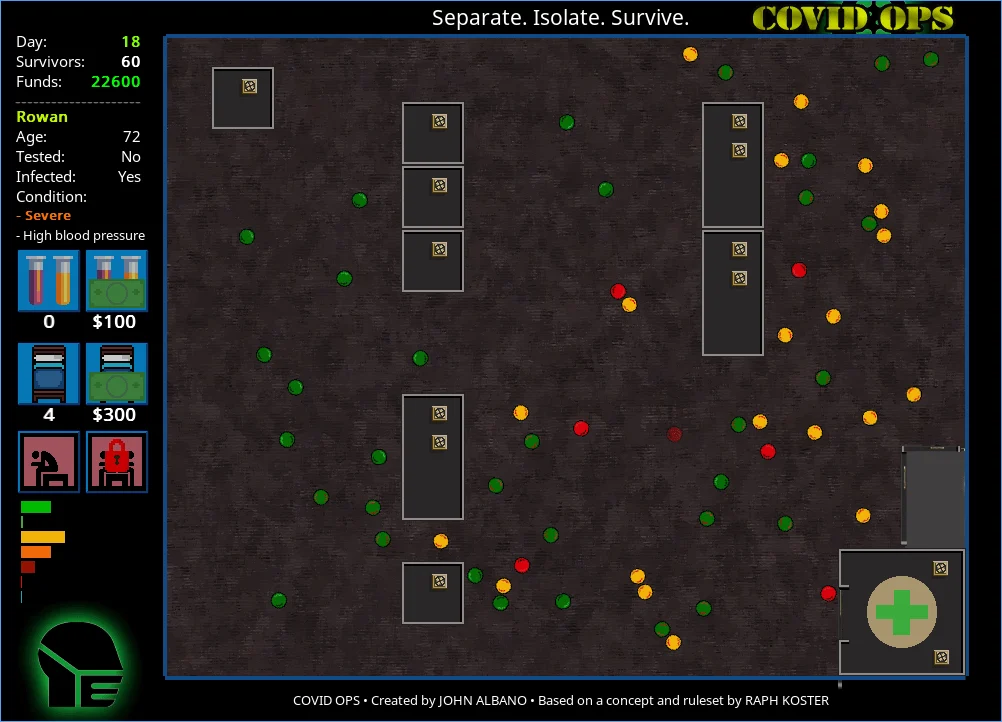
On March 24, 2020, Koster published this sketch. Within six days, John Albano released Covid Ops on the indie platform Itch.io. Shortly thereafter, a larger-scale project led by Khail Santia in the Philippines, In the Time of Pandemia, began development during the "Jamdemic 2020" game jam. By July 2020, these concepts had matured into fully realized educational simulations that gained viral traction across the Pacific Rim.
The Mechanics of Infection: The Design Sketch
Koster’s original design was deceptively simple, intended to be "not even a hard game to make." The goal was to visualize the invisible. The proposed mechanics included:
1. The Population Model
The simulation featured "little circles" bouncing on a plain field. Crucially, each circle was assigned a name from a baby book, an age, and a statistically grounded chance of having a comorbidity (such as diabetes or hypertension). This "humanized" the data, transforming abstract dots into relatable individuals.
2. State Progression
Entities moved through various states: Healthy, Asymptomatic, Symptomatic (Mild/Severe/Critical), and eventually Recovered or Dead. A "Diagnosed" flag determined whether the player could see the entity’s true status. Asymptomatic carriers were rendered identically to healthy ones, mirroring the "stealth" transmission that made COVID-19 so difficult to contain.
3. Player Interventions
The player acted as a public health official with a limited set of "buttons" representing real-world policy levers:
- Social Distancing: Slowing the movement speed of the circles.
- Close Schools/Work: Removing a percentage of circles from the field.
- Testing: Increasing the rate at which the "Diagnosed" flag was applied.
- Isolate: Moving diagnosed circles to a separate area.
- Hospitalize: Increasing the recovery rate for critical cases, provided hospital capacity was not exceeded.
The game would run for a simulated 18 months—the estimated time to develop a vaccine—ending with a tally of the "souls lost" and the economic cost.
Supporting Data: The Reality of Comorbidities
A central pillar of the design was the inclusion of comorbidities, a factor that many early skeptics ignored. Koster emphasized that the "at-risk" population was not a small, isolated niche, but a massive segment of the general public.
Drawing from data provided by the American Heart Association and the American Diabetes Association, the simulations integrated the following realities:
- Hypertension: Nearly 46% of U.S. adults (approximately 103 million people) have high blood pressure, a significant risk factor for severe COVID-19.
- Diabetes: Roughly 10.5% of the U.S. population is diabetic, with another 34.5% of adults classified as pre-diabetic.
- Obesity: Clinical studies published in JAMA indicated that a high Body Mass Index (BMI) significantly increased the likelihood of requiring mechanical ventilation.
Because the disease spread primarily within households, Koster’s design illustrated that "protecting the vulnerable" was impossible without broader social measures. If 40-50% of the population had a comorbidity, "targeted isolation" was a logistical fallacy; the entire social fabric was effectively "at risk."
Official Responses and Validation
The projects sparked by Koster’s sketch received significant attention from both the gaming press and the medical community. In the Time of Pandemia, in particular, became a flagship for "mindful gaming."
Medical Vetting
Dr. Mariane Faye Acma, a resident physician who consulted on the project, noted that the game effectively developed skills in critical thinking and multitasking. "The game will make players realize how challenging the work of the health sector is in this crisis," she stated. The simulation was validated by a mathematical biologist to ensure the "flattening the curve" mechanics aligned with epidemiological reality.
Academic Integration
Gregg Victor Gabison, Dean of the University of San Jose-Recoletos, integrated the game into the curriculum for information and communications technology students. He praised it as a storyline that "connects with reality," providing a visceral understanding of resource allocation and public health management.
Media Coverage
The games received extensive coverage from outlets such as IGN Southeast Asia, The Star Malaysia, and Philstar. They were recognized not just as entertainment, but as vital responses to a local crisis—specifically in Cebu City, which was a major COVID-19 hotspot in the Philippines at the time.
Implications: The Power of Ludic Literacy
In hindsight, the "math" that Koster and his fellow designers championed proved remarkably accurate. While early detractors scoffed at the mention of "millions dead," the global toll is now estimated by various health organizations to be between 15 and 28.5 million. In the United States alone, the toll reached approximately 1.4 million.
The success of these simulations highlights several key implications for future crisis management:
1. Games as "Systems Teachers"
The pandemic revealed a gap in "systems literacy." Traditional news media often struggles to explain how a 1% change in a transmission rate can result in thousands of additional deaths weeks later. Games, by their nature, are interactive systems. They allow users to witness the consequences of variables in real-time, making them uniquely suited for public health education.
2. The Psychological Impact on Creators
For the developers—Albano, Santia, and Koster—the act of creation was a form of "transcending the chaos." In a time of forced isolation, building a tool to help others understand the threat provided a sense of agency and connection.
3. Future Preparedness
As of late 2024, the emergence of human cases of H5N1 bird flu serves as a reminder that the threat of zoonotic diseases remains constant. The frameworks developed during the COVID-19 pandemic—both the digital simulations and the collaborative networks between designers and doctors—provide a blueprint for how society might respond to the "next" pandemic with greater speed and clarity.
Conclusion
Raph Koster’s design sketch was never intended to be a commercial product, but rather a catalyst. By distilling complex epidemiological data into a set of interactive rules, he and the teams that followed him provided a "visceral understanding" of a global catastrophe.
While the discourse has shifted toward the economic and educational impacts of the pandemic, the legacy of these games remains a testament to the power of systemic thinking. In the words of Khail Santia, these projects were a "thread connecting a diversity of talents" in a time of darkness. They proved that even a simple "little circle" on a screen could help save lives by making the invisible visible.