
Kurt Vonnegut’s Enduring Legacy: The Rejected Thesis That Mapped the Soul of Storytelling
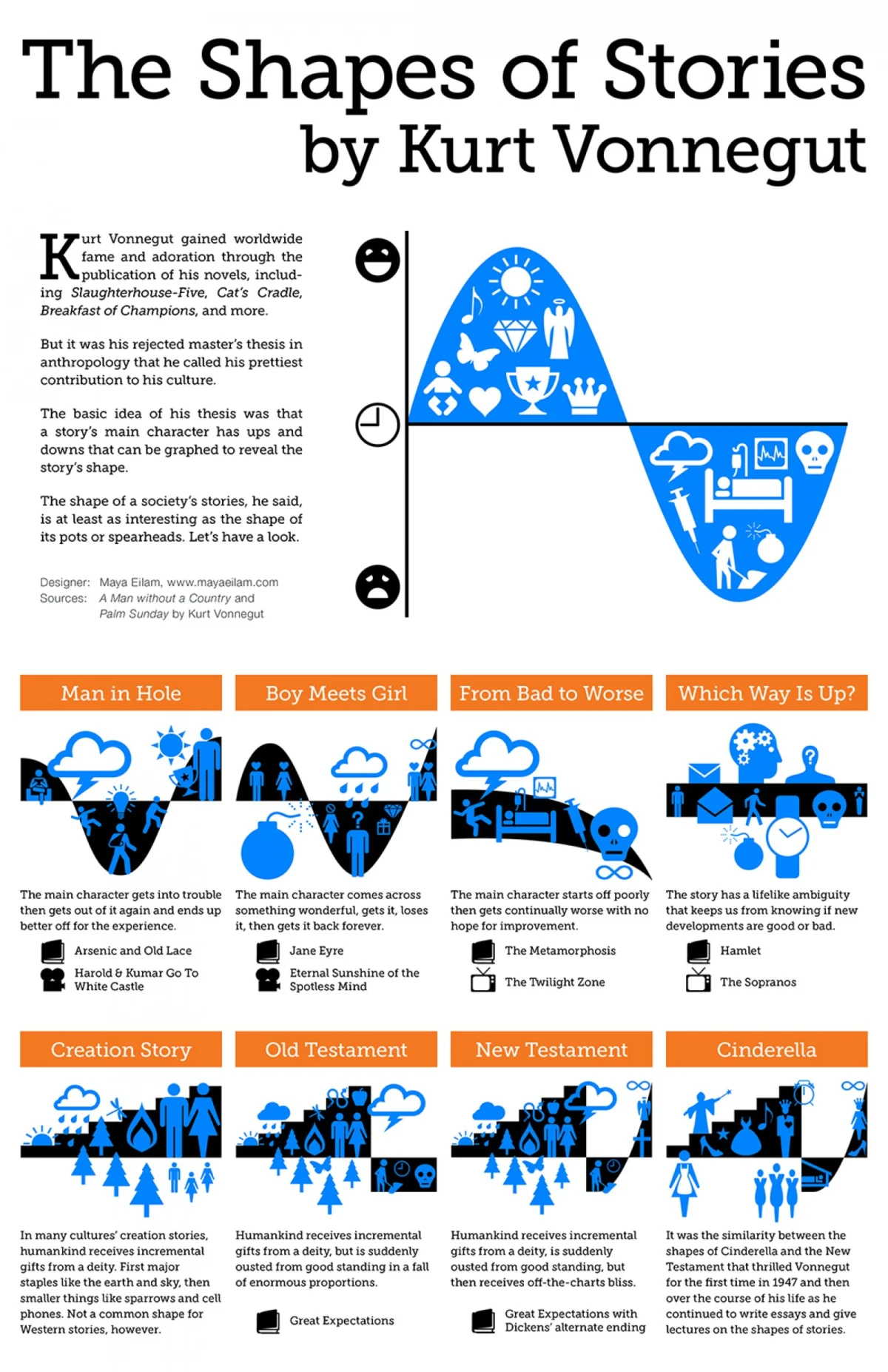
June 3, 2026 – Decades after its controversial rejection by the University of Chicago, Kurt Vonnegut’s master’s thesis, "The Shapes of Stories," continues to resonate, offering a profoundly insightful and refreshingly simple framework for understanding narrative. Far from being a mere academic curiosity, Vonnegut’s elegant theory, which posits that stories possess quantifiable shapes that can be charted, has cemented its place as a cornerstone of literary analysis and a testament to the author’s unique genius. This exploration delves into the origins of this groundbreaking work, its visual representations, and its lasting impact on how we perceive the very essence of storytelling.
The Genesis of a Singular Vision: A Master’s Thesis Ahead of Its Time
Kurt Vonnegut, a literary titan known for his darkly humorous and profoundly humanistic explorations of the human condition, famously declared his master’s thesis in anthropology for the University of Chicago as his "prettiest contribution to culture." Submitted in the mid-20th century, the thesis, titled "The Shapes of Stories," proposed a radical yet remarkably accessible idea: that narratives, like any other form of human creation, possess discernible structures that can be visualized. This concept, which he articulated with his characteristic blend of wit and profound observation, was reportedly rejected by the university for its perceived simplicity and an almost defiant sense of playfulness.
Vonnegut himself summarized the core of his thesis in a single, powerful sentence: "The fundamental idea is that stories have shapes which can be drawn on graph paper, and that the shape of a given society’s stories is at least as interesting as the shape of its pots or spearheads." This assertion, made with characteristic Vonnegutian directness, challenges traditional literary criticism to move beyond subjective interpretation and engage with the quantifiable architecture of narrative. It suggests that the way a society tells its stories is as revealing of its cultural identity and values as its material artifacts. The rejection, therefore, can be seen not as a failure, but as a prelude to the thesis’s enduring power, its simplicity proving to be its greatest strength, allowing it to transcend academic confines and capture the imagination of creators and audiences alike.
Visualizing the Narrative Landscape: From Blackboard to Infographic
The inherent visual nature of Vonnegut’s theory found its most potent amplification through various mediums, most notably through his own explanations and later, through insightful graphic representations. In 2011, Open Culture featured a video of Vonnegut himself eloquently expounding on "The Shapes of Stories," a lecture that perfectly encapsulated his accessible and engaging pedagogical style. His ability to distill complex ideas into easily digestible concepts, delivered with his signature dry wit, made his insights on narrative structure immediately graspable.
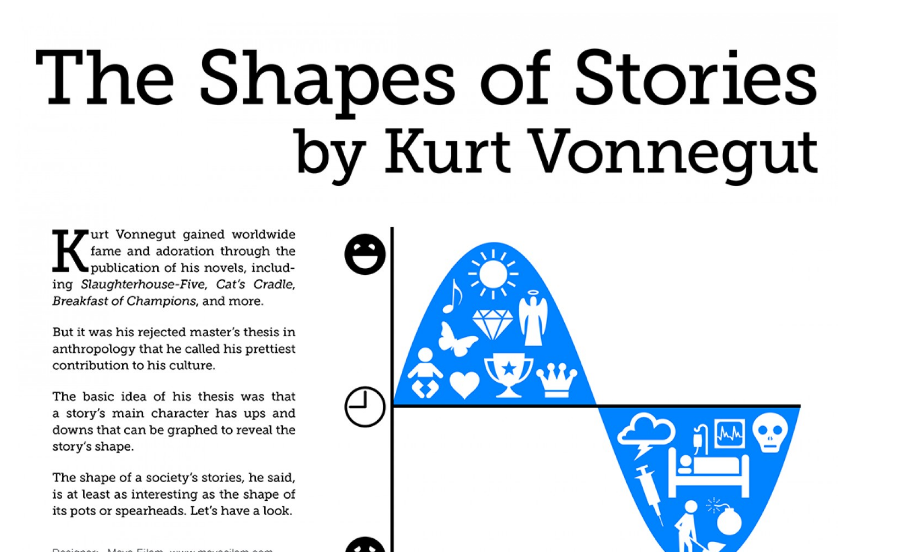
More recently, graphic designer Maya Eilam took Vonnegut’s theoretical framework and translated it into a striking infographic. This visual aid, presented alongside Vonnegut’s explanations, vividly illustrates the various story shapes he outlined in his thesis. By using clear iconography and examples, Eilam’s work breathes life into Vonnegut’s abstract concepts, making them tangible and easily understood. The infographic, a testament to the power of visual communication in demystifying complex theories, effectively demonstrates how stories can be mapped onto a graph, revealing patterns of rising action, climax, falling action, and resolution, and even more nuanced emotional arcs. This visual interpretation not only honors Vonnegut’s original vision but also expands its reach, making his ideas accessible to a broader audience, from aspiring writers to casual readers seeking a deeper understanding of the narratives that shape their lives. The combination of Vonnegut’s spoken word and Eilam’s visual interpretation creates a powerful synergy, offering a comprehensive and engaging exploration of his seminal contribution to the study of storytelling.
A Chronology of Narrative Insight: Vonnegut’s Literary Journey
While "The Shapes of Stories" thesis was a foundational element, it was deeply intertwined with Vonnegut’s broader literary output and his consistent engagement with the craft of writing. His career can be viewed as a continuous exploration of narrative structures and the human experience they encapsulate.
- Mid-20th Century: Vonnegut submits his master’s thesis, "The Shapes of Stories," to the University of Chicago. The thesis, proposing the idea that stories have quantifiable shapes, is reportedly rejected for its perceived simplicity.
- 1960s-1970s: Vonnegut’s novels, such as Slaughterhouse-Five, Cat’s Cradle, and Breakfast of Champions, gain widespread acclaim, showcasing his unique narrative voice and his ability to weave complex themes into compelling stories, often defying conventional linear structures.
- 1980s: In his autobiography, Palm Sunday (1981), Vonnegut reflects on his thesis and its rejection, humorously referring to it as his "prettiest contribution to culture." This public acknowledgment brings renewed attention to his ideas on narrative structure.
- 1990s: Vonnegut continues to write and lecture, often sharing his insights on writing and storytelling. His influence on subsequent generations of writers grows, with his unique approach to narrative structure becoming a subject of academic and popular interest.
- Early 21st Century (2011): Open Culture features a video of Vonnegut explaining "The Shapes of Stories," reigniting interest in his theoretical work and its practical applications.
- Mid-2010s: Graphic designer Maya Eilam creates an infographic that visually represents Vonnegut’s "Shapes of Stories" theory, further popularizing the concept and making it accessible to a wider audience. This infographic becomes a key tool for understanding and applying Vonnegut’s ideas.
- 2020s and Beyond: Vonnegut’s "Shapes of Stories" continues to be a vital concept in literary studies, writing workshops, and popular culture, demonstrating the enduring relevance of his simple yet profound insights into the art of narrative.
Supporting Data: The Enduring Appeal of Simplicity and Structure
The enduring appeal of Vonnegut’s "Shapes of Stories" can be attributed to several key factors, all of which underscore the power of his seemingly simple thesis.
- Universality of Narrative: At its core, Vonnegut’s theory taps into the fundamental human need for stories. Every culture, throughout history, has relied on narratives to convey knowledge, preserve history, and make sense of the world. By proposing that these narratives possess underlying structures, Vonnegut offers a way to analyze and understand this universal human practice.
- The Power of Visualization: Humans are inherently visual beings. The ability to see a story’s shape laid out on a graph paper transforms abstract concepts into concrete representations. This visual approach makes the theory accessible and engaging, allowing individuals to apply it to their own reading and writing experiences. The infographic by Maya Eilam is a prime example of this, translating complex theoretical constructs into easily digestible visual forms.
- Vonnegut’s Unique Voice: Kurt Vonnegut was a master communicator. His ability to blend profound philosophical observations with accessible language and a healthy dose of dark humor made his ideas not only understandable but also deeply memorable. His lectures and writings on the subject are infused with this characteristic charm, making the learning process enjoyable.
- Practical Application for Writers: For aspiring and established writers, Vonnegut’s theory offers a practical toolkit. Understanding story shapes can help authors to construct more compelling narratives, to identify potential weaknesses in their plots, and to experiment with different narrative structures to achieve specific effects. His advice, such as the "Eight Rules for Writing Fiction," complements his structural theories by providing actionable guidance.
- Cultural Resonance: The idea that a society’s stories reflect its values and preoccupations is a powerful one. By analyzing the shapes of stories prevalent in a particular culture, one can gain insights into its collective consciousness, its hopes, fears, and aspirations. This makes Vonnegut’s theory relevant not only to literature but also to sociology, anthropology, and cultural studies.
Official Responses and Academic Reception
While the University of Chicago’s initial rejection of Vonnegut’s thesis is a well-known anecdote, the subsequent reception and academic engagement with his ideas paint a different picture. The narrative of rejection has, in many ways, contributed to the mystique and enduring appeal of "The Shapes of Stories."
- Initial Rejection: The story of the thesis being rejected by the University of Chicago for being "too simple and looked like too much fun" has become a legendary part of Vonnegut’s biography. This anecdote highlights a potential academic resistance to theories that challenge traditional, often more complex, analytical frameworks, and a skepticism towards approaches that prioritize clarity and engagement over perceived academic rigor.
- Academic Re-evaluation: Despite the initial rejection, Vonnegut’s ideas on narrative structure have gained significant traction within literary and creative writing circles. Educators and scholars now frequently reference his work, acknowledging its insightful contribution to understanding storytelling. The visual representations, such as Maya Eilam’s infographic, have played a crucial role in this academic re-evaluation, making the theory more approachable and demonstrable.
- Influence on Creative Writing Pedagogy: Vonnegut’s concepts are widely incorporated into creative writing courses and workshops. His emphasis on clear, understandable narrative arcs provides a valuable framework for students learning the craft of storytelling. The "Shapes of Stories" theory offers a tangible starting point for dissecting existing narratives and for constructing original ones.
- Broader Cultural Impact: Beyond academia, Vonnegut’s theory has permeated popular culture, influencing discussions about film, literature, and even the narratives we encounter in everyday life. The accessibility of his ideas means they resonate with a broad audience, demonstrating the universal appeal of understanding how stories are built.
Implications: The Enduring Relevance of Vonnegut’s Vision
Kurt Vonnegut’s "The Shapes of Stories" theory, despite its unconventional academic reception, carries profound implications for our understanding of narrative and its role in human culture.
- Democratization of Literary Analysis: By offering a visual and relatively simple framework, Vonnegut’s theory democratizes the analysis of literature. It empowers individuals without formal literary training to engage with the underlying structures of stories, fostering a more inclusive appreciation of narrative art.
- The Art of Storytelling as a Science: Vonnegut’s work suggests that there are indeed discernible patterns and principles governing effective storytelling, moving it from a purely intuitive art form towards something that can be understood and, to some extent, mastered through analysis. This has significant implications for the teaching and learning of creative writing.
- Cultural Archetypes and Collective Consciousness: The idea that a society’s stories have a discernible shape implies that these narratives reflect a collective consciousness, shared anxieties, and cultural values. Analyzing these shapes can offer a unique lens through which to understand the evolving identity and preoccupations of a society.
- Timelessness of Narrative Principles: While literary trends and genres evolve, the fundamental human need for stories and the underlying principles of narrative construction remain remarkably constant. Vonnegut’s theory, by focusing on these fundamental shapes, offers insights that transcend specific historical periods or cultural contexts.
- The Power of Simplicity in Communication: The very rejection of Vonnegut’s thesis for its simplicity underscores a critical point: that profound insights can often be found in elegantly simple ideas. His enduring legacy is a testament to the fact that clarity and accessibility are not antithetical to depth and intelligence, but rather can be powerful tools for conveying complex truths.
In conclusion, Kurt Vonnegut’s "The Shapes of Stories" is far more than a quirky academic footnote. It is a brilliant, enduring contribution to our understanding of narrative, a testament to the author’s unique genius, and a powerful reminder that sometimes, the most insightful observations come in the most accessible packages. The rejected thesis, visualized and re-examined, continues to shape how we perceive the stories that shape us.


Leave a Comment