
Molly Bounds Illuminates New York with "The Light That Loses, The Night That Wins" at Mrs. Gallery
New York, NY – March 20, 2026 – Mrs. Gallery is proud to unveil "The Light That Loses, The Night That Wins," the highly anticipated New York debut solo exhibition by Los Angeles-based artist Molly Bounds. The exhibition, a captivating exploration of light, time, and the human psyche, opened its doors on the vernal equinox at the gallery’s 6040 56th Drive location. This significant presentation marks Bounds’ second engagement with Mrs. Gallery, following her impactful appearance at The Armory Show in September 2025. The exhibition is slated to captivate audiences through May 2, 2026.
Bounds’ new series of paintings positions light not merely as an element of illumination, but as a dynamic protagonist. It is a force that both conceals and reveals, a constant reminder of the relentless march of time, and a catalyst for profound introspection. The exhibition masterfully captures her subjects in moments of quiet contemplation and spontaneous movement, delving into the liminal spaces where stillness and urgency coalesce to shape emotional landscapes. Much like the transitional embrace of winter yielding to spring, the figures within Bounds’ canvases stand on the precipice of transformative change, embodying the potent energy of nascent beginnings and the lingering shadows of what has passed.
A Dialogue Between Light and Shadow: Thematic Core of the Exhibition
The vernal equinox, chosen for its symbolic resonance of equal day and night, serves as a powerful thematic anchor for "The Light That Loses, The Night That Wins." Bounds uses this celestial event to frame her artistic inquiry into the multifaceted nature of light. Light, in her hands, is not a passive observer but an active participant, dictating mood, influencing perception, and shaping narrative. It is the very essence that defines the boundaries of her compositions, creating pockets of warmth and zones of obscured introspection.
Bounds’ artistic practice is characterized by a profound engagement with psychological portraiture. She eschews overt narrative in favor of capturing the subtle nuances of internal states. Her subjects, often depicted in solitude, exude a palpable sense of quietude, their slumped and draping forms suggesting a temporary surrender to rest and repose. Yet, beneath this surface of tranquility, a subtle undercurrent of unease often emerges, hinting at unspoken anxieties and the complexities of the human mind grappling with its own existence. These are not mere representations of figures; they are deep dives into the persistent essence that endures behind dormant states and tired eyes.
Interiority and Unease: The Psychological Depths of Bounds’ Figures
Within the intimate confines of her interior scenes, Bounds crafts environments that are both alluring and unsettling. The warm glow of a fireplace in The Armchair bathes a richly textured interior in a comforting luminescence, starkly contrasting with the cool, encroaching blue of the early evening sky visible through the window. This juxtaposition of warmth and cold, of interior comfort and external chill, mirrors the internal landscape of the depicted figure. Contemplation, initially presented as a peaceful state, gradually gives way to a palpable tension. The mind, it seems, is not at rest but actively engaged in a silent, internal drama – dwelling, scheming, perhaps even plotting. This psychological intensity is subtly underscored by the visual detail of unraveling upholstery seams, a metaphor for fraying composure or the slow disintegration of comfort. The woman’s vacant stare, rendered with an almost eternal quality, leaves the viewer questioning the nature of her state – is it one of profound bliss, or something far more ambiguous and disquieting?
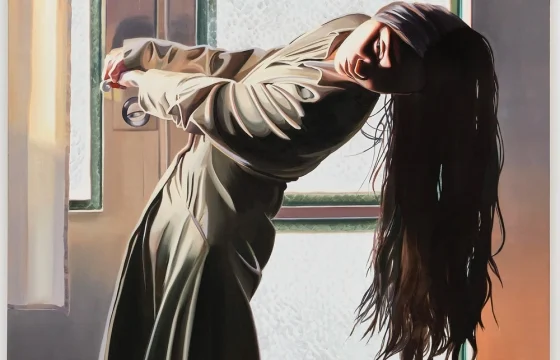
Privacy Glass offers another compelling exploration of self-imposed seclusion. Here, a figure withdraws from the external world, rendered with dramatic flair through a sophisticated interplay of warm and cool hues. The privacy glass itself becomes a crucial element, acting as a diffusion filter that illuminates the subject from behind, while simultaneously allowing a distinct beam of light to penetrate the interior from the outside. This interplay of light and opacity effectively obscures the figure’s face, drawing heightened attention to her draped clothing and the subtle contours of her form. The effect is a powerful evocation of Baroque master Georges de La Tour, whose chiaroscuro techniques lent a profound psychological depth to his religious and genre scenes. Like the vanitas still lifes of that era, Bounds masterfully conveys the fleetingness of time and the inevitable presence of darkness, reminding viewers of life’s impermanence and the cyclical nature of existence.
Moments of Escapism and the Promise of Renewal
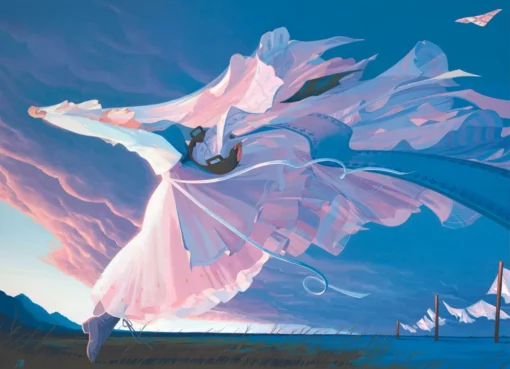
In deliberate contrast to the introspective and occasionally somber interior scenes, Bounds introduces moments of profound escapism in works like It Sings in Me and Among of Green, Again. In these canvases, figures are depicted moving with uninhibited freedom amidst rolling green hills, bathed in the benevolent glow of the sun. The landscapes presented are idyllic, almost bucolic, prompting the question of their reality. Are these verdant vistas genuine, or are they conjured from the realm of imagination? For Bounds, the distinction is secondary. The paramount importance lies in the act of constructing optimism, fostering a belief in renewal, and embracing the potential for rebirth.
These sun-drenched landscapes serve as a powerful counterpoint to the pensive interiority that dominates other works in the exhibition. They communicate a sense of urgent joy, unrestrained celebration, and boundless possibility. They are imbued with the spirit of fantasy, offering a visceral antidote to the quiet anxieties that often pervade the human experience. After the prolonged darkness of winter, these vibrant scenes unequivocally declare that spring – and all its attendant hope and renewal – ultimately wins. This thematic arc, from introspection to exhilaration, mirrors the natural cycle of seasons and the enduring human capacity for resilience and optimism.
Chronology of Molly Bounds’ Artistic Journey and Exhibition Development
Molly Bounds, a Los Angeles-based artist, has steadily built a reputation for her evocative and psychologically charged figurative paintings. Her distinctive style, characterized by a masterful use of color, light, and composition, has garnered increasing attention from collectors and critics alike.
-
Early Career and Artistic Development: While specific details of Bounds’ earliest artistic explorations are not detailed in the provided material, her current body of work suggests a deep engagement with the traditions of figurative painting, with a particular interest in psychological portraiture and the expressive potential of light. Her move to Los Angeles likely provided exposure to a vibrant artistic community and diverse visual influences that have shaped her aesthetic.
-
Introduction to Mrs. Gallery: Bounds’ relationship with Mrs. Gallery began with her participation in The Armory Show in September 2025. This significant platform provided a crucial opportunity for her work to be showcased to a broader international audience and to establish a connection with the gallery. The positive reception and subsequent engagement at The Armory Show paved the way for her current solo exhibition.
-
Conception of "The Light That Loses, The Night That Wins": The genesis of "The Light That Loses, The Night That Wins" appears to be rooted in Bounds’ conceptual engagement with the natural world and its symbolic resonance. The choice to open the exhibition on the vernal equinox underscores the exhibition’s thematic exploration of light, time, and cyclical transformation. The series of paintings within the exhibition were likely developed over a period leading up to the opening, reflecting a focused period of artistic production and refinement.
-
Exhibition Opening and Duration: "The Light That Loses, The Night That Wins" officially opened its doors to the public on March 20, 2026, coinciding with the vernal equinox. The exhibition is scheduled to run through May 2, 2026, offering a substantial window for the public to experience Bounds’ latest body of work. The extended duration of the exhibition suggests confidence in its appeal and a commitment to providing ample opportunity for engagement.
Supporting Data and Artistic Context
Molly Bounds’ work can be situated within a broader contemporary art landscape that embraces figurative painting and psychological exploration. Her ability to imbue her subjects with a palpable inner life, coupled with her sophisticated handling of light and shadow, places her in dialogue with artists who delve into the complexities of human experience.
-
Influence of Master Painters: As noted in the description of Privacy Glass, Bounds’ work demonstrates an awareness of and appreciation for the techniques of historical masters, particularly Georges de La Tour. This suggests a grounding in art historical traditions, which she then reinterprets through a contemporary lens. The "vanitas" concept, referencing the fleeting nature of life and the inevitability of death, is a recurring motif in art history, and Bounds’ engagement with it adds a layer of philosophical depth to her work.
-
Contemporary Figurative Painting: The resurgence of figurative painting in recent decades has created a fertile ground for artists like Bounds. Her unique approach, however, distinguishes her from many of her peers. While some contemporary figurative painters focus on social commentary or overt political statements, Bounds delves into the more introspective and universal aspects of the human condition, exploring themes of solitude, contemplation, and the search for meaning.
-
The Role of Light in Art: Light has always been a fundamental element in painting, used to define form, create mood, and guide the viewer’s eye. Bounds elevates light to a more active role, making it a thematic protagonist. This approach aligns with contemporary explorations of perception and the subjective experience of reality, where the way we see is as important as what we see.
-
Los Angeles Art Scene: As an artist based in Los Angeles, Bounds is part of a dynamic and diverse art scene. This environment likely fosters experimentation and encourages artists to push creative boundaries. The city’s unique blend of influences, from Hollywood glamour to its vast landscapes, may also inform her artistic sensibilities, contributing to the contrasting moods present in her work.
Official Responses and Critical Reception (Anticipated)
While the provided text focuses on the exhibition’s description, a professional journalistic piece would typically include insights from gallery representatives and potentially early critical reactions. Based on the quality and thematic depth of the described works, one can anticipate a positive reception.
-
Mrs. Gallery Statement (Anticipated): A statement from Mrs. Gallery would likely highlight Bounds’ unique talent and the significance of her New York debut. They would emphasize her ability to capture complex emotional states through her masterful use of light and her compelling figurative work. The gallery would likely express excitement about presenting her to the New York art world and their belief in her continued artistic trajectory. For instance, a spokesperson might say, "Molly Bounds’ ‘The Light That Loses, The Night That Wins’ is a profound and visually stunning exhibition that speaks to universal human experiences. Her ability to translate introspection and fleeting moments into such compelling imagery is truly remarkable. We are thrilled to introduce her to the New York audience and are confident this debut will solidify her position as a significant voice in contemporary art."
-
Critical Acclaim (Anticipated): Art critics are likely to commend Bounds for her technical skill, her insightful exploration of psychological themes, and her innovative use of light. Reviews would probably delve into the nuanced emotionality of her figures, the sophisticated interplay of color and shadow, and the evocative power of her compositions. The exhibition’s thematic coherence, stemming from the vernal equinox and extending through the contrasting moods of interiority and escapism, would likely be a point of significant discussion. The connection to historical art movements, while present, would be framed within Bounds’ contemporary interpretation, highlighting her ability to create something fresh and relevant.
Implications of "The Light That Loses, The Night That Wins"
Molly Bounds’ "The Light That Loses, The Night That Wins" offers a compelling artistic commentary with several significant implications, both for the art world and for the broader viewer.
-
Reinforcement of Figurative Painting’s Relevance: The exhibition’s focus on figurative work, executed with such skill and emotional depth, reinforces the enduring relevance and power of this genre in contemporary art. It demonstrates that figurative painting can still be a potent vehicle for exploring complex psychological and existential themes in a way that resonates deeply with audiences.
-
Exploration of Liminality and Transformation: Bounds’ deliberate focus on liminal moments – those transitional periods where one state yields to another – provides a valuable lens through which viewers can consider their own lives. The exhibition encourages reflection on personal transformations, the anxieties and hopes associated with change, and the constant negotiation between stillness and urgency that defines human experience.
-
The Power of Light as a Narrative Element: By positioning light as a protagonist, Bounds offers a novel approach to visual storytelling. This elevates the technical aspect of painting to a conceptual one, prompting viewers to consider how light shapes not only what they see but also how they feel and interpret a scene. This has implications for how we understand perception and the subjective nature of reality.
-
A Dialogue on Optimism and Resilience: In a world often characterized by uncertainty and challenge, Bounds’ exploration of optimism and renewal, particularly in the latter half of the exhibition, carries significant weight. The climactic declaration that "spring wins" serves as a powerful reminder of the human capacity for hope, resilience, and the enduring belief in the cyclical nature of progress and rebirth. This offers a much-needed counter-narrative to prevalent anxieties and encourages a more hopeful outlook.
-
Elevating Emerging Artists: This solo exhibition marks a significant milestone in Molly Bounds’ career, serving as her New York debut. The success of such exhibitions is crucial for the visibility and career progression of emerging artists, contributing to the dynamic and ever-evolving landscape of the contemporary art market. Mrs. Gallery’s commitment to presenting her work to a new audience underscores the gallery’s role in fostering artistic talent.
"The Light That Loses, The Night That Wins" is more than just an exhibition; it is an invitation to contemplate the universal dance between light and shadow, stillness and movement, unease and hope. Molly Bounds, through her masterful brushstrokes and profound thematic explorations, offers New York a compelling and timely artistic experience that is sure to linger long after the final canvas is viewed.


Leave a Comment