Mastering the Art of the Pitch: Unpacking Your Story’s Hook and Heart
In the competitive landscape of storytelling, capturing an audience’s attention is an art form that demands precision, intrigue, and a deep understanding of what truly resonates. Aspiring authors and seasoned professionals alike often grapple with the challenge of distilling the essence of their narratives into compelling pitches. This endeavor requires a nuanced approach, recognizing the distinct yet interconnected roles of a story’s "hook" and its "heart."
The Elusive Thirty-Second Pitch: A Test of Narrative Dexterity
Imagine a high-stakes scenario: a mere sixty seconds to convince a discerning reader, agent, or publisher that your story is worth their invaluable time. This compressed timeframe necessitates a potent blend of mystery and promise, hinting at the overarching plot, thematic depth, and atmospheric tone without succumbing to overwhelming detail. While seemingly straightforward, the process of crafting such a concise yet captivating pitch often reveals a fundamental truth: the elements that ignite curiosity are not always the same as those that imbue a story with lasting meaning.
This distinction between a story’s "hook" and its "heart" is not merely a semantic nuance; it’s a foundational concept that can profoundly impact every facet of the writing process. Understanding and optimizing both can elevate a good story to a truly unforgettable one, transforming a compelling narrative into a resonant experience that lingers long after the final page.
Defining the Core: The Story’s Heart and Its Resonance
At its core, a story’s "heart" represents its fundamental essence, its soul. This is the irreducible "what it’s all about." While genre—be it romance, thriller, or coming-of-age—provides a foundational category, the heart delves deeper. It encompasses the story’s central meaning, the underlying message that shines through the narrative craft. It’s the reason a story matters to readers after they’ve been initially drawn in by its premise.

To effectively identify your story’s heart, consider these probing questions:
Question 1: The Genesis of Creation – Why Are You Writing This Story?
The initial impulse behind a story often points towards its heart. Answering "I love romance" or "I want to explore the challenges of adolescence" is a starting point, but it requires further excavation. Why this specific romance? What particular aspects of adolescence resonate with you? The "why" behind your creative drive is a powerful compass. For instance, a desire to explore the resilience of the human spirit in the face of adversity might be the heart of a story, even if its plot involves fantastical elements. This intrinsic motivation is what fuels the author’s passion and, subsequently, can connect with readers on a deeper emotional level.
Question 2: The Unveiling of Truth – What Is the Story Truly About?
When asked to summarize your work, what is the most concise and accurate description of its central thrust? This is not about listing every plot point or subplot, but about distilling the narrative’s core purpose. For example, the story of Paul Volponi’s young adult novel, Rikers High, is succinctly described as "a story about a kid who ends up in the prison on Rikers Island, where he is inspired to turn his life around, thanks to the school there." This captures the narrative’s main trajectory and its underlying message of redemption and the transformative power of education.
Illustrative Examples of Story Hearts:

- Reflex by Steven Gould: A man possesses the extraordinary ability to teleport globally, only to find himself a target of those seeking to exploit his power, forcing him into a desperate fight for survival. The heart lies in the individual’s struggle against overwhelming forces and the ethical dilemmas of extraordinary abilities.
- Light of Eidon by Karen Hancock: A prince, sold into slavery, navigates a path of faith and self-discovery, ultimately transforming into a formidable warrior amidst the brutal world of gladiatorial combat. The heart beats with themes of faith, inner strength, and the forging of identity through hardship.
- Wide Sargasso Sea by Jean Rhys: This novel delves into the tumultuous inner life of Edward Rochester’s first wife, exploring her descent into madness amidst a loveless marriage and her husband’s callous indifference. Its heart lies in the exploration of mental fragility, societal constraints, and the devastating impact of emotional neglect.
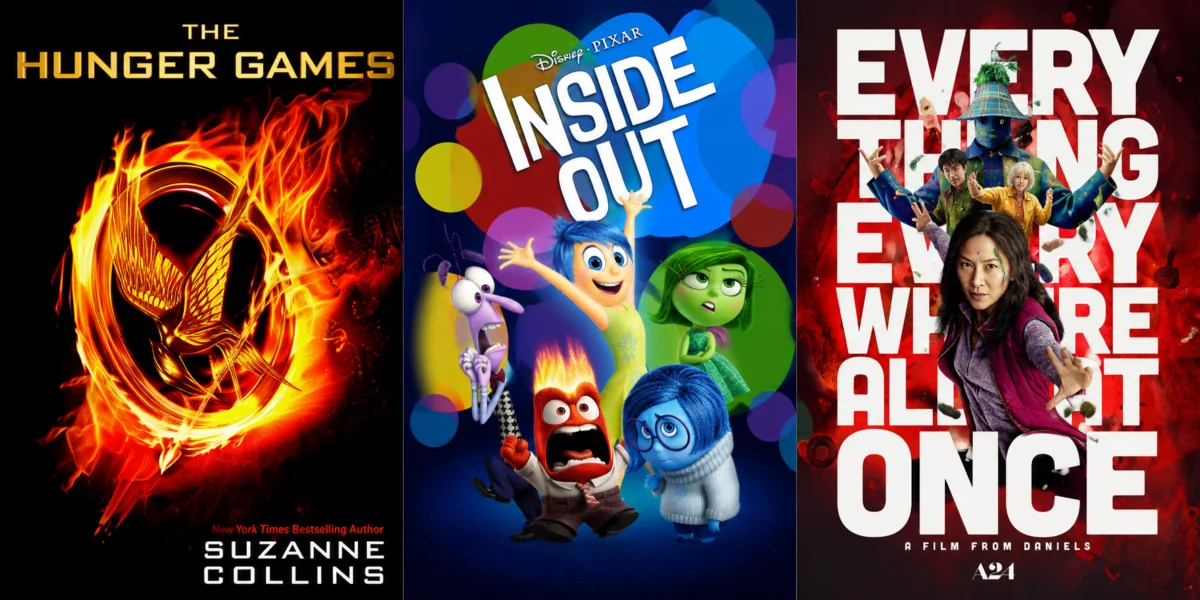
- The Hunger Games by Suzanne Collins: A teenage girl is thrust into a politically charged, televised gladiatorial competition, where her defiance of the brutal system ignites a spark of rebellion. The heart of this story pulsates with the tension between survival and retaining humanity, and the critique of oppressive regimes that exploit spectacle.
- Inside Out (Film): The anthropomorphized emotions within a young girl’s mind must learn to cooperate when a traumatic move coincides with the onset of adolescence, forcing them to confront the necessity of sadness. The heart lies in the exploration of emotional complexity, the acceptance of all feelings, and the process of growing up.
- Everything Everywhere All at Once (Film): A laundromat owner is swept into a multiversal adventure, harnessing the skills of her alternate selves to confront fractured family relationships. While the multiverse provides the hook, the heart beats with the profound exploration of intergenerational trauma, familial love, and finding meaning amidst chaos.
These descriptions highlight the streamlined nature of identifying a story’s heart. They focus on the central conflict and thematic underpinnings, deliberately omitting subplots or intricate twists that, while crucial to the narrative, are secondary to its core essence.
The Intriguing Spark: Crafting the Story’s Hook
While the heart provides depth and meaning, the "hook" is the element that ignites reader curiosity and compels them to pick up the book in the first place. It’s the unique, often surprising, or provocative aspect that differentiates your story from countless others within the same genre. A story’s hook is its immediate draw, its promise of something fresh and engaging.
To uncover your story’s hook, consider these interrogatives:
Question 1: The Audience’s Engagement – Why Should Audiences Care About This Story?
Without a compelling hook, even the most profound story risks remaining undiscovered. The hook answers the implicit question: "What makes this story worth my attention in a crowded marketplace?" It needs to offer a unique perspective, an unexpected premise, or a question that readers will be eager to see answered. For instance, while "a story of star-crossed lovers" might describe the heart of Romeo and Juliet, the hook lies in the specific tragic circumstances: "two star-crossed teenagers fall in love and, when their families object, end up committing double suicide." This specificity creates intrigue.

Question 2: The Singular Distinction – What Is the Single Most Interesting and Unique Element in This Story?
Often, the genesis of a story lies in its heart—a passion for a theme or character. However, to craft a potent hook, writers must look beyond their initial inspiration and identify the most distinctive element. What makes your story stand out? Why is it not just another iteration of a familiar trope? This could be a unique character ability, an unusual setting, a novel twist on a classic concept, or a surprising combination of elements.
Illustrative Examples of Story Hooks:
- Reflex: The unique premise of a man who can teleport through space, presented not as a superhero narrative but as a story of a hunted individual fighting for self-preservation, provides a compelling hook.
- Light of Eidon: While themes of faith and transformation are its heart, the hook emerges from the unexpected combination of a weakling prince forced into gladiatorial combat, a scenario rarely explored.
- Wide Sargasso Sea: The hook is inherently built into its premise: a prequel to Charlotte Brontë’s Jane Eyre, told from the perspective of the mysterious "mad wife in the attic," instantly piques the interest of fans of the original.
- The Hunger Games: The chilling concept of children forced to kill each other on live television, set against a backdrop of oppressive regimes and societal control, serves as a potent and disturbing hook.
- Inside Out: The high-concept premise of the story unfolding within a young girl’s mind, with her emotions as literal characters, offers immediate visual and conceptual intrigue.
- Everything Everywhere All at Once: The hook is the audacious premise of an ordinary laundromat owner accessing the skills of infinite alternate selves across the multiverse, a chaotic and visually arresting concept that grounds itself in relatable family dynamics.
These hooks are designed to create an immediate spark of curiosity, prompting readers to ask, "What happens next?" or "How will this unfold?"
The Art of Synthesis: Combining Hook and Heart in a Pitch
The ultimate goal is to seamlessly weave the story’s hook and heart into a compelling narrative pitch, whether for a query letter, back-cover copy, or an elevator pitch. The universally accepted strategy is to lead with the hook.

The Hook Takes Center Stage:
No audience will engage with the heart of your story until their curiosity has been captured. Present the most intriguing and unique aspect of your novel upfront. This is your "big gun," the element that will make readers pause and lean in. If you cannot grab them immediately, the opportunity to share your story’s deeper resonance may be lost.
Anchoring with the Heart:
While the hook reels readers in, the heart provides the substance and direction. If space or the medium allows, present the story’s core meaning as concisely as possible. Ideally, the heart should also be phrased in a way that maintains intrigue, acting as a secondary hook. For example, after introducing the multiverse hook of Everything Everywhere All at Once, the heart can be presented as a compelling secondary element: "a mother who doesn’t know how to understand her daughter." This anchors the fantastical premise in relatable human emotion.

Strategic Integration:
The most effective novel pitches often integrate the hook and heart so seamlessly that they become inseparable. This is achieved by identifying the unique element that not only sparks curiosity but also directly leads to the story’s central conflict and thematic exploration.
Implications for the Writing Process and Beyond
The understanding and application of the hook-heart dichotomy extend far beyond the pitching stage. Recognizing these core components early in the writing process can:
- Provide Direction: A clear understanding of the story’s heart and hook can guide plot development, character arcs, and thematic exploration, ensuring a cohesive and impactful narrative.
- Enhance Focus: By knowing what truly matters to the story, writers can avoid extraneous plot points or thematic tangents that might dilute the core message or weaken the hook.
- Strengthen Character Development: The heart of a story often dictates the emotional journey of its characters, while the hook can present unique challenges that test their resolve and reveal their true nature.
- Improve Reader Engagement: A story that effectively balances an intriguing hook with a resonant heart is more likely to captivate readers from beginning to end and leave a lasting impression.
In conclusion, mastering the art of the pitch—and indeed, the art of storytelling itself—hinges on the ability to articulate both the immediate allure and the profound significance of a narrative. By dissecting and refining your story’s hook and heart, you equip yourself with the essential tools to not only attract readers but to create an experience that truly resonates and endures.