Navigating the Cosmic Abyss: A Deep Dive into Recent Mothership RPG Modules Reveals Innovation and Frustration
The vast, dark expanse of space is a fertile ground for horror, and few tabletop role-playing games capture its chilling essence quite like Mothership. Renowned for its streamlined mechanics, potent atmosphere, and commitment to sci-fi survival horror, Mothership has fostered a vibrant ecosystem of third-party modules. A recent exploration into a selection of these new releases, intended to restock an open table’s "jobs board," has unveiled a landscape of both brilliant innovation and perplexing design choices, offering GMs a mixed bag of cosmic terror and creative challenge.
This deep dive into five distinct modules – Reclaimer, Meat Farm, Carrion Protocol, Burying Grounds on Pavel Theta, and Quantum Cargo – highlights the ambitious spirit of the Mothership community. Yet, it also underscores persistent issues in independent game design, from frustrating formatting to glaring narrative gaps. For GMs seeking their next terrifying voyage, understanding these nuances is crucial to separating the hidden gems from the diamonds in the rough that demand significant polishing.
Module Deep Dive: A Chronological Assessment of Recent Releases
The journey through these modules reveals a spectrum of design philosophies and execution qualities, each leaving a distinct impression on the potential for a thrilling game night.
Reclaimer: A Promising Concept Drowned in Flaws (Grade: D)
Main Facts: Reclaimer posits a compelling scenario: player characters (PCs) are hired to salvage resources from the long-abandoned Galloway Outpost on the desert moon Kara-9. The twist? A rival corporation has dispatched another team for the same objective, creating an immediate competitive dynamic. Adding to the tension, the entire facility is slated to collapse within hours of the PCs’ arrival, imposing a strict time limit on their operations.
Chronology & Supporting Data: The initial concept is undeniably strong, offering a solid foundation for a tense, action-packed scenario. The included map, though suffering from continuity errors (depicting a space station instead of a land-based outpost), is otherwise well-structured for potential conflicts between the competing salvage crews. This core idea, a race against time and rivals, holds significant promise for classic Mothership emergent gameplay.
However, the execution of Reclaimer is unfortunately plagued by a multitude of self-inflicted wounds, rendering it "senselessly hostile" to GMs. The module’s primary downfall stems from its commitment to a custom micro-pamphlet format. While "cute" in theory, this design choice necessitates printing, cutting, and origami-style folding of the PDF, an impractical and time-consuming task for most GMs. The practical implications are severe: the outpost map, a critical component for tactical play, is inconveniently split across multiple spreads, making it arduous to reference during gameplay. Furthermore, the map employs a series of custom symbols, none of which are keyed or explained, leaving GMs to decipher their meaning—a task that proves impossible for some.
Beyond formatting, the adventure suffers from significant functional incompleteness. The central dynamic revolves around scavenging under a time limit, yet the module provides no guidelines for the time required to salvage materials. While a list of salvage types (industrial fuel, raw minerals, rare electronics) is provided, their location on the map is vaguely and contradictorily keyed, and critically, no value is assigned to any salvaged items. This omission cripples the core mechanic, as GMs are left without the necessary information to adjudicate success, failure, or the economic consequences of the mission. The arbitrary string of coincidences in the setup—two teams arriving simultaneously at a "long-abandoned" outpost that coincidentally collapses hours later—further strains credulity and highlights a lack of cohesive narrative planning.

Implications: Reclaimer serves as a stark reminder that a strong concept alone cannot carry a module. Poor formatting, unkeyed elements, and functional incompleteness place an undue burden on the GM, transforming preparation into an extensive design project rather than a simple read-through. It raises questions about the balance between innovative presentation and fundamental usability in indie RPG publishing.
Meat Farm: Creature Feature with a Muddled Map (Grade: C)
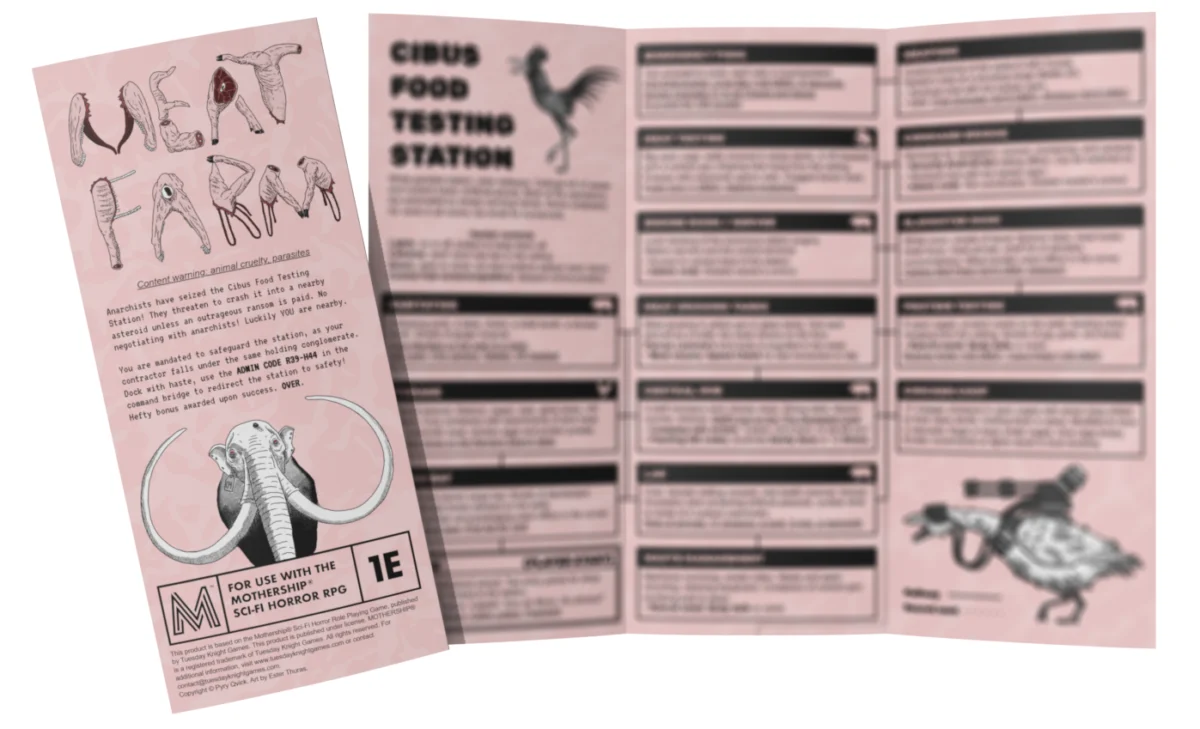
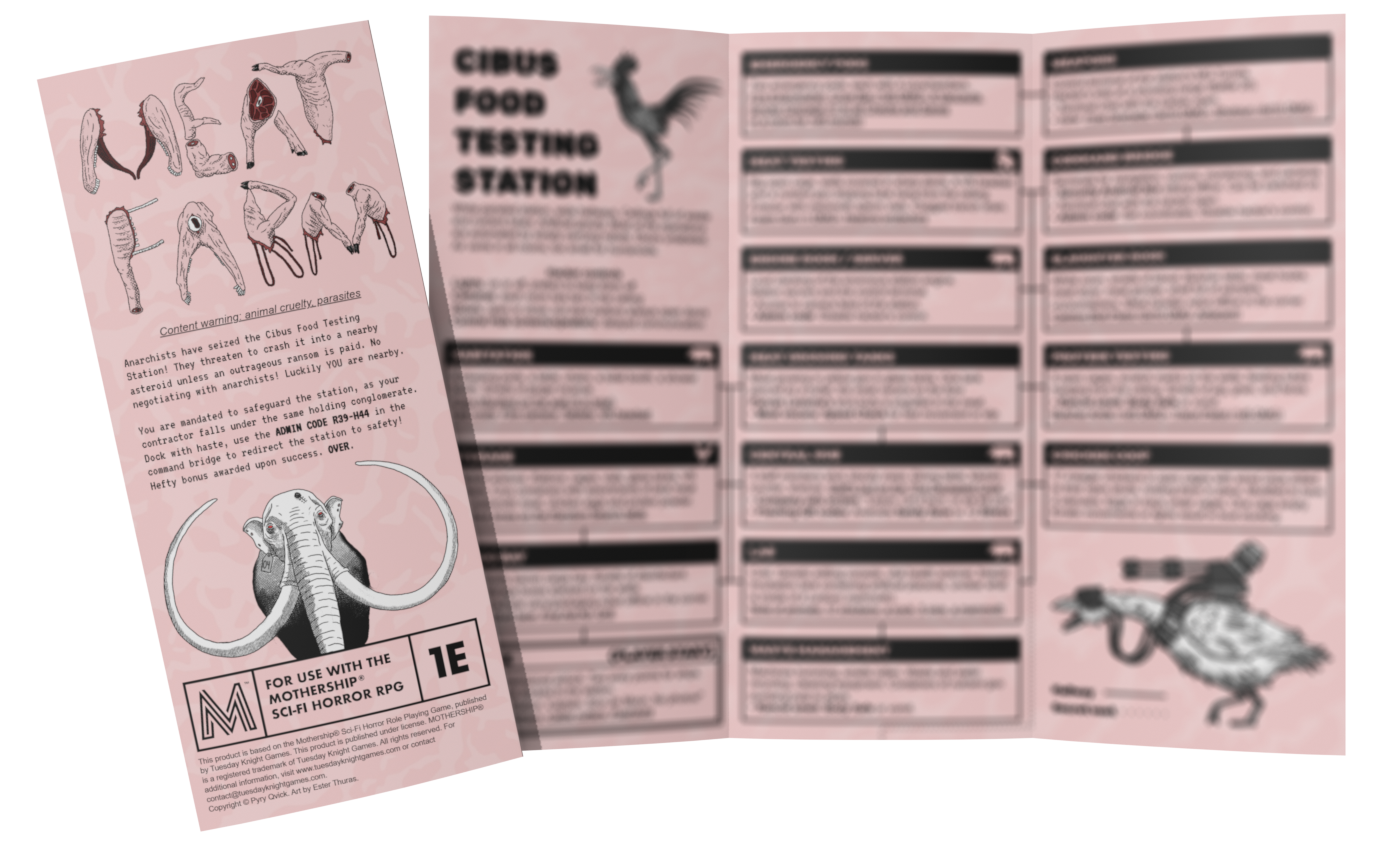
Main Facts: Meat Farm plunges PCs into a corporate nightmare: a lone hacker has seized control of Cibus Station, a research facility, freeing experimental subjects, eliminating most of the crew, and demanding a ransom. The PCs are dispatched by their corporate overlords to regain control of the compromised station.
Chronology & Supporting Data: Pyry Qvick’s Meat Farm excels at layering threats, a hallmark of effective Mothership design. GMs must contend with the hacker, who weaponizes the station’s automated systems against the PCs, a homicidal suborned android, and a horrifying menagerie of dangerous, weird, and disturbing experimental animals. The module truly shines in its creature design, offering a "nifty combo pack" of unique horrors, including "turret gooses," "parasite pigs," and "albino mammoths." These grotesque creations are cleverly stocked within minimal-but-vividly keyed rooms, ensuring each encounter feels distinct and memorable. The varied and interesting nature of the rooms themselves adds to the exploration and sense of dread.
However, the adventure’s primary flaw lies in its pointmap, which is described as "maddeningly vague to the point of incoherence." While pointmaps are inherently abstract representations, they must still convey a logical and descriptive sense of the game world. When a GM cannot describe the connections between rooms or visualize the layout, it severely hinders their ability to run the adventure smoothly and consistently. This issue, not unique to Meat Farm among Mothership modules, forces GMs to undertake the significant task of re-mapping and re-contextualizing the station’s layout, adding considerable prep time.
Implications: Meat Farm demonstrates that even compelling narrative hooks and excellent monster design can be undermined by fundamental issues in spatial representation. For GMs, the necessity of rebuilding the map from the room keys transforms a potentially exciting module into a more labor-intensive project. It highlights the critical importance of clear and functional maps, even abstract ones, in facilitating smooth gameplay and immersion.
Carrion Protocol: Creepy Atmosphere, Unclear Lore (Grade: C)
Main Facts: Carrion Protocol begins with a classic sci-fi horror trope: PCs respond to a distress call from the FUV Irene, only to discover a catastrophic malfunction in the ship’s meat labs. The vessel is now overrun by semi-sentient flesh growths and aggressive "fleshhounds."
Chronology & Supporting Data: This module is lauded for being "short, creepy, and fun," delivering a strong sense of atmosphere and immediate horror. The concept of a ship consumed by sentient, predatory flesh is inherently unsettling and well-suited to the Mothership aesthetic.
Despite its strengths, Carrion Protocol suffers from a lack of a clear, coherent pre-arrival narrative. While the module scatters "clues" like blood trails and corpses, they don’t coalesce into an understandable sequence of events. This ambiguity poses a significant challenge for GMs, who struggle to answer player questions consistently if they don’t fully grasp "what happened" on the ship. A related continuity issue arises with the pacing mechanic: "every 10 minutes a room adjacent to meat growth is overgrown." At such a rapid rate, the entire ship should have been consumed long before the PCs could have answered a distress call, creating a logical disconnect. Furthermore, the module, presented as a pamphlet, is marred by printing issues across all available PDFs, preventing GMs from assembling a functional physical copy—a frustrating impediment for those who prefer tactile materials.
Official Responses (General Community Perspective): As a "pay-what-you-want" title, Carrion Protocol exemplifies a common trade-off in indie publishing. Its accessibility encourages experimentation, but it often means accepting rough edges in terms of polish and comprehensive design. The community generally appreciates creative concepts at this price point but often acknowledges the extra work required to integrate them fully into a campaign.
Implications: Carrion Protocol underscores the importance of a solid, albeit possibly hidden, narrative backbone for a horror scenario. Players actively investigate, and a GM’s inability to provide consistent answers can break immersion. The printing issues also highlight the necessity of thorough quality control, even for free or low-cost offerings, as usability remains paramount.
Burying Grounds on Pavel Theta: A Promising Horror Hook Lacking Depth (Grade: C-)
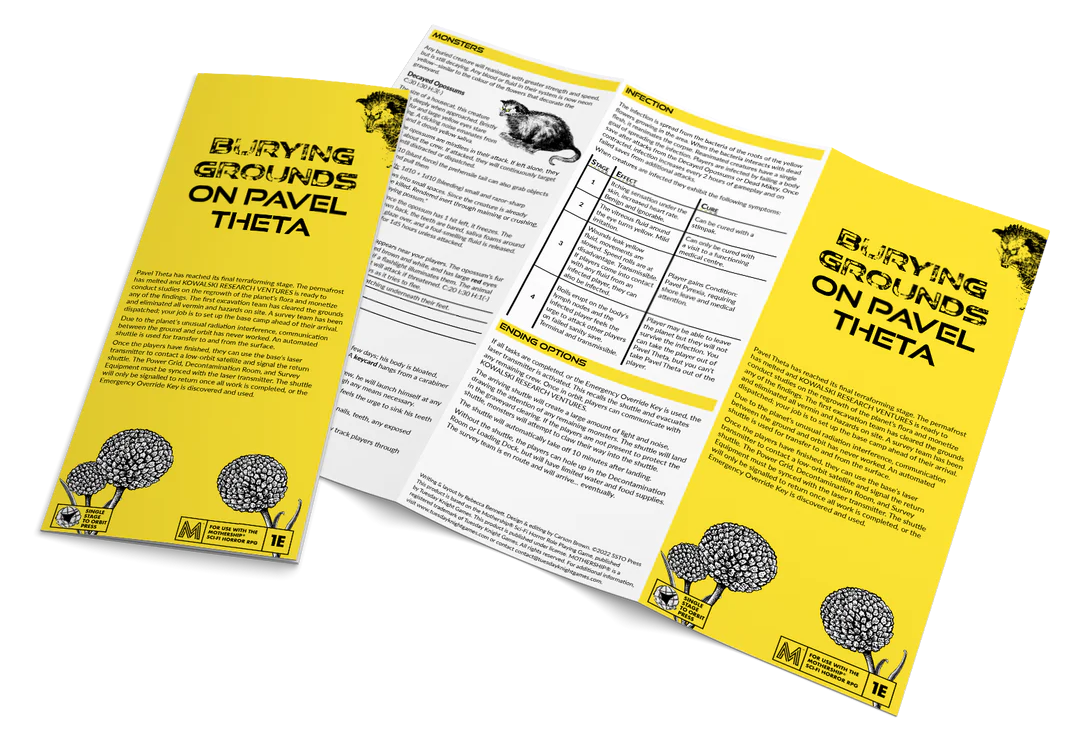
Main Facts: Rebecca Bennett’s Burying Grounds on Pavel Theta offers a chilling Pet Sematary-esque premise. On a newly terraformed world, a corporation has lost contact with its base camp team, and the PCs are sent as a backup. They soon discover that any corpses buried on Pavel Theta reanimate, leading to the resurrection of a deceased team member, Mikey, and a horde of "undead opossums."
Chronology & Supporting Data: Conceptually, this adventure is quite strong. The idea of undead opossums is "incredibly creepy," providing a unique and unsettling threat. Bennett also includes a well-designed pacing mechanic for these creatures, ensuring their presence builds tension effectively.
However, like Carrion Protocol, Burying Grounds critically lacks an authoritative background narrative. GMs are left wondering what happened to the rest of the previous team, where they are, the origin of the opossums, and how they became buried. This absence of a clear "pre-story" makes it difficult for GMs to answer inevitable player inquiries and maintain a consistent game world. The adventure’s "cool stuff" ultimately "falls apart when you look at it"—precisely what players are prone to do. Additionally, the module includes recorded audio logs meant to enhance immersion, but these are reportedly performed by voice generators with flat intonation, detracting from their intended effect and making them largely unusable.
Implications: Burying Grounds on Pavel Theta demonstrates the fine line between intriguing mystery and frustrating ambiguity. While GMs are often expected to improvise, a scenario’s core mystery needs a solvable, internal logic to feel satisfying. The failure of the audio logs also illustrates that including multimedia elements requires attention to production quality; poorly executed additions can detract rather than enhance the experience.
Quantum Cargo: A Glimpse of Genius Amidst Minor Flaws (Grade: B-)
Main Facts: Quantum Cargo presents a complex, high-concept scenario: researchers on the FMV Dirac were perfecting quantum duplication technology. Dr. Flora Ciama’s attempt to steal the prototype inadvertently triggered a quantum collapse, causing the ship to vanish and reappear weeks later, broadcasting multiple distress signals. The PCs are dispatched by the Quantum Dynamics Corporation (QDC) to retrieve the top-secret research, arriving to find the Dirac trapped in a quantum flux. At "ground zero," three different versions of Dr. Ciama are endlessly replaying the heist: one succeeds, one fails and triggers the explosion, and one remains trapped in the quantum core chamber.
Chronology & Supporting Data: This module stands out for its "incredibly clever structure" and innovative premise. The core idea of a ship caught in a quantum loop, where reality is constantly shifting, offers truly unique and reality-bending set pieces. The dynamic combination of four different zones with random quantum effects ensures high replayability and unpredictable challenges. Despite some minor "lacunae," the module exhibits "loving attention to detail," including providing detailed player maps, which significantly aids GM preparation and player immersion.
The "issues" are relatively minor compared to its strengths. Similar to Burying Grounds, it could benefit from a more definitive crew list and a slightly more coherent, step-by-step explanation of the ship’s pre-arrival events. However, these are manageable gaps for a GM, especially given the sheer creativity and structural integrity of the module’s central concept.
Implications: Quantum Cargo represents the high potential of innovative design in Mothership modules. Its success in crafting a genuinely unique and dynamic scenario, despite minor narrative gaps, shows that strong core mechanics and creative concepts can overcome small imperfections. This module serves as a benchmark for how Mothership can push the boundaries of TTRPG storytelling, offering complex, multi-layered challenges that genuinely feel alien and terrifying. The inclusion of detailed player maps also highlights a critical component of user-friendly design.
Supporting Data and Broader Context: The Mothership Phenomenon
The Mothership RPG has carved out a significant niche in the tabletop landscape since its initial release, celebrated for its brutal efficiency, evocative sci-fi horror themes, and accessibility. Its format, often favoring concise trifold or pamphlet adventures, has democratized content creation, leading to a sprawling ecosystem of third-party modules available on platforms like DriveThruRPG and Itch.io. This proliferation allows for rapid iteration and diverse creative voices, but it also inevitably leads to a wide variance in quality and polish.
Many of the issues highlighted in these reviews—frustrating formatting, unkeyed symbols, narrative gaps, and functional incompleteness—are common challenges faced by independent designers. These creators often operate with limited resources, balancing their creative vision with the practical demands of clarity, usability, and professional presentation. The "prep tax" imposed on GMs by some modules, where significant design work is offloaded from the creator to the game runner, is a recurring theme in indie RPGs. While Mothership GMs are often expected to improvise and adapt, there’s a limit to how much "fixing" a module should require before it becomes more of a burden than an asset. The platform’s emphasis on short-form adventures can also, paradoxically, lead to a lack of detail, as designers attempt to fit complex ideas into constrained page counts.
Official Responses and Community Outlook
While there are no specific "official responses" from the module creators within the provided text, the broader Mothership community typically engages actively with new content. Forums, social media, and dedicated review sites provide avenues for feedback, often with a generous spirit given the indie nature of many releases. This feedback loop is crucial for creators to refine their work, though the sheer volume of new content means that not every module receives the same level of scrutiny or subsequent revision.
From a publisher’s perspective (e.g., those hosting content on DriveThruRPG), the balance lies in fostering a vibrant creative community while also encouraging a baseline level of quality. Platforms provide tools and reach but often leave content vetting to the community and individual reviewers. The intent behind certain design choices can also be debated: are some modules intentionally minimalist to encourage GM improvisation, or are they simply unfinished? The consensus often leans towards the latter when core mechanics or narrative coherence are significantly compromised.
Implications for Players and Game Masters
For players, the varied quality of Mothership modules primarily impacts their experience through the GM. A GM forced to heavily redesign or improvise due to a module’s flaws may inadvertently create a less coherent or immersive session, even with the best intentions. The importance of GM preparation, therefore, becomes even more pronounced when dealing with less polished content.
For Game Masters, these reviews serve as a vital guide. Choosing modules requires a discerning eye, and being prepared to adapt, fill gaps, or even outright redesign sections is often a prerequisite for running indie content. The "prep tax" can be significant, turning a quick read into a multi-hour design project. GMs are advised to read multiple reviews, look for modules that clearly articulate their core mechanics and narrative, and prioritize usability over mere novelty in presentation.
Looking ahead, the future of Mothership content likely lies in a continued push for innovation, but hopefully accompanied by an increased focus on polish and comprehensive design, even within the short-form pamphlet format. The community thrives on creativity, but sustained engagement requires modules that are not only imaginative but also functionally sound and respectful of a GM’s time. The balance between allowing creative freedom and ensuring a minimum standard of usability will be key to the platform’s continued success.
Conclusion
The recent batch of Mothership modules offers a microcosm of the indie RPG landscape: a dynamic space where brilliant ideas often collide with practical constraints. From the frustratingly unplayable Reclaimer to the ingeniously structured Quantum Cargo, the spectrum of quality is broad. While some modules demand significant GM intervention to become playable, others stand out as beacons of creative design, pushing the boundaries of what a short-form adventure can achieve.
Ultimately, the enduring appeal of Mothership as a system persists, fueled by its potent themes and the dedication of its creative community. As GMs continue to navigate the cosmic abyss, discerning content will remain a critical skill, allowing them to unearth the truly terrifying and memorable adventures that lie waiting in the vast, dark void. The journey through these modules is a testament to both the boundless imagination of the Mothership ecosystem and the continuous need for refinement in its content creation.