
Navigating the Nine Realms of Knowledge: A Definitive Guide to Essential Norse Mythology Literature
Oslo, Norway – The enduring allure of Norse mythology, with its pantheon of formidable gods, epic sagas of creation and destruction, and vibrant cosmology, continues to captivate minds across the globe. From the thunderous might of Thor to the cunning intellect of Odin and the mischievous chaos of Loki, these ancient tales resonate deeply within contemporary culture, inspiring countless works of fiction, film, and art. However, the sheer volume of literature dedicated to this rich tradition can be daunting for newcomers and seasoned enthusiasts alike.
This article serves as a meticulously curated guide, presenting ten essential books designed to illuminate the complex and fascinating world of Norse mythology and religion. Catering to both beginners seeking an accessible entry point and intermediate students eager to delve deeper into scholarly analysis and primary sources, this list provides a structured pathway through the vast literary landscape. The selections prioritize clarity, scholarly rigor, and comprehensive coverage, offering a progressive journey from foundational introductions to the very texts that shaped our understanding of the ancient North.
The Evolving Landscape of Norse Studies
The study of Norse mythology is a dynamic field, continuously enriched by new archaeological discoveries, linguistic analyses, and re-evaluations of existing texts. Our primary understanding of these myths stems largely from medieval Icelandic manuscripts, primarily the Poetic Edda and the Prose Edda, compiled centuries after the Viking Age. These sources, themselves products of a Christianized society looking back at its pagan past, present both invaluable insights and interpretative challenges.

Modern scholarship, therefore, seeks to contextualize these narratives, disentangling the ancient beliefs from later reinterpretations and understanding the underlying religious practices that gave them meaning. The books on this list reflect this evolving scholarly endeavor, offering a blend of modern retellings that capture the narrative spirit, academic analyses that dissect the historical religion, and direct translations of the foundational primary sources. The following selection is organized to facilitate a gradual immersion, beginning with user-friendly overviews and progressing to more advanced and specialized works, allowing readers to build a robust understanding layer by layer.
A Deep Dive into Essential Texts: Supporting Data and Critical Acclaim
The following ten books represent a spectrum of approaches to Norse mythology, each offering unique strengths for different stages of learning. They have been chosen for their quality, impact, and ability to deepen one’s appreciation for the ancient traditions of the Norse and other Germanic peoples.
1. The Viking Spirit: An Introduction to Norse Mythology and Religion by Daniel McCoy
This work stands out as an ideal starting point, particularly for those seeking a holistic understanding. Author Daniel McCoy, a respected voice in Norse studies, endeavors to bridge the gap between academic rigor and accessibility. The Viking Spirit offers a comprehensive introduction that not only retells 34 gripping Norse myths—a number surpassing most comparable works—but also provides an equally thorough exploration of the pre-Christian religion of the Vikings.
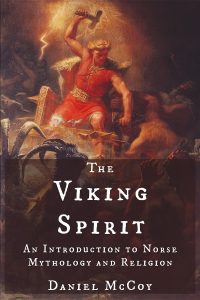
McCoy delves into crucial aspects of Viking belief, including their complex pantheon of gods and goddesses, their profound concept of fate (wyrd), their views on the afterlife, the moral codes that guided their lives, and their intricate cosmology. Furthermore, the book elucidates how their religion was practiced and the significant role magic played in their daily existence. Its strength lies in its balanced approach, giving equal weight to both the compelling narrative of the myths and the factual, historical context of the religion from which they emerged. By incorporating the latest research, The Viking Spirit establishes itself as a modern, authoritative, yet eminently readable introduction for the 21st century.
2. Norse Mythology by Neil Gaiman
Acclaimed fiction writer Neil Gaiman brings his characteristic narrative brilliance to the ancient tales in Norse Mythology. Known for his masterful reimagining of mythologies in works like American Gods, Gaiman here directly retells a selection of the most pivotal Norse myths. While not exhaustive in its coverage, his curated collection includes essential narratives such as the universe’s creation, the adventures of the Æsir and Vanir, and the prophesied cataclysm of Ragnarök.
Gaiman’s unique strength lies in transforming these ancient stories into a fluid, novelistic experience. He fleshes out the characters and events with an engaging style that makes the often fragmented or terse original accounts come alive with modern literary flair. This book is particularly celebrated for its ability to draw new readers into the world of Norse myth through sheer storytelling power. While it intentionally focuses more on the narrative than on the historical religious context, its compelling prose serves as an excellent gateway, often inspiring readers to seek out more comprehensive, scholarly works to complement their understanding. Its popular reception underscores its success in making these tales resonate with a contemporary audience.

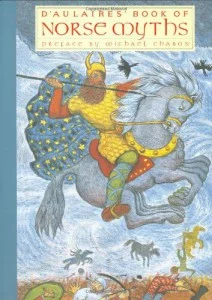
3. The D’Aulaires’ Book of Norse Myths by Ingri and Edgar Parin d’Aulaire
For families and younger readers, The D’Aulaires’ Book of Norse Myths is unparalleled. Specifically crafted for children aged 5-9, this classic work has introduced generations to the wonders of Asgard and Midgard. The d’Aulaires’ distinctive lithographic illustrations, rich in color and detail, are as much a part of the storytelling as the text itself, creating a vivid and imaginative experience.
The narratives are lovingly and evocatively retold, simplifying complex mythological concepts without losing their essence. The authors carefully select and adapt the tales, omitting elements that might be considered too graphic or intense for a young audience, ensuring a "family-friendly" presentation. This book is not merely a collection of stories; it is an immersive experience that fires a child’s imagination and instills an early appreciation for the grandeur and characters of Norse mythology. Its enduring popularity testifies to its success as a foundational text for budding mythographers.
4. Gods and Myths of Northern Europe by H.R. Ellis Davidson
Hilda Roderick Ellis Davidson was a towering figure in 20th-century Norse scholarship, renowned for her ability to synthesize rigorous academic research with accessible prose. Gods and Myths of Northern Europe exemplifies this talent, offering an ideal entry point for beginners seeking a scholarly yet approachable perspective on Norse religion.

Rather than simply retelling myths, Davidson focuses on the pre-Christian religious beliefs and practices of the Norse and other Germanic peoples. She meticulously reconstructs the worldview, rituals, and societal functions of this ancient faith, drawing on archaeological evidence, linguistic analysis, and comparative mythology. The book provides a nuanced and thorough understanding of Germanic religion, moving beyond mere narrative to explore the deeper cultural significance of the myths. For decades, it has been a cornerstone text for understanding the Viking Age, widely praised for its clarity, depth, and the enduring relevance of its insights.
5. Myth and Religion of the North: The Religion of Ancient Scandinavia by E.O.G. Turville-Petre
E.O.G. Turville-Petre, a legendary Oxford professor of Old Norse, offers a work of profound scholarship in Myth and Religion of the North. While more academic in tone than Ellis Davidson’s book, it is an indispensable resource for those ready to move beyond introductory material. Turville-Petre’s work provides an exhaustive overview of ancient Scandinavian religion, demonstrating an astonishing breadth of knowledge and acuity of insight.
This book is frequently cited as the definitive reference work in universities worldwide for its comprehensive treatment of Norse mythology and religion. Turville-Petre systematically examines the literary sources, archaeological findings, and linguistic evidence to construct a detailed picture of the ancient faith. Engaging with this text is often considered an "intellectual initiation" into serious Norse studies, pushing readers to grapple with the complexities and nuances of the subject matter at a deeper level. Its enduring status as a scholarly benchmark underscores its critical importance for anyone aspiring to a thorough understanding of the field.

6. The Poetic Edda translated by Jackson Crawford
Direct engagement with the primary sources is crucial for any serious student of Norse mythology, and The Poetic Edda stands as our most vital literary window into the ancient Germanic world. This collection of Old Norse mythical and heroic poems, composed by anonymous poets in Iceland or Scandinavia during and shortly after the Viking Age, is a work of immense vision and beauty.
Translating such ancient poetry presents significant challenges, balancing faithfulness to the original text with readability and poetic resonance in the target language. Jackson Crawford’s translation is widely acclaimed for achieving this delicate balance. He renders the poems in a clear, accessible English style that captures much of the aesthetic and philosophical depth of the Old Norse, a feat many other translations struggle to accomplish. Reading The Poetic Edda allows direct access to the raw power and evocative imagery that shaped the Norse worldview, offering an unfiltered experience of these foundational narratives. Its status as an essential primary text, coupled with Crawford’s masterful translation, makes it indispensable.
7. The Prose Edda by Snorri Sturluson, translated by Jesse L. Byock
Often considered the second most important source for Norse mythology, The Prose Edda was authored in the 13th century by the Icelandic scholar Snorri Sturluson. Originally conceived as a handbook for aspiring poets, it aimed to explain the mythological allusions prevalent in Old Norse skaldic poetry. In doing so, Snorri provided what amounts to the most systematic summary of Norse mythological narratives, deities, and cosmology that we possess.

While Snorri’s work is an unparalleled treasure trove of information that would otherwise be lost, scholars continue to debate the extent of his accuracy. As a Christian author writing centuries after the pagan era, Snorri inevitably filtered the myths through his own cultural and religious lens, potentially embellishing or misunderstanding certain aspects. Nevertheless, despite these interpretative challenges, The Prose Edda remains absolutely essential. Jesse L. Byock’s translation is highly regarded for its scholarly precision and readability, providing critical annotations that help readers navigate the complexities of Snorri’s monumental work.
8. The Saga of the Volsungs translated by Jackson Crawford
Among the wealth of Icelandic sagas—which, alongside the Eddas, constitute critical literary sources for our knowledge of pre-Christian Germanic peoples—The Saga of the Volsungs reigns as perhaps the most popular and influential. This truly epic narrative recounts the larger-than-life deeds of the Volsung clan, detailing their interactions with the gods and focusing particularly on the heroic exploits of Sigurd. It is a tale replete with dragons, lost treasures, shape-shifting, and profound insights into ancient Northern European values and mythological archetypes.
The stories forming the basis of this saga date back to the early centuries AD, circulating widely across the Germanic world. Elements of these narratives are also preserved in the Poetic Edda and the medieval German Das Nibelungenlied. The cultural significance of these tales is profound, as evidenced by their immense influence on later works: Richard Wagner’s monumental Ring operas are directly based on The Saga of the Volsungs, and it served as a major inspiration for J.R.R. Tolkien’s The Lord of the Rings. Jackson Crawford’s translation makes this foundational heroic saga accessible, often including the companion Saga of Ragnar Lothbrok for added context.

9. The Sagas of Icelanders
The medieval Icelandic sagas are remarkable literary achievements, characterized by their stark, matter-of-fact prose that often conveys deep emotional and cultural implications through understatement. These sagas are invaluable not only for their literary merit but also as primary historical sources offering insights into the pre-Christian mythology, religion, and societal norms of the Norse and other Germanic peoples.
This comprehensive 740-page tome collects ten significant sagas, alongside numerous shorter tales, providing an unparalleled introduction to the genre. Its centerpiece, Egil’s Saga, is particularly noteworthy. It chronicles the life of the formidable warrior-poet Egil Skallagrimsson, a devoted follower of Odin, and is celebrated for both its literary quality and the wealth of cultural and mythological information it subtly conveys. The translations in this collection are carefully selected for their excellence, making it an exceptional value and an essential resource for exploring the rich tapestry of Icelandic saga literature.
10. Norse Mythology: A Guide to the Gods, Heroes, Rituals, and Beliefs by John Lindow
John Lindow’s Norse Mythology stands apart from the other entries on this list, not as a narrative introduction, but as an indispensable reference tool. Structured as an alphabetical encyclopedia, it provides detailed entries on the most important personages (gods, goddesses, giants, heroes), cosmological locations (Asgard, Midgard, Hel), mythical creatures, rituals, and key terms within Norse mythology.

This book is not designed to be read cover-to-cover but rather to serve as a companion volume to other texts. Much like the glossaries accompanying complex fictional worlds, Lindow’s guide helps readers navigate the potentially confusing profusion of proper nouns and intricate concepts encountered in the Eddas, sagas, and scholarly analyses. It clarifies ambiguities, provides concise summaries of figures and places, and offers scholarly perspectives on their significance. For anyone delving into the rich and often intricate world of Norse mythology, Lindow’s work is an invaluable aid for deepening understanding and ensuring accuracy.
Academic Discourse and Modern Interpretation
The books presented here collectively represent the cornerstone of modern Norse studies. From the groundbreaking work of Ellis Davidson and Turville-Petre, which established rigorous academic frameworks for understanding Germanic religion, to contemporary scholars like Jackson Crawford, who make primary sources accessible, the field is characterized by ongoing scholarly dialogue. Debates around the reliability of Snorri Sturluson’s accounts, the nuances of poetic translation, and the reconstruction of ancient rituals continue to enrich our understanding. These "official responses" within the academic community drive the constant refinement of our knowledge, ensuring that the study of Norse mythology remains vibrant and intellectually stimulating.
The Enduring Legacy: Why Norse Mythology Matters
The implications of studying Norse mythology extend far beyond mere historical curiosity. These ancient narratives offer profound insights into the human condition, exploring universal themes of heroism, sacrifice, fate, honor, and the struggle between order and chaos. They provide a unique window into the worldview of a powerful and influential culture that shaped much of northern Europe.

Moreover, the legacy of Norse mythology is vibrantly alive in contemporary culture. Its influence is evident in modern fantasy literature (from Tolkien to countless others), blockbuster films, popular video games, and even the names of our weekdays. By engaging with these foundational texts, readers not only connect with a rich historical past but also gain a deeper appreciation for the enduring power of myth to shape human imagination and meaning. For those who have journeyed through these essential works, the path to more advanced scholarship and specialized topics, such as the intricacies of runes, the history of the Vikings, or the complexities of the Old Norse language, lies open, promising even greater depths of knowledge and fascination.


Leave a Comment