Orchid Rain on the Underground: Chris "Daze" Ellis Illuminates NYC’s Enduring Creative Pulse at PPOW Gallery
New York, NY – PPOW Gallery is currently hosting "Orchid Rain on the Underground," the third solo exhibition by iconic New York City artist Chris "Daze" Ellis. Running through April 25, 2026, the exhibition is a vibrant testament to the enduring legacy of the city’s seminal graffiti and nightlife culture, reinterpreted through Ellis’s masterful and evolving artistic practice. Featuring a compelling new series of paintings, a dynamic multimedia installation, and a striking site-specific mural, "Orchid Rain on the Underground" not only revisits the raw energy of the 1970s and 80s but also powerfully asserts its continued relevance in the contemporary creative landscape.
Ellis, a Brooklyn native born in 1962, emerged from the crucible of a New York City that was as much a muse as it was a canvas. His artistic journey began in the mid-1970s, fueled by the groundbreaking work of early graffiti pioneers like Blade, Lee Quiñones, and the visionary PHASE 2, whom he encountered during his formative years at the High School of Art and Design. This period, characterized by a burgeoning subway art movement, was intrinsically linked to the city’s electrifying nightlife. Ellis was a regular fixture in legendary venues such as the Lit Lounge in the East Village, Danceteria on West 21st Street, and the Mudd Club in Tribeca. These spaces, far more than mere entertainment hubs, served as vital incubators for social and artistic experimentation, blurring the lines between art galleries, performance spaces, and cultural melting pots. It was within this fertile ground that the foundational elements of Ellis’s distinctive style began to coalesce, transitioning from the kinetic energy of tagging subway cars to a more deliberate and contemplative studio practice that sought to encapsulate the very essence of the urban experience.
A Chronicle of Urban Evolution: From Subway Cars to Studio Mastery
Chris "Daze" Ellis’s artistic trajectory is deeply intertwined with the physical and cultural evolution of New York City. His early immersion in the graffiti scene of the late 1970s and early 1980s provided him with a unique perspective on the city’s infrastructure and its inhabitants. The ubiquitous subway system, with its constant motion and ever-changing landscape, became an accidental gallery, a dynamic canvas that fueled his creativity. His involvement in this underground art form was not merely about leaving a mark; it was about engaging with the city on its own terms, communicating a message, and asserting an identity within a vast and often impersonal metropolis.
During his high school years, the vibrant energy of the subway graffiti movement was a powerful draw. He was inspired by the bravery and innovation of artists who transformed utilitarian public spaces into expressions of personal and collective identity. This era was characterized by a raw, uninhibited spirit, a drive to create and be seen, often in defiance of established norms. Ellis absorbed this energy, learning from the pioneers and developing his own distinct visual language.
Simultaneously, the burgeoning nightlife scene of New York City provided a crucial social and artistic context for Ellis’s developing career. Venues like the Lit Lounge, Danceteria, and the Mudd Club were more than just places to party; they were vital centers of subcultural convergence. These spaces fostered a sense of community among artists, musicians, writers, and dancers, creating an environment where cross-pollination of ideas was not only encouraged but inevitable. The art displayed on the walls, the music played, and the very atmosphere of these clubs served as a constant source of inspiration, influencing Ellis’s aesthetic sensibilities and his understanding of art’s role in social discourse.
By the early 1980s, a significant shift was underway in Ellis’s artistic practice. While the visceral thrill of subway graffiti remained a potent influence, he began to translate this energy into a more structured studio environment. This transition was not a repudiation of his roots but rather an expansion of his artistic vocabulary. He recognized the potential to translate the spontaneity and boldness of graffiti into a more enduring and accessible medium. This move allowed him to explore themes and narratives with greater depth and nuance, while still retaining the raw power and immediacy that defined his early work. The ethos of the city, with its constant flux, its diverse populations, and its relentless drive, became the central subject of his studio practice, a theme he continues to explore with unwavering dedication.
Influences and Innovations: A Dialogue Between Urban Realism and Abstract Expressionism
Ellis’s artistic vision is a rich tapestry woven from a diverse array of influences, demonstrating a sophisticated dialogue between the gritty realism of urban life and the liberating freedom of abstract expressionism. His early engagement with the raw energy of the streets and subways provided a foundational understanding of New York City as a subject matter rich in narrative and visual complexity. This grounding in urban realism is further illuminated by his conscious nods to early 20th-century artists who similarly sought to capture the pulse of city life.
The Ashcan School, with artists like John Sloan, who depicted the unvarnished realities of American urban existence, and Reginald Marsh, known for his vibrant and often chaotic portrayals of WPA-era New York, resonate deeply within Ellis’s work. These artists brought an unflinching gaze to the streets, taverns, and bustling thoroughfares, revealing the humanity and dynamism of everyday life. Ellis embraces this tradition, elevating the streets and subways not just as backdrops but as integral components of his creative evolution, sites where personal narratives unfold and collective experiences are forged.
Simultaneously, Ellis draws inspiration from the more abstract and gestural realms of modern art. The lyrical abstraction of artists like Joan Mitchell and Willem De Kooning, characterized by their bold brushwork, vibrant palettes, and emotional intensity, informs his approach to composition and color. Mitchell’s ability to convey profound emotion through sweeping gestures and De Kooning’s raw, energetic canvases provide a framework for Ellis to imbue his urban scenes with a sense of dynamism and psychological depth.
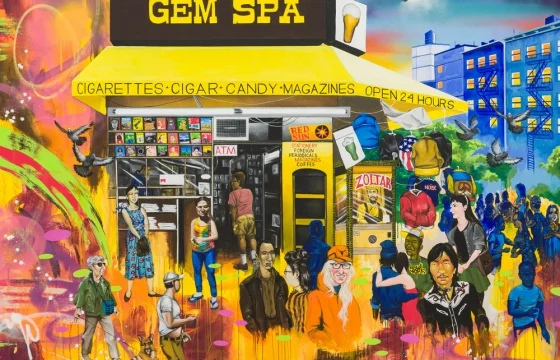
This confluence of influences is masterfully evident in his painting, Gem Spa In the 80s (2025). This evocative work reimagines the iconic corner newspaper stand and candy store at St. Mark’s Place and Second Avenue, a legendary hub for New York’s subcultures. Gem Spa, immortalized by literary figures like Jack Kerouac and Allen Ginsberg, served as a vital nexus for artists, writers, and thinkers, a place where ideas were exchanged and friendships were forged. In Ellis’s rendition, the familiar facade of Gem Spa becomes a stage upon which the vibrant tapestry of 1980s New York is replayed.
Crucially, the painting is populated by figures who were central to the city’s cultural landscape. Among the throng, critic and curator Carlo McCormick and artist Martin Wong emerge, their presence in the foreground anchoring the scene and highlighting the interconnectedness of the artistic community. This inclusion transforms the painting from a mere depiction of a place into a vibrant portrait of an era, honoring the individuals who shaped its creative output.
Beyond specific portraits, Ellis employs a recurring motif of flowers, often presented in striking juxtapositions. In some works, technicolor blossoms erupt from heaps of urban rubble, a potent symbol of optimism and resilience blooming in the face of adversity. This imagery speaks to the enduring capacity for beauty to emerge from destruction and for hope to persist amidst inequality. The inclusion of both tropical flora and local flowers from his upstate New York home adds another layer of meaning, serving as poignant memorials to what has been lost and as hopeful testaments to the enduring beauty and creativity that can be found even in the most unexpected corners of the city. Through these varied combinations, Ellis crafts a visual language that is both deeply personal and universally resonant, a celebration of life’s persistence and the transformative power of art.
Immersive Experience: A Journey Through Daze’s Creative Landscape
"Orchid Rain on the Underground" transcends the traditional gallery experience by offering a deeply immersive journey into Chris "Daze" Ellis’s artistic world. The exhibition is meticulously designed to engage multiple senses, transporting viewers into the very environments that have shaped his creative output.
A significant highlight is the site-specific mural, a powerful element that brings an often-externalized aspect of Ellis’s practice into the intimate confines of the gallery. Covering the walls of a dedicated hallway, this mural acts as a visual gateway, seamlessly guiding visitors towards the exhibition’s culminating experience. It’s a bold move that bridges the gap between public art and gallery presentation, allowing the raw, expansive energy of graffiti to permeate the interior space.
This mural leads to a multimedia installation that serves as the exhibition’s emotional and experiential core. This installation is conceived as a portal to Ellis’s youth, a meticulously crafted composite scene designed to evoke the atmosphere and spirit of the formative years that ignited his artistic passion. Viewers are not merely passive observers; they are invited to step into a recreated environment that pulsates with the energy of a bygone era.
The installation features a light-up dance floor and a disco ball, instantly conjuring the vibrant nightlife that was so integral to Ellis’s early artistic development. The pulsating lights and the iconic mirrored sphere evoke a sense of freedom, celebration, and communal energy. Complementing this are actual subway car seats, grounding the experience in the urban reality that served as his initial canvas. These tangible elements connect the viewer directly to the artist’s lived experience and the physical spaces that inspired him.
Further enhancing the immersive quality is a curated soundtrack that fuses the foundational genres of house, disco, and hip-hop with classic club music. This sonic landscape is not incidental; it is an integral component of the installation, designed to amplify the sense of freedom and creative inspiration that characterized these settings. The music serves as a visceral reminder of the vibrant cultural milieu that fueled Ellis’s personal and artistic growth.
By combining these diverse elements – the visual impact of the mural, the tactile and atmospheric qualities of the installation, and the evocative power of the soundtrack – Ellis creates an experience that is both intellectually stimulating and emotionally resonant. "Orchid Rain on the Underground" is not simply a collection of artworks; it is a carefully orchestrated environment that allows viewers to step into the artist’s memory and understand the profound influence of New York City’s cultural heartbeat on his enduring artistic legacy. The exhibition masterfully showcases Daze’s lifelong exploration of daily life in the city, offering a profound homage to the people and places that continue to fuel its vibrant creative spirit.
Enduring Legacy and Future Implications
Chris "Daze" Ellis’s "Orchid Rain on the Underground" at PPOW Gallery is more than just an exhibition; it is a powerful assertion of the enduring relevance of a cultural moment that continues to shape contemporary art. By skillfully blending the raw, spontaneous energy of 1970s and 80s graffiti with a mature, studio-honed practice, Ellis demonstrates that the foundations of urban art are not relics of the past but vital sources of inspiration for the present and future.
The exhibition’s success lies in its ability to evoke nostalgia while simultaneously presenting new and vital artistic dialogues. The "Orchid Rain" motif, with its juxtaposition of delicate flora against urban grit, offers a poignant commentary on resilience, beauty, and the persistent creative spirit that can flourish even in challenging environments. This imagery speaks to a broader societal concern about urban decay and renewal, offering a hopeful perspective through artistic expression.
For emerging artists, "Orchid Rain on the Underground" serves as an invaluable educational tool and a source of inspiration. It underscores the importance of understanding artistic roots, recognizing the historical context from which contemporary movements emerge, and the power of drawing from lived experience. Ellis’s journey from subway car to gallery walls exemplifies a dedication to craft and a commitment to evolving one’s artistic practice without abandoning foundational principles.
The exhibition’s multimedia installation, in particular, offers a blueprint for how galleries can move beyond static displays to create truly immersive and engaging experiences. By incorporating sound, light, and physical environments, Ellis invites viewers to not just observe art but to inhabit it, fostering a deeper connection and understanding of the artist’s intent and the cultural milieu that shaped it. This approach can encourage a new generation of artists to experiment with diverse mediums and create more dynamic and interactive exhibitions.
Furthermore, the exhibition indirectly addresses the ongoing dialogue surrounding the commercialization and gentrification of urban art. Ellis’s sustained commitment to capturing the essence of New York City’s cultural heartbeat, even as the city itself has transformed, highlights the importance of preserving and celebrating the authentic voices and experiences that have contributed to its unique identity. "Orchid Rain on the Underground" stands as a vibrant testament to the fact that the creative spirit of New York, born from the streets and nurtured in its vibrant cultural hubs, continues to rain down, transforming and revitalizing the urban landscape for generations to come.