Rattlesnake: A High Noon Duel That Reinvents the Wild West Card Game
Main Facts
In a tabletop landscape teeming with familiar themes, the Wild West often rides into town, guns blazing, yet rarely leaves a lasting impression. However, a new challenger has emerged from the dust, ready to carve its name into the annals of card dueling. Prepare to be swept into the strategic maelstrom of Rattlesnake, a two-player deck builder from the acclaimed Osprey Games that doesn’t just embrace its Western theme but uses it as the very foundation for an innovative and deeply engaging experience.
Rattlesnake isn’t content to simply exist within its genre; it aims to dominate it. Designed by the intriguing Michael Hardacre, this game successfully elevates itself above the commonplace, delivering a potent blend of rapid-fire strategy, tactical bluffing, and thematic immersion that demands attention. Its core objective is brutally simple yet infinitely complex: outmaneuver and outgun your opponent, filling them "so full of lead, you could use them like a pencil." This visceral goal is achieved through a clever fusion of traditional deck-building mechanics with a high-stakes, poker-style combat system, all wrapped up in a compact package that belies its depth.
Osprey Games, known for its diverse and often critically lauded portfolio, has found a gem in Rattlesnake. The game promises a quick setup and straightforward rules, making it accessible for newcomers while offering enough strategic nuance to satisfy seasoned gunslingers. Its portability, designed to slip into a backpack, ensures that a showdown can erupt anytime, anywhere – provided a table is handy. With a playing time of just 15 minutes per duel and a recommended age of 14+, Rattlesnake offers intense, digestible bursts of competitive play. Priced at £17.99, it presents an exceptional value for the tactical depth it delivers, solidifying its status as a "Must Play" title in the competitive two-player card game arena.
Chronology: From Concept to Showdown
The journey of Rattlesnake from an initial spark of an idea to a fully realized, critically acclaimed tabletop game is a testament to the vision of its designer, Michael Hardacre, and the publishing acumen of Osprey Games. While specific dates of its inception remain somewhat guarded, the trajectory of its development can be pieced together, revealing a thoughtful and iterative process that refined its unique blend of mechanics and theme.
The Genesis: Michael Hardacre’s Vision
Michael Hardacre, an individual described as an "engineer, inventor, and master procrastinator," brings a distinctive background to game design. His engineering mindset likely instilled a drive for precision, balance, and elegant solutions to complex problems, all of which are evident in Rattlesnake‘s tightly woven mechanics. His "inventor" streak suggests a desire to create novel experiences, rather than simply iterating on existing formulas. It is plausible that Hardacre, having started game design over a decade ago, spent considerable time honing his craft, observing the tabletop landscape, and identifying a niche where his unique approach could flourish.
The initial concept for Rattlesnake almost certainly revolved around capturing the essence of a Wild West gunfight in a card game format. The challenge, however, lay in translating the tension, the bluff, and the rapid decision-making of a cinematic duel into engaging gameplay. Hardacre’s genius appears to have been in recognizing the inherent thematic synergy between poker—a quintessential Western pastime—and the strategic depth of deck-building. He didn’t just graft one onto the other; he meticulously integrated them, creating a system where the management of one’s card supply directly fuels the dramatic confrontations of the other.
Early prototypes would have focused on balancing the pace of deck construction with the impactful moments of combat. Playtesting would have been crucial in calibrating card costs, ability strengths, and the overall rhythm of the game. It’s easy to imagine Hardacre, with his engineering precision, meticulously tweaking numerical values, hand sizes, and the frequency of event triggers to ensure a consistently thrilling and fair experience. The "master procrastinator" label, while humorous, might also hint at a designer who takes his time, perfecting every detail before revealing his creation, much like a gunslinger waiting for the perfect moment to draw.
Partnering with Osprey Games
The decision by Osprey Games to publish Rattlesnake speaks volumes about the game’s inherent quality and market potential. Osprey Games, an imprint of Osprey Publishing, has a reputation for releasing distinctive and often historically or thematically rich games, ranging from wargames to narrative-driven experiences. For Rattlesnake, a two-player card duel, to catch their eye, it must have demonstrated not only strong mechanics but also a compelling artistic vision and a broad appeal.
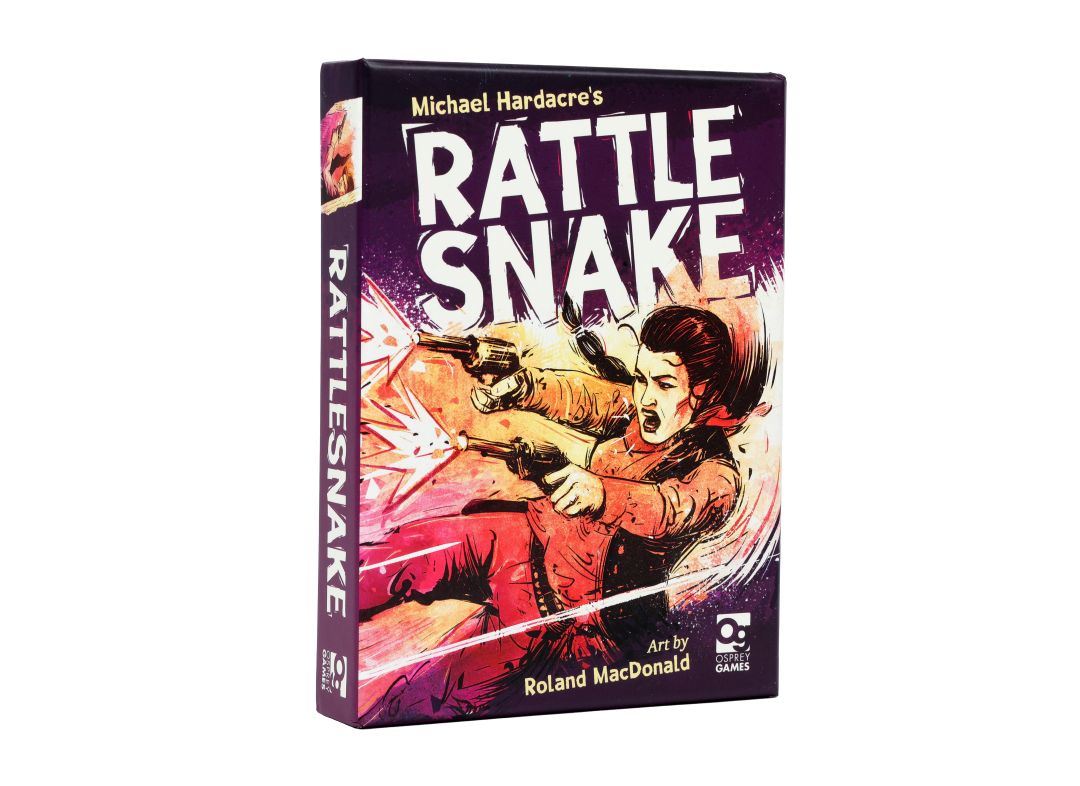
The collaboration would have involved refining the artwork, ensuring clear iconography, and developing a compelling rulebook that effectively communicates Hardacre’s streamlined yet deep design. Osprey’s editorial team likely provided invaluable feedback during the final stages, helping to polish the game for mass production and distribution. Their experience in the market would have guided the packaging and marketing strategy, positioning Rattlesnake as a standout title within their diverse catalog. The compact box size and accessible price point were likely strategic choices to broaden its appeal, making it an impulse purchase for many and an essential addition for fans of two-player games.
Release and Critical Acclaim
While the exact release date is implied to be around 2026 based on image metadata, positioning Rattlesnake as a relatively recent or upcoming title, its reception has already been overwhelmingly positive. The "Must Play" endorsement from Tabletop Gaming magazine, as highlighted in the original review, is a strong indicator of its immediate impact. This kind of critical praise typically translates into enthusiastic player engagement, with early adopters praising its innovative mechanics and strong thematic execution.
The buzz surrounding Rattlesnake likely stems from its ability to deliver a satisfying strategic experience in a short timeframe, a highly sought-after quality in today’s busy gaming landscape. Its unique blend of familiar elements (deck-building, poker) with fresh twists (Action card abilities, Hit tokens as draw penalties) sets it apart, demonstrating Hardacre’s success in poking his "nose higher than most Western games without getting it shot off." This early positive reception sets a strong precedent for Rattlesnake‘s longevity and potential to become a staple in many gamers’ collections.
Supporting Data: Dissecting the Wild West Duel
At its heart, Rattlesnake is a masterclass in elegant design, distilling the drama and strategy of a Wild West gunfight into a taut, 15-minute card game. Its supporting mechanics are meticulously crafted to enhance both thematic immersion and strategic depth, making every decision count.
The Core Loop: Ammunition and Opportunity
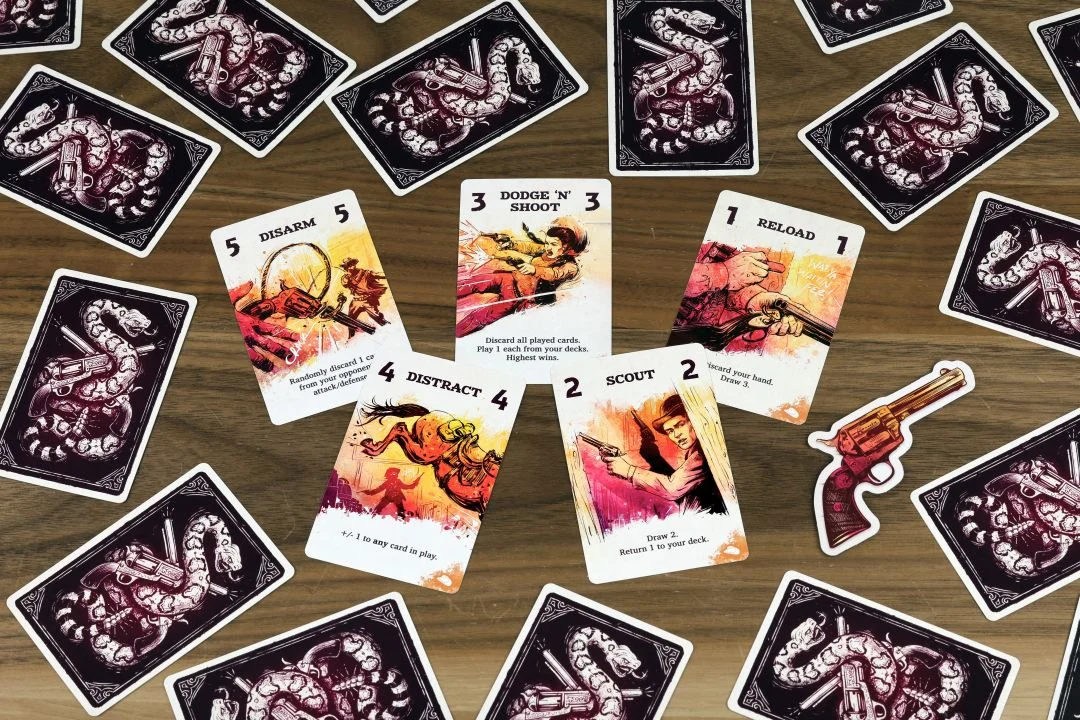
Gameplay in Rattlesnake flows with a deliberate yet dynamic rhythm, ensuring players are constantly engaged. Each turn begins with both players drawing up to a hand of five cards, ensuring a consistent supply of "ammunition" for both offense and defense. This simple rule eliminates frustrating turns where a player might be left with no viable options, maintaining the game’s brisk pace.
The active player receives a pistol-shaped token, a clear visual indicator of who holds the initiative. This player then gains two crucial opportunities: to acquire new Action cards from the Saloon and to initiate an attack.
Deck-Building in the Saloon: Forging Your Arsenal
The Saloon is where players refine their deck, much like a gunslinger acquiring better equipment. It features a rotating market of Action cards. To purchase an Action card, the active player must discard two cards from their hand. This cost is a crucial strategic decision: do you sacrifice immediate options for long-term power? The newly acquired Action card goes directly into the player’s hand, ready for immediate use. Once played, it enters the player’s personal Action deck, becoming a permanent part of their arsenal, cycling back into their hand in subsequent turns. This creates a satisfying sense of progression, as players build more potent and specialized decks over the course of the game.
The Saloon’s market is dynamic. As Action cards are purchased, new ones are drawn to replenish the slots. However, this flow can be disrupted by Event cards. When an Event card appears in the Saloon, it blocks that slot, preventing purchases until the Event is resolved. This introduces an element of unpredictability, forcing players to adapt their purchasing strategies.
Event Cards: The Shifting Sands of the Frontier
Event cards are Rattlesnake‘s secret weapon for injecting variability and unexpected twists into each duel. These cards represent sudden occurrences that alter the rules of the game, often for a single turn or until a specific condition is met. For instance, the "Knives Out" Event card adds a brutal layer to combat: if an attacker fails to hit their target, they suffer one Hit themselves. This dramatically raises the stakes of an attack, forcing players to be more cautious and calculated.

Other Event cards might affect card draws, modify attack strengths, or even change the cost of Saloon cards. Their presence ensures that no two games of Rattlesnake play out exactly alike, demanding constant tactical adjustment and preventing players from relying on a single dominant strategy. They embody the unpredictable nature of the Wild West, where fortunes can turn on a dime.
The Showdown: Poker-Style Combat and Tactical Bluffing
When a player decides to engage in a head-to-head confrontation, Rattlesnake truly shines, leveraging a poker-style combat system to simulate the frantic tension of a quick-draw duel. This is where the game expertly leans into its theme, making players feel like gunslingers flashing their hands to their pistols.
The combat sequence unfolds as follows:
- Initiation: The attacker declares an attack and selects cards from their hand, placing them face down.
- Defense: The defender then does the same, choosing whether to play cards or even opt not to play any, potentially relying on other means to mitigate damage.
- Reveal: Once both players have placed their chosen cards, they are simultaneously revealed. No further cards can be added.
Players are attempting to form the best possible poker hand with their revealed cards. The game recognizes several standard poker hands, each with increasing strength:
- Single High Card: The highest numerical value card.
- Pair: Two cards of the same numerical value.
- Run: At least three cards in sequential numerical order (e.g., 1, 2, 3).
- Set: Three cards of the same numerical value (three of a kind).
- Four of a Kind: Four cards of the same numerical value.
- Five of a Kind: Five cards of the same numerical value (a rare and powerful hand).
A key strategic element is the ability to include "duds" – cards that aren’t part of your best poker hand – to bluff a stronger hand or to preserve crucial cards for future turns. However, this comes with a significant risk, as these "duds" cannot be used for their special abilities during combat.
Action Card Abilities: The Dynamic Edge
The true innovation in Rattlesnake‘s combat lies in the dynamic interplay of Action card abilities. Unlike traditional poker, where hands are static once played, Rattlesnake allows players to influence the outcome after cards are revealed but before the winner is determined. Each Action card possesses a unique Ability that can be activated by discarding it during the combat resolution phase.
These abilities are designed to disrupt an opponent’s carefully constructed hand or to bolster one’s own. For example:
- Number Manipulation: An ability might allow a player to change the numerical value of a card in an opponent’s revealed hand, potentially breaking their run or set. This can turn a winning hand into a losing one in an instant.
- Card Drawing: Other abilities might allow a player to draw additional cards, providing new options for defense or offense, or even fishing for another powerful ability.
- Damage Modification: Some abilities could increase or decrease the damage dealt or taken.
The strategic depth here is immense. Players must decide when to bluff with duds, when to commit valuable Action cards to a poker hand, and when to hold them back for their game-changing abilities. This creates a constant tension, as neither player is truly safe until the very last Action card has been played and resolved.
Hit Tokens: The Stakes of Survival
Each gunslinger begins the duel with four precious Hit tokens. These tokens represent a player’s life force. If the attacker wins a combat, the defender must discard one of their Hit tokens. If the defender wins, nothing happens, and the duel continues.
The cleverest aspect of Hit tokens is their integration into the game’s deck. When a player loses a Hit token, it is shuffled back into their main draw pile. This means that as a player takes damage, their deck becomes "diluted" with these "Hit cards." Drawing a Hit card during the game essentially means drawing a "dud" – a card that offers no strategic value for buying Saloon cards or forming poker hands. This brilliantly simulates the thematic impact of taking damage; as a gunslinger gets weaker, their ability to fight effectively diminishes, turning survival into a desperate struggle. When a player has no Hit tokens remaining, the other gunslinger wins the duel.

Official Responses: The Minds Behind the Bullet
While direct quotes from Michael Hardacre or Osprey Games specifically about Rattlesnake are not provided in the original text, we can infer their perspectives based on the game’s quality and the information given.
Michael Hardacre: The Engineer-Inventor’s Philosophy
Michael Hardacre’s self-description as an "engineer, inventor, and master procrastinator" offers a fascinating glimpse into his design philosophy. As an engineer, he likely approaches game design with a focus on functional elegance, ensuring that every component and rule serves a clear purpose and contributes to a balanced system. The tight integration of deck-building with poker combat, and the ingenious use of Hit tokens as a deck-thinning penalty, are hallmarks of an engineer’s meticulous attention to system design. He seeks not just to create fun, but to create efficient fun.
As an inventor, Hardacre is driven by originality. He isn’t content to simply apply a Wild West skin to existing mechanics. Instead, he sought to create a unique blend, giving familiar concepts a fresh twist that genuinely enhances the gameplay. The dynamic Action card abilities during combat are a prime example of this inventive spirit, transforming a static poker hand into a fluid, interactive negotiation.
The "master procrastinator" label, while perhaps a self-deprecating joke, might also suggest a designer who allows ideas to marinate, to be fully formed and perfected in his mind before committing them to paper. This deliberate, unhurried approach could be key to the game’s polished feel and the sense that every mechanic has been thoughtfully considered and optimized. The review’s hope that he "cures that procrastination issue" speaks to the high regard for his talent and the desire to see more of his innovative designs come to fruition. His goal for Rattlesnake was likely to create a deeply thematic, highly replayable, and strategically rich two-player experience that felt genuinely new, and by all accounts, he has succeeded admirably.
Osprey Games: Curating Quality and Innovation
Osprey Games’ decision to publish Rattlesnake aligns perfectly with their reputation for producing high-quality, often niche-breaking, and thematically strong games. They are not a publisher that chases trends blindly; rather, they seem to seek out games that offer unique experiences or refine established genres in compelling ways.
For Osprey, Rattlesnake likely represented an opportunity to enter the highly competitive two-player card duel market with a distinctive product. Its compact size, accessible rules, and rapid playtime make it an attractive offering for both casual gamers looking for a quick skirmish and more dedicated players seeking a strategic filler. The strong thematic integration and innovative combat system would have undoubtedly stood out during their evaluation process.
Publishing Rattlesnake reinforces Osprey’s commitment to supporting emerging talent like Michael Hardacre and to bringing fresh, inventive designs to the tabletop community. The game’s success will undoubtedly bolster Hardacre’s profile as a designer and further solidify Osprey Games’ position as a publisher willing to take calculated risks on unique and well-crafted titles. It suggests a strategic move to diversify their portfolio while maintaining their high standards for game design and production.
Implications: A New Standard for the Old West
Rattlesnake is more than just another card game; it’s a significant contribution to the two-player duel genre and a refreshing take on the often-revisited Wild West theme. Its implications resonate across several facets of tabletop gaming, from design philosophy to player engagement.

Elevating the Wild West Theme
The tabletop gaming market is saturated with themes: pirates, zombies, fantasy, sci-fi. The Wild West, while popular, often struggles to differentiate itself beyond aesthetic choices. Rattlesnake shatters this ceiling by deeply integrating its theme into its core mechanics. The "frantic feeling of hands flashing to the pistols," the "Saloon" as a deck-building market, and the "Poker-style combat system" are not mere window dressing. They are fundamental to the gameplay, creating an experience that genuinely feels like a high-stakes gunfight. This sets a new benchmark for thematic integration, demonstrating how a well-executed theme can elevate mechanical depth rather than just overlaying it. It proves that there’s still gold in them thar hills for designers willing to dig deeper.
A Masterclass in Two-Player Duel Design
In the crowded space of two-player competitive card games, Rattlesnake stands out as a "Must Play" for its elegant design and intense interactivity. Many such games can devolve into solitaire experiences where players focus solely on their own engine, but Rattlesnake forces constant interaction. Every card purchase from the Saloon affects the market for your opponent. Every attack is a psychological battle of bluffs and counter-bluffs. The dynamic Action card abilities mean that even a seemingly won combat can be snatched away at the last second. This constant back-and-forth, coupled with a swift 15-minute playtime, makes it an ideal "lunch break" or "after-dinner" game that delivers a full strategic punch without overstaying its welcome.
Comparison to GUNFIGHTER
The recommendation to "Try This if you Liked… GUNFIGHTER" offers a useful comparative lens. GUNFIGHTER, another two-player, deck-management card game, shares the Wild West theme and competitive nature. However, Rattlesnake distinguishes itself significantly. While GUNFIGHTER incorporates "added dice rolling" for combat resolution, introducing an element of pure chance, Rattlesnake opts for a more deterministic, yet bluff-heavy, poker-style system. This shift means that while both games embrace luck, Rattlesnake places a greater emphasis on strategic card play, hand management, and the psychological warfare of bluffing. Players who prefer mitigating luck through skill and outsmarting opponents will likely find Rattlesnake‘s combat system more engaging, offering a deeper sense of agency in their duels.
Accessibility and Replayability
One of Rattlesnake‘s most compelling implications is its ability to appeal to a broad audience without sacrificing depth. The "quick setup and very simple rules" make it highly accessible for newcomers to deck-building or two-player duels. Yet, the layers of strategy—deck construction, hand management, bluffing, and timing of Action card abilities—ensure that experienced players will find endless nuances to explore.
The game’s replayability is exceptionally high, primarily due to two factors:
- Variable Saloon Market: The ever-changing array of Action cards in the Saloon means that players must adapt their deck-building strategies from game to game.
- Event Cards: The unpredictable nature of Event cards constantly shifts the game’s parameters, forcing players to think on their feet and react to new challenges, ensuring that no two duels feel identical.
- Dynamic Combat: The bluffing and counter-ability play in combat mean that even with the same cards, the interactions can lead to vastly different outcomes based on player decisions.
A Bright Future for Michael Hardacre
The overwhelmingly positive reception for Rattlesnake bodes well for Michael Hardacre’s future as a game designer. The review’s hope that he "cures that procrastination issue" is a playful nod to his talent and a genuine desire to see more innovative titles bear his name. Rattlesnake positions him as a designer capable of delivering polished, thematic, and strategically rich experiences. Its success could open doors for larger projects or further explorations of the unique mechanics he has pioneered here.
In conclusion, Rattlesnake by Osprey Games is not merely a good game; it is a significant one. It packs heat, delivering a truly cinematic Wild West gunfight experience through clever, integrated mechanics. It stands as a testament to innovative design, proving that familiar themes can still yield fresh and exhilarating gameplay. For anyone seeking a fast, furious, and deeply strategic two-player card duel, Rattlesnake is an undisputed must-play that will likely resonate within the tabletop community for years to come.
Review by Matt Chapman
PLAY IT?
This game packs heat, cleverly recreating the drama and energy of Western gunfights.

Try This if you Liked…
GUNFIGHTER
Another two-player, deck-management card game that pits you against an opponent, with added dice rolling.
What’s in the box?
- 65 Cards
- Pistol token
- Rulebook

About Rattlesnake
Category: Card Games
Designer: Michael Hardacre
Publisher: Osprey Games
Time to Play: 15m
Players: 2 Players
Age: 14+
RRP: £17.99
Sometimes we may include links to online retailers, from which we might receive a commission if you make a purchase. Affiliate links do not influence editorial coverage and will only be used when covering relevant products.