Revisiting a Classic: Unpacking the Enduring Appeal of A2: Secret of the Slavers Stockade
FOR IMMEDIATE RELEASE
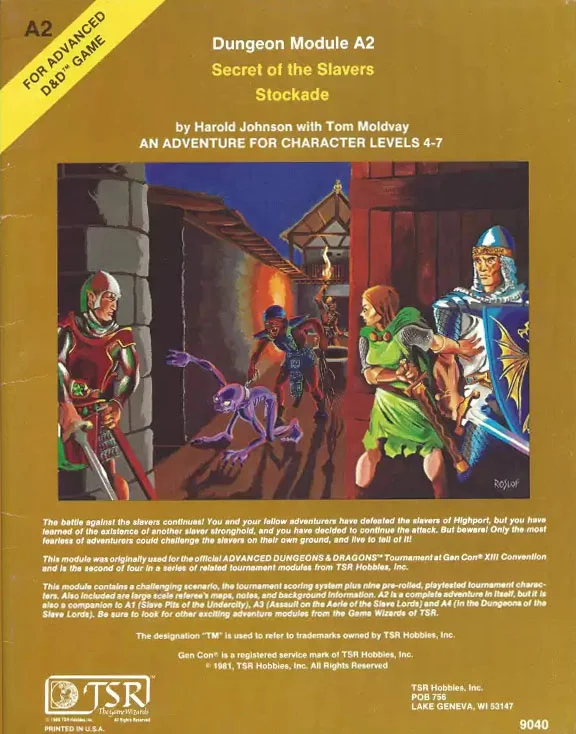
[City, State] – [Date] – Decades after its initial publication, TSR, Inc.’s A2: Secret of the Slavers Stockade continues to command attention and critical acclaim within the venerable landscape of tabletop role-playing games. A recent retrospective review hails this module, originally released in 1981, as the pinnacle of the iconic Against the Slave Lords series, praising its robust design, compelling narrative, and challenging encounters. The review, initially published in 2002 and revisited for its enduring insights, positions A2 not merely as a historical artifact but as a testament to classic Dungeons & Dragons adventure design that still resonates with players and Dungeon Masters today.
Authored by Harold Johnson with contributions from Tom Moldvay, A2 stands as the second installment in the four-part A-series, picking up directly from the conclusion of David Cook’s A1: Slave Pits of the Undercity. While acknowledging the inherent challenges of revisiting a module from a bygone era of game design, the review unequivocally declares A2 to be a superior experience, offering greater depth, more engaging characters, and a higher standard of overall execution. It posits that if a player or DM fails to appreciate A2, they are unlikely to find satisfaction in the broader A-series, highlighting its exemplary status within the saga.
Main Facts: A Fortified Bastion of Classic D&D
At its core, A2: Secret of the Slavers Stockade presents players with a formidable strategic challenge: the siege of a heavily guarded fort. Following the events of A1, player characters (PCs) are armed with a crucial map, guiding them to "an old fort lost in the midst of the Drachensgrab Hills." This fortified compound serves as a critical stockade for the nefarious humanoid slaver caravans, a pivotal hub in the Slave Lords’ illicit operations. The adventure thrusts players into a high-stakes scenario where tactical planning, stealth, and direct confrontation are equally viable, yet perilous, paths to success.
The review emphasizes that the central concept revolves around the PCs initiating a siege, a design choice that was notably ambitious for its time. While acknowledging the module’s origins as a tournament adventure, which sometimes led to a more static portrayal of non-player characters (NPCs), the reviewer commends Johnson’s success in crafting a "gritty, dangerous, well-fortified fort." The module’s explicit design philosophy is clear: gaining entry will be difficult, but escaping alive will prove even more arduous, setting a tone of relentless challenge and high stakes.
Moreover, A2 significantly expands the roster of antagonist figures, introducing multiple "Slave Lords" who elevate the narrative’s complexity. Markessa, a dangerous fighter and wizard engaged in chilling human experiments, oversees the fort. Her authority, however, is not absolute; she is locked in a power struggle with Icar, the fort’s commander, and Blackthorn, a direct representative of the broader Slave Lords organization. These central figures are supported by Executioner, Icar’s lieutenant, and Gulyet, Markessa’s assistant and apprentice. This intricate web of rivalries and alliances among the villains adds layers of intrigue and potential strategic opportunities for discerning player groups, a notable enhancement over the single primary antagonist featured in A1.
Chronology: A Glimpse into Early RPG Publishing
A2: Secret of the Slavers Stockade emerged during a golden age of tabletop role-playing game development, specifically in 1981. This was a period when TSR, Inc., under the guidance of industry pioneers like Gary Gygax, was rapidly expanding the Dungeons & Dragons universe, establishing many of the tropes and design principles that would define the hobby for decades. The A-series, known collectively as Against the Slave Lords, began its life not as a retail product but as a set of modules designed for competitive play at official Dungeons & Dragons tournaments, most notably the 1980 AD&D Open.
The sequential nature of the A-series is crucial to understanding its design and impact. A1: Slave Pits of the Undercity, written by David Cook, established the initial premise of rescuing prisoners and uncovering the slave trade’s operations. A2 then escalated the conflict, moving from a dungeon crawl to a full-blown tactical assault on a stronghold. The shift in creative teams, from Cook for A1 to Johnson and Moldvay for A2, speaks to the collaborative and sometimes varied approaches to module development at TSR during this era. Each module, while part of a larger narrative, carried the distinct stylistic imprint of its authors.
The retrospective review itself, originally published on March 16th, 2002, provides a critical chronological marker. This 21st-century assessment offers valuable perspective, judging the 1981 module against the backdrop of two decades of RPG evolution. It implicitly acknowledges the challenge of assessing vintage content while simultaneously recognizing its foundational importance. The reviewer’s commitment to analyzing the entire series, with subsequent reviews planned for A3 and A4, further contextualizes A2‘s standing as a pivotal installment.
Supporting Data: Deconstructing Design and Flaws
The comprehensive review delves into both the strengths and weaknesses of A2, providing a detailed breakdown that serves as valuable supporting data for its overall high appraisal.
Strengths: A Masterclass in Adventure Design
The review unequivocally positions A2 as the strongest entry in the A-series, citing several key areas of superiority over its predecessor, A1. Firstly, A2 is described as a "larger module, giving you more in the way of sheer material." This indicates a greater breadth of content, potentially translating to longer playtimes, more diverse encounters, and richer world-building within the module’s confines. For players and DMs, this meant more value and more engaging content to explore.
Secondly, the "encounters are better designed and better conceived." This speaks to a higher level of creativity, strategic depth, and narrative integration in the challenges presented to the PCs. Unlike potentially more generic "monster in a room" encounters, A2‘s design elements likely required more nuanced approaches, rewarding cleverness and tactical thinking over brute force. This improved design contributes significantly to the module’s overall replayability and memorability.
Thirdly, A2‘s "characters are more compelling and dynamic." The introduction of multiple, internally conflicted Slave Lords – Markessa, Icar, and Blackthorn – immediately elevates the narrative. These aren’t just statistics on a page; they are active participants in the module’s unfolding drama, with their own motivations, rivalries, and strategic objectives. This complexity helps players "understand why people talk about the Slave Lords as being villains of special quality," transforming them from mere obstacles into truly memorable antagonists who could influence the flow of the adventure based on the PCs’ actions.
Finally, and perhaps most crucially, the review highlights a general improvement in "execution: The average quality of material on A2’s page is higher than the average quality of material on A1’s page." This suggests a more polished, coherent, and thoughtfully presented adventure, indicative of a mature design process that benefited from the lessons learned in earlier modules. This consistent quality across the module’s 42 pages solidifies its reputation as a standout publication.
Weaknesses: Minor Flaws in an Otherwise Polished Gem
While highly praising A2, the review does not shy away from identifying its shortcomings, though it notes they are "far less severe" than those found in A1. Common to many modules of its era, A2 suffers from "artwork and presentation [that is] sub-par by modern standards." Early D&D modules often featured utilitarian black-and-white art and straightforward layouts, which, while functional, lack the visual sophistication and production values expected in contemporary RPG products.
A more specific and "seriously debilitating element" identified is a series of rooms inhabited by a "madman pretending to be a ghost through a variety of parlor tricks." The reviewer finds this conceit difficult to reconcile with the presence of a powerful sorceress like Markessa, questioning why such a deception would be tolerated or remain undiscovered in a heavily guarded, magically overseen fort. This particular flaw underscores how certain narrative choices, while perhaps intended for flavor, can break immersion if they contradict established world logic. The reviewer suggests this, along with "a handful of similar, but less severe, flaws," would require "minor clean-up work," easily resolvable within "less than a half hour of work." This implies that the core structure is sound, and only superficial adjustments are needed for a seamless modern play experience.
A significant recommendation for enhancement revolves around the fort’s defenses. The reviewer advocates for taking them "up to the next level," suggesting that the "fort’s defenders could benefit from a bit more dynamism" and "more involvement from the fort’s leaders in organizing, coordinating, and contributing to that defense." This critique points to a desire for a more reactive and intelligent opposition, where the villains actively respond to player incursions rather than merely waiting for confrontation in predetermined locations. This aligns with modern design principles that emphasize dynamic environments and proactive antagonists.
Technical Annotation: The ESD Map Flaw
An important historical note highlighted in the review concerns a flaw in early digital releases of A2. The "ESD currently available from Wizards has a flaw which the printed module lacks: Due to the poor quality of the scan, the map of the fort is practically illegible." This digital artifact presented a significant hurdle for DMs attempting to run the adventure, forcing them to "do a fair bit of work trying to reconstruct the map key from the few legible clues which remain." This issue, which was met with "stony silence" from Wizards of the Coast at the time, has since been rectified in current PDF copies, underscoring the iterative nature of digital product management and the importance of preserving the integrity of historical content.
Official Responses and Modern Revisions
While the original review mentioned a lack of "official response" regarding the ESD map flaw, the subsequent note confirming that "this is no longer true of the current PDF copies available for sale" serves as a retroactive official correction. This indicates that Wizards of the Coast, as the current custodians of the Dungeons & Dragons legacy, eventually addressed the quality control issue in their digital offerings. Such revisions are crucial for ensuring the accessibility and playability of classic modules for new generations of DMs and players.
Beyond this specific technical correction, the broader "official response" to the Against the Slave Lords series can be seen in its continued availability and periodic re-releases. Wizards of the Coast published Against the Slave Lords (ISBN: 978-0786965717) in 2013, a hardcover compilation designed for the 5th Edition of Dungeons & Dragons. This official product adapts the original A1-A4 modules, including A2: Secret of the Slavers Stockade, for modern rulesets while retaining their classic narrative and challenges. This act of re-publishing is perhaps the most significant official acknowledgment of the series’ enduring quality and its place in the D&D canon, providing updated artwork, revised stat blocks, and streamlined presentation to make these adventures accessible to a contemporary audience.
Implications: Legacy and Enduring Influence
The retrospective review of A2: Secret of the Slavers Stockade carries significant implications for understanding the legacy of early Dungeons & Dragons and its continued relevance.
Firstly, it solidifies A2‘s position as a quintessential example of "classic D&D at its best." This isn’t just nostalgia; it speaks to foundational design principles that remain effective: a "strong, well-defined concept," an "excellent setting," "memorable villains," and "challenging encounters." These elements are timeless and serve as a benchmark for effective adventure design across all editions of D&D and other RPGs. The success of A2 demonstrates that good storytelling and solid mechanics transcend specific rulesets.
Secondly, the review’s emphasis on the "Slave Lords as being villains of special quality" highlights the module’s contribution to the pantheon of iconic D&D antagonists. The multi-faceted nature of Markessa, Icar, and Blackthorn, with their internal conflicts and distinct personalities, set a precedent for more complex and engaging villains in future modules and campaigns. This sophistication moved beyond simple "monster of the week" encounters, encouraging DMs to portray antagonists with depth and agency.
Thirdly, the reviewer’s personal reflection on "designing adversary rosters" directly links A2‘s suggested improvements to broader RPG design theory. The desire for a "more dynamic defense of the stockade" and more active involvement from NPC leaders stems from a modern understanding of immersive gameplay. The concept of "adversary rosters," which allows DMs to track and dynamically deploy enemy forces, directly addresses the perceived "static" nature of some original tournament module NPCs. This connection underscores how classic adventures can still inspire contemporary design innovations and how DMs can adapt older materials to meet modern expectations for player agency and reactive game worlds.
Finally, the enduring appeal of modules like A2, leading to critical retrospectives and official re-releases, speaks volumes about the power of foundational RPG content. These modules are not just historical curiosities; they are living documents that continue to be played, adapted, and celebrated. They offer a window into the origins of the hobby, providing both nostalgic enjoyment for veteran players and invaluable lessons in adventure design for newcomers. A2: Secret of the Slavers Stockade, in particular, stands as a testament to the fact that compelling narrative, challenging gameplay, and memorable antagonists remain the cornerstones of truly great tabletop adventures.
Conclusion:
A2: Secret of the Slavers Stockade remains a vibrant and essential piece of Dungeons & Dragons history. The review’s assessment of its "Style: 2" and "Substance: 4" (on an unspecified scale, presumably out of 5) suggests that while its aesthetic presentation might be dated, its core content and playability are exceptionally strong. Its robust conceptualization, superior encounter design, and the introduction of truly memorable villains solidify its reputation as the standout module of the Against the Slave Lords series. For DMs seeking a classic challenge or players eager to experience a foundational piece of D&D lore, A2 continues to offer a compelling, gritty, and deeply rewarding adventure. It serves as a powerful reminder that the best of tabletop role-playing transcends time, offering timeless thrills and strategic depth that resonate across generations of gamers.