Revisiting the Undercity: A Deep Dive into D&D’s Enduring Classic, A1: Slave Pits of the Undercity
Originally Published: March 16th, 2002
(This article revisits and expands upon an earlier review, contextualizing its insights for a contemporary audience.)
The annals of tabletop role-playing games are replete with legendary adventures, modules that have shaped generations of players and Dungeon Masters. Among these revered texts, the A-series, commonly known as the "Slavers" or "Slave Lords" series, holds a particularly iconic status. Launched in the nascent years of Advanced Dungeons & Dragons (AD&D), these modules not only provided thrilling dungeon crawls but also laid foundational stones for campaign design and narrative progression. This article delves into the first installment of this seminal series, A1: Slave Pits of the Undercity, examining its historical context, original design, enduring strengths, palpable weaknesses, and its continued relevance for the modern gamer, drawing extensively from a critical review published in 2002.
Main Facts: A Glimpse into the Slavers’ Lair
A1: Slave Pits of the Undercity, authored by David Cook and published by TSR, Inc. in 1980, serves as the grim gateway to the infamous "Scourge of the Slavelords" campaign arc. This module, along with its three successors (A2: Secret of the Slavers Stockade, A3: Assault on the Aerie of the Slave Lords, and A4: In the Dungeons of the Slave Lords), plunged player characters (PCs) into a desperate struggle against a pervasive and sinister slaver conspiracy. The series was originally conceived for and debuted at the AD&D Tournament at Gen Con XIII, a significant detail that profoundly influenced its design philosophy and structure.
The core premise of A1 is straightforward yet compelling: a ruthless network of slavers, guided by the shadowy "Slave Lords," has been ravaging coastal towns, prompting local nobility to set aside their differences and launch a collective counter-offensive. The player characters are thrust into this conflict, tasked with infiltrating a ruined temple compound that serves as a base of operations for a local slaver sect. Their objective: navigate the compound, descend into the sewers and underground slave pens, free the captives, and eliminate the local Slave Lord.
While contemporary gamers might find the primitive artwork of Jeff Dee and the sparse presentation of David Cook’s material somewhat quaint, the module’s reputation for greatness within the gaming community is undeniable. The 2002 review highlighted this dichotomy, posing a crucial question: does this bygone glory rest upon a foundation still worthy of consideration today? This analysis aims to answer that question by dissecting the module’s conceptual underpinnings, scrutinizing its perceived flaws, celebrating its inherent strengths, and offering practical advice for its adaptation to modern playstyles and rule sets.
Chronology: From Tournament Tables to Digital Archives
The A-series modules emerged during a pivotal period for Dungeons & Dragons. The late 1970s and early 1980s saw the rapid expansion of the game’s universe and the formalization of its rules with the release of Advanced Dungeons & Dragons (AD&D) in 1977-1979. TSR, Inc. was at the forefront, pushing boundaries in adventure design and competitive play.
- 1980: A1: Slave Pits of the Undercity is released, closely followed by A2: Secret of the Slavers Stockade. Both modules debuted at Gen Con XIII, serving as the official AD&D Tournament adventures. This tournament origin is crucial; it meant the adventures were designed for specific time limits, clear objectives, and a scoring system, often prioritizing puzzle-solving and combat efficiency over open-world exploration or deep role-playing.
- 1981: A3: Assault on the Aerie of the Slave Lords and A4: In the Dungeons of the Slave Lords complete the series, continuing the narrative thread and escalating the conflict against the Slave Lords.
- Mid-1980s: Recognizing the popularity and cohesive narrative of the series, TSR releases Scourge of the Slavelords, an omnibus edition collecting all four modules. This compilation not only made the entire campaign more accessible but also cemented its identity as a unified storyline, one of D&D’s earliest examples of a multi-part campaign arc.
- 2002: The original review of A1: Slave Pits of the Undercity is published, offering a critical look at the module from the perspective of a D&D 3rd Edition era, reflecting on how classic design principles held up against evolving player expectations.
- Present Day: The entire A-series, including the Scourge of the Slavelords omnibus, remains available in electronic form through platforms like the DMsGuild (an official storefront for D&D content), ensuring its continued accessibility to new generations of DMs and players. This digital preservation highlights the module’s enduring appeal and historical significance within the D&D canon.
The consistent presence of the A-series, from its competitive origins to its digital rebirth, underscores its enduring legacy. It represents a significant chapter in D&D’s evolution, showcasing early attempts at serialized storytelling and the unique challenges and opportunities presented by tournament-style adventure design.
Supporting Data: Unpacking the Undercity’s Design Philosophy
To truly appreciate A1: Slave Pits of the Undercity, one must understand the design ethos prevalent in early AD&D. The 2002 review offered a candid assessment, balancing nostalgic appreciation with a critical eye towards contemporary playability.
The Core Concept and Its Tournament Roots
The narrative backbone of the A-series, the "Slave Lords" conspiracy, is inherently captivating. It taps into universal themes of oppression, heroism, and the fight for freedom. However, the implementation in A1 bears the unmistakable hallmarks of its tournament origins. Adventures designed for competitive play often prioritize specific encounters and challenges, leading to a more linear progression and less emphasis on sandbox exploration or detailed world-building.
A1 exemplifies this with its direct, almost funnel-like approach. PCs arrive at a ruined temple, which acts as a glorified access point. The subsequent journey through sewers, past monstrous threats (originally aspis), and into the slave pens is tightly choreographed. The 2002 review rightly pointed out that DMs running this module in a continuous campaign would need to "fill in all of the details which surround the actual dungeon crawls themselves," a task often underestimated by those unfamiliar with early D&D modules. This expectation placed a significant burden on the DM to weave the adventure seamlessly into a broader narrative fabric, an implicit understanding of the era that often surprises modern DMs accustomed to more self-contained or richly detailed campaign settings.
Weaknesses: Cracks in the Foundation
The 2002 review was unflinching in identifying several key weaknesses, many of which stem directly from the module’s age and design philosophy.
-
Structural Flaws in the Temple Compound: A glaring oversight highlighted by the reviewer was the lack of connectivity within the ruined temple compound itself. "As far as I can tell, there is absolutely no way to get from the left half of the compound to the right half of the compound." This fundamental mapping error forces DMs to improvise, suggesting a gateway between Area 9 and Area 16A as a simple fix. Such a basic design flaw speaks to either rushed production or a focus on individual encounters over holistic environmental logic. For a modern DM, this immediately signals a need for pre-game preparation and minor revisions to ensure a smooth player experience. Without it, players might feel frustrated by arbitrary barriers or a lack of logical progression, detracting from immersion.
-
Logical Inconsistencies with Creature Placement: The presence of aspis (giant insects) guarding the slave pens raised significant questions. "Why would the slavers build their slave pens here, where the aspis pose a potential threat? Why wouldn’t the slavers drive these creatures out? And why is there a tunnel leading from the aspis hive straight to the underground office of the local Slave Lord?" These queries expose a common issue in early dungeon design where cool monsters were sometimes placed without sufficient narrative justification. Modern players and DMs often seek a cohesive internal logic within the game world. The original review correctly identified this as a point of friction, where the "cool factor" of a monster superseded the narrative sense of the environment.
-
The "Gygaxian Puzzle" Style: Perhaps the most significant criticism leveled by the 2002 review was against the "Gygaxian style of adventure design in which the entire game world has been structured into a giant puzzle which the PCs must solve." This refers to a particular brand of dungeon design, often associated with Gary Gygax’s early works, where specific items or actions are required to overcome particular obstacles, much like an interactive fiction game. The example cited – "Enter room 5A. Pick up barrel of stale vinegar. Go to room 5B. Throw vinegar at glue-like creature in 5B" – perfectly illustrates this often-contrived approach.
This style, while challenging and perhaps rewarding for players who enjoyed dissecting the designer’s intent, often stifled player agency and creative problem-solving. It implied a "correct" solution rather than allowing for emergent gameplay. In contrast, modern adventure design tends to offer multiple pathways, allowing players to utilize their character’s skills, spells, and inventiveness to overcome challenges, rather than relying on a singular, predetermined solution. The "Gygaxian puzzle" can feel arbitrary and frustrating to contemporary players who expect a more dynamic and responsive game world.
-
Atmosphere Killers: The reviewer also took issue with elements like "automated slave pens with remote-control doors," calling them an "atmosphere killer." While perhaps intended to showcase advanced (or magical) technology, such elements can feel anachronistic or jarring in a traditional fantasy setting. They can break immersion by introducing concepts that don’t quite fit the established tone, pulling players out of the fantasy.
Strengths: A Rock-Solid Foundation
Despite these identified weaknesses, the 2002 review was quick to praise A1‘s fundamental strengths, affirming its status as a "rock solid foundation."
-
Engaging Scenario: The core premise of fighting slavers is universally appealing and provides an immediate, moral imperative for player characters. It offers a clear objective and a compelling antagonist, ensuring player buy-in from the outset. This "hook" remains as potent today as it was in 1980.
-
Sound Structure: Even with its mapping glitches, the overall progression from surface compound to underground lair is well-paced and logical. It provides a clear series of challenges that build tension effectively, moving from infiltration to confrontation. The structure, at its heart, is a classic dungeon crawl, a format that remains a beloved staple of D&D.
-
Well-Done Maps and Evocative Descriptive Text: For its era, the module’s maps were functional and clear, guiding the DM through the various locations. The descriptive text, though sparse by modern standards, was praised for being "evocative," providing enough detail to spark the DM’s imagination and set the scene effectively. This concise writing style allowed DMs to easily interpret and elaborate upon the provided information, fostering creativity rather than constraining it.
-
Potential for Memorable Encounters and Character Concepts: Despite the general "boss monster" approach, the encounters within A1 are often well-designed and challenging. The review notes that "the character concepts have a lot of potential," suggesting that the NPCs, even if briefly sketched, offer opportunities for role-playing and memorable interactions beyond mere combat.
In essence, A1: Slave Pits of the Undercity possesses a robust skeleton. While some of its flesh and adornments may have aged poorly, the underlying structure and core concept are undeniably strong, providing a solid framework upon which a skilled DM can build.
Official Responses: The Legacy of a Classic
While direct "official responses" to a 2002 review are not applicable, the broader history of A1 and the A-series itself serves as an official testament to its impact and the publisher’s recognition of its value.
TSR’s decision to compile the four modules into the Scourge of the Slavelords omnibus edition in the mid-1980s was a crucial "official response." It signaled that the series was more than just a collection of tournament scenarios; it was a coherent campaign arc worthy of being presented as a unified product. This move likely broadened its reach beyond those who had participated in or followed the Gen Con tournaments, making it accessible to a wider D&D audience seeking more extended narratives.
Furthermore, the continued availability of the A-series in digital format through official channels like the DMsGuild is another form of "official response." It demonstrates that Wizards of the Coast, the current custodians of D&D, recognizes the historical and intrinsic value of these early modules. They are preserved not just as relics but as playable adventures, inviting new DMs to experience and adapt them.
David Cook, the module’s author, would go on to become a primary designer for AD&D 2nd Edition. His later work, particularly in codifying and streamlining the rules, suggests a keen understanding of game design evolution. While A1 reflects the design principles of its time, Cook’s subsequent career indicates a designer who learned and adapted, contributing to the very evolution that led to the critiques leveled against his earlier work.
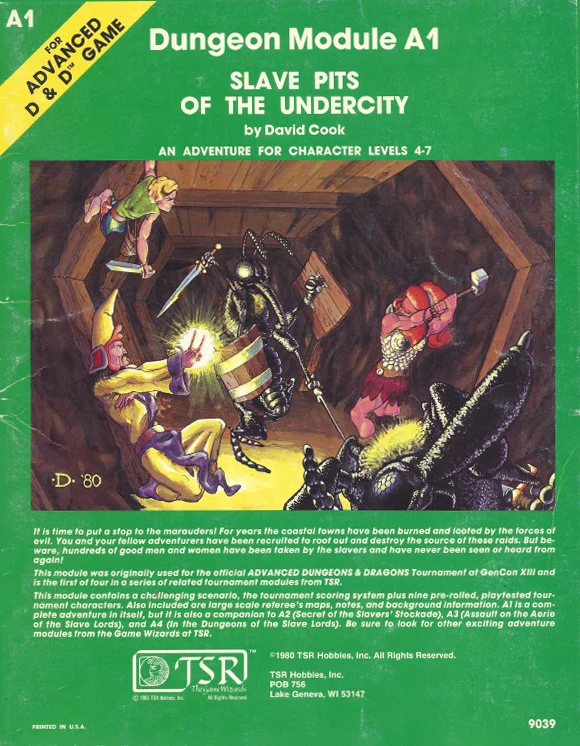
The original reviewer’s nuanced take on Jeff Dee’s artwork also merits consideration as a form of "official" critical commentary. While acknowledging the "primitive" nature of the 1980 work, the review also lauded Dee’s "raw creativity and fantastical cleverness of his compositions" and "technical detail of his backgrounds." The cover of A1, featuring a halfling clinging to the ceiling and a multi-limbed aspis, is cited as an example of this imaginative power. This perspective highlights that even early D&D art, despite its stylistic differences from later periods, contributed significantly to the game’s unique visual identity and fostered a sense of wonder and danger that defined the era. The art, like the module itself, is a product of its time, but its imaginative spark remains.
Implications: Adapting a Diamond in the Rough for Modern Tables
The 2002 review concluded with a resounding "Yes" to the question of A1‘s worth, labeling it a "diamond in the rough." This assessment holds true, if not more so, two decades later. The implications of revisiting such a classic are manifold, touching upon DM preparation, player expectations, and the enduring nature of good adventure design.
DM Adaptation: A Blueprint for Renovation
The most significant implication is the module’s demand for DM intervention. The 2002 review provided a clear, concise blueprint for modernizing A1:
- Structural Connectivity: Adding a gateway between Area 9 and Area 16A is a trivial fix that vastly improves the compound’s logic and player navigation. This simple change allows for more organic exploration and prevents players from feeling arbitrarily blocked.
- Streamlining Encounters: Removing the aspis and goblin caverns entirely, as suggested, makes the slaver base "far more utilitarian (and logical) in the sewers." This eliminates narrative inconsistencies and streamlines the adventure, focusing on the core conflict rather than tangential monster encounters that strain credulity. This decision also reduces the cognitive load on the DM to justify illogical placements.
- Eliminating "Gygaxian Puzzles": The recommendation to "just plain removed" the Gygaxian puzzles is perhaps the most impactful. Replacing the sundew/vinegar puzzle with a more conventional "tendriculus, set there specifically to guard against unauthorized access" transforms a contrived obstacle into a narratively justified challenge. This shift empowers players to use a wider range of solutions (combat, stealth, magic, diplomacy if applicable) rather than seeking a single, predetermined one. It encourages genuine problem-solving over puzzle-solving.
- Enhancing Immersion: Removing elements like "automated slave pens with remote-control doors" helps maintain a consistent fantasy aesthetic. While some DMs might lean into magi-tech, for most, a more grounded approach to slaver operations enhances the gritty realism and emotional impact of the adventure.
These adaptations are not about "fixing" a broken module but about polishing a raw gem. They acknowledge that design sensibilities evolve, and what was acceptable or even lauded in 1980 might feel cumbersome or illogical today. The necessity of these modifications highlights a crucial aspect of classic modules: they often provide excellent conceptual frameworks that benefit immensely from a modern DM’s creative reinterpretation.
Beyond AD&D 1st Edition: Cross-Edition Compatibility
The 2002 review also addressed the practicalities of adapting A1 for D&D 3rd Edition, a process that can be readily extended to later editions (4th, 5th Edition, Pathfinder, etc.).
- Monster Conversion: For most common monsters (goblins, orcs, guards, etc.), simply grabbing stats from the Monster Manual of the desired edition is straightforward. Unique creatures like the aspis (if retained) or tendriculus might require more specific stat-blocking, but the core concept remains adaptable.
- NPC Redesign: Converting NPCs involves applying the desired edition’s class levels, skills, and equipment. This allows DMs to tailor the difficulty and capabilities of the slaver leaders and their minions to suit their campaign’s power level and thematic needs.
- Balancing Encounters: The advice to "modify the number of creatures in an encounter and/or giving them additional class levels" remains evergreen. DMs can scale the adventure up or down to fit any desired party level, transforming A1 from a mid-level challenge to a low-level struggle or a high-level gauntlet with relative ease. This flexibility makes A1 a versatile tool in a DM’s arsenal.
The Enduring Value of "Diamonds in the Rough"
The legacy of A1: Slave Pits of the Undercity and the A-series in general speaks to the enduring quality of compelling narrative hooks and strong foundational design, even when wrapped in the sometimes-clunky mechanics or stylistic quirks of an earlier era. It reinforces the idea that classic modules are not merely historical curiosities but living documents that can be continually reinterpreted and enjoyed.
For today’s players, running A1 offers a unique opportunity to connect with D&D’s heritage. It’s a chance to experience the roots of dungeon crawling, to appreciate how adventure design has evolved, and to witness firsthand the raw creativity that fueled the game’s early success. For DMs, it’s a masterclass in adaptation, demonstrating how a little effort in renovation can transform an old blueprint into a magnificent structure.
Conclusion: A Jewel Worth Polishing
A1: Slave Pits of the Undercity is, without a doubt, a classic. While its 1980s sensibilities might require some thoughtful revision for modern tables, the core adventure scenario is engaging, the structure is sound, and the potential for memorable gameplay is immense. The 2002 review’s ultimate verdict remains steadfast: "Yes. No doubt about it. This is a diamond in the rough, and it may take a little bit of work on your part to clean it up and present it in its best light — but once you do, you’ll have a real jewel on your hands."
Its weaknesses are easily mitigated by an experienced Dungeon Master willing to apply a touch of logic and contemporary design philosophy. Its strengths, however, are inherent and timeless: a compelling premise, a clear objective, and a classic dungeon crawl that challenges players while offering rich opportunities for heroism. As the entry point to one of D&D’s most iconic campaigns, A1 continues to beckon adventurers into the grim depths of the Undercity, promising an unforgettable struggle against the insidious Slave Lords. Its continued availability and the ease with which it can be adapted ensure that this vintage adventure will continue to enthrall players for decades to come, proving that some classics truly never fade.
Module Details:
Author: David Cook
Publisher: TSR, Inc.
Price (Original): $4.99
ISBN: 0-935696-25-3
Product Code: TSR9039
Pages: 24
Year Published: 1980