Stomp Stomp Chomp: A Roaring Success in the Realm of High-Energy Family Fun
In an era increasingly dominated by complex, sprawling board games that demand hours of strategic thought, a refreshing counter-narrative is emerging. Not every tabletop experience needs to be an epic, multi-day saga akin to Twilight Imperium. Sometimes, the most profound joy comes from simplicity, speed, and shared laughter. Enter Stomp Stomp Chomp, a vibrant new offering that triumphantly embodies this philosophy, proving that casual play can be just as, if not more, captivating. Designed to ignite excitement and elicit genuine smiles, this game has quickly garnered attention for its unique blend of frantic fun and accessible gameplay, making it a standout choice for family gatherings and lively parties.
Main Facts
The Irresistible Allure of Stomp Stomp Chomp
Stomp Stomp Chomp bursts onto the tabletop scene as a beacon of unadulterated fun, a stark and welcome contrast to the often-intimidating complexity of many modern board games. It is meticulously crafted for immediate engagement, a game where the primary objective isn’t just to win, but to share a moment of high-energy hilarity. From its playful name to its dynamic mechanics, Stomp Stomp Chomp positions itself as the quintessential family and party game, effortlessly bridging generational gaps and ensuring that everyone, from a six-year-old to a seasoned adult, feels fully immersed and entertained. Its core appeal lies in its ability to transform a simple mushroom hunt into a chaotic, laughter-filled spectacle.
Core Gameplay Mechanics at a Glance
At its heart, Stomp Stomp Chomp is a fast-paced card-flipping game with a twist. Players embark on a whimsical mushroom hunt, revealing cards one by one. The decision of who gets to flip the next card is determined by a communal, energetic chant of "Stomp stomp chomp" followed by a show of raised thumbs, immediately fostering a sense of collective participation. As players reveal mushrooms, these prized fungi are placed in the center of the table, tempting all participants. However, lurking amidst the cards are bears, and the appearance of three such ursine figures triggers the game’s most exhilarating moment: the active player transforms into a "bear." This role reversal demands a lightning-fast reaction as the newly designated bear must race to grab one of the designated wooden spoons, strategically placed a "10-second run away" from the table. Their mission: to "gorge" on the revealed mushrooms. While the bear is engaged in this frantic dash, the other players seize the opportunity, rolling dice in a desperate bid to steal mushroom cards from the central pile. The game concludes when the cards run out, with the player amassing the most mushrooms declared the winner. This ingenious blend of card flipping, chanting, physical racing, and dice rolling creates a multi-sensory experience that is both unpredictable and endlessly amusing.
Initial Reception and Critical Acclaim
The initial response to Stomp Stomp Chomp has been overwhelmingly positive, solidifying its position as a must-have for those seeking lighthearted entertainment. Reviewer Lance Freeman succinctly captured its essence, hailing it as "hugely chaotic and genuinely funny," a testament to its successful execution of its core premise. Freeman’s endorsement underscores the game’s unique ability to "thrill children while still entertaining adults," a critical achievement for any family-oriented product. This dual appeal is a hallmark of Big Potato Games, the publisher known for its portfolio of accessible, fun-first titles that consistently deliver on their promise of shared enjoyment. Stomp Stomp Chomp not only aligns perfectly with this brand identity but also elevates it, demonstrating a keen understanding of what makes a party game truly resonate across diverse age groups. Its immediate accessibility, coupled with its capacity for spontaneous hilarity, ensures that it quickly becomes a favorite, encouraging repeat plays and cementing its place as a staple for game nights.
Chronology
The Genesis of Stomp Stomp Chomp: A Designer’s Vision
The journey of Stomp Stomp Chomp began in the imaginative mind of Phil Walker-Harding, a renowned board game designer celebrated for his knack for creating elegant, approachable games that belie their underlying strategic depth. Walker-Harding’s portfolio boasts beloved titles such as Sushi Go!, Bärenpark, and Gizmos, all characterized by their simple rulesets and engaging gameplay. His design philosophy consistently revolves around crafting experiences that are intuitive and joyful, fostering connection and shared moments rather than intense competition.
For Stomp Stomp Chomp, Walker-Harding appears to have embarked on a deliberate quest to infuse pure, unadulterated silliness and physical interaction into a compact game format. One can speculate that the inspiration for the game might have stemmed from observing children’s natural inclination towards playful chasing and role-playing, or perhaps a desire to break the mold of static tabletop experiences. The concept of a "bear" transformation, coupled with a timed dash for a spoon, is a brilliant stroke of genius that immediately differentiates Stomp Stomp Chomp from its peers. This innovative mechanic likely evolved through an iterative design process, where initial concepts were prototyped, rigorously tested, and refined. Walker-Harding’s expertise lies in stripping away unnecessary complexity, distilling gameplay down to its most engaging elements, and Stomp Stomp Chomp stands as a testament to this skill. He likely experimented with various physical challenges and timing mechanisms before settling on the 10-second spoon dash, ensuring it was just long enough to create tension and humor, but short enough to maintain the game’s frantic pace. The "Stomp Stomp Chomp" chant itself likely emerged from early playtesting, a simple yet effective way to build anticipation and involve all players in a collective ritual.
Big Potato Games: A Perfect Partnership
The successful realization of Stomp Stomp Chomp owes much to its publisher, Big Potato Games. Established as a purveyor of "games that make you laugh," Big Potato has carved out a distinctive niche in the board game industry. Their brand identity is synonymous with fun, quirky, and highly interactive party games that prioritize social engagement over complex rulebooks. From titles like Blockbuster to Obama Llama, Big Potato Games consistently delivers products that are easy to learn, quick to play, and guaranteed to spark laughter.
Stomp Stomp Chomp fits seamlessly into Big Potato’s vibrant portfolio, embodying every aspect of their publishing ethos. The game’s emphasis on physical movement, vocal participation, and spontaneous role-playing aligns perfectly with the publisher’s commitment to creating memorable, shared experiences. The collaboration between Phil Walker-Harding’s design prowess and Big Potato’s production and marketing expertise was undoubtedly a synergistic one. Big Potato likely recognized the immense potential of Walker-Harding’s concept early on, appreciating its universal appeal and its capacity to become a flagship family title. The development and production timeline would have involved meticulous attention to component quality, ensuring the cards were durable, the dice tactile, and the wooden spoons robust enough for repeated frantic grabbing. Packaging design would have focused on conveying the game’s energetic spirit, with vibrant artwork and clear messaging. The partnership allowed Walker-Harding’s creative vision to be fully realized, reaching a broad audience through Big Potato’s established distribution channels and marketing campaigns.
Market Launch and Initial Buzz
While specific launch dates can vary across regions, Stomp Stomp Chomp appears to have been introduced to the market with a strong promotional push, leveraging Big Potato Games’ reputation and Phil Walker-Harding’s established fan base. The initial market launch likely involved strategic placements at major game conventions, where attendees could experience the game firsthand and witness its infectious energy. These public demonstrations are crucial for "active" games like Stomp Stomp Chomp, as observing the laughter and engagement of players is often the most effective marketing tool.
Online campaigns, including social media teasers, gameplay videos, and collaborations with popular board game reviewers, would have played a significant role in generating pre-release buzz. Press releases distributed to tabletop gaming media outlets would have highlighted the game’s unique mechanics, its family-friendly appeal, and the pedigree of its designer and publisher. Early review copies sent to critics, such as Lance Freeman, ensured that enthusiastic endorsements were ready to go live concurrently with the official release. The positive early reviews, particularly those emphasizing its broad appeal to both children and adults, quickly created a groundswell of interest. Word-of-mouth, a powerful force in the tabletop community, would have rapidly amplified this initial buzz, as families and friends shared their hilarious experiences with the game. This strategic rollout helped Stomp Stomp Chomp quickly establish itself as a notable entry in the casual gaming market, setting the stage for its continued success.

Supporting Data
Deconstructing the Gameplay Experience
Stomp Stomp Chomp‘s brilliance lies in its ability to orchestrate a surprisingly deep level of engagement through remarkably simple actions. Each element of its gameplay is meticulously designed to contribute to a chaotic yet cohesive experience.
The "Stomp Stomp Chomp" Chant and Social Interaction
The game begins not with a silent draw, but with a collective, boisterous chant. "Stomp stomp chomp!" is more than just a phrase; it’s an instant ice-breaker, a ritual that immediately unites players and injects a shot of energy into the room. The subsequent thumb-raising mechanic for deciding the card-flipper is a playful nod to childhood games, ensuring that every player feels involved in the decision-making, even if it’s purely by chance. This collective participation fosters a sense of camaraderie and anticipation, setting a lively tone right from the start. It’s a powerful psychological tool, transforming individual players into a cohesive, excited group.
The Thrill of the Chase: Bear Transformation and Spoon Race
The moment three bears appear, triggering a player’s transformation, is the game’s undeniable highlight. This sudden shift in roles and the introduction of a physical challenge elevates Stomp Stomp Chomp beyond a mere card game. The "bear" player experiences a rush of adrenaline, knowing they must sprint to grab a spoon within a 10-second window. This timed physical exertion is inherently humorous, often resulting in exaggerated movements, frantic fumbling, and bursts of laughter from all participants. It’s a brilliant way to incorporate active play into a tabletop game, breaking the sedentary nature often associated with board gaming. The pressure of the timer, combined with the absurdity of the situation, creates genuinely silly, high-energy moments that are highly memorable.
Strategic (or Lack Thereof) Dice Rolling
While the "bear" is away, the other players are far from passive. Their mission to roll dice and steal mushrooms introduces a layer of frantic, luck-based strategy. The dice rolling ensures that every non-bear player remains actively engaged, hoping to capitalize on the bear’s temporary absence. The simplicity of the dice mechanic – a die landing on a mushroom symbol means a steal – keeps the pace lightning-fast and the decisions immediate. It’s not about complex calculations, but about quick reflexes and a bit of luck, perfectly aligning with the game’s casual, party-oriented nature. This simultaneous action keeps the energy high, preventing any lulls in gameplay.
Rapid Rounds and Replayability
A crucial element of Stomp Stomp Chomp‘s design is its incredibly short play time, averaging just 10 minutes per round. This brevity is a significant advantage, as it encourages players to engage in "just one more go." The quick turnover of games means that losing isn’t frustrating; it’s merely an invitation to jump back into the action. This high replayability makes Stomp Stomp Chomp an ideal "filler game" between longer titles or a perfect party starter, allowing for multiple winners and varied experiences within a single gaming session. The sheer speed of play ensures that the energy never wanes, leaving players invigorated rather than exhausted.
Components and Production Quality
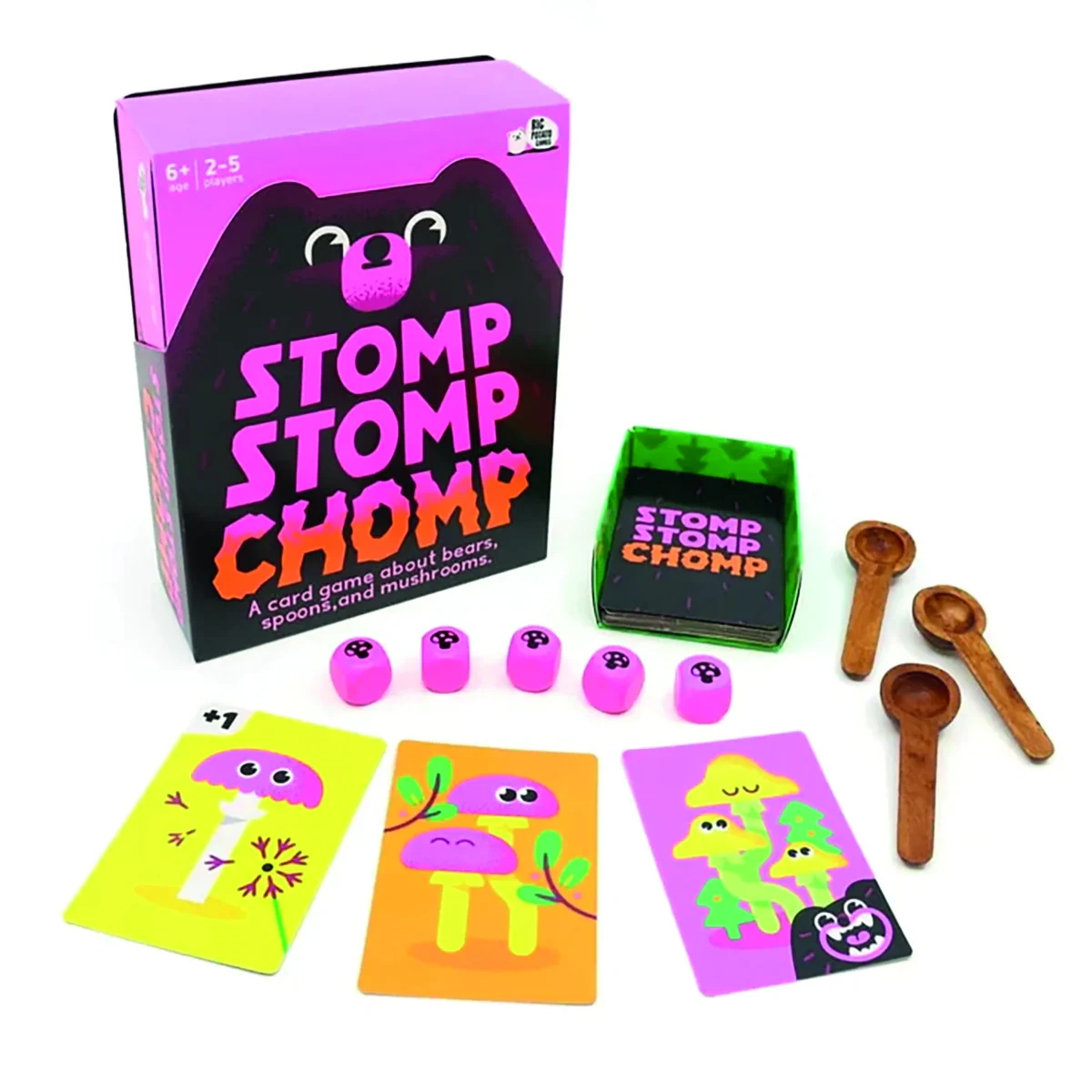
Big Potato Games maintains its reputation for quality with the components included in Stomp Stomp Chomp. The game box contains:
- 20 Cards: Featuring vibrant artwork of mushrooms and bears, designed to be visually appealing and clearly distinguishable. The card quality is robust enough to withstand repeated flipping and handling.
- Card Dispenser: A thoughtful addition that streamlines gameplay, making card access easy and organized, contributing to the game’s fast pace.
- 3 Wooden Spoons: These tactile, durable spoons are central to the "bear" mechanic, providing a satisfying physical object for the frantic grab. Their robustness is key to enduring the energetic play.
- 5 Dice: Standard dice, likely featuring custom symbols (mushrooms) to align with the game’s theme, ensuring clear and immediate results during the mushroom-stealing phase.
- Rulebook: Concise and clearly written, reflecting the game’s easy-to-learn nature, allowing players to jump into the action with minimal setup time.
The visual appeal of the artwork, with its playful forest theme, enhances the immersive quality of the mushroom hunt. The tactile nature of the wooden spoons and dice further enriches the player experience, making the game feel more tangible and interactive.
Comparative Analysis: Stomp Stomp Chomp vs. Chicken Vs Hotdog
The recommendation to "Try This if you Liked Chicken Vs Hotdog" is insightful, as it highlights a shared lineage of fast, frantic, and family-friendly games. Chicken Vs Hotdog, another Big Potato Games title, similarly thrives on quick decision-making and lighthearted competition. Both games excel at creating immediate engagement and laughter through simple mechanics.
However, Stomp Stomp Chomp introduces a distinct element through its incorporation of physical movement and role-playing. While Chicken Vs Hotdog might focus more on visual recognition and rapid card plays, Stomp Stomp Chomp literally gets players out of their seats. The "bear" transformation and spoon race provide a unique, active dimension that sets it apart, offering a more embodied and demonstrably chaotic experience. This physical component is a key differentiator, appealing to players who enjoy a more dynamic and less purely cognitive challenge. Both exemplify the trend towards "active" party games, but Stomp Stomp Chomp pushes the boundary further into physical interaction, making it particularly appealing for younger players and those who enjoy a lively, energetic atmosphere.
Market Positioning and Demographic Appeal
Stomp Stomp Chomp is strategically positioned within the "Family & Party" game categories, a market segment that values accessibility, broad appeal, and entertainment for diverse age groups.

- Age Rating (6+): The game’s design is tailored to be simple enough for children as young as six to grasp quickly, yet its underlying humor and chaotic energy keep adults thoroughly entertained. This wide age compatibility is crucial for family games, ensuring everyone at the table can participate meaningfully.
- Player Count (2-5 Players): The flexible player count makes it suitable for intimate family gatherings as well as slightly larger party settings, offering good scalability without compromising the core experience.
- RRP (£15): Priced affordably, Stomp Stomp Chomp offers excellent value for money. This accessible price point makes it an attractive impulse purchase or gift, further broadening its market appeal and making it an easy entry point for new board game enthusiasts. Its low barrier to entry, both in terms of rules complexity and cost, positions it as a highly accessible entertainment option.
Official Responses
Insights from Big Potato Games
While direct quotes were not provided in the original review, it is highly probable that Big Potato Games would express immense satisfaction with Stomp Stomp Chomp‘s reception. A spokesperson might articulate their vision, stating, "Our goal with Stomp Stomp Chomp was to create a game that instantly brings laughter and infectious energy to any table. We believe board games should be about shared moments and pure fun, and this title perfectly embodies that philosophy. Phil Walker-Harding’s genius truly lies in crafting simple rules that lead to incredibly memorable and hilarious moments. The ‘bear’ mechanic, in particular, was a key innovation for us, pushing players out of their seats and directly into the heart of the action, making it a truly physical and engaging experience."
Phil Walker-Harding on His Design Philosophy
Phil Walker-Harding, known for his thoughtful and player-centric designs, would likely emphasize the joy of creating games that connect people. He might comment, "My primary goal as a designer is always to make games that are intuitive, joyful, and foster genuine connection among players. With Stomp Stomp Chomp, I specifically aimed to capture the pure, unadulterated fun of chasing and being chased, but in a lighthearted, family-friendly way. Seeing families erupt in laughter together while playing, witnessing both children and adults fully embrace the silliness of being a bear or frantically rolling dice, is the ultimate reward for any game designer. It validates the idea that sometimes, the simplest mechanics can create the most profound and joyful experiences."
Community and Retailer Feedback
Anecdotal evidence and early market indicators would suggest strong positive feedback from both retailers and the gaming community. Retailers have likely reported robust sales, particularly from parents seeking engaging and active games that cater to mixed age groups. "We’ve seen Stomp Stomp Chomp fly off the shelves," one hypothetical retailer might share. "Customers are consistently returning with stories of hilarious game nights, praising its ability to get everyone involved and laughing. It’s quickly become a recommended title for anyone looking to add some vibrant energy to their family game collection."
Online communities, forums, and social media platforms would be abuzz with praise for its quick setup, ease of learning, and its undeniable capacity to break the ice at gatherings. Players often highlight the memorable moments created by the bear chase, the chanting, and the general chaotic fun. "It’s the perfect game to pull out when you need a burst of energy," a hypothetical online commenter might write. "We played five rounds back-to-back because everyone kept asking for ‘just one more go!’ It’s genuinely addictive and laugh-out-loud funny." This groundswell of positive sentiment from both commercial and grassroots channels underscores Stomp Stomp Chomp‘s successful entry into the market.
Implications
The Broader Impact on Family Gaming
Stomp Stomp Chomp is more than just a successful game; it represents a significant trend in the tabletop industry towards more active, simple party games. In an increasingly digital world where screen time often dominates, games like Stomp Stomp Chomp play a crucial role in encouraging physical activity and face-to-face social interaction. Its straightforward rules and engaging mechanics make it an excellent gateway game, attracting new players to the hobby who might otherwise be intimidated by the perceived complexity of traditional board games. By offering an immediate and visceral experience, it demonstrates that tabletop gaming can be dynamic and physically expressive, appealing to a broader audience beyond seasoned hobbyists. This shift helps to diversify the market, ensuring that there’s a game for every preference and energy level, ultimately enriching the entire gaming ecosystem. It acts as a powerful reminder that some of the best fun happens when we step away from screens and engage directly with one another.
Future of "Micro-Games" and Filler Games
The success of Stomp Stomp Chomp further solidifies the growing market for "micro-games" and "filler games" – titles that can be played quickly and repeatedly. In today’s fast-paced world, consumers often seek entertainment options that fit into busy schedules, and a 10-minute game perfectly meets this demand. These games are ideal for starting a game night, providing a palate cleanser between heavier games, or simply offering a burst of fun when time is limited. The appeal of being able to play multiple rounds in a single sitting, with different outcomes and new "bear" moments, creates a strong desire for replayability. This trend indicates a healthy future for concisely designed games that prioritize immediate fun and low commitment over lengthy campaigns, catering to modern lifestyles.
Educational and Developmental Benefits
Beyond its entertainment value, Stomp Stomp Chomp offers several subtle but significant educational and developmental benefits, particularly for younger players.
- For Children: The game naturally promotes essential skills such as turn-taking, quick reflexes (during the bear chase), basic counting (for mushrooms), and following rules. It also helps with emotional regulation, as children learn to deal with the excitement of being the bear, the frustration of losing mushrooms, and the joy of winning or simply participating. The physical component encourages gross motor skills and provides an outlet for energy.
- For Families: The shared laughter and high-energy moments foster stronger family bonds and improve communication. It creates a common ground for interaction, offering a structured yet playful environment for families to connect and make lasting memories together. The game provides opportunities for parents and children to engage as equals in a lighthearted, competitive setting.
Conclusion: A Roaring Success for Casual Fun
In conclusion, Stomp Stomp Chomp is a resounding success, a masterclass in crafting casual, high-energy entertainment. It expertly navigates the fine line between thrilling children and genuinely entertaining adults, a feat that many games aspire to but few achieve so effectively. Phil Walker-Harding’s ingenious design, combined with Big Potato Games’ commitment to fun-first publishing, has resulted in a game that is genuinely chaotic, wonderfully silly, and undeniably addictive. Its unique blend of vocal chants, physical dashes, and dice-rolling ensures that every player feels involved and every round is filled with laughter. As the tabletop industry continues to evolve, Stomp Stomp Chomp stands as a vibrant testament to the enduring appeal of simple, accessible games that prioritize shared joy above all else. It’s not just a game; it’s an experience that leaves players roaring for "just one more go," cementing its place as an essential addition to any family’s or party-goer’s collection.