The Aesthetics of Dissent: Thaddé Comar and the Visual Language of Modern Surveillance
In the contemporary landscape of global unrest, the image of the protester has undergone a radical transformation. No longer defined solely by the placards they carry or the slogans they shout, the modern activist is increasingly defined by what they wear to remain invisible: gas masks, umbrellas, laser pointers, and high-tech fabrics designed to baffle facial recognition software. At the center of this visual evolution is Thaddé Comar, a French-Swiss photographer whose work transcends traditional photojournalism to document the "dreamlike, unsettling realities" of life on the frontlines of the surveillance age.
Comar’s body of work, most notably his acclaimed project How Was Your Dream?, serves as a chilling and beautiful inventory of the tools and tactics used in the 2019 Hong Kong pro-democracy movement and the recurring waves of civil unrest in Paris. By stepping away from the frantic, reactionary pace of daily news and adopting a more deliberate, artistic approach, Comar has captured the psychological weight of living in a world where every gesture of defiance is tracked by an omnipresent digital eye.
Main Facts: A New Documentary Frontier
Thaddé Comar’s approach to photography is rooted in a fundamental shift from the "decisive moment" of Henri Cartier-Bresson to what might be called the "systemic moment." His work does not merely capture a clash; it captures the architecture of the clash itself.
The Artist’s Pedigree and Philosophy
Educated at the prestigious ECAL (École Cantonale d’Art de Lausanne) in Switzerland, Comar was raised on the visual diet of National Geographic, Life Magazine, and the legendary Magnum photographers. However, he quickly realized that the "studio practice" of photography held little interest for him. Instead, he sought the "stuff happening on the street"—the historical movements that redefine societies.
"How Was Your Dream?"
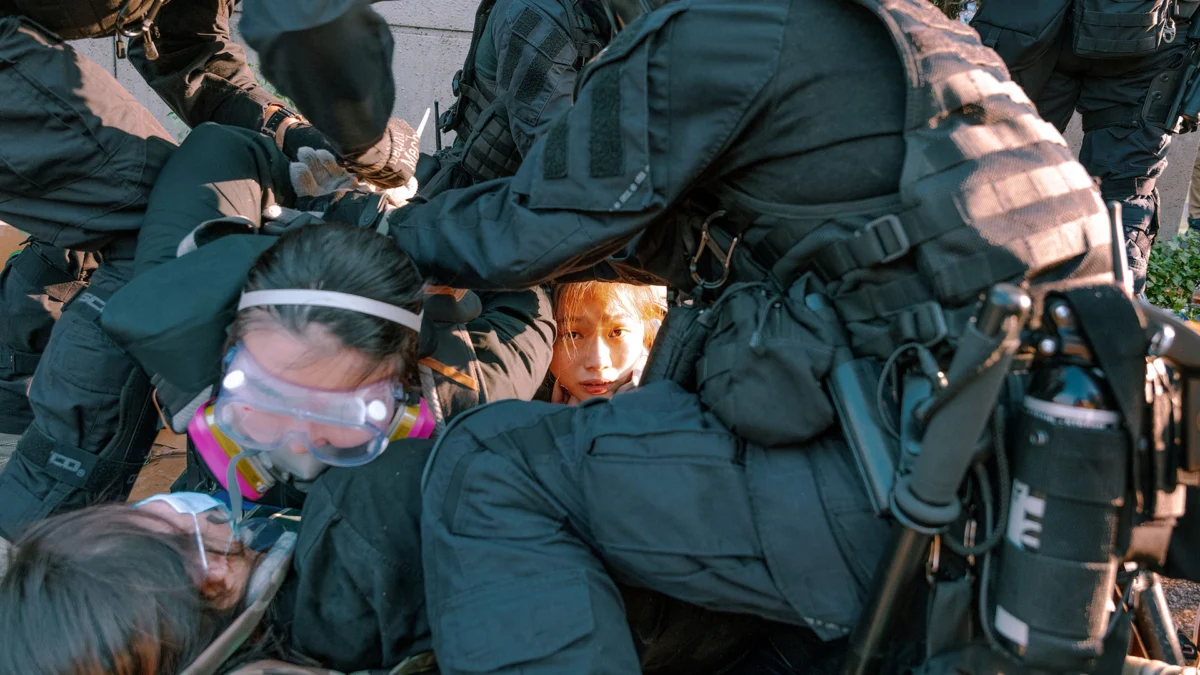
His most significant contribution to date is the photobook How Was Your Dream?, which focuses on the 2019 Hong Kong protests. The title itself is a reference to a coded phrase used by protesters to check in on one another while avoiding digital keywords that might trigger police surveillance. The work is characterized by a clinical, almost forensic use of flash, which isolates subjects against dark backgrounds, turning a chaotic street battle into a staged, theatrical tableau of resistance.
The Focus on Gear and Anonymity
Unlike traditional war photography, which seeks the human face to evoke empathy, Comar’s work often obscures the face. He focuses on the "prosthetics of protest": the makeshift shields, the industrial goggles, and the blue dye sprayed by police cannons to mark dissidents for later arrest. This focus highlights the dehumanizing effect of modern policing and the necessary anonymity of the modern rebel.
Chronology: From the Streets of Paris to the Heights of Hong Kong
The trajectory of Comar’s career mirrors the escalating intensity of global civil disobedience over the last two decades.
2006: The Formative Spark
Comar’s obsession with the street began in his youth. Growing up in France, he was exposed early to the nation’s robust culture of manifestation. He recalls protesting against the far-right politician Jean-Marie Le Pen with his family, but his "most intense experience" occurred in 2006. As a college student during the anti-CPE (First Employment Contract) movement, he experienced the raw, sensory overload of being alone in a crowd of thousands, surrounded by noise and the looming presence of the riot police. This period instilled in him a fascination with how crowds move and how authority responds.
The ECAL Years and Artistic Evolution
While studying at ECAL, Comar began to bridge the gap between fine art and reportage. He would frequently travel back to Paris to photograph the "Yellow Vests" (Gilets Jaunes) and other movements. It was during this time that he moved away from the "pressure of direct reporting." By choosing the status of an artist over a photojournalist, he granted himself the luxury of time—allowing him to "digest" the scenes and bring a level of creative abstraction to the violence of the street.
2019: The Hong Kong Watershed
In 2019, drawn by the unique technological nature of the Hong Kong pro-democracy movement, Comar traveled to the city. Hong Kong represented the "frontline" of a new kind of war—one fought not just for territory, but for data privacy and digital autonomy. He spent months documenting the "Be Water" strategy, where protesters utilized high-speed communication and physical agility to evade a highly sophisticated police force.

Supporting Data: The High-Tech Standoff
The context of Comar’s work is supported by the staggering statistics and technological realities of the movements he documents.
- Surveillance Density: At the time of the 2019 protests, Hong Kong was one of the most surveilled cities in the world, with plans to install "smart lampposts" equipped with facial recognition sensors. This led to protesters using high-powered laser pointers to blind the cameras—a visual element that Comar captures with haunting precision.
- The Scale of Conflict: During the height of the Hong Kong movement, police fired nearly 10,000 rounds of tear gas and arrested over 10,000 people. Comar’s photography moves away from these "macro" statistics to focus on the "micro" details: the texture of a gas mask filter or the way light reflects off a plastic raincoat.
- Tactical Evolution: In Paris, the use of "LBD" (ballistic launchers) by French police led to hundreds of serious injuries among protesters. Comar’s work in France often reflects this heightened physical risk, showing the heavy armor and weaponry that have become standard issue for European "peacekeeping" forces.
Official Responses and the Legal Battle for the Image
Comar’s work exists in a tense legal and political environment where the act of taking a photograph is itself a political statement.
The French "Global Security Law"
In recent years, the French government attempted to pass Article 24 of the Global Security Law, which sought to criminalize the filming or photographing of police officers in a way that could "harm their physical or psychological integrity." While the most restrictive parts of the law were eventually struck down or amended following massive protests (which Comar also photographed), the intent was clear: to control the narrative of the street.
Hong Kong’s National Security Law
Following the period documented in How Was Your Dream?, Beijing imposed a sweeping National Security Law on Hong Kong in 2020. This law effectively ended the era of mass protest and led to the arrest of many of the activists featured (albeit anonymously) in Comar’s work. His photos have since transitioned from contemporary reportage to a historical archive of a "lost" movement.
The Police Perspective
Law enforcement agencies in both France and Hong Kong have defended their tactics as necessary responses to "radicalized" elements within protest movements. They argue that the high-tech gear and surveillance are essential for maintaining public order in an age where protesters use encrypted apps like Telegram to coordinate "black bloc" tactics.
Implications: The Future of Dissent in a Panoptic Society
The work of Thaddé Comar carries profound implications for the future of photography and civil liberties.
The Death of the Traditional Photojournalist?
Comar’s success suggests that the role of the traditional "news photographer" is being supplanted by the "artist-witness." In an age where everyone has a smartphone and can livestream a riot, the value of professional photography lies in its ability to provide a deeper, more conceptual understanding of the event. Comar doesn’t just show us what happened; he shows us how it felt and what it means in the context of the 21st century.
The Asymmetry of Power
His focus on the "unsettling realities of surveillance" highlights the growing asymmetry between the state and the citizen. When the state possesses facial recognition, gait analysis, and thermal imaging, the citizen’s only defense is a total erasure of the self. Comar’s photos of masked, anonymous figures are a testament to this erasure. They represent a world where to be political is to be faceless.
The Permanence of the Digital Trace
Ultimately, Comar’s work raises questions about the "dream" referenced in his book’s title. Is the "dream" the hope for democracy, or is it the fever-dream of a society where every movement is recorded and archived? By freezing these moments of defiance in high-contrast, beautiful imagery, Comar ensures that even if the movements are crushed and the protesters are silenced, the visual record of their resistance remains—a permanent glitch in the system of total surveillance.
As protests continue to erupt from Tehran to Tbilisi, the visual language established by Thaddé Comar provides a roadmap for understanding the modern struggle. It is a world of shadows, lasers, and masks—a world where the most powerful thing a person can do is refuse to be seen, even as they stand in the middle of the street.