The Alchemy of Obsolescence: Amber Cowan and the Resurgence of Flameworked Glass
Main Facts: Reimagining the Fragile Medium
In the heart of Philadelphia’s vibrant arts district, Amber Cowan is orchestrating a quiet revolution in the world of contemporary glass. Known for her incredibly dense, lush assemblages, Cowan has carved out a unique niche by transforming the discarded remnants of the American glass industry into intricate works of high art. Her medium—primarily flameworked glass—is a testament to both technical precision and a deep, archival appreciation for a nearly lost industrial heritage.
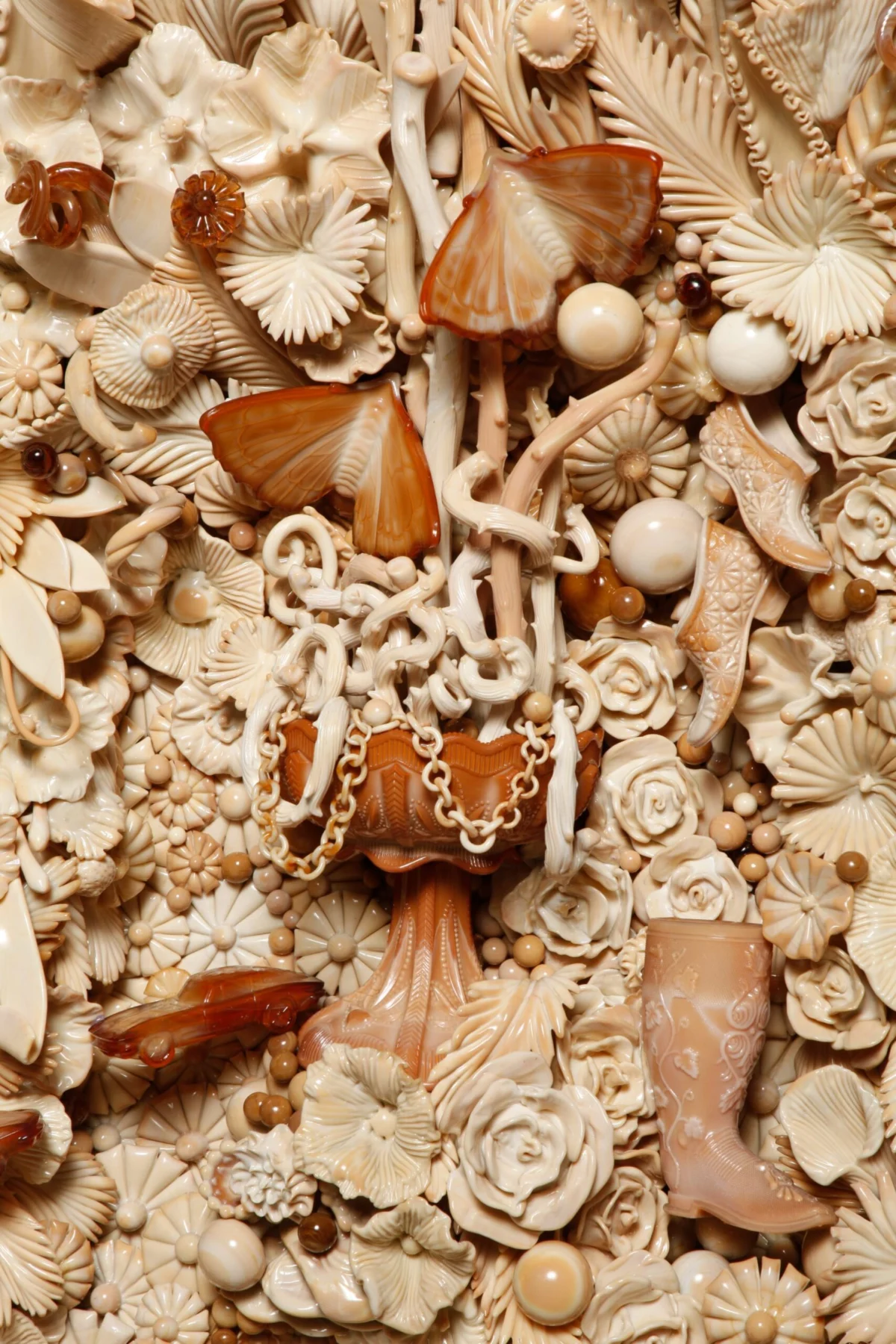
Cowan’s work is characterized by a maximalist aesthetic. Her sculptures are not merely objects but ecosystems of glass; they are populated by delicate flowers, intricate filigree, and colorful baubles that cluster together to form fairytale narratives. Recently, her practice has seen a shift toward "cloche and coupe" sculptures—miniature, self-contained worlds housed under glass domes—alongside her signature large-scale, wall-based assemblages.
The artist’s primary material is "cullet"—industrial scraps, factory floor offcasts, and vintage glassware sourced from thrift stores and defunct manufacturing sites. By working with these specific materials, Cowan is able to utilize colorways and chemical compositions that are no longer in production, such as the storied "Delphite" and "Rosalene" hues. This process turns each sculpture into a historical repository, preserving the DNA of mid-century American manufacturing within a whimsical, contemporary framework.

Chronology: A Season of High-Profile Exhibitions
Amber Cowan’s career trajectory is currently reaching a new zenith, with a series of major exhibitions scheduled across the United States. This timeline highlights her current and upcoming engagements, showcasing her growing influence in both the craft and fine art sectors.
Current Engagement: The Baker Museum (Naples, Florida)
Currently, Cowan’s work is a focal point of the exhibition The Passion of Collecting at The Baker Museum. This exhibition explores the psychology and aesthetics of accumulation, making Cowan’s "assemblage" style a natural fit. Her pieces in this show demonstrate the transition from individual found objects to a singular, cohesive narrative, reflecting the collector’s journey from acquisition to curation.
September 2025: Museum of Craft and Design (San Francisco)
As fall approaches, Cowan is preparing for a significant solo or featured showcase at San Francisco’s Museum of Craft and Design. This exhibition is expected to lean heavily into her recent explorations of the cloche format. These works, such as "Summer Cloche in Jade" and "Butterfly in Argonaut," represent a more intimate scale of storytelling, focusing on the preservation of beauty within a controlled, protective environment.

December 2025: Design Miami
The artist’s year will culminate at Design Miami, one of the world’s most prestigious forums for collectible design. Her participation in this event underscores the "crossover" appeal of her work, which sits at the intersection of traditional craft, decorative arts, and contemporary sculpture. The pieces slated for Miami are rumored to be some of her most ambitious to date, utilizing rare, discontinued glass stocks that highlight the "luxury" inherent in reclaimed industrial history.
Supporting Data: The Materiality of Memory
The power of Cowan’s work lies in the specific history of the glass she breathes new life into. To understand the depth of her sculptures, one must look at the data and history of the American glass industry, particularly the companies whose "scraps" she utilizes.
The Significance of Discontinued Colorways
Cowan frequently works with colors like "Delphite" (a pale blue milk glass) and "Rosalene" (a soft pink glass often containing gold chloride). These colors were staples of companies like Fenton Art Glass and the Corning Glass Works during the early to mid-20th century.

- Delphite: Originally developed in the 1920s, this opaque blue glass was often used for kitchenware and decorative items. It is no longer mass-produced due to the cost of pigments and the decline of the traditional pressed-glass industry.
- Rosalene: A "heat-sensitive" glass, Rosalene requires a secondary heating process to develop its signature blush. The complexity of this process makes it a rarity in modern industrial glassmaking.
Analysis of Key Works
The 2025-2026 collection features several standout pieces that exemplify her technical prowess:
- "Swans in Delphite and Rosalene" (2026): Standing at 11 x 8 x 8 inches, this piece utilizes the two aforementioned colors to create a romantic, neoclassical scene. The use of the swan—a recurring motif in vintage glass—serves as a bridge between the material’s past life as a trinket and its new life as a sculpture.
- "Strawberries and Mandarin in Sky" (2025): At over 20 inches tall, this work incorporates taper candles and fruit motifs, pushing the boundaries of the "coupe" format. The "Sky" blue glass provides a vibrant backdrop for the flameworked botanical elements.
- "Rosalene with World’s Fair Pears" (2025): This wall-based work (28.5 x 20 x 8 inches) is a masterclass in composition. It centers around a chalice, surrounded by a cornucopia of glass fruit and flowers. The title alludes to the "World’s Fair," a nod to the era of industrial optimism that birthed the very glass she uses.
Official Responses: Curatorial and Artistic Perspectives
The reception of Cowan’s work by the institutional art world has been overwhelmingly positive, focusing on her ability to synthesize history with a fresh, feminine, and fiercely technical perspective.
Curatorial Insights from The Baker Museum:
Curators at The Baker Museum have noted that Cowan’s work "challenges the viewer to reconsider the value of the ‘offcast.’ By taking materials that were literally swept off a factory floor and elevating them to the status of museum-grade sculpture, she questions our definitions of luxury and waste."

Artist Philosophy:
In her own reflections, Cowan often discusses the "ghosts" within her materials. "I am working with a medium that has a memory," Cowan has stated in various artist talks. "When I pick up a piece of glass from a factory that closed forty years ago, I am interacting with the labor and the color-science of a different era. My job is to take that history and fold it into a new fairytale."
Critical Reception:
Critics have praised her "maximalist restraint." While her pieces are incredibly busy—filled with hundreds of tiny, flameworked components—they are often unified by a monochromatic or limited color palette. This choice prevents the work from becoming kitsch, instead lending it a ghostly, ethereal quality that feels both antique and avant-garde.
Implications: The Future of Craft and Sustainability
The work of Amber Cowan carries significant implications for the future of the contemporary craft movement and the broader conversation regarding sustainability in the arts.

1. The Preservation of Industrial Knowledge
As traditional glass factories continue to close across the United States, the specialized knowledge of color formulas and pressing techniques is at risk of vanishing. Cowan’s practice acts as a form of "guerrilla archiving." By using these materials, she ensures that the unique visual properties of 20th-century American glass remain in the public eye, albeit in a transformed state.
2. Sustainability Through "Up-Cycling"
In an era where the environmental impact of art production is under scrutiny, Cowan’s reliance on "cullet" and scraps provides a model for sustainable high-art. She proves that "newness" in art does not require the extraction of new raw materials. Instead, innovation can be found in the creative reconfiguration of what already exists.
3. The "Crossover" Appeal
Cowan is part of a generation of artists blurring the lines between "craft" (traditionally associated with utility and domesticity) and "fine art" (associated with concept and gallery spaces). Her upcoming presence at Design Miami is a clear indicator that the market for "collectible design" is increasingly hungry for works that possess both extreme hand-skill and a strong conceptual narrative.

4. Narrative and Femininity
Cowan’s use of flowers, swans, and soft colors reclaims "feminine" aesthetics from the realm of the purely decorative. Her work suggests that these motifs can carry weight, complexity, and even a sense of mourning for the lost industries of the past.
As Amber Cowan moves toward her major 2025 exhibitions in San Francisco and Miami, she remains a pivotal figure in the glass world. Her ability to weave together the broken shards of industrial history into seamless, breathtaking visions of nature and myth ensures that her work will remain a vital part of the contemporary art dialogue for years to come. Through her lens, the fragile becomes formidable, and the forgotten becomes unforgettable.