The Ankara Gambit: Security, Secrecy, and the Ethical Fallout of the Presidential ‘Shell Game’
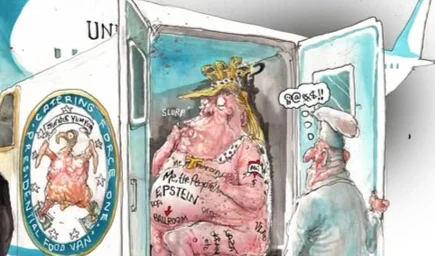
LONDON — In a maneuver that has ignited a firestorm of debate over presidential security, transparency, and the safety of the fourth estate, details have emerged regarding a high-stakes "shell game" played by the U.S. Secret Service during President Donald Trump’s recent transit from Ankara to London. The revelation that the President was covertly extracted from Air Force One and transported via a catering vehicle to a secondary aircraft—leaving a plane full of unsuspecting journalists and staff to serve as a decoy—has raised profound questions about the lengths to which the government will go to protect the Commander-in-Chief.
The incident, fueled by intelligence regarding a credible Iranian assassination plot, has not only shifted the geopolitical conversation regarding U.S.-Iran relations but has also prompted a scathing critique from political commentators and editorial cartoonists alike. At the heart of the controversy is a singular question: At what point does the protection of the President infringe upon the ethical obligations owed to the civilians who travel in his wake?
Main Facts: The Ankara Deception
The security operation took place during a sensitive diplomatic mission in mid-August 2026. While the public image presented was one of a standard departure from Ankara, Turkey, the reality behind the scenes was a complex tactical extraction.
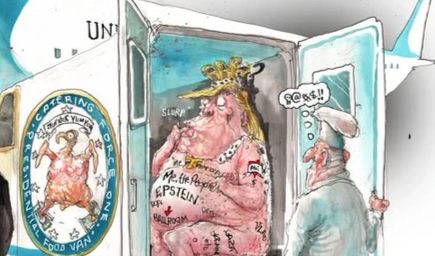
According to reports first surfaced by the Washington Post and subsequently analyzed by security experts, President Trump publicly boarded the primary Boeing VC-25A (the traditional Air Force One). However, once inside, he was immediately moved to the opposite side of the aircraft. A catering van, modified for secure transport, was elevated to the galley door—a standard procedure for restocking supplies that attracts little attention. The President then entered the van and was driven across the tarmac to a non-descript, unmarked aircraft that departed for London shortly before the official Air Force One took flight.
The primary aircraft, carrying the White House press corps, various administrative staffers, and a full complement of Secret Service agents, proceeded to London under the assumption that the President was in his private quarters. It was only weeks later that the passengers learned they had unknowingly served as a "kinetic shield" or decoy against a rumored Iranian missile or drone strike.
Chronology of a Secret Extraction
The timeline of the event suggests a rapidly evolving security environment:
- 08:00 AM (Ankara): Intelligence reports are finalized suggesting that Iranian-backed elements have positioned shoulder-fired surface-to-air missiles (MANPADS) or high-altitude drones along the projected flight path over the Mediterranean.
- 09:30 AM: The Secret Service initiates "Operation Shell Game." The decision is made to use the primary Air Force One as a decoy to draw potential fire away from the President.
- 10:15 AM: President Trump boards Air Force One in full view of the media. The iconic "wave from the stairs" is performed to solidify the narrative of his presence.
- 10:25 AM: Under the cover of a routine catering resupply, the President exits the starboard side of the plane into a food truck.
- 11:00 AM: The secondary, unmarked aircraft departs Ankara.
- 11:15 AM: Air Force One, carrying the press and staff, departs Ankara. The flight crew is aware of the switch, but the passengers are not.
- 02:00 PM (London): Both planes land safely at a secure airfield. The President is reunited with his motorcade, while the press corps is funneled through standard security channels, still unaware of the day’s deception.
Supporting Data: The Evolution of the Iranian Threat
The decision to utilize such extreme measures is rooted in a deteriorating security landscape. Since the escalation of tensions in the Persian Gulf in early 2025, Iran has repeatedly vowed "definitive justice" for the death of its head of state—a death for which President Trump took public credit, labeling the late Iranian leader a "bloodthirsty thug" in social media posts.
Security analysts point out that the threat of "one-man warfare" has reached an all-time high. The technology behind shoulder-fired missiles has advanced significantly since the U.S. first supplied Stingers to Afghan mujahideen 46 years ago. Modern variants are more portable, harder to detect, and capable of targeting specific heat signatures with devastating precision.
Furthermore, this is not the first time the President has faced such proximity to violence. The memory of the Butler, Pennsylvania, assassination attempt remains a cornerstone of the national psyche. While that event was marked by a defiant "bravado" from Trump, subsequent incidents—including a thwarted attempt to crash the White House Correspondents’ Association (WHCA) dinner—have reportedly made the President more compliant with Secret Service demands for "absolute discretion."
The Decoy Controversy: Human Shields or Security Necessity?
The most polarizing aspect of the Ankara incident is the treatment of the White House press corps. Unlike previous instances of presidential decoys, the journalists on board were never informed of the risk.
Historical precedents exist, but they differ in crucial ways. In 2000, President Bill Clinton flew into Pakistan on an unmarked plane while a decoy Air Force One followed. However, in that instance, the press corps was briefed on the security risks associated with the region. In the Ankara case, the secrecy was absolute.
Editorial cartoonists have been quick to highlight the perceived cowardice and the "target" painted on the backs of the journalists. Artists like Heller and Deering have depicted Air Force One with a literal bullseye on its fuselage, suggesting that the lives of the staff were deemed "expendable" in the service of the President’s safety.
Clay Jones, a prominent political commentator, noted the ethical rift: "The difference is agency. When you tell a reporter they are entering a combat zone, they can weigh the risk. When you use them as a human shield without their knowledge, you have violated the basic social contract between the presidency and the free press."
Official Responses and Rationalizations
The White House Press Office has remained largely defensive, citing the "unprecedented nature of the threats" facing the President. A spokesperson for the Secret Service, speaking on the condition of anonymity, stated, "Our mission is the protection of the Office of the Presidency. Methods used to ensure the safety of the Commander-in-Chief are classified, but they are always dictated by the severity of the intelligence. We do not have the luxury of transparency when lives are at stake."
Critics, however, argue that the "tough guy" persona cultivated by the President—who has frequently bragged about "destroying" the Iranian air force and navy—is at odds with the "cloak-and-dagger" maneuvering seen in Ankara. The juxtaposition of a President hiding in a catering van while his supporters believe he is "unafraid" has provided significant ammunition for political opponents.
Implications: A Precedent for Peril
The "Ankara Gambit" sets a troubling precedent for the future of presidential travel. If the press corps can no longer trust that they are being told the truth about their own safety, the traditional "pool" system—where a small group of journalists travels with the President to ensure accountability—may collapse.
1. Erosion of Trust: The relationship between the White House and the media is at a historic low. This incident reinforces the narrative that the administration views the press not as a vital part of democracy, but as a utility to be used—or a decoy to be sacrificed.
2. Geopolitical Signaling: By resorting to such extreme measures, the U.S. may be inadvertently signaling a lack of confidence in its own ability to secure international airspace. If the President of the United States cannot fly in his own branded aircraft, it suggests that the "Iranian threat" is far more potent than the administration’s rhetoric would suggest.
3. The "Target" Problem: Now that the tactic of using a decoy Air Force One has been publicized, the primary aircraft itself may become a more frequent target for symbolic strikes, regardless of whether the President is on board. This increases the danger for every staffer, technician, and journalist who maintains the fleet.
In the final analysis, the Ankara incident is a study in the modern paradox of the presidency: an office that demands a projection of absolute power, yet is increasingly forced into the shadows by the realities of asymmetrical warfare. As the President continues his European tour, the image of the "leader of the free world" hidden among trays of airline food remains a haunting metaphor for a world where nowhere is truly safe.