
The Architect of Middle-earth vs. The Prophet of Arrakis: Inside J.R.R. Tolkien’s "Intense Dislike" of Frank Herbert’s Dune

In the pantheon of 20th-century speculative fiction, two names tower above all others: J.R.R. Tolkien and Frank Herbert. One is the father of modern high fantasy, whose meticulously crafted Middle-earth set the standard for world-building; the other is the visionary behind Dune, a work of socio-political science fiction that reshaped the genre with its ecological and messianic complexity. For decades, literary scholars and fans alike have drawn parallels between the two, often labeling Dune as the "science fiction answer" to The Lord of the Rings.
However, historical records reveal that the admiration was far from mutual. In a 1966 letter that has recently resurfaced in literary circles, J.R.R. Tolkien expressed a profound and "intense" distaste for Herbert’s magnum opus. This revelation offers a rare glimpse into the friction between two distinct philosophies of "sub-creation" and provides a deeper understanding of why these two pillars of fiction, despite their structural similarities, remain ideologically worlds apart.
Main Facts: The Discovery of the Tolkien-Bush Correspondence
The revelation of Tolkien’s disdain for Dune stems from a 1966 letter written by the author to his friend and fan, John Bush. The correspondence was brought to light through its inclusion in Tolkien’s Library: An Annotated Checklist, a scholarly volume that catalogs the books Tolkien owned or read.
In the letter, Tolkien acknowledges that he was sent a copy of Dune by Sterling Lanier—an editor at Chilton Books who famously took a chance on Herbert’s manuscript after it had been rejected by over 20 publishers. Tolkien’s response was uncharacteristically blunt. While he often maintained a polite, scholarly distance when discussing contemporary works, his reaction to Dune was visceral.
"In fact, I dislike ‘Dune’ with some intensity," Tolkien wrote. He further explained that it is "impossible for an author still writing to be fair to another author working along the same lines." Out of a sense of professional courtesy, Tolkien opted to remain silent publicly during his lifetime, stating, "it is much the best and fairest to another author to keep silent and refuse to comment."
This private admission has sparked a renewed debate among literary historians regarding what, specifically, about Herbert’s arid world of Arrakis so thoroughly repelled the creator of the Shire.

Chronology: The Parallel Rise of Two Epics
To understand the friction between these two authors, one must look at the timeline of their respective publications and the cultural shifts occurring between them.
- 1937: J.R.R. Tolkien publishes The Hobbit, introducing the world to Middle-earth.
- 1954–1955: The Lord of the Rings trilogy is published. It becomes a slow-burn success, eventually exploding in popularity during the 1960s counter-culture movement.
- 1963–1965: Frank Herbert’s Dune is serialized in Analog magazine before being published as a novel in 1965. It arrives at a time when the "New Wave" of science fiction is beginning to challenge the tropes of the Golden Age.
- 1966: Tolkien receives Dune from multiple sources and writes his disparaging letter to John Bush.
- 1973: Tolkien passes away, never having seen the full scope of the Dune sequels or the eventual cinematic adaptations of his own work.
- 1984–Present: Both franchises undergo multiple adaptations, from David Lynch and Peter Jackson to the modern-day interpretations by Denis Villeneuve and Amazon Studios.
While Tolkien was an established literary giant by the mid-1960s, Herbert was the "new kid on the block." The fact that Tolkien’s peers were insistently sending him copies of Dune suggests that, even in 1966, the literary world recognized a shared DNA between the two works—a DNA that Tolkien himself seemed eager to disavow.
Supporting Data: Comparative World-Building and Divergent Philosophies
The comparison between The Lord of the Rings and Dune is founded on their shared commitment to "total immersion." Both authors spent years developing glossaries, appendices, maps, and deep histories that precede the actual narrative. However, the data suggests their motivations for doing so were diametrically opposed.
Philology vs. Ecology
Tolkien was first and foremost a philologist. His world-building was an exercise in "linguistic aesthetic." He famously stated that the stories were made to provide a world for the languages, not the other way around. His mythology was rooted in Northern European folklore, Catholic theology, and a mourning for the pre-industrial English countryside.
In contrast, Frank Herbert was a journalist and a political speechwriter. His world-building was rooted in ecology, sociology, and the "human sciences." Arrakis was not built to house a language, but to serve as a laboratory for testing how humans react to resource scarcity, religious manipulation, and the "superhero" myth.
The Role of Religion
One of the most significant points of contention likely lay in the treatment of faith. Tolkien was a devout Roman Catholic. While The Lord of the Rings lacks explicit religious ritual, it is infused with Catholic morality, the concept of "eucatastrophe" (the sudden happy turn), and a clear distinction between divine good and corruptive evil.

Herbert’s Dune, conversely, is deeply cynical about organized religion. The Bene Gesserit’s "Missionaria Protectiva" is a program of planting false prophecies on primitive worlds to be exploited later by their own agents. For Tolkien, who viewed myth-making as a form of "sub-creation" honoring the Creator, Herbert’s depiction of religion as a tool of political engineering and psychological warfare likely felt profane.
Official Responses and Historical Context
While Frank Herbert never publicly responded to Tolkien’s private letter (as it only became widely known long after both were deceased), Herbert’s own writings provide a counter-perspective on the genre. Herbert often spoke of his desire to subvert the "Chosen One" trope—a trope that Tolkien’s Aragorn arguably epitomizes.
Herbert once noted that the "messianic convulsion" was a dangerous phenomenon. He wanted to show that even a "good" leader (like Paul Atreides) could lead humanity into a jihad that kills billions. Tolkien’s work, which celebrates the return of the rightful king and the restoration of a moral order, stands in direct opposition to Herbert’s warning that "power attracts pathological personalities."
Literary critics suggest that Tolkien’s "intense dislike" may have also been a reaction to the "New Wave" of science fiction that Dune helped usher in. This movement was characterized by its experimental nature, its focus on "soft" sciences (psychology, sociology), and a general trend toward moral ambiguity and cynicism—all of which were antithetical to Tolkien’s more traditional, heroic, and romantic sensibilities.
Implications: The Ongoing Battle for Genre Supremacy
The friction between Tolkien and Herbert is not merely a historical footnote; it defines the two primary paths that speculative fiction has taken in the 21st century.
The Cinematic Arms Race
Today, we see this rivalry manifest in the "streaming wars" and the box office. Peter Jackson’s Lord of the Rings trilogy defined the 2000s, proving that high fantasy could be both critically acclaimed and commercially dominant. Decades later, Denis Villeneuve’s Dune (2021) and Dune: Part Two (2024) have attempted to do the same for "prestige" science fiction, utilizing a similar scale of epic world-building but with a drastically different aesthetic and emotional tone.
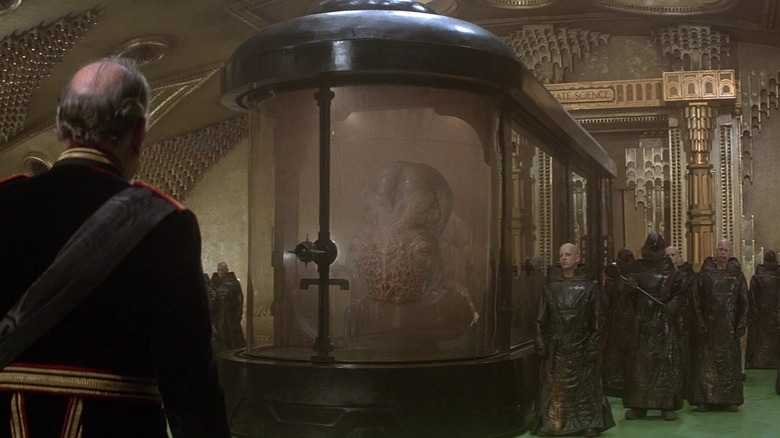
The current landscape features Amazon’s The Lord of the Rings: The Rings of Power and HBO/Max’s Dune: Prophecy. Both series serve as prequels, expanding the "lore" of their respective universes. The fact that both franchises are being mined for content simultaneously suggests that the appetite for complex, mapped-out worlds is higher than ever, even if the creators of those worlds couldn’t stand each other’s work.
The Legacy of "Sub-Creation"
Tolkien’s letter serves as a reminder that "world-building" is not a monolith. There is the Tolkienian model: celebratory, mythic, and rooted in the preservation of beauty and tradition. And there is the Herbertian model: deconstructive, analytical, and rooted in the critique of power and the inevitability of change.
For the modern reader, the choice between Middle-earth and Arrakis is often a choice of temperament. Those who seek comfort in the triumph of the human spirit over darkness gravitate toward the Shire. Those who seek to understand the mechanics of power, the dangers of charisma, and the harsh realities of survival find themselves drawn to the sands of Arrakis.
Conclusion
J.R.R. Tolkien’s "intense dislike" of Dune was likely not a critique of Herbert’s skill as a writer, but a fundamental rejection of his worldview. To the Oxford don, the desert of Arrakis was perhaps too cold, too cynical, and too devoid of the "joy" he believed was the ultimate goal of all great stories.
Yet, in the grand tapestry of literature, both authors are essential. Tolkien gave us the map to our dreams, while Herbert gave us the map to our nightmares. Whether one prefers the singing forests of Lothlórien or the brutal winds of the Deep Desert, it is clear that the dialogue between these two giants—even when it was one-sided and disparaging—continues to shape the boundaries of the human imagination. As the battle for dominance on both the page and the screen continues, the "intense" friction between these two visions remains the engine that drives the genre forward.




Leave a Comment