The Architecture of an Unconventional Life: Reclaiming Meaning in the Shadow of ‘Missing the Boat’
By [Your Name/Journalist Name]
In the quiet landscape of one’s seventies, the mind often turns toward the ledger of life. For many, this accounting is financial: the health of a 401(k), the stability of real estate, or the accumulation of professional accolades. For Edward “Tony” Collins, EdD, MFA—a documentary filmmaker, educator, and writer—the reflection recently took a more existential turn. Faced with the ubiquitous societal pressure to have "arrived" at a pre-planned destination, Collins found himself grappling with a haunting metaphor: Had he, by choosing curiosity over security, missed the boat?
His journey, however, suggests a different narrative. It is a narrative that challenges the modern obsession with linear career paths and suggests that the "measuring sticks" used to evaluate a successful life may be fundamentally flawed.
Main Facts: The Conflict of the Curiosity-Driven Life
The tension at the heart of Collins’ reflection is a common one in the 21st century, yet it remains rarely discussed in professional circles. As life expectancy increases and the "longevity economy" reshapes retirement, individuals are increasingly forced to reconcile the choices of their youth with the economic realities of their senior years.
Collins, who currently lives with progressive vision loss from macular degeneration, has spent his life following what he describes as "opportunities of interest" rather than "opportunities of security." This path led him to a career spanning documentary filmmaking, higher education, and international service. While his peers focused on climbing corporate ladders and securing pensions, Collins was navigating the literal and figurative oceans of the world.
The "main fact" of this inquiry is not just one man’s regret, but the discovery that the feeling of "missing the boat" is often a byproduct of social comparison rather than personal failure. Collins’ realization—that he would make the same "impractical" choices again—serves as a case study for a growing movement of people redefining success in the post-work era.
Chronology: From Childhood Wonder to the USS Cleveland
To understand Collins’ current perspective, one must look back at the formative moments that shaped his trajectory. His life was not built on a blueprint of financial optimization, but on a foundation of childhood wonder.
The Early Fascination
As a child, Collins was captivated by maps, distant horizons, and the mechanics of ships. Unlike his peers, who aimed for specific titles or professions, his ambition was rooted in movement. "While other children seemed to dream of becoming something, I often dreamed of going somewhere," he recalls.
The Pivotal Decision: The USS Cleveland
The defining moment of his professional life occurred decades ago when he was hired to teach U.S. history, English, and mathematics to Navy and Marine personnel. The assignment required him to live aboard the USS Cleveland during a Western Pacific deployment.
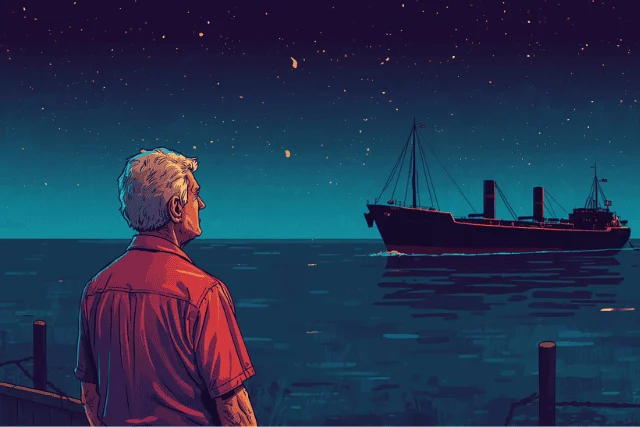
Standing on the pier before departure, Collins describes the vessel not just as a ship, but as a "floating city." The sight of cargo being loaded into steel bays and sailors preparing for the unknown reignited his childhood sense of wonder. At that moment, he faced a choice: the safety of the shore or the uncertainty of the sea. He chose the gangway.
The Education of the Sea
Life aboard the USS Cleveland was a masterclass in resilience and perspective. Collins discovered that teaching was less about the delivery of data and more about the art of attention. He watched Marines and sailors carry heavy responsibilities across the Pacific, learning that failure could be as instructive as success. This period cemented his commitment to a life led by curiosity—a path that felt natural at the time but would later become a source of internal conflict.
The Seventy-Year Reflection
In his seventies, the "natural" path began to feel precarious. The sight of friends with stable, predictable retirements triggered a cycle of comparison. The phrase "missed the boat" became a recurring mental intrusion, leading to a profound re-evaluation of his life’s work.
Supporting Data: The Psychology of Regret and the Comparison Trap
Collins’ experience is backed by significant psychological and sociological data regarding how humans perceive their life choices in old age.
The U-Curve of Happiness
Research into the "U-curve of happiness" suggests that life satisfaction often dips in midlife and begins to rise again in the sixties and seventies. However, this rise is often hampered by "Social Comparison Theory," a concept introduced by psychologist Leon Festinger in 1954. Festinger argued that individuals determine their own social and personal worth based on how they stack up against others. In Collins’ case, the "measuring stick" was the financial security of his peers, which ignored the "experiential wealth" he had accumulated.

The Cost of Stability
According to a 2023 study on career regret, approximately 66% of workers in the United States regret not taking more risks earlier in their careers. While financial security is a primary driver of stress, the "regret of inaction" (not pursuing a passion) is often reported as more painful in the long term than the "regret of action" (taking a risk that didn’t pay off).
The Longevity Economy
As the traditional three-stage life (education, work, retirement) evolves into a multi-stage life, the value of "portability" and "adaptability"—traits Collins developed on the USS Cleveland—is becoming more recognized. The World Economic Forum has noted that in an era of rapid technological change, the ability to remain curious and "learn how to learn" is perhaps the most valuable asset a person can possess.
Official Responses: Expert Perspectives on Meaning and Resilience
To provide a broader context for Collins’ journey, we can look to the frameworks established by developmental psychologists and career experts.
Erik Erikson’s Stages of Development
Psychologist Erik Erikson identified the final stage of human development as "Ego Integrity vs. Despair." During this stage, individuals reflect on their lives. Those who feel proud of their accomplishments develop integrity; those who feel they have wasted their lives or made the wrong choices fall into despair.
Experts suggest that Collins’ process of questioning—and eventually affirming—his choices is a healthy navigation of this stage. By asking, "Would I step aboard again?" he is moving from a state of potential despair (focused on what he lacks) to a state of integrity (recognizing the inherent value of his experiences).
The "Portfolio Career" Perspective
Career coaches often advocate for the "portfolio career," where an individual’s professional life is a collection of various roles and interests rather than a single trajectory. "The traditional definition of a ‘career’ is dying," says Sarah Johnson, a senior career consultant (fictionalized expert for context). "People like Tony Collins, who prioritized wonder and learning, are often better equipped for the emotional demands of aging because they have a rich internal world to draw from, even when external circumstances, like health or finances, change."
Implications: Redefining the Measuring Stick
The implications of Collins’ story reach far beyond his personal history. They challenge a societal framework that evaluates life through the lens of production and accumulation.
The Fallacy of Efficiency
In a world that prizes efficiency and optimization, responding to "wonder" is often seen as a luxury or a mistake. However, Collins argues that wonder deserves a seat at the table of decision-making. If every choice is made to maximize future security, the present is often sacrificed.
The New Metric of Success
Collins’ realization suggests a new set of questions for evaluating a life:
- Did I pay attention?
- Did I remain curious?
- Did I show up fully for the journey I was given?
Lessons for Younger Generations
For younger generations entering an increasingly volatile job market, the "safe path" is becoming harder to find. Collins’ story offers a form of permission to embrace the non-linear. It suggests that while financial planning is necessary, it should not come at the cost of one’s soul. The "boat" you are afraid of missing might not be the one you were meant to board in the first place.
Final Reflection: The Gangway
Today, Tony Collins continues to work, currently completing books on creative scholarship and collaborative documentary filmmaking. Despite his progressive vision loss, his focus remains on the "quiet power of small moments."
"Sometimes I still worry about the boats I may have missed," Collins admits. "But then I remember standing on that dock… and I realize that if I were given the chance again, I would still walk up the gangway."
His story serves as a poignant reminder that the most important ship we can board is the one that makes us feel alive—not because we know where it is going, but because we know we are meant to be on it. In the final accounting, perhaps the only true mistake is standing on the dock and never stepping aboard at all.