The Architecture of Disinformation: Analyzing the Intersection of Media, Climate Policy, and Global Instability

In an era defined by rapid-fire information and deep political polarization, the role of the editorial cartoonist and the investigative journalist has shifted from mere observation to a desperate form of historical preservation. The contemporary landscape is no longer just a battleground of ideas; it is a meticulously engineered environment where corporate interests and governmental narratives often supersede scientific consensus and social welfare. From the "Madman Theory" of international diplomacy to the systematic dismantling of environmental protections, the current socio-political climate reflects a sophisticated evolution of the disinformation tactics first pioneered by the tobacco industry in the mid-20th century.
Main Facts: A Multi-Front Crisis of Governance and Information
The current global state is characterized by several intersecting crises, each exacerbated by a shift in how information is reported and how policy is enacted. At the forefront is the abandonment of climate science in favor of industrial deregulation. Reports indicate a significant "quid pro quo" between the executive branch and the fossil fuel industry, where massive campaign contributions have directly translated into the halting of alternative energy projects and the expansion of drilling in ecologically sensitive areas, including national parks and monuments.
Simultaneously, the United States is grappling with a domestic social safety net in tatters. The housing crisis has reached a breaking point, with waitlists for Section 8 housing vouchers extending between two to eight years in many jurisdictions. This domestic instability is mirrored in foreign policy, where the application of "Madman Theory" tactics—behaving unpredictably to intimidate adversaries—has brought the nation to the brink of conflict with Iran, despite a lack of popular mandate.
Furthermore, the very history of the nation is being re-indexed. Major institutions, such as the Smithsonian, have begun installing disclaimers on exhibits regarding the histories of women and minorities, suggesting that these factual accounts may not align with the current administration’s "determined reality." This move represents a pivot from debating the future to actively litigating the past.
Chronology: From Organic Dissent to Organized Disinformation
To understand the current state of affairs, one must trace the evolution of public discourse and corporate pushback over the last half-century.
The 1970s and 80s: The Era of Tangible Victories
In the 1970s and 80s, public uprisings against environmental and social issues were often organic and effective. The pushback against fluorocarbons (CFCs) to protect the ozone layer is a primary example of science-driven policy that succeeded because the opposition had not yet perfected the art of "manufacturing doubt." Similarly, movements like the Vietnam War protests and the United Farm Workers’ boycotts of grapes and lettuce demonstrated that dissent could be voiced and heard without facing a billion-dollar counter-insurgency of disinformation.
The Tobacco Template
The turning point in corporate-funded skepticism was the rise of the Tobacco Institute. When the link between smoking and lung cancer became undeniable, the institute did not attempt to win the argument; they attempted to delay the verdict. By funding "bogus reports" and popularizing "illogic," they created a veneer of scientific controversy where none existed. This fraud was eventually uncovered, notably through investigative journalism by programs like 60 Minutes, but the damage to the template of public discourse was permanent.
The Modern Era: The Professionalization of Denial
Today, the "villains" have become better organized. The transition from the Tobacco Institute to the current fossil fuel lobby represents a leap in efficiency. Unlike the spontaneous environmentalism of the 80s, modern climate denial is a top-down operation supported by dedicated media ecosystems. This has led to a situation where local disasters, such as the wildfires currently ravaging France, Spain, and the American West, are treated as isolated incidents or political leverage rather than symptoms of a global climate emergency.
Supporting Data: The Cost of Policy and Delay
The human and environmental costs of these policy shifts are quantifiable and stark. The following data points highlight the widening gap between governmental action and public need:
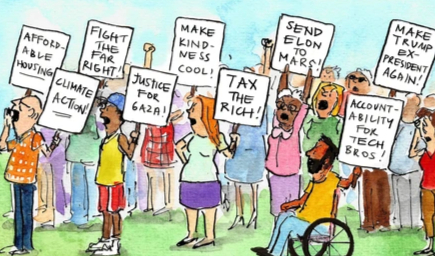
- Environmental Deregulation: Following a reported request for a $1 billion campaign donation from the petroleum industry, the administration has moved to cut back protections on national monuments. This includes a strategic "green-lighting" of oil drilling and mining in areas previously designated as protected wilderness.
- Housing and Poverty: The crisis in "affordable" housing is no longer just a campaign talking point but a structural failure. In the United States, the waitlist for Section 8 vouchers is so long that children often reach adulthood before their families receive housing assistance. This is compounded by recent "SNAP" (Supplemental Nutrition Assistance Program) cuts, which have left millions of Americans facing food insecurity.
- Wildfire Research and Management: Despite a record-breaking rash of wildfires, funding for wildfire research has been significantly reduced. In a notable instance of geopolitical friction, the U.S. administration has placed punitive tariffs on Canada, blaming them for wildfire smoke, while simultaneously denying FEMA (Federal Emergency Management Agency) grants to states like Oregon to fight their own massive blazes.
- Public Opinion on Conflict: Military tensions with Iran continue to escalate, yet data shows that only one in three Americans supports a war with the nation. The majority of the citizenry remains unsure of the administration’s ultimate strategic goals, suggesting a failure of the "consent of the governed."
Official Responses and Institutional Shifts
The official response to these crises has been a mix of aggressive deregulation, geopolitical brinkmanship, and the redefinition of historical facts.
The Smithsonian "Reality" Markers
In an unprecedented move, the Smithsonian museums have seen the installation of signs declaring that the history and facts presented—specifically those concerning the struggles and contributions of women and minorities—may not reflect the "reality" as determined by the current administration. This has been criticized as an attempt to enforce "political correctness" from a conservative perspective, turning an old progressive pejorative into a tool for state-sanctioned historical revisionism.
The "Madman" Strategy in Diplomacy
The administration’s conduct regarding Iran is frequently defended as a modern iteration of Richard Nixon’s "Madman Theory." The premise is that if a leader appears irrational or unstable, opposing governments will be more likely to yield to demands to avoid a catastrophic confrontation. However, critics point out that this theory fails when applied to nations that are not bound by democratic consent, creating a "barroom brawl" scenario where two irrational actors square off with no predictable outcome.
International Friction
The global community has reacted with a mixture of alarm and mockery. In Australia, editorial cartoonists have begun using American domestic issues—such as the housing crisis and climate denial—as cautionary tales. The "American footprint" is described as wide but "hardly flattering," as the U.S. moves from a global leader in innovation to a global outlier in climate policy and social welfare.
Implications: The Erosion of Truth and the Future of Dissent
The long-term implications of these trends suggest a fundamental shift in the relationship between the state, the media, and the citizen.
The Failure of "Perspective" Reporting
The tradition of "man on the street" reporting—where journalists visit diners or bars to gauge public opinion—has been revealed as a "fool’s errand." By treating anecdotal opinions as equivalent to scientific or statistical data, the media inadvertently validates manufactured disinformation. When editors assign reporters to "confirm what the editor has already decided people are thinking," they contribute to the polarization that makes organized disinformation so effective.
The Global Climate Feedback Loop
As the U.S. continues to put the brakes on alternative energy and cuts funding for wildfire research, the global impact becomes irreversible. Local ordinances in Europe, such as Swiss bans on fireworks to prevent fires, appear "futile" in the face of a global disaster fueled by the world’s largest economies. The refusal to address climate change at a federal level in the U.S. creates a feedback loop where environmental disasters become more frequent, yet the resources to study and fight them are systematically stripped away.
The Crisis of Consent
Perhaps the most significant implication is the breakdown of the "consent of the governed." When a government’s domestic and foreign policies—from cutting food aid to declaring war—run contrary to the majority of its citizens’ wishes, the democratic fabric begins to fray. The "Madman Theory" may work in the short term to intimidate rivals, but it also alienates the citizenry and destroys the nation’s global reputation.
In conclusion, the current era is marked by a sophisticated "architecture of disinformation." It is an environment where the lessons of the past are being erased, the science of the future is being denied, and the needs of the present are being ignored in favor of corporate and political expediency. The challenge for the modern public is to distinguish between the "cartoonish" opposition of manufactured memes and the very real, very organized efforts to reshape reality. As the lines between satire and news continue to blur, the necessity for rigorous, data-driven journalism and a clear-eyed understanding of history has never been more urgent.