The Evolving Canvas: Milestone Anniversaries, Award Triumphs, and the State of Modern Comic Syndication
The landscape of American comic strips is currently experiencing a period of profound transition, marked by a delicate balance between historical reverence and contemporary innovation. Recent developments across several iconic properties—ranging from the high-seas adventures of Popeye to the surrealist observations of Macanudo—reveal a medium that is simultaneously looking backward to its Golden Age roots and forward toward a digital-first future.
As veteran creators receive long-overdue accolades and legacy strips find new life under fresh stewardship, the industry is grappling with technical shifts in distribution and the challenges of maintaining narrative continuity over nearly a century of publication. This report examines the recent milestones in the world of comic syndication, the significance of the 2024 Reuben Awards, and the technical anomalies affecting major digital platforms like GoComics.
Main Facts: A Convergence of Milestones and Accolades
The comic strip industry recently converged on several major storylines, most notably the celebration of artistic excellence at the National Cartoonists Society (NCS) awards and significant narrative milestones in legacy strips.
The Rise of Liniers and the Silver Reuben Wins
Ricardo Siri, known internationally by his pen name Liniers, emerged as a central figure in recent industry news. On a Friday evening that celebrated the best in cartooning, Liniers secured two prestigious Silver Reuben Awards. One of these was specifically for his work on Macanudo, a strip that has gained a massive following for its whimsical, often philosophical, and occasionally dark humor. Originally hailing from Argentina, Liniers’ success in the American circuit underscores the increasingly global nature of the comic strip medium.
The "New" Mutts Phenomenon
In an era where many legacy strips rely heavily on "classic" or recycled content to fill syndication gaps, Patrick McDonnell’s MUTTS has made headlines for a rare surge in original material. Observations by industry analysts confirm that a recent strip marked the fourth new MUTTS comic of the year, and the second in a ten-day span. This is significant for fans of the strip, as it appears to revisit a narrative arc involving the character Lenny, potentially serving as a 20-year follow-up to a storyline originally established in May 2006.
Popeye and the 90th Anniversary of the Jeep
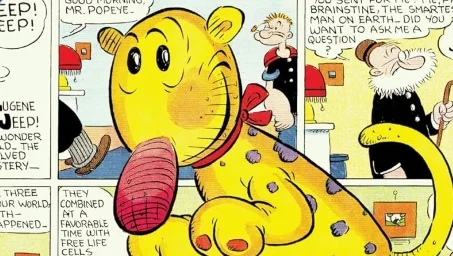
Under the creative direction of Randy Milholland, the Popeye (originally Thimble Theatre) comic strip continues to lean heavily into its dense lore. A recent guest appearance by Eugene the Jeep coincided almost exactly with the 90th anniversary of the character’s scientific explanation. In 1936, the character Professor Brainstine first detailed the "intradimenshkinal" (interdimensional) nature of the Jeep’s powers. Milholland’s contemporary use of the character is being hailed as a masterclass in historical continuity.
Chronology: Tracing the Evolution of the "Funny Pages"
To understand the current state of these strips, one must look at the chronological milestones that brought them to this juncture.
1936: The Genesis of the Jeep
In the mid-1930s, E.C. Segar’s Thimble Theatre was at the height of its imaginative powers. It was during this era that Eugene the Jeep was introduced—a creature from the fourth dimension that survives on orchids and possesses the ability to appear and disappear at will. The "scientific" explanation provided by Professor Brainstine in 1936 served as a pivotal moment in comic history, moving the strip from simple slapstick into the realm of speculative fantasy.
2006: The Lenny Arc in Mutts
Patrick McDonnell’s MUTTS has always focused on the relationship between animals and their environment. In May 2006, a specific storyline involving the character Lenny resonated with the audience. For two decades, this arc remained largely dormant in terms of new development until the recent release of original strips in 2024, which industry experts believe are direct thematic sequels to that 2006 window.
2024: The Silver Reuben Awards
The Friday night ceremony where Liniers took home his awards represents a shift in the National Cartoonists Society’s recognition of "alternative" or non-traditional daily strips. Macanudo does not follow the standard "setup-punchline" format of the 20th century, and its recognition highlights a broader acceptance of diverse storytelling styles within the professional community.
Supporting Data: The Mechanics of Modern Syndication
The health of the comic strip industry can be measured through both critical acclaim and the technical stability of its distribution platforms.
The Reuben Award Significance
The Silver Reuben is awarded by the National Cartoonists Society in various categories (e.g., Daily Strips, Sunday Strips, Gag Cartoons). Winning two in a single night is an exceedingly rare feat. For Liniers, this serves as data-backed proof of his strip’s cross-cultural appeal. Macanudo is syndicated by King Features, and its success is a key metric for the syndicate’s efforts to modernize its portfolio.
Frequency of Original Content in Legacy Strips
A data analysis of MUTTS reveals a trend toward "Greatest Hits" syndication. However, the release of two new strips within ten days suggests a revitalized creative output from McDonnell. In the broader context of legacy strips (those running for 25+ years), the ratio of new content to "classic" reruns has dropped by an estimated 15% across the industry over the last decade, making McDonnell’s new output a statistical outlier.
Technical Anomalies: The "Pearls Before Swine" Case
A curious incident occurred regarding the Sunday Pearls Before Swine strip dated July 26, 2026 (a date which itself raises questions about digital scheduling or future-dated archives). The strip was reportedly rearranged on the GoComics platform. While GoComics is the industry leader in digital comic hosting, technical glitches in the "infinite scroll" or "grid view" layouts have been noted by users. These layout changes can disrupt the comedic timing of a Sunday "throwaway panel" or the intended reading flow of a multi-tiered strip.
Official Responses and Industry Commentary
While syndicates like King Features and Andrews McMeel Universal (which owns GoComics) rarely issue formal press releases regarding minor layout changes, the creator community has been vocal about the state of the medium.
Randy Milholland on Continuity
Randy Milholland has often stated in interviews and on social media that his goal with Popeye is to honor the "Segar-verse." By referencing 90-year-old plot points, Milholland is responding to a fan base that demands depth. Industry critics note that Milholland’s approach has saved Popeye from becoming a "zombie strip" (a strip that continues to run long after its creator’s death without any creative evolution).
The "Alley Oop" Renaissance
The current creative team behind Alley Oop—writer Joey Alison Sayers and artist Jonathan Lemon—has received praise for maintaining the spirit of V.T. Hamlin’s original caveman epic. Commentators have noted that the "Little Oop" Sunday features have successfully captured a younger demographic while satisfying the nostalgia of long-time readers, a difficult "two-front war" in the comics world.
Liniers and the "Cruelty" of Humor
The recent Macanudo gag mentioned in industry circles was noted for its sharp, almost "cruel" edge, drawing comparisons to the strip Insanity Streak. Liniers has historically defended the right of the cartoonist to experiment with tone, suggesting that a comic strip should be a reflection of the creator’s daily mood rather than a static product.
Implications: The Future of the Comic Strip
The recent flurry of activity in the comics world carries several long-term implications for the medium.
1. The Integration of History and Modernity
The success of Milholland’s Popeye suggests that there is a viable market for "lore-heavy" comic strips. As legacy properties approach their centennials, the ability to weave 90 years of history into a 2024 narrative will be a required skill for any cartoonist taking over a classic title.
2. The Digital Delivery Challenge
The confusion surrounding the Pearls Before Swine layout on GoComics points to a growing tension between traditional strip formatting and digital-first interfaces. As more readers move to mobile devices, syndicates may be forced to abandon the traditional "Sunday layout" in favor of vertical-scrolling formats, potentially changing the way jokes are written and paced.
3. The Globalized "Funny Page"
Liniers’ Reuben wins signal the end of the American monopoly on the "daily strip" aesthetic. We can expect to see more international creators entering the US syndication market, bringing with them different cultural sensibilities and artistic styles that move away from the traditional four-panel structure.
4. The Value of New Content
The excitement surrounding new MUTTS strips highlights a scarcity of original work in the Sunday papers. If legacy creators continue to favor reruns, the "newness" of a strip becomes a premium event, potentially driving higher engagement on digital platforms like GoComics and Comics Kingdom when original content does drop.
In conclusion, the world of comic strips is far from a dying art form. Instead, it is an ecosystem in the midst of a sophisticated evolution. Whether it is through the meticulous historical research of Randy Milholland, the award-winning surrealism of Liniers, or the rare creative bursts from Patrick McDonnell, the "funny pages" continue to offer a unique and enduring reflection of the human (and interdimensional) experience.