The Architecture of Healing: How a Florida Banyan Tree Redefined Mental Health Recovery for One Mentor
By [Your Publication Name] Staff
In an era where mental health statistics are reaching record highs, the search for effective interventions has increasingly moved beyond the therapist’s couch and into the natural world. A compelling narrative of recovery, shared by Dr. Daniel H. Shapiro, a prominent keynote speaker and author, highlights a profound shift in psychological treatment: the move from inward-focused rumination to outward-focused care.
Dr. Shapiro’s journey from debilitating panic attacks to a life of mentorship began not in a clinic, but under the sprawling canopy of a Banyan tree in Florida. His experience serves as a cornerstone for modern discussions on "ecotherapy" and the reciprocal relationship between human wellness and ecological stewardship.
Main Facts: A Case Study in Nature-Assisted Recovery
The core of Dr. Shapiro’s narrative involves a transition from a state of acute anxiety to one of "present-moment awareness" facilitated by an unlikely partner: a tree named Nelly. While living in Philadelphia to pursue a Master’s degree, Shapiro began experiencing sudden, somatic manifestations of anxiety—internal shaking, chest tightness, and a desperate struggle for breath. These symptoms eventually culminated in frequent panic attacks that forced him to abandon his studies and return to his home state of Florida.
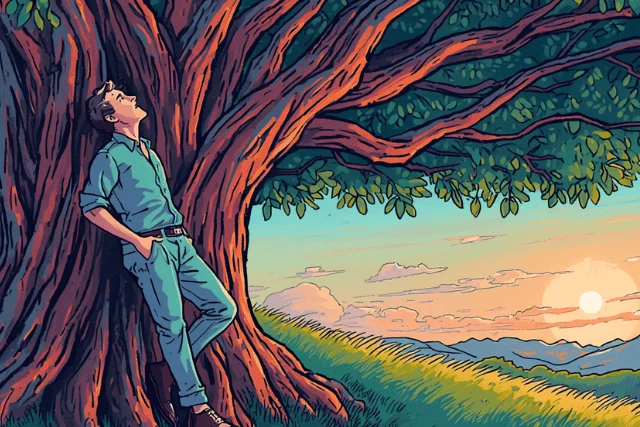
The "turning point" in his recovery occurred at a local park, where he discovered a massive Banyan tree (Ficus benghalensis). Unlike most trees that grow strictly upward, Banyan trees send aerial roots down from their branches, creating a "living cathedral" of multiple trunks. Shapiro found that by physically occupying the space within the tree’s branches and engaging in the meticulous task of removing rusted nails driven into its trunk, his physiological symptoms of anxiety began to subside.
This process—moving from a state of hyper-vigilance regarding his own internal sensations to a state of focused care for another living entity—forms the basis of his philosophy on healing. Today, Dr. Shapiro uses these lessons to inform his work as a mentor and author of The 5 Practices of the Caring Mentor, advocating for a "turned-outward" approach to mental wellness.
Chronology of a Crisis and Subsequent Healing
The Philadelphia Years: The Onset of "Internal Fire"
Dr. Shapiro’s struggle began in his early twenties. Following the traditional path of academic advancement, he moved to Philadelphia for graduate school. The transition proved to be a catalyst for latent anxiety. He describes a sudden shift where his body felt as though it were "shaking from the inside."
The panic attacks were not merely psychological; they were physically arresting. Shapiro recalls fleeing a movie theater mid-film, convinced he was suffocating. Despite seeking professional therapy, the interventions failed to provide immediate relief, leading to a sense of profound personal failure. By the end of his first semester, the academic dream had collapsed, and Shapiro returned to Florida, carrying the weight of what he perceived as a "stumbled" life.
The Florida Retreat: Finding the "Living Cathedral"
Back in Florida at age 22, Shapiro faced a void of direction and a mind that felt "constantly on fire." His search for relief led him to a park featuring a pond and a large Banyan tree. The tree’s unique architecture offered a physical sanctuary. He began spending hours within its branches, experiencing a phenomenon where the tree seemed to "absorb" his anxiety.
The Act of Reciprocity: Removing the Nails
The healing process shifted from passive to active when Shapiro noticed that the Banyan tree had been vandalized. Numerous nails, some rusted with age and others recently driven, pierced the bark. Shapiro began a ritual of prying these nails loose. This act of service became a meditative practice.
One afternoon, while struggling to remove a particularly stubborn nail, Shapiro realized that his chest tightness had vanished. For the first time in months, his focus was entirely external. This realization—that caring for the tree provided a reprieve from the "monitoring" of his own heartbeat and thoughts—marked the beginning of his long-term recovery.
Legacy: Passing the Canopy to the Next Generation
Decades later, the Banyan tree remains a central figure in Shapiro’s life. Now a father, he has introduced his children to the tree, which his daughter named "Nelly." The site has transitioned from a place of desperate refuge to a site of family connection, illustrating the long-term efficacy of nature-based grounding techniques.
Supporting Data: The Science of Ecotherapy and Attention Restoration
Dr. Shapiro’s personal success is supported by a growing body of scientific literature regarding the "Biophilia Hypothesis" and "Attention Restoration Theory" (ART).
The Biophilia Hypothesis
Coined by Edward O. Wilson, this hypothesis suggests that humans possess an innate tendency to seek connections with nature and other forms of life. Shapiro’s feeling that the tree was "absorbing" his anxiety aligns with research showing that exposure to green spaces reduces cortisol levels and lowers heart rate variability.

Attention Restoration Theory (ART)
Developed by Rachel and Stephen Kaplan, ART suggests that urban environments drain our "directed attention" (the energy we use to focus on tasks and manage stress). Natural environments, conversely, invoke "soft fascination," which allows the brain’s inhibitory mechanisms to rest.
In Shapiro’s case, the act of pulling nails from the tree was a perfect example of "soft fascination" combined with a goal-oriented task. By shifting his "directed attention" away from his internal panic symptoms and toward the external health of the tree, he allowed his nervous system to reset.
The Impact of "Outward-Facing" Mindfulness
Clinical psychology often emphasizes "monitoring" thoughts, but as Dr. Shapiro notes, for some, this can lead to hyper-fixation. Data suggests that "prosocial behavior"—acting in the interest of others (or even other living things like trees)—releases oxytocin and dopamine, which act as natural buffers against the adrenaline and cortisol spikes associated with panic disorders.
Official Responses and Professional Perspectives
As a mentor and keynote speaker, Dr. Daniel H. Shapiro has formalized these experiences into a professional framework. His book, The 5 Practices of the Caring Mentor, emphasizes that human connection and "inherent goodness" are vital components of psychological resilience.
While Dr. Shapiro is not a clinical psychiatrist, his work as a PhD-level mentor places him at the intersection of leadership development and emotional intelligence. His "official response" to the modern anxiety epidemic is a call for a return to mentorship and external service.
"Anxiety has a way of pulling our attention inward," Shapiro explains. "Every sensation feels important. Every heartbeat becomes something to monitor. The Banyan tree invited me into a different way of living. Instead of asking, ‘How do I make this feeling stop?’ I began asking, ‘What needs my attention right now?’"
This shift is now being echoed by various mental health organizations. The "Green Walking" initiative in the UK and similar "Park Rx" programs in the United States are beginning to see medical professionals "prescribe" time in nature as a legitimate adjunct to traditional therapy and medication.
Implications: Nature as a Public Health Necessity
The story of the Banyan tree and Dr. Shapiro has broader implications for urban planning, public health, and environmental conservation.
1. The Necessity of Urban Green Spaces
If healing is tied to the availability of "living cathedrals" like the Florida Banyan, then the preservation of old-growth trees in urban and suburban areas becomes a public health priority. The "nails" in Shapiro’s tree represent a larger trend of environmental neglect that may inadvertently stifle the healing potential of our parks.
2. Reciprocal Healing
The narrative suggests that the relationship between humans and nature is not one-sided. While the tree provided Shapiro with a sense of peace, he provided the tree with "surgical" care by removing harmful hardware. This suggests that environmental activism and mental health recovery are deeply intertwined; by healing the earth, we provide the theater for our own psychological restoration.
3. Shifting the Mental Health Paradigm
Shapiro’s experience challenges the purely "self-help" model of the late 20th century, which often focused exclusively on internal cognitive restructuring. The "Banyan Model" suggests that for some, the path to wellness is found by becoming "so absorbed in loving, serving, or noticing something beyond ourselves that our anxious minds loosen their grip."
4. Intergenerational Resilience
Finally, the transition of "Nelly" the tree from a sanctuary for a panicked young man to a playground for his children highlights the importance of "place-based" healing. Creating lasting connections with specific natural landmarks can provide a sense of continuity and "belonging to something larger" that modern, transient lifestyles often lack.
In conclusion, Dr. Daniel H. Shapiro’s journey from the "internal fire" of Philadelphia to the cool shade of a Florida Banyan tree serves as a powerful testament to the restorative power of the natural world. It reminds us that when we find ourselves trapped in the labyrinth of our own minds, the simplest way out may be to look up, reach out, and find a living thing that needs our care.