The Architecture of Time: Dr. Elliot McGucken’s Fusion of Einsteinian Physics and Landscape Photography
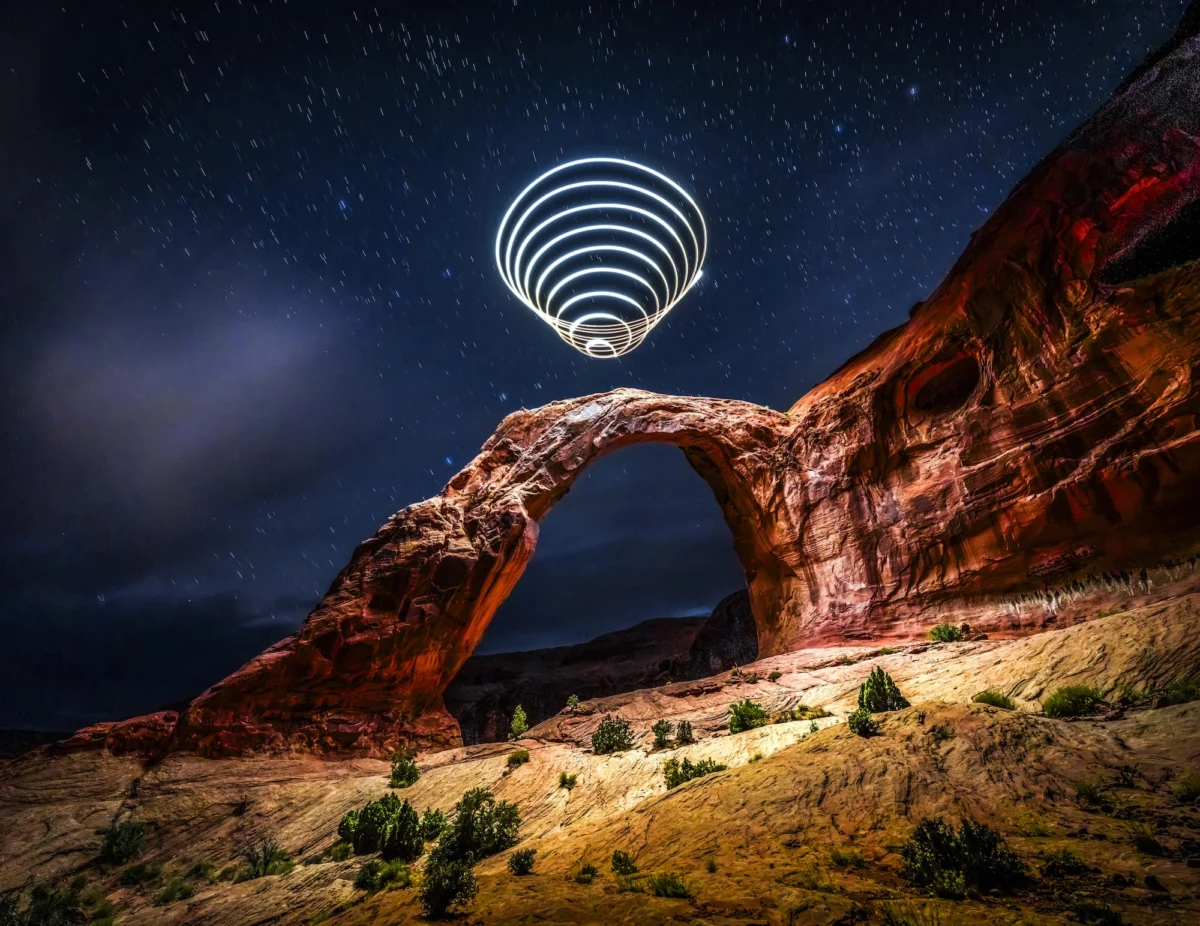
In the silent, arid stretches of the American Southwest, where the geography feels more like a Martian outpost than a terrestrial desert, a new form of "monument" is being erected. These structures do not consist of stone or steel; they are built of photons, captured over time, and rooted in the complex mathematics of general relativity.
Dr. Elliot McGucken, a physicist whose professional life is dedicated to restoring sight to the blind, has spent years traversing North America’s most rugged terrains to bridge the gap between the empirical and the ethereal. His ongoing series, Spacetime Light Cone Sculptures $dx^4/dt=ic$, represents a sophisticated intersection of advanced drone technology, long-exposure photography, and the foundational theories of Albert Einstein. By "sculpting" light in four dimensions, McGucken is not merely taking pictures; he is visualizing the very fabric of the cosmos.
Main Facts: The Intersection of Science and Aesthetics
Dr. Elliot McGucken is a polymath whose work defies easy categorization. As a physicist, his research is grounded in the tangible and the life-altering—specifically, the development of artificial retina prosthetics. This work seeks to bypass damaged photoreceptors to restore visual perception, a task that requires a profound understanding of how light interacts with biological and mechanical systems.

However, when he steps away from the laboratory, McGucken applies this obsession with "seeing" to the natural world. His photography spans the diverse ecosystems of North America, from the "ghostly, flood-carved walls" of Antelope Canyon to the brown bears of Katmai National Park and the rare wildflower "superblooms" of Death Valley.
The centerpiece of his recent work is the Spacetime Light Cone Sculptures series. The project utilizes the following key elements:
- Theoretical Foundation: Einstein’s 1922 work, The Meaning of Relativity, which introduces the "light cone" as a representation of the relationship between space, time, and the velocity of light.
- Technological Medium: Custom-programmed drones equipped with high-intensity LED lights.
- Methodology: Long-exposure photography, where the camera’s shutter remains open for several minutes, allowing the drone’s flight path to be recorded as a solid, glowing "sculpture" of light.
- Mathematical Context: The title of the series, $dx^4/dt=ic$, references the movement of the fourth dimension (time) at the speed of light, a concept central to McGucken’s philosophical and scientific worldview.
Chronology: From the Laboratory to the "Exalted Easel"
The evolution of McGucken’s work follows a trajectory from theoretical inquiry to physical exploration.

The Scientific Foundation
McGucken’s journey began in the realm of theoretical physics. His fascination with Albert Einstein’s Theory of Relativity and quantum mechanics was not merely academic; it was a search for the "mysterious" that Einstein himself described as the cradle of true art and science. While working on the artificial retina, McGucken became intimately familiar with the physics of lenses and the manipulation of light. This professional background provided the technical expertise required to master the advanced optics of modern cameras.
The Landscape Exploration
Before the inception of the Light Cone series, McGucken established himself as a premier landscape photographer. His travels took him to the vicissitudes of the Rocky Mountains and the remote wilderness of Alaska. These early expeditions were focused on capturing natural phenomena—the way light hits a mountain peak at dawn or the vibrant colors of a desert bloom. This period allowed him to scout the "exalted easels" of the Southwest, identifying locations like the Trona Pinnacles and the Alabama Hills that would later serve as the backdrops for his light sculptures.
The Birth of the Light Cone Sculptures
In recent years, McGucken began integrating contemporary technology into his practice. He recognized that drones could do more than just carry cameras; they could serve as "paintbrushes" in three-dimensional space. Drawing on Einstein’s diagrams from 1922, McGucken began experimenting with flight paths that mimicked the hourglass-like shape of a light cone—the mathematical representation of a flash of light’s path through spacetime.

In early 2024, his work gained significant attention when he documented a rare superbloom in Death Valley, followed by the release of his most complex light paintings to date. These works were captured in remote locations, often in total darkness, requiring precise navigation and timing to align the drone’s movements with the landscape’s natural features.
Supporting Data: The Physics of the Light Cone
To understand the depth of McGucken’s work, one must understand the physics that informs it. In special relativity, a "light cone" is the path that a flash of light, emanating from a single point in space and a single moment in time, takes through spacetime.
The Fourth Dimension
Einstein posited that space and time are not separate entities but a unified four-dimensional manifold. McGucken’s series title, $dx^4/dt=ic$, is a nod to the idea that time is a dimension that expands at a constant rate—the speed of light. By using a drone to create a spiral or a cone in the air, McGucken is creating a physical manifestation of this expansion.

Technical Specifications of the Shoot
The creation of a single "sculpture" involves a rigorous technical process:
- Site Selection: Locations like the Mobius Arch or Trona Pinnacles are chosen for their geological drama and lack of light pollution.
- Long Exposure: Cameras are set to long-exposure modes, often ranging from 30 seconds to several minutes.
- Drone Pathing: The drone is flown in a pre-programmed or manual spiral. As the drone moves, the camera sensor accumulates the light, "weaving" the flight path into a continuous glowing ribbon.
- Aperture and ISO Management: To maintain the detail of the stars in the background while capturing the brightness of the drone, McGucken must balance the exposure settings perfectly, a feat that requires a deep understanding of optical physics.
The resulting images feature an "hourglass" shape—two cones meeting at a single vertex. In physics, the bottom cone represents the "past light cone" (all signals that could have reached the point), and the top represents the "future light cone" (all signals that can be sent from that point).
Official Responses and Philosophical Context
While McGucken’s work is a solo endeavor, it exists within a broader dialogue of "Light Painting" and scientific visualization.

The Einsteinian Legacy
McGucken frequently cites Einstein’s The Meaning of Relativity as his primary "script." In his own words, McGucken describes these works as "sculptures upon nature’s exalted easel." He views the technology of the drone not as a gimmick, but as a tool to "illuminate theories of existence and the cosmos." This sentiment echoes the mid-20th-century movement of "scientific aestheticism," where the beauty of a mathematical proof was considered equal to the beauty of a painting.
Comparisons to Contemporary Art
Art critics have drawn parallels between McGucken and other light-painting pioneers like Reuben Wu. While Wu uses drones to create geometric halos and topographies, McGucken’s work is more explicitly tied to specific mathematical formulas and historical scientific texts. His work is often viewed as a bridge between the "Light and Space" movement of the 1960s (led by artists like James Turrell) and modern digital-age exploration.
Implications: The Future of Perception
The implications of Dr. McGucken’s work extend beyond the gallery wall and the scientific journal. His dual career highlights a growing trend in "STEAM" (Science, Technology, Engineering, Art, and Mathematics), where the boundaries between disciplines are increasingly porous.

Restoring Sight vs. Capturing Light
There is a poetic symmetry in McGucken’s life. By day, he works on the artificial retina—a device designed to help the blind perceive light. By night, he creates light sculptures that challenge those with sight to perceive the invisible dimensions of time and space. Both pursuits are fundamentally about the limits and possibilities of human vision.
Environmental Stewardship
By photographing remote and pristine landscapes, McGucken also contributes to the tradition of conservation photography. His images of the California Desert Conservation Area and Katmai National Park serve as reminders of the sublime beauty of the American wilderness. By adding a "sculptural" element to these landscapes, he emphasizes that these places are not just piles of rock and dirt, but stages for the fundamental laws of the universe.
Technological Advancement in Art
As drone technology and sensor sensitivity continue to improve, the "Light Cone" series suggests a future where art is no longer static. McGucken’s work hints at the possibility of augmented reality (AR) installations where these light sculptures could be viewed in real-time by observers on-site, further blurring the line between the physical world and mathematical abstraction.

In conclusion, Dr. Elliot McGucken’s Spacetime Light Cone Sculptures are more than just striking photographs. They are a physicist’s love letter to the universe—a calculated, glowing testament to the idea that the laws of physics are the most beautiful art form of all. Through his lens, the "mysterious" that Einstein spoke of becomes visible, if only for a few minutes of exposure time, etched against the eternal backdrop of the desert night.