Celestial Masterpieces: The Central West Astronomical Society Unveils the Winners of the 2024 David Malin Awards
The intersection of rigorous scientific observation and sublime artistic expression has once again found its focal point in the heart of New South Wales. The Central West Astronomical Society (CWAS) has officially announced the winners of its prestigious annual astrophotography competition, held in conjunction with the celebrated AstroFest. This year, the competition reached new heights of technical sophistication and aesthetic brilliance, culminating in the crowning of Stefan Buda as the overall winner for his breathtaking lunar study, "The Lunar Apennines."
As amateur and professional photographers from around the globe submitted their most compelling views of the cosmos, the 2024 awards underscored a burgeoning era in astrophotography—one defined by accessible high-end technology and an increasingly sophisticated understanding of the night sky. The awards, named after the world-renowned pioneer of scientific color astrophotography, Dr. David Malin, continue to be the gold standard for the medium in the Southern Hemisphere and beyond.

Main Facts: A Triumph of Lunar Detail and Deep-Sky Wonder
The 2024 David Malin Awards saw hundreds of entries across a diverse array of categories, including Deep Sky, Solar System, Wide-Field, and Nightscapes. The judging panel, traditionally led by Dr. Malin himself, looks for more than just a "pretty picture." The criteria demand a harmonious balance of technical skill, astronomical accuracy, and a "painterly" eye for composition.
The Overall Winner: Stefan Buda’s "The Lunar Apennines"
The highest honor of the competition was bestowed upon Stefan Buda for his monochromatic masterpiece, "The Lunar Apennines." This image, which also secured the top spot in the Solar System category, provides a startlingly intimate view of Montes Apenninus, a rugged mountain range on the northern face of the Moon.

Buda’s work was praised for its exceptional tonal range and the clarity with which it depicts the jagged peaks and deep shadows of the lunar surface. The range, which borders the Mare Imbrium, contains some of the highest mountains on the Moon, with some peaks rising over 5,000 meters. Buda’s ability to capture the interplay of light across this desolate landscape offers a perspective usually reserved for orbiting spacecraft, bridging the gap between Earth-bound observation and lunar exploration.
Category Highlights and Honorable Mentions
Beyond the overall prize, several other photographers were recognized for their contributions to the field:

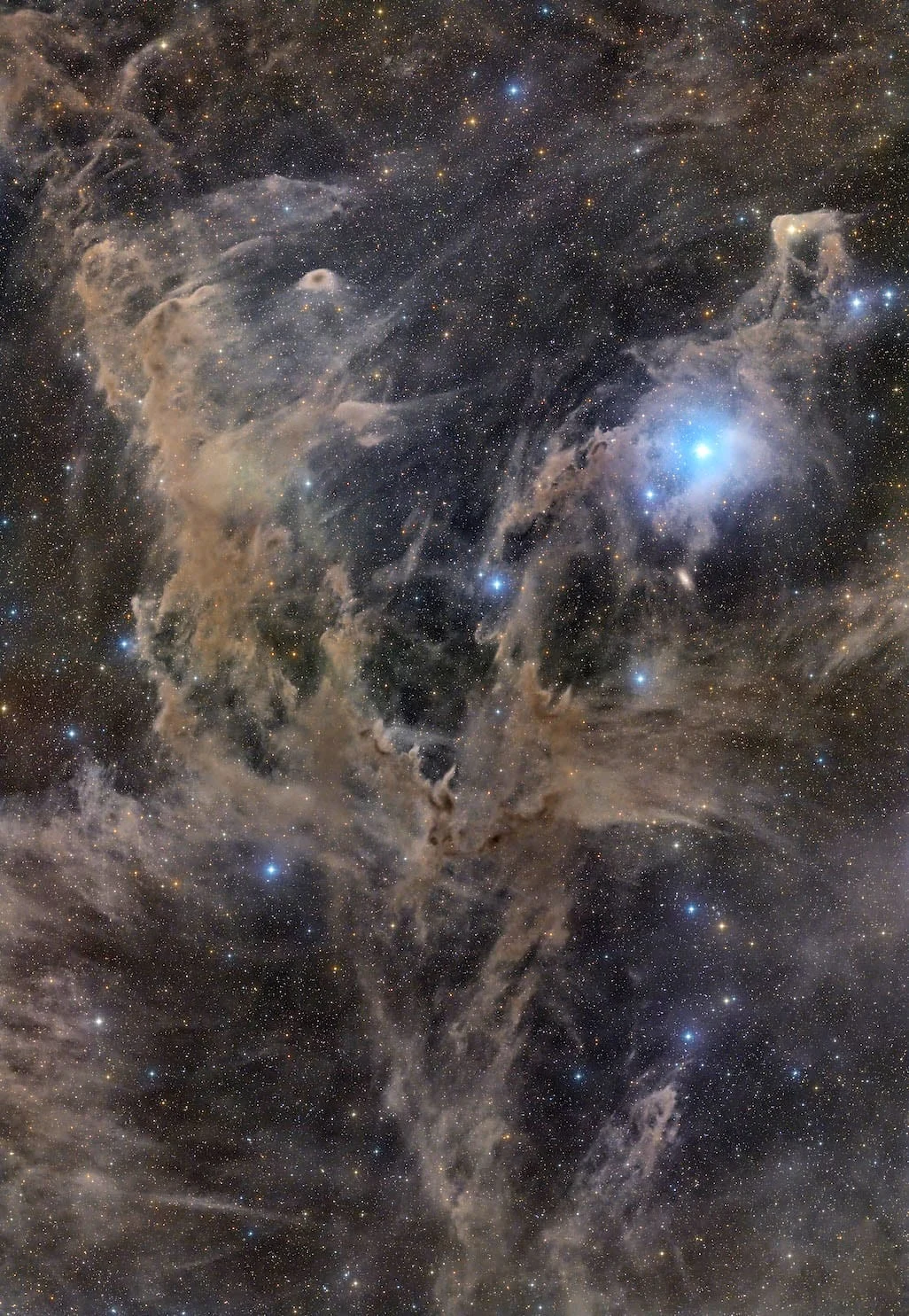
- Deep Sky Winner: Andy Campbell received top honors for "The Rippling Flames – Chamaeleon III," a hauntingly beautiful depiction of a dark molecular cloud.
- Nightscapes (International) Winner: Brighton Seeley’s "Zenith" captured the awe-inspiring scale of the heavens above a terrestrial foreground, illustrating the connection between our planet and the wider universe.
- Deep Sky Honorable Mentions: Notable recognitions were given to Paul Montague for his image of NGC 1097, a barred spiral galaxy featuring mysterious jets, and Jarrod Rueff for "BRAN 56."
- Nightscapes Honorable Mentions: Luke Tscharke’s "Tasman Arc" and Lucy Yunxi Hu’s "Milky Way and Zodiacal Light" were highlighted for their masterful use of long-exposure techniques to capture the ephemeral glow of the Southern Lights and rare celestial alignments.
Chronology: The Legacy of AstroFest and the Malin Awards
The Central West Astronomical Society, based in Parkes, New South Wales—the "Dish" city famous for its role in the Apollo 11 moon landing—has long been a pillar of the Australian scientific community. The David Malin Awards were established to encourage the highest standards in astrophotography and to provide a platform for enthusiasts to showcase their work to a broader audience.
The Evolution of the Competition
The awards began as a local initiative but quickly gained international traction. Named after Dr. David Malin, who revolutionized the way we see the universe through his work at the Australian Astronomical Observatory (AAO), the competition mirrors his philosophy: that the beauty of the universe is a gateway to understanding its complexity.

Over the last two decades, the timeline of the competition has evolved:
- Submission Phase: Usually held in the first half of the year, photographers submit digital files across various categories.
- The Judging Process: Unlike many photography contests, the Malin Awards involve a rigorous review of the metadata and processing techniques to ensure that the final images remain true to the astronomical data they represent.
- AstroFest Celebration: The winners are traditionally announced during the CWAS AstroFest, a festival that brings together astronomers, educators, and the public for a weekend of lectures and stargazing.
- The Touring Exhibition: Following the announcement, the winning images embark on a year-long tour of science centers and galleries across Australia, ensuring that the public can experience these cosmic vistas in high-resolution print.
Supporting Data: The Science Behind the Art
The 2024 winning gallery is not merely a collection of photographs; it is a repository of astronomical data. To reach the level of detail seen in Stefan Buda’s or Andy Campbell’s work, photographers must employ advanced techniques such as "stacking" (combining dozens of images to reduce noise) and "tracking" (using motorized mounts to cancel out the Earth’s rotation).

Understanding the Subjects
- Montes Apenninus: The subject of the winning image was formed nearly 3.9 billion years ago during the impact that created the Imbrium Basin. It is a site of significant historical importance, as the Apollo 15 mission landed at the base of the range at Hadley-Apennine in 1971.
- NGC 1097: Featured in Paul Montague’s honorable mention, this galaxy is located approximately 45 million light-years away in the constellation Fornax. It is known for its "jets," which were long thought to be the result of a galactic collision, though they are now understood to be the remains of a smaller galaxy being "eaten" by the larger spiral.
- Chamaeleon III: Andy Campbell’s winning deep-sky subject is part of a complex of dark nebulae. These are regions of space so dense with dust that they block the light from stars behind them, serving as the stellar nurseries where new suns are born.
Technical Accessibility
The 2024 awards highlighted a significant trend: the "democratization of the stars." While high-end observatories once held a monopoly on these views, the data shows that modern CMOS sensors and software like PixInsight have allowed amateur astronomers to produce images that rival professional plates from the late 20th century.
Official Responses: Insights from the Judges
In his assessment of this year’s entries, Dr. David Malin emphasized the importance of authenticity. "We are looking for images that are not just technically proficient but that evoke a sense of wonder," a spokesperson for the CWAS noted during the presentation. "Stefan Buda’s image of the Lunar Apennines does exactly that. It captures the three-dimensional nature of the Moon in a way that feels tangible."

The society also highlighted the educational value of the awards. By making the winning images available in a 2027 calendar and an online gallery, the CWAS aims to inspire the next generation of scientists. "Every year, the quality of submissions increases," the society stated. "What was once considered an impossible shot for an amateur is now becoming the standard. This pushes the entire community to look deeper and further into the void."
The inclusion of the "Nightscapes" category has been particularly successful in bridging the gap between traditional landscape photography and astronomy. By including recognizable terrestrial features—such as the "Wishing Tree" in Luke Rasmussen’s honorable mention—the photographers provide a sense of scale that helps the viewer relate to the vastness of the cosmos.

Implications: The Future of Astrophotography
The success of the 2024 David Malin Awards has several long-term implications for the scientific and artistic communities. First, it reinforces the role of "citizen science." Many of the images captured by these photographers—particularly those of transient phenomena like comets or aurorae—provide valuable data points for professional researchers.
Advancing Technology and Environmental Awareness
The move toward more sophisticated "International" categories in the Nightscapes division reflects a global community united by a shared sky. However, the competition also serves as a silent advocate for "Dark Sky" initiatives. As light pollution continues to encroach on rural areas, the ability to capture images like those seen in AstroFest becomes increasingly difficult. The CWAS uses these awards to highlight the importance of preserving the night sky as a natural heritage.

Cultural Impact and Public Engagement
The 2027 calendar featuring these winning images serves as more than just a promotional tool; it is a year-long educational resource. For many, these images are their first introduction to the concepts of nebulae, galactic structures, and lunar topography.
As the CWAS looks toward the future, the integration of new technologies—such as AI-assisted sharpening and specialized narrow-band filters—will continue to challenge the judges. The 2024 awards have set a high bar, proving that while the universe is billions of years old, our ways of seeing it are constantly being born anew. Through the lenses of Stefan Buda, Andy Campbell, and their peers, the "Final Frontier" feels a little closer to home, inviting us all to look up and wonder.