"The Artificer’s Knot" Weaves a Complex Tale of Ambition and Corruption, Securing SPFBO Semi-Finalist Status
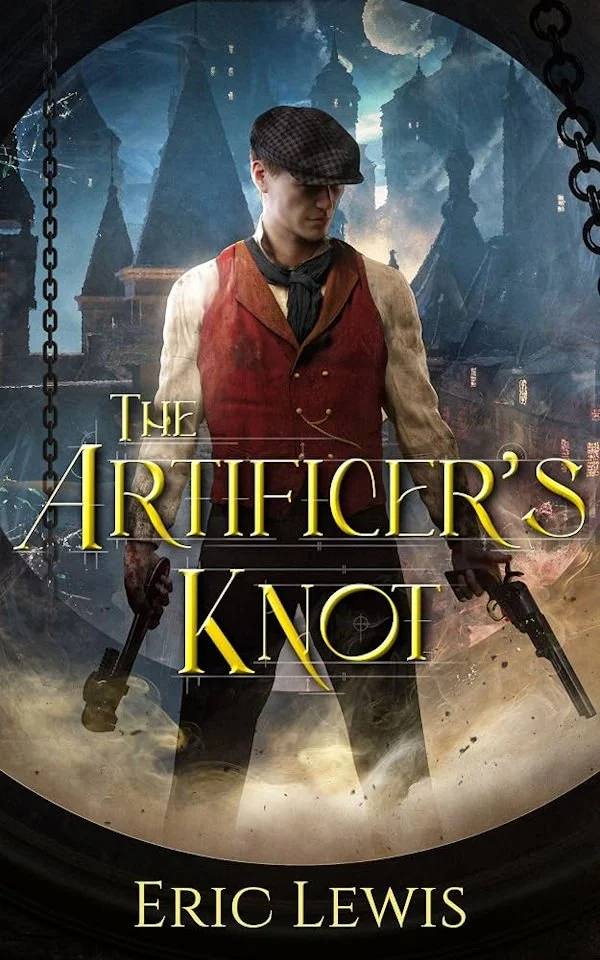
A riveting blend of gaslamp fantasy, gritty crime, and sharp political intrigue, The Artificer’s Knot has captivated judges in the prestigious Self-Published Fantasy Blog-Off (SPFBO), earning its place among the competition’s semi-finalists. The novel, lauded for its compelling narrative, distinctive characters, and unsettlingly relevant themes, delves into a world where mystical energy fuels an industrial age, and the discovery of a new power source threatens to upend a fragile societal order.
At its heart is Randyll Tephius, a brilliant but naive Artificer thrust into the perilous underworld after his groundbreaking research into nascent oil deposits draws the ire of the powerful, Vril-monopolizing Alchemists. His expulsion from the university leaves him disgraced and destitute, forcing him to forge an unlikely alliance with Gouger Nebb, an aging mob boss seeking a path to legitimate retirement. This partnership ignites a chain of events that exposes the ruthless underbelly of power, industry, and survival, compelling Ran to confront profound moral dilemmas as he navigates a treacherous landscape of rival gangs, aristocratic machinations, and sadistic law enforcement.
The book’s journey to the SPFBO semi-finals underscores its unique appeal, described by judges as "not a straightforward fantasy" but one that "pulled our judges in with its sharp prose, distinctive characters, and a world that feels uncomfortably relevant." Its exploration of energy monopolies, industrial upheaval, and the corrosive nature of power resonates deeply in contemporary contexts, making The Artificer’s Knot a standout entry in this year’s competition.
A World Forged in Vril and Shadow: The Narrative Chronology
The narrative of The Artificer’s Knot unfurls within a meticulously crafted world, an industrial age powered by a mysterious, energetic substance known as Vril. This mystical resource has not only reshaped society but has also become the exclusive domain of the elite Alchemists, who wield their monopoly with an iron fist, dictating the flow of power and wealth across the land. It is into this entrenched system that Randyll Tephius, a young and ambitious Artificer, inadvertently stumbles, setting the stage for his dramatic fall and subsequent resurgence.
The Catalyst: Oil, Espionage, and Expulsion
Randyll’s initial downfall is precipitated by his audacious university thesis, which posits the existence and potential of newly discovered oil deposits as an alternative energy source. This seemingly academic pursuit is, in fact, an existential threat to the Alchemists’ global Vril monopoly. Their swift and brutal response—orchestrating Ran’s expulsion in disgrace—serves as a stark reminder of their immense power and their willingness to crush any challenge to their dominance. Stripped of his academic standing and future prospects, Ran finds himself adrift in the unforgiving streets, a brilliant mind reduced to penury.
An Unlikely Sanctuary: The Mob Boss’s Gambit
His survival hangs by a thread until an unexpected hand extends from the shadows of the underworld: Gouger Nebb, an aging but shrewd mob boss. Nebb, recognizing Ran’s unparalleled intellect and technical prowess, offers him a lifeline. This isn’t an act of pure altruism, however; Nebb envisions Ran as the key to his own retirement, using the young Artificer’s ingenuity and mob capital to transition his illicit empire into a "legitimate business." This symbiotic relationship forms the core of the narrative, forcing Ran to confront the moral ambiguities of his new life, balancing his ambition with the grim realities of criminal association.
Invention, Sabotage, and Escalating Conflict
Under Nebb’s patronage, Ran begins to flourish, his inventive genius finding new outlets. He develops ingenious contraptions and systems, pushing the boundaries of technology. However, this burgeoning success does not go unnoticed. The established powers—the Alchemists, rival gangs, opportunistic aristocrats, and even the corrupt police—perceive Ran and Nebb’s enterprise as a burgeoning threat. Sabotage becomes a constant companion, forcing Ran to navigate a labyrinth of double-crosses, violent confrontations, and ruthless political maneuvering. The stakes continually escalate, transforming Ran from a theoretical scholar into a pragmatic, street-smart survivor.
The Ultimate Temptation: Betrayal or Loyalty?
As Ran’s reputation grows, so does the attention he garners. The very Alchemists who orchestrated his ruin re-emerge, presenting him with a seductive offer: immense wealth and a path to redemption, provided he switches allegiance and aids them in expanding their Vril monopoly worldwide. This proposition represents the ultimate moral crucible for Ran, demanding the betrayal of the man who saved him. It forces him to weigh his past grievances against his newfound loyalties, his ambition against his principles, and the allure of legitimate power against the bonds forged in the underworld.
The SPFBO Journey: From Submission to Semi-Finals
The Artificer’s Knot‘s journey through the SPFBO competition reflects its intricate narrative. From a vast pool of self-published fantasy novels, it steadily advanced through initial rounds, catching the discerning eyes of the judges. Its unique premise and execution allowed it to stand out, culminating in its well-deserved recognition as a semi-finalist. This progression highlights the book’s ability to engage and provoke thought, affirming its place as a significant contender in the independent fantasy literary landscape.
Deep Dive into the Narrative: Supporting Data from Judge Reviews
The SPFBO judges provided comprehensive feedback on The Artificer’s Knot, offering a multi-faceted view of its strengths and occasional points of contention. Their collective insights paint a detailed picture of a novel that, while not without minor critiques, largely succeeds in its ambitious scope and execution.
A World of Grime and Gears: Prose and World-Building
The novel’s prose received near-universal acclaim. Judge EG described the writing as "excellent," "smooth," and drawing the reader along effortlessly, possessing a "je ne sais quoi" that is highly valued. Adawia echoed this sentiment, praising the "solid writing" and "really good flow and pacing." Julia further elaborated, characterizing the book as "fast, clever, and confident in its blend of gaslamp fantasy, crime story, and political intrigue." Maureen vividly depicted the experience of reading the book as "like riding a zip line above the crowds on a fairground midway," highlighting the constant action and vibrant setting, replete with "steam trains, steam boats."
The world itself, while initially hinting at a "steampunk-esque adventure" to EG, quickly evolves beyond genre conventions. It’s a "gritty world" (Adawia) where corruption and gang rivalry are rampant, making success for a "nice person" nearly impossible. The industrial age, fueled by Vril, provides a rich backdrop for technological marvels, but it’s the looming shadow of oil as a new, disruptive power source that gives the setting its "uncomfortably relevant" edge, as noted by several judges.
Complex Morality: Character Development of Ran and Nebb
The characters, particularly Randyll Tephius and Gouger Nebb, were consistently highlighted as major strengths. Ran, the central protagonist, is portrayed as a figure of captivating contradictions. EG found him "fascinating," noting his "unsuitable background for being a gangster, yet he seemed to thrive there," which added "twisty and fascinating" layers to the story. Julia delved deeper, asserting that Ran’s "brilliance is both the engine of the plot and its biggest weakness," acknowledging his "over-competence" could occasionally drain tension. However, she emphasized that "watching him test his own limits, compromise his values, and slowly reshape his sense of right and wrong gave the story its emotional weight. His voice felt grounded, and his flaws felt human, even when his abilities stretched credibility." Kerry, too, appreciated the ending’s moral ambiguity, leaving readers "questioning our MC’s morals and how he now views the world." Maureen highlighted Ran’s struggle to "keep himself basically honest" amidst the chaos.
Gouger Nebb, the mob boss, also received nuanced appreciation. EG praised him as "snarky and dangerous and yet somehow one of the most intelligent characters in the book, despite his lack of education." Adawia initially harbored reservations, finding Nebb a "bit like a try-hard version of Brick Top (Snatch)," but was ultimately won over by his "overall sharpness and—sometimes brutal—common sense." Julia found Nebb "not a flashy or charismatic figure, but was written in a way that made me care about his fate. He is ruthless when he needs to be, but not senselessly so. There is a sense of rough fairness to him, a practical code that includes protecting people in his territory and taking responsibility for the consequences of his power." Maureen simply described him as a "charming underworld mob boss," capturing his dangerous charisma. While Kerry noted the "amiable looking but vicious and violent gangster" trope, the consensus points to a character with depth beyond initial appearances.
Plot Dynamics: Action, Predictability, and Thematic Resonance
The plot’s pacing and structure drew mixed but generally positive reactions. Maureen celebrated the "no lack of ups and downs, edge of-your-seat moments, and treachery," describing it as a "lively one." Adawia found that the "story developed in complexity and cleverness as it went on," with "good flow and pacing." Julia, while acknowledging that Ran’s consistent success sometimes "drain[ed] some tension," found the narrative’s focus on "power, choices, and momentum rather than shock value" to be effective. Kerry, despite reading it in one sitting, felt it "didn’t really excite me," suggesting that while engaging, it lacked a certain spark for her.
EG, however, presented the most significant critique of the plot, finding it "less like a steampunk novel and more like a historical fiction about a gang war." She felt the "drama just kept increasing," leading to a sense of being "underwhelming and a bit predictable," to the point where she started skimming later chapters. This contrast in perception highlights a potential divergence in reader expectations, where some found the escalating stakes thrilling, while others desired more variation or surprise.
Uncomfortable Truths: Themes and Relevance
A defining characteristic of The Artificer’s Knot is its thematic depth and contemporary relevance. Julia particularly lauded its "political and scientific underpinnings," stating that the "struggle over energy, monopolies, and control feels sharply relevant, with entrenched powers willing to sabotage any threat to their dominance." She highlighted the "uncomfortable framing of oil as a relative improvement over existing systems, while still clearly carrying its own moral and environmental cost," and praised the book’s "refusal to offer clean solutions," which "gives the world real bite." Kerry echoed this, noting how Ran’s journey "exposes the greed and corruption in the world of energy production" and that the product, petroleum, "does and should sit uncomfortably on the reader especially in light of what is happening in the real world at present." The SPFBO introductory remarks encapsulated this perfectly, noting the world "feels uncomfortably relevant."
Official Responses and The SPFBO Platform
The recognition of The Artificer’s Knot as a semi-finalist is a testament to its quality within the highly competitive SPFBO landscape. The judges collectively lauded its "sharp prose, distinctive characters, and a world that feels uncomfortably relevant," highlighting the core elements that resonated most strongly.
The SPFBO competition, now in its eleventh year, serves as a crucial platform for self-published authors, offering invaluable visibility and critical assessment. The transparent judging process, involving a diverse panel of dedicated readers and reviewers, ensures a thorough and fair evaluation of each submitted work. The judges for this year include Adawia Asad, Eva Geraghty, Evelyn Grimald “E.G.” Stone, Julia Kitvaria Sarene, Karen Lucia, Kerry Smith, Kit Caelsto, Maureen Neuman, Robert Max Freeman, Sara Rosevear, Sherry Cammer, Stacey Markle, Tianna Twyman, and Yaniv Rosenfeld Cohen.
The official announcement from the SPFBO organizers underscores the significance of reaching this stage: "Not every book makes it to the semi-finals, but The Artificer’s Knot earned its place." This acknowledgment is not just a nod to the author’s talent but also to the book’s ability to stand out in a crowded field. The anticipation now builds for Friday, June 26th, when the finalist pick for Round Two will be revealed, potentially propelling The Artificer’s Knot even further into the spotlight. The SPFBO team extended "a sincere thank you to every author who entered. Putting your work forward for a competition takes real courage, and we appreciate each and every one of you for it."
Implications: Beyond the Knot
The success of The Artificer’s Knot in the SPFBO competition carries several significant implications, both for the novel itself and for the broader landscape of genre fiction.
Elevated Visibility and Readership: As a semi-finalist, The Artificer’s Knot gains considerable exposure within the fantasy community and beyond. This recognition often translates into increased sales, reviews, and a broader readership, offering the author a significant boost in their career. For self-published authors, such validation from a respected competition can be a game-changer, opening doors to new opportunities and a dedicated fan base.
Contribution to Genre Evolution: The book’s genre-blending nature—a "gaslamp crime story" that isn’t "straightforward fantasy"—positions it as a valuable contribution to the ongoing evolution of speculative fiction. It demonstrates the exciting possibilities that arise when authors defy rigid genre categorizations, weaving together elements of historical fiction, crime thrillers, and fantastical world-building. This encourages other authors to experiment and pushes the boundaries of what readers expect from fantasy.
Timely Social Commentary: The novel’s sharp focus on energy monopolies, industrial corruption, and the moral costs of progress resonates powerfully in today’s world. By framing oil as a new, disruptive, yet morally ambiguous power source, the book invites readers to reflect on contemporary issues such as climate change, corporate greed, and the ethical dilemmas inherent in technological advancement. Its "uncomfortable relevance" ensures that the story is not merely escapist but also a thought-provoking commentary on societal structures and human nature.
The Enduring Questions of Morality and Power: Ultimately, The Artificer’s Knot leaves readers with lingering questions about what success truly costs, how power reshapes one’s values, and who bears the ultimate price for progress. Randyll Tephius’s journey, from an expelled academic to a figure navigating the criminal underworld and facing the temptation of a global monopoly, is a poignant exploration of ambition, survival, and moral compromise. The ending, which leaves Ran’s choices and future values in question, ensures that the narrative’s impact extends far beyond its final page.
In conclusion, The Artificer’s Knot stands as a compelling example of the creativity and quality emerging from the self-published fantasy sphere. Its recognition in SPFBO is a testament to its intricate plot, memorable characters, and its courageous engagement with themes that resonate deeply with modern audiences. As the SPFBO competition progresses, all eyes will be on this unique and powerful narrative, eagerly awaiting its next chapter.