The Banyan Tree Effect: How Stewardship and Nature Integration Provide a Path Out of Chronic Anxiety
By [Your Publication Name] Staff
In an era defined by a burgeoning mental health crisis, the search for sustainable, non-pharmacological interventions has led many back to the oldest "clinic" known to humanity: the natural world. While the benefits of nature are often discussed in broad strokes, the specific story of Dr. Daniel H. Shapiro—a keynote speaker, author, and mentor—offers a profound case study in how the intersection of environmental stewardship and "external focus" can dismantle the mechanics of panic disorder.
Shapiro’s journey, which began in a state of debilitating psychological paralysis and evolved into a lifelong practice of mindfulness, underscores a pivotal shift in mental health treatment. It suggests that healing is not merely an internal process of "fixing" one’s thoughts, but an outward movement toward caring for the living world.
Main Facts: The Intersection of Mental Health and Ecological Connection
The core of Dr. Shapiro’s experience centers on a specific Banyan tree in a Florida park, which he eventually nicknamed "Nelly." After a series of severe panic attacks forced him to abandon his graduate studies in Philadelphia, Shapiro returned to his home state, feeling defeated and trapped by his own physiology.
The primary discovery of his journey was not just the "calming effect" of nature, but the therapeutic power of stewardship. Upon finding that the Banyan tree had been vandalized with rusted nails, Shapiro began a self-appointed mission to remove them. This act of service shifted his attention from "internal monitoring"—the hyper-vigilance of one’s own heartbeat and breath common in anxiety sufferers—to an "external mission."
Modern psychology identifies this as a shift from a self-absorbed state to a state of "soft fascination," a key component of Attention Restoration Theory (ART). Today, Shapiro utilizes these lessons in his professional work as a mentor and speaker, advocating for the "Caring Mentor" framework, which emphasizes connection and external service as vital tools for personal growth.
Chronology: From Urban Collapse to Arboreal Sanctuary
The Philadelphia Crisis
The narrative began in the early 20s of Shapiro’s life. Following the traditional path of academic advancement, he moved to Philadelphia to pursue a master’s degree. The transition from the suburbs to a dense urban environment, coupled with the pressures of nighttime classes and daytime employment, served as a catalyst for a dormant anxiety disorder.
Without warning, Shapiro began experiencing "somatic" symptoms—physical manifestations of psychological distress. He describes a sensation of "shaking from the inside," chest tightness, and a terrifying inability to catch his breath. These episodes, known as panic attacks, became so frequent that they inhibited his ability to remain in public spaces, eventually leading him to withdraw from his program and move back to Florida.
The Discovery of the Banyan Tree
Returning home at age 22, Shapiro felt he had failed. His world had shrunk to the dimensions of his fear. In an attempt to find relief, he began frequenting a local park featuring a pond and a massive Banyan tree (Ficus benghalensis).
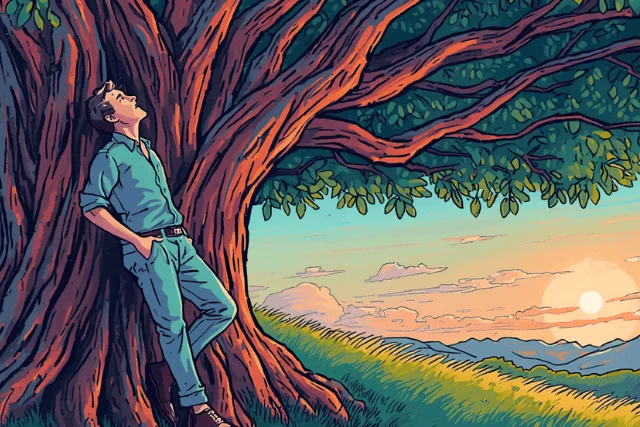
The Banyan tree is unique for its "prop roots," which grow down from branches to form new trunks. To Shapiro, the tree represented a "living cathedral," offering a sense of shelter that his urban environment lacked. He began a ritual of climbing into the tree’s branches, where he noticed a physical softening of his anxiety.
The Act of Stewardship
The turning point occurred when Shapiro noticed the tree had been used as a target for nails. Some were old and rusted; others were fresh. He began the painstaking process of prying them out.
"The more time I spent caring for the tree, the more connected I felt to it," Shapiro notes. Over several weeks, he searched every reachable branch for these "small acts of violence." During one particularly intense moment, while struggling to remove a deeply embedded rusty nail, Shapiro realized that his chest tightness had vanished. By focusing entirely on the "wound" of the tree, he had inadvertently silenced the "wound" within himself.

The Generational Legacy
Decades later, the practice has come full circle. Shapiro, now a father and husband, has integrated the park into his family’s life. His children now climb the same branches of "Nelly," turning a site of former trauma into a playground of discovery. This transition highlights the "intergenerational" aspect of nature-based healing, where a parent’s sanctuary becomes a child’s foundation.
Supporting Data: The Science of Nature and External Focus
Shapiro’s experience is supported by a growing body of peer-reviewed research in the fields of ecopsychology and cognitive behavioral science.
Attention Restoration Theory (ART)
Developed by Rachel and Stephen Kaplan, ART suggests that urban environments drain our "directed attention"—the type of focus required for work, driving, and navigating complex tasks. Nature, conversely, provides "soft fascination," which allows the mind to rest and recover. Shapiro’s focus on the nails provided a perfect balance: a task that required attention but was performed in a restorative environment.
The "Internal Monitoring" Trap
In clinical psychology, panic disorder is often maintained by "interoceptive awareness"—an over-sensitivity to bodily sensations. When a person feels a slight increase in heart rate, they interpret it as a catastrophe, which triggers more adrenaline, creating a feedback loop.
- Data Point: Studies show that "External Focus of Attention" (EFA) training significantly reduces the severity of anxiety symptoms. By focusing on the texture of bark or the extraction of a nail, Shapiro was practicing a primitive but effective form of EFA.
The Physiology of Banyan Trees
Banyan trees are known for their resilience and their ability to create an entire ecosystem within themselves. From a botanical perspective, removing nails helps prevent "canker" or fungal infections in the tree’s vascular system. Shapiro’s intuition that the nails were "acts of violence" was biologically accurate; his intervention likely extended the life of the tree, creating a genuine symbiotic relationship between the caregiver and the organism.
Official Responses and Expert Perspectives
While Shapiro’s story is personal, it aligns with the "Social Prescribing" movement gaining traction in healthcare systems across the UK, Canada, and parts of the United States.
Dr. Daniel H. Shapiro’s Perspective:
In his professional capacity as the author of The 5 Practices of the Caring Mentor, Shapiro argues that human connection and stewardship are the antidotes to the isolation of modern anxiety. "Anxiety has a way of pulling our attention inward," Shapiro says. "The Banyan tree invited me into a different way of living. Instead of asking, ‘How do I make this feeling stop?’ I began asking, ‘What needs my attention right now?’"
The Psychological Consensus:
Experts in mindfulness-based stress reduction (MBSR) suggest that "service-oriented mindfulness"—the act of being mindful while performing a helpful task—is often more effective for high-anxiety individuals than "quiet meditation," which can sometimes force a person to focus too much on the very thoughts they are trying to escape.
Environmental Advocacy:
Park rangers and arborists have long noted that "community stewardship" (volunteers caring for local flora) leads to higher rates of neighborhood well-being. Shapiro’s actions represent a grassroots version of this phenomenon, where the preservation of public green spaces becomes a public health intervention.
Implications: Nature as a Primary Mental Health Resource
The story of "Nelly" and Dr. Shapiro suggests several broad implications for how society approaches mental health and urban planning:
- The Necessity of "Third Places": Shapiro’s healing required a park that was accessible and "wild" enough to allow for interaction. Urban planners are increasingly viewing green spaces not as luxuries, but as essential infrastructure for mental health.
- Stewardship as Therapy: There is a move toward "Green Prescriptions," where doctors prescribe gardening, trail maintenance, or birdwatching. Shapiro’s experience suggests that active stewardship—fixing or helping nature—may be more potent than passive observation.
- Reframing Healing: Shapiro’s journey challenges the "self-help" industry’s focus on the "self." His recovery suggests that the "self" is often healed most effectively when it is forgotten in the service of something else.
- Resilience through Connection: The Banyan tree, with its multiple trunks and interconnected roots, serves as a metaphor for the human psyche. We are not single, isolated pillars; we are a network of connections. Healing, therefore, does not happen in isolation but through the "re-rooting" of the individual into their environment.
As Dr. Shapiro concludes, "In caring for another living thing and paying attention to beauty, we offer ourselves to something beyond our own fears. And when we do, we just might discover that we are the ones being healed."
The rusty nails may be gone from the Florida Banyan, but the lesson remains: the path out of the "obstacle course" of the mind often leads directly into the woods.